Responsible Artificial Intelligence (AI) is not a destination but a perpetual journey, a principle that extends far beyond the initial deployment of a model. The effectiveness and equity of AI systems are not static; they are dynamic, susceptible to drift and change over time. This fundamental reality, once a nuanced consideration, is now shaping regulatory landscapes and demanding robust governance frameworks to ensure AI continues to operate fairly and equitably in the real world.
The challenge lies in the inherent nature of AI models. A model that demonstrates impeccable fairness and accuracy at the moment of its launch can, and often will, deviate from its initial performance. This drift can occur due to a multitude of factors. The data distributions encountered by the model in production can significantly differ from the controlled environments of its training phase. New use cases may emerge, exposing edge cases or scenarios that the original evaluation parameters did not anticipate. Without proactive and continuous monitoring, these shifts in performance and potential biases can go unnoticed until a problem has already manifested, leading to detrimental real-world consequences.
This ongoing concern is increasingly being reflected in governmental and regulatory bodies worldwide. In the United States, the Equal Employment Opportunity Commission (EEOC) has taken a proactive stance with its AI and Algorithmic Fairness Initiative. This initiative serves as a clear signal to employers that AI-powered hiring tools, if they result in disparate outcomes, can trigger significant civil rights liabilities. The implications are profound: organizations utilizing AI for recruitment must be acutely aware of the potential for these tools to perpetuate or even amplify existing societal biases, leading to discriminatory hiring practices.
Adding further weight to this evolving regulatory environment, New York City has enacted its Automated Employment Decision Tools (AEDT) law. This landmark legislation mandates that any employer employing AI-assisted hiring tools must conduct an independent bias audit before deploying such tools. Crucially, this audit is not a one-time event; it must be repeated annually. This requirement underscores the understanding that AI systems are not static and necessitate ongoing scrutiny to maintain their fairness. These regulatory shifts are not the sole impetus for developing comprehensive AI governance frameworks; rather, they serve as a potent validation that the broader industry is aligning with the principles that responsible AI practice has always advocated. Governance, identified as the fourth pillar in Eightfold.ai’s responsible AI framework, is the essential infrastructure designed to uphold commitments to fairness and prevent their degradation after a model has been deployed.
The Chasm Between Model Evaluation and Real-World Outcomes
The initial phase of AI development often involves extensive model evaluation, employing specific metrics to answer critical questions. A primary concern is whether an AI model, such as Eightfold.ai’s Talent Intelligence Platform, performs equitably across various demographic subgroups. This is an indispensable question, but it is far from the only one that matters.
A model can exhibit equal performance across demographic groups during evaluation and still generate unequal real-world outcomes if the underlying training data itself contains systemic biases. For instance, if historical societal barriers have led to the underrepresentation of women in datasets labeled as "successful hires," an AI model trained on this data will likely perpetuate these historical patterns. Even if the model, in its internal calculations, shows no differential performance based on gender, its recommendations will still reflect the historical biases embedded in the data.
This is where Adverse Impact Analysis becomes crucial. This analytical approach addresses a complementary question: does the practical application of this AI tool result in disparate outcomes across different groups? This methodology mirrors the principles that employment law has applied to human hiring decisions for decades, providing a framework for assessing the real-world impact of AI-assisted hiring tools.
Adverse Impact Analysis: Bridging AI and Employment Law
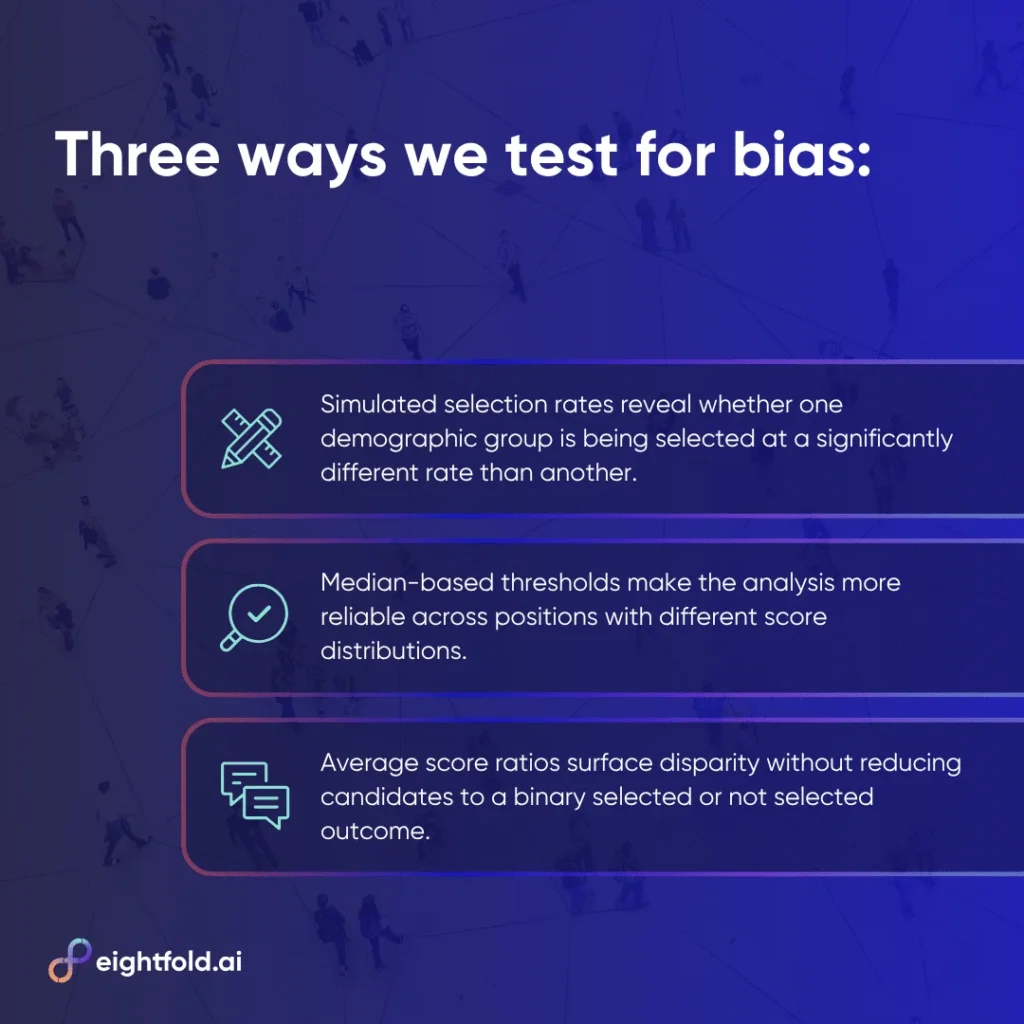
Adverse Impact Analysis meticulously examines selection rates across various demographic subgroups. Its core function is to determine whether the observed differences in selection rates are substantial enough to indicate discrimination, whether intentional or unintentional. This is a critical step in ensuring that AI systems do not inadvertently disadvantage protected groups.
To provide a comprehensive understanding, Eightfold.ai employs three complementary analytical approaches, each tailored to different data conditions and offering distinct insights into potential disparities. These methods are:
-
Statistical Significance Tests: These tests, like the Z-test, are employed to determine if the observed differences in selection rates between subgroups are statistically significant. They are most effective with moderate sample sizes where statistical fluctuations are less likely to skew results.
-
The 4/5ths Rule (or 80% Rule): This rule, a long-standing benchmark in employment law, focuses on practical significance, independent of sample size. It posits that a selection rate for any protected group should not be less than 80% of the selection rate for the group with the highest selection rate. This is particularly valuable for large-scale datasets where even minor percentage differences can become statistically significant but may lack practical relevance.
-
Fisher’s Exact Test: This test is the preferred method when dealing with small sample sizes or when the assumptions of other statistical tests are not met. It calculates the precise probability of observing a particular selection pattern under the assumption of no discrimination, avoiding approximations.
Each of these approaches sheds light on different facets of potential disparity, and crucially, each has limitations that render it insufficient when used in isolation. The true strength of an effective adverse impact analysis lies in the synergistic application of these diverse methodologies.
The Nuances of Statistical Testing in AI Fairness
The history of adverse impact analysis in employment law has generated a rich body of literature detailing the strengths and weaknesses of various statistical tests. This accumulated knowledge is directly relevant to the operation of AI systems at scale.
The Z-test, for instance, is adept at identifying statistically significant differences in selection rates between subgroups, particularly at moderate sample sizes. However, when applied to the colossal datasets routinely encountered by platforms like the Talent Intelligence Platform, the Z-test can become an unreliable indicator of meaningful bias. At millions of applications, a mere 1% difference in selection rates can achieve high statistical significance, even if that difference has negligible practical impact on individual candidates. This can lead to a false alarm or, conversely, mask subtle but significant disadvantages.
To address this limitation, the 4/5ths Rule offers a crucial counterpoint by measuring practical significance irrespective of sample size. A selection rate ratio falling below 0.8 or exceeding 1.25 signals potentially significant adverse impact, regardless of statistical significance. Its scale-independence makes it invaluable for analyzing large datasets. Conversely, at very small sample sizes, a single additional selection can dramatically alter the outcome, rendering the rule unreliable without supplementary safeguards. The "flip-flop" test, which assesses whether a result changes if a single selection is moved from the advantaged to the disadvantaged group, is one such safeguard.
Fisher’s Exact Test emerges as the preferred tool for small sample sizes where the statistical assumptions of the Z-test may not hold. It computes the exact probability of observing a given selection pattern under the null hypothesis of no discrimination, bypassing the approximations used by other tests. However, its primary limitation is computational intensity. For extremely large sample sizes, the factorial calculations involved can become prohibitively expensive, rendering it impractical for real-time analysis.
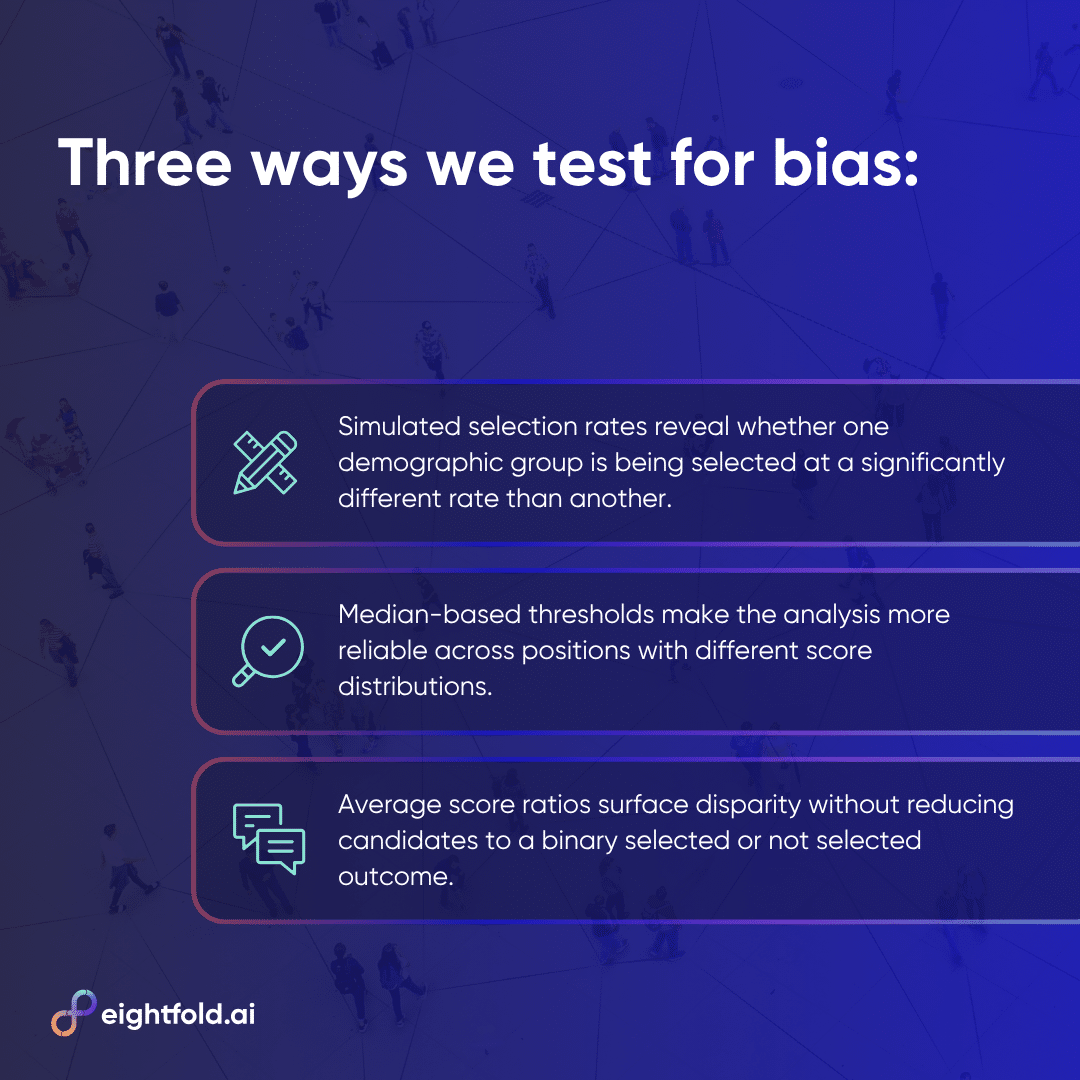
Eightfold.ai’s adverse impact analysis framework leverages all three approaches, applying each where it is most reliable. Statistical significance tests are used for moderate sample sizes, the 4/5ths rule for large-scale data, and Fisher’s Exact Test for smaller datasets. This comprehensive approach aims to construct a holistic picture of fairness that no single statistical test can provide on its own.
Perturbation Testing: Ensuring Fairness at the Individual Level
While adverse impact analysis provides a valuable population-level perspective, it doesn’t address fairness at the individual candidate level. Perturbation testing bridges this gap by asking a critical question: for a specific candidate, does their score change if resume details implying a different demographic group are substituted?
In this rigorous testing methodology, pairs of resumes are meticulously created. An original resume is modified to include signals, such as names, that are commonly associated with different demographic groups (e.g., gender or ethnicity). The match scores for both the original and modified resumes are then compared using an independent samples t-test.
The fundamental expectation for the Talent Intelligence Platform is that it should produce statistically indistinguishable scores for both versions of the resume. The underlying qualifications, skills, experience, and overall fit for the role remain unchanged. If the scores diverge significantly, it is a strong indicator that the model is inappropriately treating demographic signals as relevant features—a clear violation of responsible AI principles.
A low t-score and a high p-value resulting from perturbation tests signify that match scores are not statistically sensitive to the demographic signals embedded in names. This constitutes one of the most direct tests for the presence of bias at the individual model scoring level. It directly upholds the standard that every candidate deserves to be evaluated based on their capabilities and suitability for a role, not on immutable personal characteristics.
External Audits: Accountability Beyond Internal Scrutiny
While internal testing, however rigorous, is an indispensable part of the AI development lifecycle, it possesses inherent limitations as a sole accountability mechanism. The same team responsible for building an AI system may not be ideally positioned to objectively assess its fairness. Internal incentives, shared assumptions, and a deep familiarity with the system can inadvertently create blind spots, making it challenging to identify subtle forms of bias.
External bias audits directly address this challenge by introducing an independent perspective into the evaluation process. Credentialed third-party auditors meticulously examine AI platforms, such as the Talent Intelligence Platform, against objective fairness standards. They provide detailed findings to stakeholders and customers, creating a public record of accountability. For organizations operating in jurisdictions like New York City, where mandatory bias audit requirements are in place, external audits also ensure legal compliance.
Beyond mere compliance, external audits serve a critical trust function. Candidates and hiring managers interacting with AI-assisted hiring systems cannot independently verify their fairness. An independent audit, conducted by experts utilizing a defined and transparent methodology, offers the kind of objective assurance that internal claims of fairness alone cannot provide. This commitment to external validation is a key reason why the Talent Intelligence Platform holds certifications like FedRAMP Moderate and ISO 42001, standards that general-purpose AI tools often cannot meet.
Continuous Monitoring: Sustaining Fairness Commitments Post-Launch
The final, yet arguably most critical, component of Eightfold.ai’s responsible AI governance framework is continuous monitoring. This infrastructure is designed to ensure that the fairness commitments made at launch are actively maintained over time.
Key metrics, including latency and accuracy, are tracked on live dashboards and regularly reviewed by the engineering team. Automated alarms are configured to trigger when these metrics cross predetermined thresholds, prompting immediate investigation and corrective action. This approach treats model drift, including fairness drift, as an ongoing operational concern rather than an occasional review item.
Furthermore, the organization maintains continuously growing "golden datasets." These curated datasets, developed through a human-in-the-loop process, serve as a consistent benchmark. AI models in production are regularly evaluated against these golden datasets to detect performance changes that might not be immediately apparent in aggregate metrics.
A specific standard maintained is the stability of match score probability distributions across different positions over time. A deviation in these distributions serves as an early warning sign that the model’s behavior may have changed, potentially impacting fairness.
The integration of automated monitoring, regular human review, and structured golden dataset evaluation creates multiple overlapping detection mechanisms. This layered approach ensures that issues are identified early, before they have the opportunity to compound and result in significant real-world negative impacts.
Fairness as the Foundational Principle
The four pillars of Eightfold.ai’s responsible AI approach—right products, right data, right algorithms, and right governance—collectively represent a singular, unwavering commitment: that every candidate deserves an evaluation of equal quality, judged by the same standard, and held to the same bar. This applies not only to early applicants or candidates from the largest demographic groups but to every single candidate.
AI fairness is not a static achievement; it is an ongoing process of maintenance and adaptation. The regulatory landscape is in constant flux, research in AI ethics is rapidly advancing, and the data distributions that AI models encounter in the real world are continuously evolving. An approach to responsible AI that fails to evolve alongside these dynamic factors risks creating systems that become progressively less fair over time, even in the absence of any intentional alteration of their design.
For HR leaders and talent acquisition professionals tasked with evaluating AI tools, this comprehensive framework offers a critical set of questions to consider. The focus should shift from a superficial inquiry of "what did you do before launch?" to a more profound examination of "what happens after?" The question should move beyond "does your model show equal accuracy?" to "do outcomes look equitable in practice?" And instead of merely asking "have you been audited?", the crucial inquiry becomes "how often, by whom, and with what methodology?"
The answers to these probing questions delineate AI systems built with genuine accountability from those that treat fairness as a mere checkbox. It is about embedding fairness not as an add-on feature, but as the fundamental bedrock upon which AI systems are built and maintained.
For organizations seeking to deepen their understanding of responsible AI practices and the methodologies for ensuring fairness, Eightfold.ai offers further resources, including a whitepaper detailing their approach.