
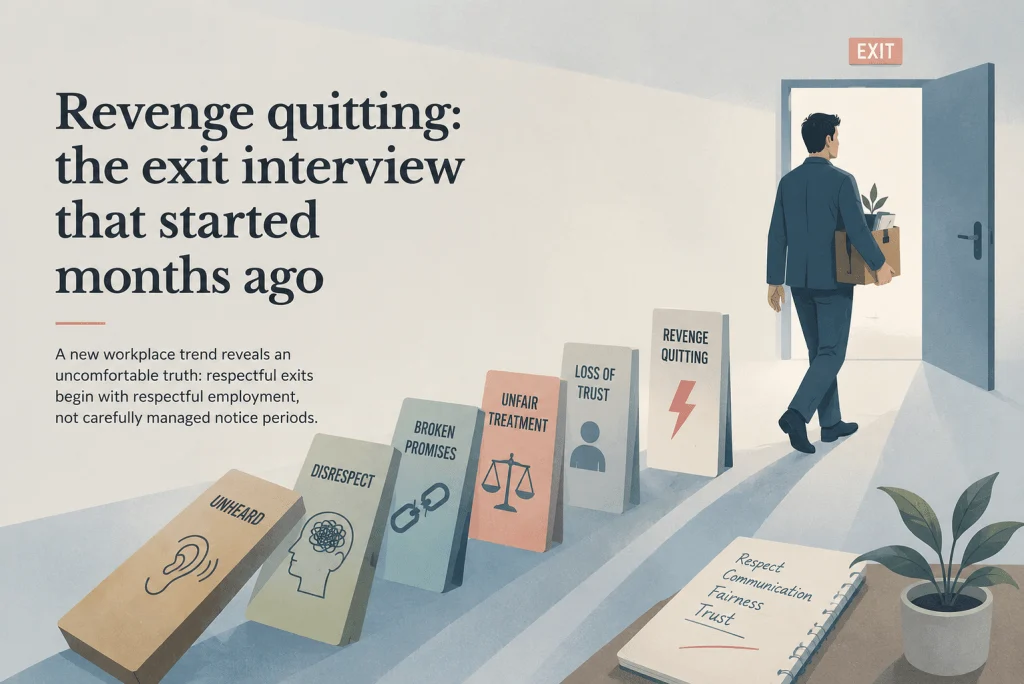
The modern workplace has become fluent in a complex lexicon of departures, each term attempting to capture the evolving dynamics of employee disengagement and exit. From the widespread upheaval of the Great Resignation, which saw millions voluntarily leave their jobs in pursuit of better work-life balance and opportunities, to the more subtle disengagement characterized by quiet quitting – where employees do the bare minimum required – and its more active counterpart, rage applying, where frustration fuels an aggressive job search, the landscape of employment has been in constant flux. These trends, alongside phenomena like bare minimum Mondays and career cushioning, have all, in their own way, sought to explain why employees mentally check out long before they physically depart. However, a more unsettling and disruptive phenomenon is now gaining traction: revenge quitting. This is not merely an employee quietly walking away from a dissatisfying role, but rather a deliberate and often calculated effort to ensure their departure leaves a significant, and sometimes damaging, scar on the organization.
Revenge quitting transcends the conventional understanding of resignation after a negative experience. It embodies a conscious intention to disrupt operations, inflict harm, or sabotage relationships as a final act of defiance or retribution. The manifestations of this behavior are varied and can include delaying critical knowledge transfer, deliberately withholding essential information, actively damaging client relationships, publicly attacking former employers through social media or review platforms, deleting sensitive files, or intentionally creating chaos and confusion during the notice period. The advent of social media has significantly amplified these stories, transforming what might once have been private grievances into viral narratives, often portraying the departing employee as a courageous figure striking back against a perceived toxic employer or unjust system. This public celebration, while offering a sense of vindication for some, raises critical questions about professionalism, ethics, and the long-term implications for both individuals and organizations.
The Evolution of Workplace Disengagement: A Chronology of Trends
To fully comprehend the emergence of revenge quitting, it is crucial to place it within the broader context of recent shifts in the global labor market and employee-employer relations. The early 2020s marked a pivotal period, commencing with the Great Resignation. Fueled by the introspection brought on by the COVID-19 pandemic, employees across various sectors re-evaluated their priorities, leading to unprecedented turnover rates. According to the U.S. Bureau of Labor Statistics, millions of Americans quit their jobs each month in 2021 and 2022, with similar patterns observed globally. This mass exodus was driven by a desire for higher pay, better benefits, improved work-life balance, and more fulfilling career paths. It signaled a significant power shift, empowering employees to demand more from their employers.
Following the Great Resignation, the concept of quiet quitting gained prominence in 2022. This trend saw employees choosing to do only the tasks explicitly outlined in their job descriptions, refraining from extra effort or voluntary contributions. It was less about outright departure and more about a psychological withdrawal, a refusal to go above and beyond without commensurate reward or recognition. Surveys by Gallup indicated that a significant portion of the global workforce was "not engaged" or "actively disengaged," aligning with the quiet quitting phenomenon. For instance, their 2023 "State of the Global Workplace" report revealed that only 23% of employees worldwide were engaged at work. This passive form of resistance was a precursor to more overt forms of dissatisfaction.
Building on this, other related terms emerged: rage applying, where disaffected employees aggressively apply for numerous jobs out of sheer frustration with their current role; bare minimum Mondays, a weekly ritual for some to ease into the work week with minimal effort; and career cushioning, a proactive strategy where employees quietly build networks, skills, or even side hustles to prepare for potential job loss or to facilitate a smoother transition to a new role. Each of these trends, while distinct, pointed to a growing chasm between employee expectations and organizational realities, eroding the traditional psychological contract that once bound workers to their employers. Revenge quitting, therefore, represents an extreme end of this spectrum, where accumulated grievances boil over into deliberate acts of sabotage, transforming the act of leaving into an act of retaliation.
Unpacking "Revenge Quitting": Beyond the Final Act
The fundamental truth about revenge quitting, as underscored by HR leaders, is that it rarely begins on the employee’s last working day. Instead, it is the culmination of a prolonged and often agonizing process of disengagement, where the relationship between employee and employer has progressively deteriorated beyond repair. Sriharsha Achar, a seasoned HR leader, articulates this perspective, stating, "I don’t believe revenge quitting is entirely new. What is new is that social media has made dramatic exits visible, celebrated and, in some cases, glorified." This insight is critical: while the underlying emotions of bitterness and resentment in departures are perennial, the public visibility and potential for viral amplification are novel.
Historically, bitter departures were confined to private conversations among close friends or former colleagues, their narratives rarely extending beyond a small, trusted circle. Today, platforms like LinkedIn, Glassdoor, and various social media channels transform individual grievances into public performances. A single disgruntled post or review can rapidly disseminate, morphing one employee’s complaint into a widely shared narrative within hours, potentially damaging an employer’s reputation and brand significantly. This expanded audience means the stakes for both employees and employers are considerably higher, even if the core emotions driving such exits remain largely unchanged.
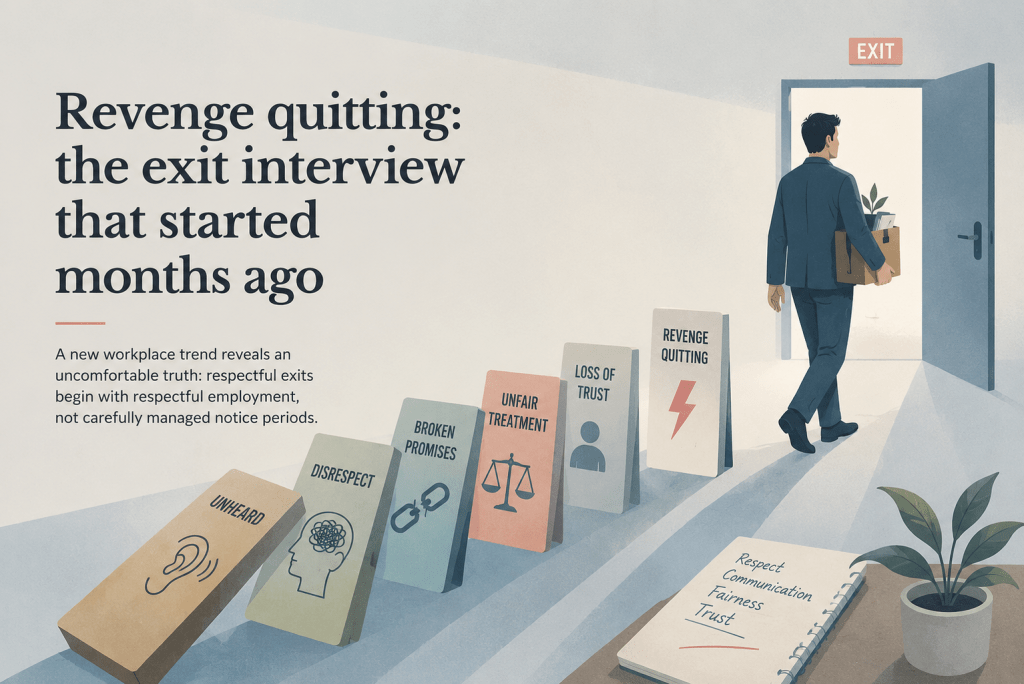
Crucially, revenge quitting seldom stems from a singular incident. Organizations often err by searching for one identifiable trigger – a denied promotion, a contentious appraisal, or a disagreement with a manager. The reality, however, is almost invariably more gradual and insidious. Employees who resort to retaliatory exits frequently describe months, if not years, of accumulated disappointment. This includes feelings of being consistently unheard despite repeatedly raising concerns, experiencing perceived unfairness in recognition or compensation, encountering disrespectful leadership behavior, witnessing broken promises regarding career opportunities, or enduring humiliation during performance conversations. Individually, each of these incidents might appear manageable or isolated. Yet, when aggregated, they coalesce into a powerful and corrosive narrative of betrayal, chipping away at trust and fostering deep-seated resentment. Research on the psychological contract in the workplace consistently shows that breaches of trust and perceived injustice are significant predictors of negative employee behaviors, including withdrawal and, in extreme cases, active sabotage.
While understanding the emotional genesis of revenge quitting is vital, Sriharsha Achar draws a clear ethical distinction between empathy for the emotion and acceptance of the behavior. "Employees have every right to resign; however, they do not have the right to damage people, systems or the organisation in the process," he asserts. He argues that institutions are inherently larger and more enduring than individuals, and therefore, personal frustration, no matter how profound, cannot ethically or legally justify deliberate harm to the organization or its stakeholders.
The Misconception of Resignation as the First Signal
One of the most significant blind spots for employers, as highlighted by Praveer Priyadarshi, another senior HR leader, is "treating resignation as the first indication of disengagement. In reality, resignation is often the final confirmation of something that has been developing for months." This perspective fundamentally reorients the conversation from managing the fallout of a difficult exit to understanding and addressing the root causes of disengagement long before it escalates.
The earliest warning signs of disengagement are rarely dramatic or overt. They manifest through subtle but meaningful behavioral shifts that, if recognized and addressed, could prevent a relationship from fracturing beyond repair. These signals include:
- Withdrawal from discussions: Employees who once actively contributed become quieter, less engaged in meetings and collaborative efforts.
- Shift from curiosity to cynicism: Enthusiasm and a proactive approach give way to a cynical outlook, questioning initiatives and expressing skepticism.
- Decline in collaboration: A reduced willingness to work with colleagues, share information, or participate in team projects.
- Increased frequency of conflicts: More frequent disagreements with colleagues or managers, indicating heightened irritability or frustration.
- Fading discretionary effort: The willingness to go above and beyond, to put in extra hours, or to take on additional responsibilities diminishes.
- Conversations about leaving: Employees openly or subtly express dissatisfaction with their current role or organization and discuss their desire to seek new opportunities.
None of these signals, in isolation, definitively predicts revenge quitting. However, when observed collectively over time, they often paint a clear picture of an employment relationship that has begun to unravel. For HR departments and organizational leadership, this understanding fundamentally changes the conversation. Instead of solely focusing on strategies to manage a difficult exit gracefully, the imperative shifts to asking a more profound question: why did the employment relationship deteriorate to this critical point in the first place?
Proactive Strategies for Prevention: From Exit to Stay
This paradigm shift necessitates a proactive approach, moving away from reactive measures to preventative strategies. Achar champions "stay interviews" as one of HR’s most underused yet potent tools. While exit interviews occur when the outcome is irreversible – the employee has already decided to leave – stay interviews offer a crucial opportunity to intervene much earlier. These conversations aim to understand why employees choose to stay, what truly motivates them, and critically, what frustrations, if left unaddressed, might eventually drive them away. They create a safe space for difficult conversations to happen while there is still time to rebuild trust, address grievances, and reinforce positive aspects of the employee experience. Data from HR consultancies suggests that companies regularly conducting stay interviews report higher retention rates and improved employee engagement.
However, the responsibility for fostering a positive and resilient workplace culture cannot rest solely with HR. As Praveer Priyadarshi emphasizes, "Managers often determine whether employees experience fairness, respect and psychological safety on a daily basis. Difficult conversations around performance, promotions, role changes or disciplinary issues cannot simply be administratively correct; they must also preserve dignity." Managers are the frontline representatives of the organization, and their interactions profoundly shape an employee’s perception of their workplace. Employees rarely remember only the decision itself; they vividly remember how that decision was communicated and how they were treated during the process. A manager who handles difficult conversations with empathy, transparency, and respect can mitigate much of the bitterness that fuels disengagement.
Beyond interpersonal interactions, revenge quitting also exposes a critical organizational vulnerability: excessive dependence on individuals. Many organizations, unfortunately, treat notice periods as mere administrative formalities rather than essential business continuity exercises. Knowledge transfer often becomes a hurried checklist item completed in the final week, rather than an ongoing, systematized discipline. Documentation is frequently incomplete, cross-training is limited, and invaluable institutional knowledge remains siloed within individual employees rather than being embedded within robust systems and processes. When the departure of a single employee, particularly a disgruntled one, can create significant operational chaos, the problem extends far beyond that individual. It reflects a systemic flaw in how the organization manages knowledge, builds capability, and plans for succession. Investing in comprehensive knowledge management systems, regular cross-training, and robust succession planning can significantly reduce the potential for disruption, regardless of the nature of an employee’s exit.

Balancing Vigilance with Trust: A Measured Organizational Response
While the potential for revenge quitting demands organizational awareness, it is equally important that recognizing these risks does not lead to an atmosphere of paranoia where every resignation is viewed with suspicion. Treating every departing employee as a potential threat creates a toxic culture of distrust, unfairly punishing the overwhelming majority who choose to leave professionally and respectfully. The appropriate organizational response should remain calm, consistent, and procedural:
- Secure company assets: Ensure all company property, including laptops, mobile devices, and access cards, are returned.
- Protect critical systems: Revoke system access, change passwords, and monitor network activity to prevent unauthorized data access or deletion.
- Complete documentation: Ensure all relevant project documentation, client information, and process guides are updated and transferred.
- Ensure policy compliance: Remind departing employees of non-disclosure agreements, non-compete clauses, and other contractual obligations.
- Maintain business continuity: Implement pre-defined knowledge transfer plans and ensure handover to designated colleagues.
Emotional reactions, public confrontations, or retaliatory actions from the employer rarely improve the situation and can often exacerbate it, leading to further reputational damage or even legal challenges. Instead, organizations should conduct an honest and thorough review whenever such incidents occur. Rather than solely focusing on assigning blame to the departing employee, leaders should ask a more valuable and introspective question: "What allowed the employment relationship to deteriorate to this point?" The answers often reveal systemic weaknesses, such as inadequate feedback mechanisms, poor leadership training, an unaddressed toxic culture, or insufficient communication channels, which deserve more attention than the individual incident itself. This reflective approach transforms a negative event into a learning opportunity, driving systemic improvements.
The Long-Term Repercussions: Reputation and Professionalism
Revenge quitting carries significant consequences that extend far beyond the immediate employer-employee interaction. For the individual employee, professional reputations increasingly outlast individual jobs. In today’s interconnected professional landscape, particularly at leadership levels, former colleagues frequently become future clients, hiring managers, business partners, or industry peers. A dramatic, retaliatory exit, while perhaps offering a fleeting sense of satisfaction, often incurs a substantial, underestimated long-term cost. People remember not only how someone performed in their role but also, crucially, how they chose to leave it. A reputation for unprofessional or destructive behavior can severely hinder future career opportunities, even if the individual believes their actions were justified. Dignity and professionalism, in contrast, build a resilient and respected career trajectory.
For organizations, the implications are equally severe. Beyond the immediate operational disruption and potential financial costs associated with data loss or client damage, revenge quitting can significantly harm the employer brand. Negative public accounts can deter future talent, increase recruitment costs, and erode trust among current employees, creating a ripple effect that destabilizes the workplace. Moreover, the loss of institutional knowledge, the time and resources spent on recovery, and the potential for legal battles all contribute to a significant drain on organizational resources.
Revenge quitting, therefore, deserves to be viewed as more than just another workplace buzzword, distinct from quiet quitting or rage applying. It acts as a stark mirror, reflecting the critical consequences when organizational trust collapses and raw emotion overtakes professional conduct. For employees, it serves as a potent reminder that fostering a reputation for dignity and integrity yields far stronger career dividends than any act of short-lived retaliation. For organizations, it reinforces a fundamental and simpler truth: respectful exits are not just about the final paperwork. They begin long before the resignation letter ever reaches HR. They are cultivated through consistent, respectful leadership, transparent and fair processes, honest and open conversations, and a commitment to addressing grievances proactively before they fester and harden into deep-seated resentment.
As Sriharsha Achar succinctly puts it, "An employee’s last working day should reflect the professionalism they brought to their first. Revenge may satisfy emotion for a moment, but dignity builds a reputation for life." Ultimately, revenge quitting is not merely a story about leaving a job. It is a profound narrative about relationships that ceased to function effectively long before anyone formally submitted their resignation. By the time an exit becomes dramatic and disruptive, the critical warning signs have usually been visible for months, if not years. The real and most challenging question for all parties involved is whether anyone chose to notice them, and critically, whether anyone chose to act upon them.







