
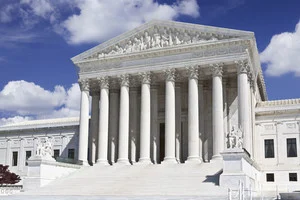
The United States Supreme Court issued a landmark ruling on June 29 that fundamentally alters the constitutional landscape of federal governance, effectively dismantling nearly a century of legal protections for the leaders of independent regulatory agencies. In the case of Trump v. Slaughter, the Court’s conservative majority ruled that the President of the United States possesses the constitutional authority to remove principal officers of independent agencies at will, a decision that expressly overrules the 1935 precedent established in Humphrey’s Executor v. United States. This shift grants the executive branch unprecedented control over entities such as the Federal Trade Commission (FTC), the National Labor Relations Board (NLRB), and the Securities and Exchange Commission (SEC), which were historically designed to operate with a degree of insulation from partisan political cycles.
The dispute originated from President Donald Trump’s early 2025 removal of FTC Commissioner Rebecca Slaughter. Under the previous legal framework, members of such commissions were protected by statutory "for-cause" provisions, meaning they could only be terminated for inefficiency, neglect of duty, or malfeasance in office. By striking down these protections, the Supreme Court has affirmed the "Unitary Executive" theory, asserting that because these officials exercise executive power, they must be directly accountable to the President to ensure the faithful execution of the law under Article II of the Constitution.
The Erosion of the Humphrey’s Executor Doctrine
To understand the magnitude of Trump v. Slaughter, one must look back to the Great Depression era. In 1935, the Supreme Court ruled in Humphrey’s Executor v. United States that Congress had the power to create "quasi-legislative" and "quasi-judicial" bodies whose members could not be removed by the President without specific cause. This allowed agencies to maintain stability and expertise across different presidential administrations, preventing the "spoils system" from dictating technical regulatory policy.
For 90 years, Humphrey’s Executor served as the bedrock of the administrative state. However, the current Court has signaled a growing skepticism toward this arrangement for over a decade. Previous rulings, such as Seila Law LLC v. CFPB (2020) and Collins v. Yellen (2021), had already begun to chip away at these protections, though they stopped short of overturning the 1935 precedent entirely. In those cases, the Court ruled that single-director agencies—like the Consumer Financial Protection Bureau—could not have for-cause protections. Trump v. Slaughter extends this logic to multi-member boards and commissions, effectively ending the era of the truly "independent" agency head.
A Chronology of the Conflict: From Removal to Reinstatement and Finality
The legal battle that culminated in the Slaughter decision was mirrored by a parallel conflict involving the National Labor Relations Board (NLRB). The timeline of these events illustrates the chaotic transition and the high stakes of the constitutional question:
- January 2025: Upon taking office, President Trump moved aggressively to reshape federal agencies, terminating several high-ranking officials including NLRB Member Gwynne Wilcox and EEOC Vice Chair Jocelyn Samuels. These removals were immediately challenged in federal court as violations of the statutory protections afforded to their respective roles.
- Spring 2025: A U.S. District Court judge ordered the reinstatement of Gwynne Wilcox, citing Humphrey’s Executor. The judge argued that the NLRB’s structure required a level of independence that prevented at-will removal by the President.
- Late 2025: The Supreme Court issued a stay on the lower court’s order, removing Wilcox from her position once again while the broader constitutional question was deliberated. This left the NLRB in a state of flux, struggling to maintain a quorum for several months.
- June 29, 2026: The Supreme Court releases its opinion in Trump v. Slaughter. The Court rules that the President’s removal power is nearly absolute for principal officers, rendering the "for-cause" statutes unconstitutional.
- July 8, 2026: In the wake of the decision, legal challenges brought by other ousted officials began to collapse. Judge Tanya Chutkan of the U.S. District Court for the District of Columbia ordered former EEOC Vice Chair Jocelyn Samuels to show cause why her lawsuit should not be dismissed. Samuels subsequently entered a voluntary dismissal of her action, acknowledging that the legal foundation for her claim had been extinguished.
Data and Structural Implications for Federal Agencies
The ruling affects a vast "alphabet soup" of federal entities. Historically, the following agencies operated under the assumption that their leadership was protected from political removal:
- The National Labor Relations Board (NLRB): Tasked with enforcing labor laws and overseeing union elections.
- The Federal Trade Commission (FTC): Responsible for consumer protection and antitrust enforcement.
- The Securities and Exchange Commission (SEC): The primary regulator of U.S. financial markets.
- The Federal Communications Commission (FCC): Regulators of interstate and international communications.
- The Merit Systems Protection Board (MSPB): An agency that protects federal employees from prohibited personnel practices.
By removing the shield of independence, the Supreme Court has essentially converted these 5-member boards into direct extensions of the White House. Critics argue this will lead to "regulatory whiplash," where federal policy on everything from corporate mergers to labor rights shifts 180 degrees every four to eight years based on the party in power.
Supporting data from legal scholars suggests that the turnover rate for agency leadership will likely increase by an estimated 40% to 60% during transition years. Previously, many board members served out their fixed terms (often five years) regardless of who was in the Oval Office. Moving forward, it is expected that incoming presidents will demand the resignations of all "independent" board members on Day One, similar to how U.S. Attorneys are treated.
Analysis of the Judicial Reasoning
The majority opinion in Trump v. Slaughter, penned by the Chief Justice, focused heavily on the separation of powers. The Court argued that the Constitution does not contemplate a "fourth branch" of government that is unaccountable to the people through the President. The ruling posited that if an official is exercising executive power—such as bringing enforcement actions or interpreting federal statutes—they must be under the President’s "supervision and control."

The dissenting justices, however, warned of a "politicization of expertise." They argued that agencies like the FTC and NLRB require technical knowledge and a long-term perspective that is incompatible with the short-term political pressures of a presidential administration. The dissent suggested that this ruling could undermine the stability of the American economy, as businesses will no longer be able to rely on consistent regulatory environments.
Immediate Impact on Labor and Employment Law
For the legal community and the business sector, the most immediate consequences of the Slaughter decision are felt in the realm of labor and employment. The NLRB has long been a site of ideological struggle, with Democratic boards generally favoring labor unions and Republican boards favoring management.
Under the previous system, the staggered terms of NLRB members meant that a President might not gain a majority on the Board until several years into their term. With the new ruling, a President can fire the existing members and appoint a new majority immediately, provided the Senate confirms the nominees.
This acceleration of change means that:
- Rulemaking: Regulations regarding joint-employer status, independent contractor classification, and union election procedures can be overturned much faster.
- Litigation Positions: The NLRB’s legal stance in ongoing court cases can be reversed overnight, leading to potential dismissals of high-profile enforcement actions against major corporations.
- Enforcement Priorities: Agencies may shift focus from aggressive corporate oversight to a more deregulatory posture (or vice versa) within weeks of an inauguration.
Reactions from Legal Stakeholders and Policy Experts
The reaction to Trump v. Slaughter has been sharply divided along ideological and professional lines. Conservative legal groups and advocates of the Unitary Executive theory hailed the decision as a restoration of constitutional order. "The President is the sole head of the Executive Branch," said one prominent legal analyst. "To have individuals exercising the power of the United States who cannot be held accountable by the Chief Executive was a historical anomaly that needed to be corrected."
Conversely, labor advocates and proponents of administrative independence expressed deep concern. "This decision effectively turns the NLRB into a political football," stated a representative from a major national labor federation. "Workers rely on the Board for fair adjudication of their rights. If the Board’s composition changes at the whim of the President, the ‘rule of law’ in the workplace becomes the ‘rule of the party.’"
Corporate law firms have begun advising clients to prepare for increased volatility. In a client alert issued shortly after the ruling, one top-tier firm noted, "Strategic planning for regulatory compliance must now account for the reality that agency leadership is no longer a stable fixture. Clients must be prepared for rapid shifts in enforcement and interpretation of federal law."
Looking Ahead: The Future of the Administrative State
The full ramifications of Trump v. Slaughter will take years to manifest as lower courts apply the ruling to various other agencies and as the executive branch tests the limits of its new authority. One looming question is whether this logic will eventually extend to "inferior officers" or if it will remain confined to "principal officers" like commissioners and board members.
Furthermore, the decision may prompt Congress to rethink how it structures new agencies. If for-cause protections are no longer a viable way to ensure independence, legislators may look toward funding mechanisms or more specific statutory mandates to limit executive overreach. However, in the current polarized environment, such legislative solutions appear distant.
As the litigation surrounding Gwynne Wilcox and others reaches its formal conclusion, the precedent of Trump v. Slaughter stands as a definitive marker in the evolution of American constitutional law. It signals a shift away from the expert-led, insulated bureaucracy of the 20th century toward a more centralized, presidentially-controlled executive branch in the 21st. For employers, employees, and the public at large, the era of the "independent" agency has effectively come to an end, replaced by a system where the ballot box directly dictates the enforcement of the nation’s most critical regulations.








