The annual ranking of the best and worst states for business, as determined by the insights of over 650 CEOs, presidents, and business owners across the United States, has unveiled significant shifts in the nation’s economic topography. This comprehensive survey, which has become a crucial barometer for business leaders evaluating operational environments, highlights a persistent emphasis on foundational economic drivers while also acknowledging emerging trends and persistent challenges. The core message from the surveyed executives is clear: states that diligently cultivate talent, invest in robust infrastructure, foster a favorable tax environment, and maintain a predictable regulatory climate are those poised for sustained success and growth.
Top Tier Stability Amidst Shifting Tiers
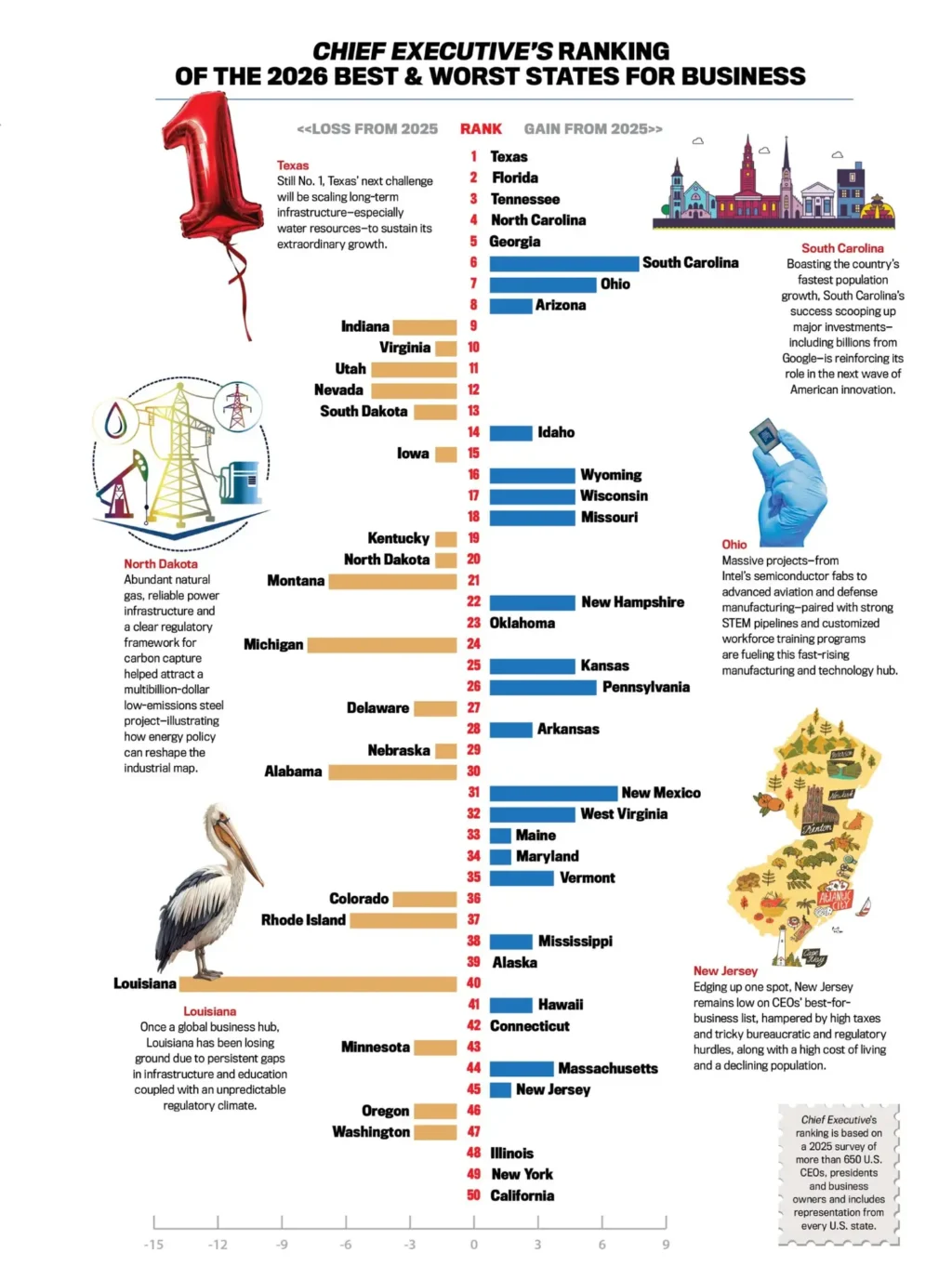
For the 2026 iteration of the Chief Executive survey, the established titans of business-friendly states have largely maintained their dominance. Texas once again secures the coveted No. 1 position, a testament to its long-standing appeal for businesses seeking growth and opportunity. Florida follows closely, holding its strong No. 2 ranking, reinforcing its reputation as a dynamic economic hub. The southeastern corridor continues to demonstrate its strength, with Tennessee, North Carolina, and Georgia rounding out the top five. This consistent performance from these states underscores a strategic approach to economic development that prioritizes core business needs.
Notable Ascensions and Strategic Momentum
While the top five exhibit remarkable stability, the landscape below this elite tier showcases considerable movement, signaling evolving perceptions and strategic successes. South Carolina, a state that has been actively cultivating its business environment, has surged an impressive seven spots to claim the No. 6 position. This upward trajectory is attributed to its focus on "Google-style fundamentals," a term often used to describe a comprehensive approach to attracting and retaining businesses through competitive advantages in talent, infrastructure, and innovation.
Ohio has also made a significant climb, advancing five places to secure the No. 7 spot, making it the highest-ranked Midwestern state. This achievement is a direct result of aggressive and targeted marketing initiatives, coupled with compelling narratives that highlight the state’s economic strengths. Furthermore, Ohio’s sustained commitment to upskilling its existing workforce has resonated with business leaders, demonstrating a forward-thinking approach to talent development.
Mid-Pack Dynamics and Emerging Strengths
In the middle ranks of the survey, the shifts are less dramatic but equally significant, often foreshadowing future economic expansions. Wyoming, Wisconsin, and Missouri each climbed four spots this year, indicating a growing positive sentiment among business leaders. Wisconsin’s ascent is particularly noteworthy, building upon a substantial nine-place jump in the previous year. This sustained momentum suggests that the state’s improvements are becoming structural, rather than merely statistical anomalies, signaling a deeper, more ingrained enhancement of its business climate.
Pennsylvania’s rise of five places to No. 26 is another compelling indicator that consistent, foundational efforts can reshape perceptions over time. According to site selection expert Larry Gigerich, executive managing director of Ginovus consultants, "The states focusing on the fundamentals—talent, infrastructure, tax and regulatory climate—are the ones that will continue to do well." This sentiment underscores the enduring importance of these core pillars in attracting and retaining businesses.
Arizona, after experiencing a dip in the previous year, has rebounded strongly to reclaim the No. 8 position. This recovery is largely attributed to proactive measures taken by state regulators and utility providers to address grid strain caused by rapid growth. The approval of nearly 5,000 megawatts of new generation and storage capacity, alongside multi-billion-dollar expansion plans, demonstrates a commitment to ensuring the state’s infrastructure can support continued economic expansion. Indiana and Virginia have maintained their strong showings, holding steady at No. 9 and No. 10, respectively. Their consistent presence in the top ten reflects a competitive tier where the margins between states are increasingly narrow, highlighting the sophistication of their economic development strategies.
States Facing Challenges and Declining Fortunes
Not all states have experienced upward mobility; some are grappling with persistent challenges that are impacting their business appeal. Louisiana has seen the most significant decline in this year’s survey, dropping 13 places to No. 40. This sharp fall is a direct consequence of ongoing infrastructure deficits and educational gaps, compounded by an unpredictable regulatory environment. These persistent issues are eroding a once-formidable competitive position.
Michigan has slipped seven spots to No. 24. While this may appear as a decline, it is more accurately interpreted as a transitional phase. The state is actively working to diversify its economy beyond its traditional auto-centric base, investing in emerging sectors like technology and life sciences. Delaware has also seen a downward adjustment, dropping four places to No. 27. Colorado has fallen four spots to No. 36, and Washington has slid four places to No. 47, indicating a need for renewed focus on their competitive advantages.
The Persistent Bottom Tier
At the lower end of the rankings, the familiar names continue to occupy the least desirable positions. California remains at No. 50, New York at No. 49, and Illinois at No. 48. This trio has consistently resided in the bottom tier of this survey for years, reflecting a pattern of challenges that have proven difficult to surmount. New Jersey, while edging up one spot to No. 45, remains firmly entrenched in the bottom tier, burdened by high taxes, bureaucratic inefficiencies, and a declining population. These states face considerable headwinds in attracting new business investment.
The Quiet Work of Sustainable Growth
Perhaps the most telling movements in this year’s survey come from states that have been diligently, and often quietly, implementing sound economic policies. New Hampshire has climbed four spots to No. 22, Kansas has risen three places to No. 25, and Arkansas has gained four spots to reach No. 28. These are not states characterized by headline-grabbing corporate relocations or massive, single-project announcements. Instead, their progress is the cumulative result of sustained efforts to make their environments more conducive to business operations year after year. This gradual but persistent improvement in foundational elements demonstrates a strategic, long-term vision for economic development.
Survey Methodology and Implications
The Chief Executive Best & Worst States for Business survey is distinguished by its straightforward methodology. Conducted among more than 650 U.S. CEOs, presidents, and business owners, with representation from every state, the survey asks respondents to identify the states they perceive as the best and worst for conducting business. This approach ensures that the results reflect not only the direct experiences of business leaders but also their perceptions—a critical metric for any state aiming to attract and retain investment.
The implications of these findings are far-reaching. For states that are rising in the rankings, it validates their economic development strategies and provides a compelling narrative for future outreach. For those in decline, it serves as a clear warning sign, highlighting areas that require immediate and focused attention. The survey underscores that while grand gestures may capture headlines, it is the consistent, fundamental work of fostering a favorable business ecosystem that ultimately determines a state’s long-term economic vitality and attractiveness to the business community. The ongoing dialogue between business leaders and state policymakers, informed by such surveys, is essential for navigating the evolving economic landscape and ensuring sustained prosperity across the nation.