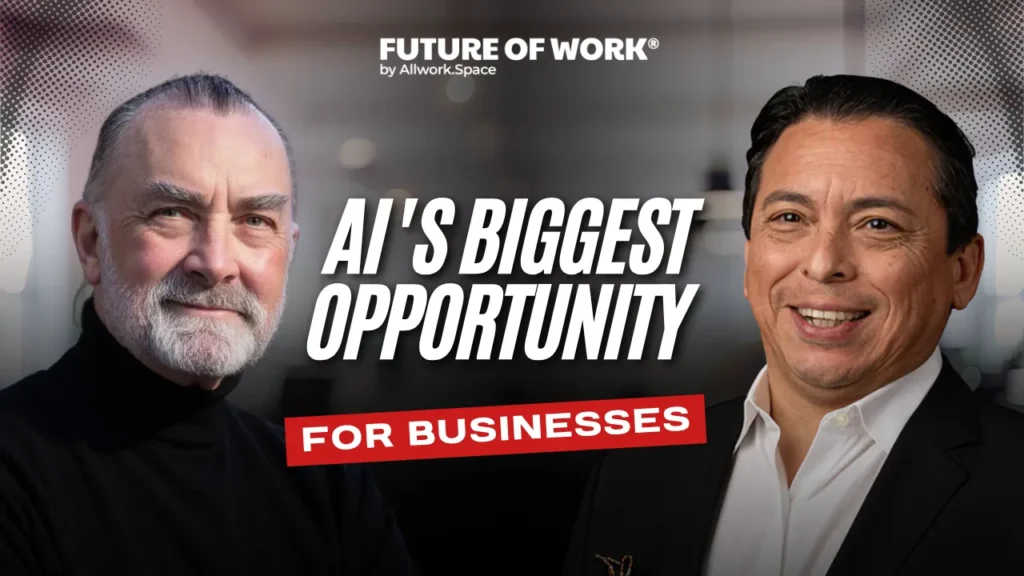
Artificial intelligence has rapidly ascended to become a dominant force shaping the global business landscape. However, many organizations remain entrenched in viewing AI primarily as a tool for cost reduction, overlooking its profound potential to drive substantial value creation and foster innovation. This perspective was a central theme in a recent episode of the Future of Work® Podcast, where host Frank Cottle engaged in a compelling discussion with Brian Solis, Head of Global Innovation at ServiceNow. Solis, a renowned digital futurist and author, argued that the current "AI moment" transcends a mere technological cycle, presenting businesses with a critical juncture.
At this crossroads, businesses face a dichotomy: one path involves optimizing existing operations through automation and enhanced efficiency, essentially refining yesterday’s business models. The alternative path embraces AI as a powerful catalyst for pioneering new business models, fostering groundbreaking innovation, and unlocking entirely new dimensions of value. Cottle and Solis delved into the multifaceted implications of this choice, exploring critical areas such as leadership, the cultivation of trust in AI-driven environments, the imperative of workforce reinvention, the concept of AI augmentation versus replacement, the spirit of entrepreneurship in the AI era, and the fundamental role of organizational culture. They also underscored the increasing responsibility that leaders bear in guiding their teams through this period of unprecedented technological transformation.
The conversation further illuminated why smaller organizations might possess a unique advantage in navigating the AI era. Solis emphasized that AI has the capacity to amplify human capabilities rather than simply displace them, positing that qualities such as curiosity, imagination, and courage are emerging as indispensable leadership attributes. For executives, entrepreneurs, and workplace leaders preparing for the future, this episode offered a nuanced roadmap for cultivating organizations that thrive on innovation rather than succumbing to fear.
Brian Solis: A Visionary in Digital Transformation
Brian Solis is a pivotal figure in understanding the intersection of technology and business. As the Head of Global Innovation at ServiceNow, he spearheads the vision and strategy for ServiceNow Futures, a global network dedicated to researching emerging technologies, business transformation, and evolving customer behaviors. His extensive career has positioned him as a leading voice in digital transformation, AI, and business reinvention. Solis is also a nine-time bestselling author and a sought-after international keynote speaker, consistently guiding organizations through complex technological shifts with insightful research and thought leadership. His book, "Infinite Visionary: Transform Businesses with AI-Forward," further elaborates on these themes.
The AI Crossroads: Efficiency vs. Value Creation
The current business environment is saturated with discussions around artificial intelligence, often dominating conversations to the exclusion of other critical topics. Frank Cottle initiated the discussion by posing a fundamental question: Are companies at a genuine pivot point, or are they merely engaged in a collective game of catch-up?
Brian Solis responded by framing the current moment as a significant crossroads. He articulated that businesses are at a decision point where they can either attempt to prolong the lifespan of their existing structures through incremental improvements or fully embrace AI as a means to achieve "net new value creation at scale." Solis observed that many executives and boards currently perceive AI primarily as a mechanism for efficiency gains and cost reduction. While acknowledging the validity of these goals, he cautioned that this narrow focus might be hindering the exploration of AI’s broader transformative potential.
Cottle raised a pertinent question about whether efficiency gains and value creation are mutually exclusive. He suggested that efficiency should ideally fuel growth, rather than merely serving as a means for cost-cutting, which can feel like a surgical incision through an organization. Solis elaborated on this, explaining that the impetus to fund AI investments often leads companies to seek cost savings elsewhere. While efficiency can lead to faster, cheaper, and more scalable operations, he cautioned that it doesn’t always equate to better outcomes.
A stark example of this was cited: Ford’s decision to lay off 350 quality engineers, replacing them with AI, only to see a decline in quality. The company subsequently rehired personnel to provide human oversight for the AI, ultimately improving their quality metrics and regaining a positive standing on industry lists. This instance highlights the complex interplay between automation, human expertise, and the potential pitfalls of prioritizing cost savings over comprehensive quality assurance.
Cottle humorously noted his preference for a different automotive brand, given the Ford example. He then pivoted to a more profound ethical consideration: the potential return of laid-off employees to such companies. He questioned whether these individuals, having been displaced by technology, would even be willing or able to return, especially in light of widespread layoffs at major tech firms like Microsoft, Google, and Facebook. This raises concerns about trust and the long-term employment prospects for those affected by technological displacement.
Solis acknowledged the human element and the potential difficulty for individuals to find comparable employment. He observed that the current narrative surrounding AI, characterized by headlines about job displacement and cost-cutting to fund AI initiatives, creates an atmosphere of fear and uncertainty among the workforce. This sentiment was further evidenced by reports of students expressing strong negative reactions to AI during graduation ceremonies.
The Role of Leadership in the AI Era

The discussion then shifted to the broader implications of AI adoption and the critical role of leadership. Cottle shared his experience with a smaller company that is actively transitioning to an AI-native model with minimal capital expenditure, emphasizing change management as a key challenge. He also noted an unexpected benefit of remote and hybrid work models: a deeper, more personal connection among colleagues, fostered by the integration of personal lives into the professional sphere.
Cottle reiterated his belief that AI should be viewed as a performance enhancement tool, not solely a headcount reduction mechanism. Solis concurred, advocating for AI as a means of augmentation, enabling individuals to grow, learn, and unlearn. He stressed that AI should increase not only capacity but also capability, leading to the future of work. This requires deliberate design, vision, architecture, training, and empowerment.
Solis articulated a balanced perspective: while improving existing operations is necessary, the true potential lies in embracing AI to explore new possibilities and create "net new value." This approach, he argued, moves beyond mere efficiency to foster innovation and unlock exponential opportunities.
The negative feedback and public apprehension surrounding AI were linked to concerns about resource utilization, the environmental impact of data centers, and the widening disparity between those who benefit from AI and those who are left behind. Solis emphasized that such pushback often signifies a failure of leadership and a lack of established trust. He stated that when students express fear or anger about AI, it reflects a breakdown in how the narrative has been communicated and managed. Leaders, he argued, must recognize that they are not immune to AI’s disruptive potential and must actively guide their organizations and employees through this transition.
Cottle expressed skepticism about the current approach of many large corporations, perceiving it as a competitive race to achieve cost savings rather than an intentional pivot driven by strategic planning. He characterized this as an "AI is bigger than your AI" mentality, suggesting that the focus should be on creating something truly "better," not just "bigger."
Solis agreed that the market often rewards cost-cutting behaviors, citing examples of companies whose stock prices have surged following significant layoffs. He called for innovators and bold leaders to pursue a different path, one that balances linear growth through automation with exponential growth through innovation. This requires challenging conventions, asking difficult questions, and fostering an environment where experimentation and learning are encouraged.
The Rise of Small Businesses and Entrepreneurship in the AI Age

The conversation then turned to the potential advantages of smaller organizations in the AI era. Cottle suggested that small and medium-sized enterprises (SMEs), which employ a significant portion of the workforce in the United States, might have an edge in adaptability and change management compared to larger, more bureaucratic entities.
Solis elaborated on this, explaining that AI can be leveraged for "scaled productivity" through "AI agents." If organizations can effectively harness these agents, even smaller companies can achieve exponential competitiveness. He envisioned a scenario where a few individuals, empowered by AI agents, could perform the work of a much larger team, enabling them to compete at the level of much larger organizations. This contrasts with larger companies that might be primarily focused on automating existing processes.
This discussion naturally led to a consideration of employment dynamics. Cottle questioned whether the true challenge lies in layoffs or in the emergence of a new breed of entrepreneur who can launch successful ventures with a significantly smaller team. He drew a parallel to the aerospace industry’s flux in the early 1980s, where many displaced engineers started their own companies, often selling services back to their former employers. This trend is currently being mirrored in the United States, with a notable increase in new entity formations, particularly among micro-businesses. These new companies are making ambitious claims, often utilizing AI for marketing and operations, despite their limited history and small team sizes.
Cultivating AI Fluency and Personal Leadership
Solis emphasized the critical need for individuals to develop "AI fluency," which extends beyond simply knowing how to prompt AI. He argued that this requires a deeper understanding of AI’s capabilities and its evolving nature. This personal investment in understanding AI is essential for navigating the future of work and for organizations to unlock new value.
He highlighted the concept of "capability overhang," observed in research by OpenAI, where many users do not fully utilize the potential of AI tools like ChatGPT. Those who do, often a minority, demonstrate significantly higher levels of capability. This suggests a substantial untapped potential within organizations.
Cottle shared an interesting observation from his own company: the high-performing employees who are achieving exceptional results with AI have, without explicit instruction, developed a form of "co-identity" with their AI tools, even giving them names. This suggests a deeper, more personal relationship with AI that fosters greater engagement and innovation. Solis resonated with this, recalling his own practice of forming a "board of directors" with ChatGPT, comprising influential figures to challenge his thinking.

The Importance of "Why" and Courageous Leadership
As the conversation neared its conclusion, Cottle asked Solis for the single most important piece of advice for leaders navigating this pivotal moment for both business and humanity. Solis suggested that leaders must embrace boldness and courage, not in the absence of fear, but in spite of it. He urged leaders to ask the questions they have been afraid to ask, to be willing to let go of preconceived notions, and to explore new possibilities.
He further advised leaders to acknowledge that they "don’t know what they don’t know." This humility is crucial for charting an uncharted path and for effectively bringing others along on the journey. Solis highlighted two foundational questions that are often overlooked in the pursuit of speed and efficiency: "Why do we do things this way?" and "Why couldn’t we do things this way?" These questions, he argued, are the gateways to curiosity, wonder, and imagination—qualities that are essential for innovation and often suppressed by traditional educational and corporate structures.
Cottle agreed that the "why" is paramount, reflecting on how his own wife often challenges his ideas with this very question, forcing him to articulate and validate his reasoning. He concluded that asking these fundamental questions is more important than ever in the current landscape.
The exchange between Frank Cottle and Brian Solis offered a profound exploration of the current AI revolution, moving beyond the superficial discourse of efficiency to delve into the strategic, human, and ethical dimensions of this transformative technology. The conversation underscored that while AI presents challenges, it also offers unprecedented opportunities for growth, innovation, and the creation of a more capable and adaptable future of work.