Belonging, the profound sense of being connected, supported, and respected, is not merely a desirable workplace amenity but a fundamental human need and a potent organizational capability. When leaders actively cultivate an environment of belonging, employees are empowered to contribute their full potential, fostering enhanced collaboration and driving innovation. Conversely, a deficit in belonging manifests acutely in diminished engagement, higher attrition rates, and compromised performance. This critical concept, often underestimated, is reshaping how organizations attract, retain, and empower their most valuable asset: their people.
Globally, a stark reality underscores the urgency of this issue: only 20% of employees report being engaged at work, according to comprehensive research by Gallup. This statistic points to a pervasive "belonging gap" within many organizations—a quiet, persistent undercurrent of uncertainty that compels individuals to withhold their full contributions rather than risk alienation. The true value of belonging transcends a simple sense of "fitting in"; it encompasses a complex web of affirmations that impact an individual’s professional identity and their commitment to their organization.
The Tangible Value of Belonging
The impact of belonging on the workforce is demonstrably significant, influencing everything from individual job satisfaction and self-esteem to organizational performance and overall employee well-being. Research consistently highlights that when individuals feel a consistent sense of inclusion and certainty about their place, they become more willing to embrace calculated risks and are more comfortable extending and receiving support. This psychological safety, born from a strong sense of belonging, is the bedrock upon which honest dialogue, creative ideation, and unwavering commitment are built.
Furthermore, a robust sense of belonging is intrinsically linked to heightened resilience. Employees who feel they belong are more likely to persevere through challenges, rebound effectively from setbacks, navigate organizational shifts with greater agility, and exhibit significantly reduced intentions to leave their roles. In a notable partnership with a leading global automotive manufacturer, researchers identified that employees’ perceptions of inclusion, their uncertainty about belonging, and their overall sense of belonging were the most potent predictors of turnover intentions, burnout, and challenges with work-life integration.
Beyond individual well-being and retention, the cultivation of belonging has been recognized as a critical component of effective leadership development. In one study, fostering connection and belonging among participants emerged as one of the most impactful outcomes of leadership training programs. Similarly, an extensive study involving participants of a renowned Leadership Development Program (LDP) and their colleagues revealed that nearly three-quarters of participants reported observable improvements in feeling valued, respected, heard, and trusted.
It is crucial to distinguish between inclusion and belonging. While related, they are not synonymous. Inclusion, in essence, refers to structural access—ensuring individuals have a seat at the table. Belonging, however, is the felt experience of connection, the deep-seated assurance of being valued once present. While organizational systems and policies can effectively promote inclusion, the cultivation of belonging is primarily an emergent property of consistent, high-quality human interactions over time. Research unequivocally supports the notion that both the presence of belonging and the uncertainty surrounding it can be actively influenced by organizational leaders and their strategic initiatives. By intentionally working to diminish this uncertainty, leaders create an environment where employees can shed their anxieties and contribute their full capabilities to the collective enterprise.
The Shadow of Belonging Uncertainty
Belonging and the uncertainty surrounding it are, in many ways, two sides of the same coin, each wielding a profound influence on the workplace experience. Belonging uncertainty arises when individuals are not consistently assured of their place within the organizational fabric. This wavering sense of security can stem from feeling dissimilar to colleagues, whether due to differences in appearance, cultural background, or life experiences. This is particularly acute for employees from underrepresented groups, who may harbor anxieties about facing negative stereotypes or perceiving subtle cues that suggest their path to success is more arduous. These individuals often carry a silent burden, a cognitive load that their colleagues who do not experience such messages are spared.
The tangible consequence of belonging uncertainty is often a reluctance to reveal one’s full self or to contribute fully. This can manifest as hesitation in participating, a subtle but significant signal that the environment may not feel entirely welcoming. Without proactive support, employees grappling with belonging uncertainty can feel as though they are perpetually carrying an invisible weight, impeding their ability to fully engage, think creatively, and bring their authentic selves to work. This constant drain on cognitive and emotional energy inevitably impacts performance, collaboration, and overall commitment.
Illustrative examples of belonging’s subtle yet powerful influence are often found not in overt acts of exclusion, but in the accumulation of seemingly neutral moments that are interpreted through the lens of uncertainty. Consider two employees delivering a significant presentation. If neither receives applause upon completion, the second employee, despite engaging in positive self-talk, expends mental energy to counter negative interpretations of this oversight. This burden, though invisible, accumulates, compounding across teams and entire organizations when belonging uncertainty is widespread and unaddressed. The emotional and cognitive cost of navigating this uncertainty is a significant impediment to individual growth and organizational progress.
Navigating Belonging in a Distributed, Global, and AI-Accelerated World
The traditional conditions that once facilitated the organic development of workplace belonging—shared physical spaces, consistent proximity, and stable team structures—are increasingly rare in today’s organizational landscape. Consequently, a sense of belonging must now be intentionally and strategically cultivated. The accelerating integration of Artificial Intelligence into organizational communication further amplifies the significance of human interaction. The very interactions that remain human-led are precisely those where belonging is either forged or eroded.

Global organizations face an additional layer of complexity. The manifestations of belonging, respect, and inclusion vary significantly across cultures. What signals affirmation in one cultural context may be perceived differently in another. Assumptions embedded in many belonging initiatives—such as encouraging public sharing of failures, mandatory participation in team social events, or the directive to "bring your whole self to work"—do not universally translate. Cultivating belonging across diverse geographies necessitates not only a deep reservoir of relational intention but also a sophisticated understanding of cultural intelligence. A shared set of organizational values, while important, does not automatically engender a shared sense of belonging, and global expansion undertaken without careful cultural consideration can actively undermine it.
Strategies for Cultivating Workplace Belonging
The good news is that building a sense of belonging within the workplace does not necessitate grand, costly gestures. The most effective interventions are often characterized by their consistency and their deeply human nature—small, deliberate acts of attention and inclusion that, over time, coalesce into a palpable sense of safety and connection. For maximum impact, these experiences should intentionally foster all facets of belonging: the connection with peers, the development of trust, the valuing of every voice, and the reduction of belonging uncertainty.
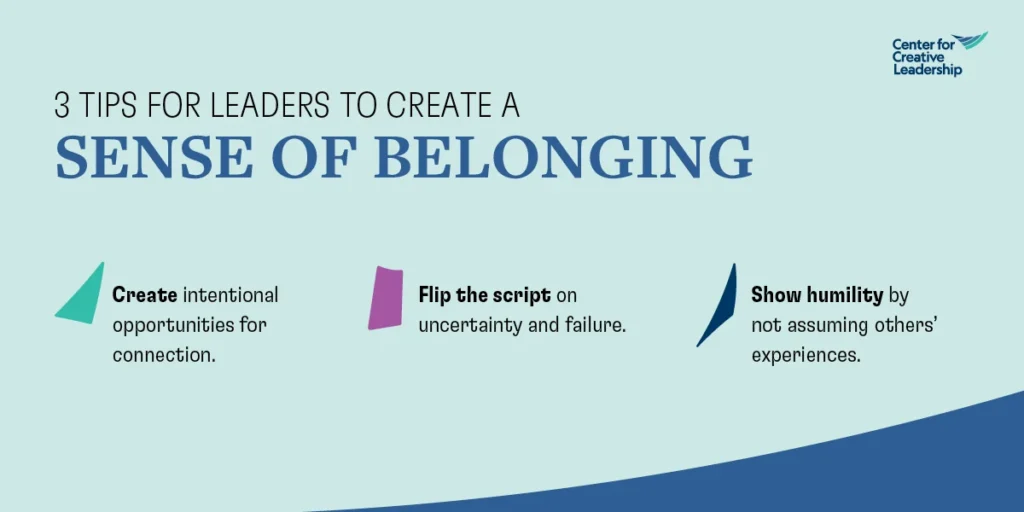
1. Forge Intentional Opportunities for Connection
Consistency is paramount. While many organizations initiate efforts by organizing team events, mixers, or social gatherings, their impact is often limited compared to the sustained influence of regular, smaller-scale opportunities for connection. This can involve dedicating time at the outset of meetings for brief personal sharing, facilitating cross-group conversations, or establishing dedicated spaces for peer connection across different functions and hierarchical levels. The objective is to foster sustainable, authentic interaction rather than performative togetherness.
In distributed and hybrid work environments, this intentionality is not merely beneficial but essential. Belonging emerges from moments where individuals feel genuinely seen and welcomed, and these moments must be deliberately created. Furthermore, the broader organizational systems play a crucial role. When promotion criteria, performance metrics, and meeting structures are deliberately aligned to reinforce rather than undermine connection at work, belonging has fertile ground to develop. Conversely, misaligned systems can propagate belonging uncertainty, irrespective of individual leaders’ efforts. The design of the organizational environment is as impactful as the intentions of its people.
2. Reframe Uncertainty and Failure
When individuals lack a strong sense of belonging, they often feel isolated in their experiences of doubt. Belonging uncertainty can lead individuals to believe they are alone in questioning their fit, when in reality, many colleagues have navigated similar sentiments at various points in their careers. When leaders and peers openly share their uncertainties or even failures, they normalize these feelings and diminish their power. This is particularly impactful when shared by individuals further along in their career trajectories; a manager recounting early-career struggles can provide permission for others to acknowledge their own uncertainties.
Within global organizations, it is vital to recognize that the expression of appropriate vulnerability varies significantly across cultures. What may be perceived as authentic openness in one context could be considered overly personal or professionally inappropriate in another. Leaders in global roles must cultivate cross-cultural awareness to calibrate their approach, fostering safety for honesty without imposing a uniform standard of openness. Mentorship stands out as a particularly potent belonging intervention during critical transitions—such as onboarding, promotions, or the assumption of new managerial responsibilities. It strategically pairs moments of high belonging uncertainty with direct relational investment. When a more experienced colleague shares their journey and offers ongoing support, belonging uncertainty diminishes, and commitment intensifies.
3. Embrace Humility by Avoiding Assumptions
Creating space for others to share their experiences is a cornerstone of building belonging. Leaders who consistently facilitate opportunities for connection and openly share their own self-doubts are more likely to cultivate an environment of psychological safety, empowering employees to comfortably articulate their experiences with belonging and belonging uncertainty. This is especially critical for employees who are frequently overlooked and underestimated.
Power dynamics can significantly influence group settings, with individuals holding more senior positions or privileged social identities often dominating speaking time. Research indicates that simply being designated a "leader" can increase speaking time by 150% to 300%. Counteracting this requires active, intentional listening—not merely creating space but actively protecting it. When an employee shares an experience, resist the urge to immediately redirect the conversation to your own perspective. A well-timed silence and a genuine follow-up question can communicate more about belonging than almost any other leadership action. Crucially, avoid pressuring employees to share beyond their comfort levels; the leader’s role is to provide the platform. Finally, discourage individuals from speaking on behalf of others by encouraging everyone to focus on their personal experiences, thereby giving individuals a direct voice.
From Individual Practice to Organizational Design
The cultivation of belonging in the workplace is an ongoing process, built through a confluence of significant and subtle interactions. However, its scalability cannot rely solely on individual efforts. Organizations that excel at fostering workplace belonging treat it as a strategic leadership challenge, scrutinizing their systems, structures, and development investments to ensure they reinforce the conditions under which individuals consistently feel connected, valued, and safe. This involves a critical examination of what is measured, what is rewarded, and how leadership is developed at every level.
The most impactful instances of workplace belonging arise from leaders who actively observe, listen, and create the necessary space for individuals to show up fully and consistently. When belonging becomes an integral aspect of leadership development—not merely a standalone module or initiative, but an expected outcome of the development process itself—it transcends a mere cultural aspiration and evolves into a tangible performance advantage. Organizations are increasingly recognizing that equipping leaders to foster inclusive cultures that genuinely support all employees is essential for creating environments where individuals are not just "okay," but truly thrive. This proactive approach, encompassing compassion, well-being, and belonging, is informed by rigorous research and translates into actionable strategies for leaders at all levels.
The journey toward a more inclusive and connected workplace is ongoing, requiring continuous commitment and a willingness to adapt. By prioritizing the cultivation of belonging, organizations can unlock unprecedented levels of engagement, innovation, and resilience, ultimately positioning themselves for sustained success in an increasingly complex global landscape.