Employee motivation serves as the vital engine driving organizational performance, a truth particularly pronounced for mid-market companies where every expenditure and strategic decision carries significant weight. In environments characterized by lean teams and stringent budget oversight, misjudging employee motivators can lead to more than just a slowdown in momentum; it can directly impact crucial metrics such as results, employee retention, and overall return on investment. The challenge is compounded by the inherent transience of motivation. What ignites enthusiasm today may well become commonplace tomorrow. For leaders navigating the complexities of growth, change, and resource constraints, a decline in employee engagement is not merely a warning sign—it represents a tangible risk that can no longer be ignored. Recent findings from Gallup underscore this concern, revealing that employee engagement in the United States has fallen to a year-low of just 31%. This statistic serves as a stark indicator that without continuous attention and adaptation, organizational momentum can rapidly dissipate.
This comprehensive analysis delves into practical, scalable strategies for fostering employee motivation, specifically tailored for mid-market organizations. These approaches are designed to deliver impactful results swiftly and efficiently, without introducing undue complexity into existing operations.
Understanding the Core of Employee Motivation
At its essence, employee motivation encapsulates the commitment, energy, and ingenuity that individuals bring to their work on a daily basis. For mid-market enterprises, this intrinsic drive directly correlates with team performance, productivity, and the capacity for adaptation and growth, often without the necessity of expanding headcount. The encouraging news is that motivation is not an arbitrary outcome; it is a cultivable asset. It can be fostered through a strategic blend of support and recognition. While tangible rewards like salary increases and promotions remain important, employees also place significant value on flexible work arrangements, visible opportunities for professional development, and consistent, everyday recognition. These elements are crucial for building motivation strategies that can scale effectively alongside business expansion.
Motivated employees exhibit higher levels of engagement, greater productivity, and a stronger propensity to remain with the organization. The positive aspect is that fostering motivation does not necessitate guesswork. By implementing the right combination of recognition, development, and well-being initiatives, mid-market organizations can cultivate a work environment where employees feel genuinely valued, all while minimizing the burden on lean HR and people operations teams.
Strategic Pillars for Enhancing Employee Motivation
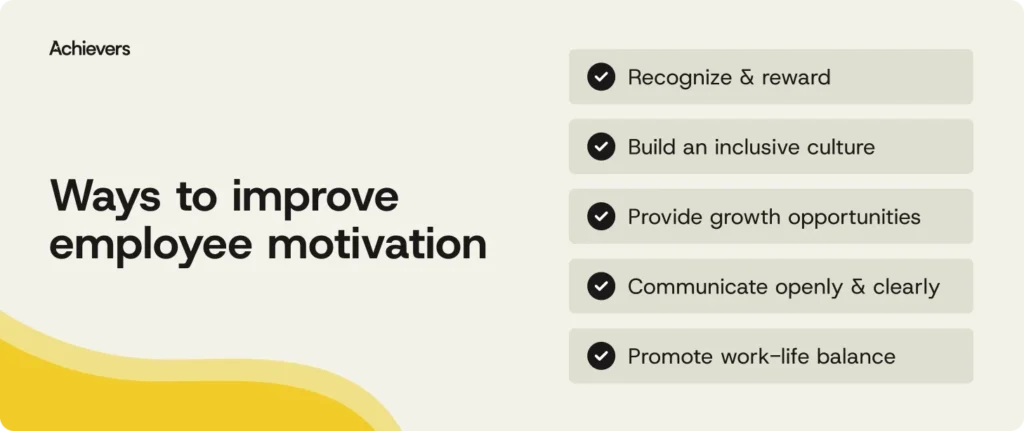
To effectively drive employee motivation and, consequently, business success, mid-market organizations can implement a series of strategic initiatives. These are not theoretical constructs but actionable steps designed for immediate and sustained impact.
1. Consistent Recognition and Rewarding
One of the most potent drivers of employee motivation is consistent recognition. When employees feel their contributions are seen and appreciated, their engagement levels rise, productivity increases, and their likelihood of staying with the company improves. For mid-market companies, the most effective recognition programs are those that are easy to implement and frequent, minimizing administrative overhead. This can be achieved through peer-to-peer recognition systems, empowering managers with user-friendly tools, and offering rewards that employees genuinely value.
Data from the Achievers Workforce Institute’s (AWI) State of Recognition Report highlights the profound impact of recognition. Employees who receive recognition at least once a month are three times more likely to trust their managers and two-and-a-half times more likely to perceive them as effective leaders. This consistent acknowledgment builds trust, reinforces strong performance, and cultivates a work environment where individuals are motivated to deliver their best. It is crucial to distinguish between genuine motivation and mere administrative compliance; recognition solely at annual review times, for instance, can feel more like a bureaucratic task than a motivational catalyst.
2. Cultivating a Positive and Inclusive Culture
The impact of company culture on employee motivation is often underestimated by leadership. A workplace founded on principles of trust, respect, and a sense of belonging provides employees with a compelling reason to remain engaged and to contribute their utmost effort. When employees understand how their individual work contributes to the broader organizational purpose, motivation naturally flourishes.
Recognition plays a pivotal role in reinforcing this culture. Publicly acknowledging achievements connects daily actions to company values, assuring employees that they are an integral part of a larger collective. Peer-to-peer recognition further amplifies this effect, creating a positive ripple that enhances motivation across all teams. However, if a company’s culture is merely articulated in a mission statement displayed on a wall without tangible daily practice, it risks becoming superficial and ineffective.
3. Prioritizing Opportunities for Growth and Development
Few factors motivate employees more effectively than the clear indication that their organization is invested in their future, even within the constraints of limited budgets and lean teams. When individuals perceive a defined pathway for skill development and career progression, their engagement deepens, their motivation intensifies, and they become less inclined to seek opportunities elsewhere.
Importantly, professional growth does not always necessitate substantial financial investment. Mentorship programs, opportunities to participate in cross-functional projects, and short, targeted training sessions can be as impactful as expensive external courses. The fundamental motivator here is the company’s genuine commitment to employee development, moving beyond mere lip service found in employee handbooks.

4. Ensuring Open and Clear Communication
Ambiguity in communication is a significant detractor from employee motivation. Employees require clarity regarding expectations, the connection between their work and organizational objectives, and their performance standing. This clarity fosters confidence, which in turn fuels motivation.
Effective communication transcends infrequent company-wide meetings. It involves regular one-on-one check-ins, fostering an environment of open dialogue, and establishing a feedback loop that operates in both directions. Tools such as pulse surveys and Voice of Employee platforms enable leaders to actively listen, prioritize concerns, and respond swiftly, circumventing lengthy approval processes or complex change management procedures. When communication is unidirectional, flowing solely from leadership downwards, it ceases to be a true dialogue and becomes a monologue, which is unlikely to inspire sustained employee commitment.
5. Championing Work-Life Balance and Well-being
The detrimental effects of burnout are antithetical to employee motivation. Individuals who feel consistently overwhelmed and overstretched exhibit reduced engagement, lower productivity, and a higher likelihood of departure. Implementing flexible work schedules, providing comprehensive wellness benefits, and offering support for mental health clearly signal that employee well-being is a paramount concern.
Achieving work-life balance does not necessitate radical policy overhauls. Simple measures such as flexible working hours, realistic workload management, and access to wellness programs can make a substantial difference. The overarching goal is to create a work environment where employees can bring their full energy to their tasks, rather than operating in a state of perpetual exhaustion.
6. Empowering Employees Through Autonomy
Micromanagement is a direct pathway to employee disengagement. When employees are granted ownership of their work, the freedom to make decisions, and the trust of their leaders, their motivation is significantly enhanced. Autonomy fosters a sense of accountability and provides individuals with the necessary space to perform at their peak potential.
The nuanced aspect of granting autonomy is that it does not imply a reduction in managerial support. Coaching, guidance, and clear operational boundaries are essential to ensure employees feel confident and supported, rather than abandoned. Managers should function as supportive observers, available when needed but not intrusive in the day-to-day execution of tasks.
7. Offering Meaningful and Personalized Incentives
While standard benefits such as health insurance and retirement plans are fundamental, they are often perceived as expected rather than as drivers of inspiration. Employees are more motivated when rewards feel personal and tailored to their individual needs and preferences, rather than being generic.
This can be achieved by implementing incentive programs that offer wellness stipends, flexible perk options, or personalized rewards that employees can actively utilize and appreciate. The critical factor is aligning incentives with what employees genuinely value. Otherwise, distributing rewards that are not sought after can create noise rather than genuine motivation.
8. Proactively Addressing Concerns and Acting on Feedback
Employee motivation can wane rapidly if individuals feel their concerns are not being heard. However, passive listening is insufficient; it is the active implementation of feedback that truly builds trust and sustains employee motivation.
In the context of mid-market organizations, closing the feedback loop swiftly is instrumental in fostering trust. This trust is frequently the decisive factor in retaining valuable talent, thereby avoiding the costly and time-consuming process of restarting recruitment efforts.
Understanding the Nuances of Motivation
A deeper understanding of the different facets of employee motivation can inform more effective strategies.
Intrinsic Motivation: The Power Within
Intrinsic motivation stems from the inherent satisfaction derived from performing work that is perceived as meaningful. This can manifest as the challenge of solving a complex problem, achieving a personal milestone, or contributing to a collective team success. This form of motivation is inherently sustainable and can persist even in the absence of external rewards.
Extrinsic Motivation: The Impact of External Factors
Extrinsic motivation is driven by external factors such as recognition, rewards, and incentives. A timely expression of gratitude or a points-based reward system can significantly contribute to extrinsic motivation. Neglecting these external drivers can diminish their impact, potentially reducing them to mere budgetary line items rather than motivational tools.
The Intertwined Relationship Between Motivation and Engagement
The relationship between motivation and engagement is direct and synergistic. Motivation provides the underlying rationale for an employee’s actions, while engagement reflects the depth and quality of their commitment and follow-through. Motivation can be viewed as the initial spark, igniting the desire to act, while engagement represents the sustained effort and dedication that propels work forward.
The Tangible Impact of Employee Motivation on Business Outcomes
Elevated employee motivation directly translates into the key business outcomes that mid-market leaders prioritize: enhanced performance, accelerated execution, and reduced employee turnover, all achievable without escalating operational costs. Recognition, as a powerful motivator, is consistently backed by compelling data. The AWI State of Recognition Report indicates that organizations with robust recognition programs experience higher employee retention rates and improved overall performance.
Furthermore, recognition acts as a vital diagnostic tool for organizational health. A decline in recognition practices often correlates with a dip in employee engagement and trust, signaling an increased risk of talent attrition. Companies like Achievers specialize in helping organizations transform everyday recognition into measurable business results, offering the scalability of enterprise solutions with the accessibility required by mid-sized teams. By integrating recognition into the fabric of daily operations, rather than relegating it to annual reviews or infrequent celebratory events, motivation becomes embedded within the organizational culture, leading to sustained impact and driving business growth.
Driving Employee Motivation and Success with Achievers
When employees feel genuinely motivated, they infuse their work with increased energy, creativity, and a collaborative spirit, generating a positive momentum that propels the business forward. Achievers provides a comprehensive solution for organizations poised for growth but seeking to avoid unnecessary complexity. By embedding recognition into everyday workflows, facilitating the delivery of rewards that truly resonate with employees, and providing real-time insights, Achievers empowers leaders to cultivate lasting motivation. The ultimate outcome is a workplace culture where employees feel consistently seen, heard, and supported—not just annually, but every single day.
Employee Motivation FAQs
What is the primary difference between intrinsic and extrinsic motivation?
Intrinsic motivation arises from the personal satisfaction and enjoyment derived from the task itself, such as learning a new skill or solving a challenging problem. Extrinsic motivation, conversely, is driven by external rewards or the avoidance of punishment, like receiving a bonus or praise.
How does employee motivation directly impact business outcomes?
Highly motivated employees are more productive, innovative, and committed to their roles, leading to improved customer satisfaction, higher quality output, reduced turnover, and ultimately, increased profitability.
What are the key indicators of low employee motivation?
Signs of low employee motivation can include increased absenteeism, higher rates of errors, decreased productivity, negative attitudes, a lack of initiative, and a rise in employee complaints or grievances.
Can recognition alone solve all motivation issues?
While recognition is a powerful motivator, it is typically most effective when part of a broader strategy that also addresses factors like fair compensation, opportunities for growth, a positive work environment, and clear communication.
How can mid-market companies measure the effectiveness of their motivation strategies?
Effectiveness can be measured through key performance indicators (KPIs) such as employee engagement survey scores, retention rates, productivity metrics, absenteeism rates, and customer satisfaction scores. Regular feedback mechanisms are also crucial.