The distinction between management and leadership, often blurred in common parlance, is critical for organizational effectiveness. While management focuses on the day-to-day execution of tasks and the efficient deployment of resources, leadership is fundamentally a broader, social process centered on influencing, inspiring, and fostering collective growth towards a shared vision. Understanding this distinction is not merely academic; it directly impacts an organization’s ability to navigate challenges, achieve ambitious goals, and cultivate a thriving work environment.
At its core, management involves planning, organizing, executing, and problem-solving. Effective managers ensure that operations run smoothly, resources are utilized optimally, and employees meet established expectations. They are adept at delegating, monitoring progress against deadlines and targets, managing resources judiciously, and resolving conflicts promptly. Their focus is often on maintaining order, predictability, and efficiency within established systems.
Leadership, conversely, operates on a different plane. It is about inspiring people, seeing the bigger picture, and enabling individuals to connect disparate ideas and fill crucial gaps. Leaders motivate teams towards a common objective, investing in both the people and the systems required for success. They articulate a compelling vision, champion innovation, and actively support the personal and professional development of others. Whether leading a small team or an entire enterprise, drawing upon both management and leadership capabilities is essential for navigating the complexities of modern work.
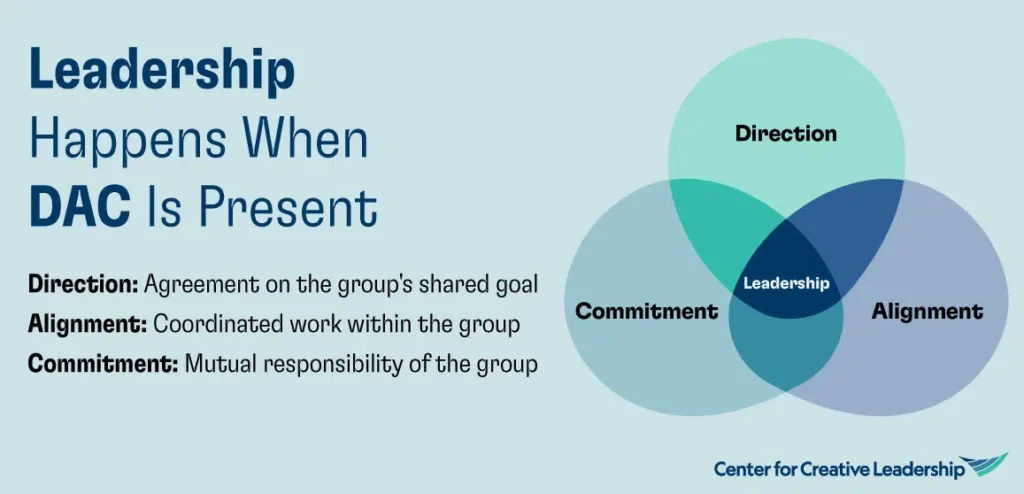
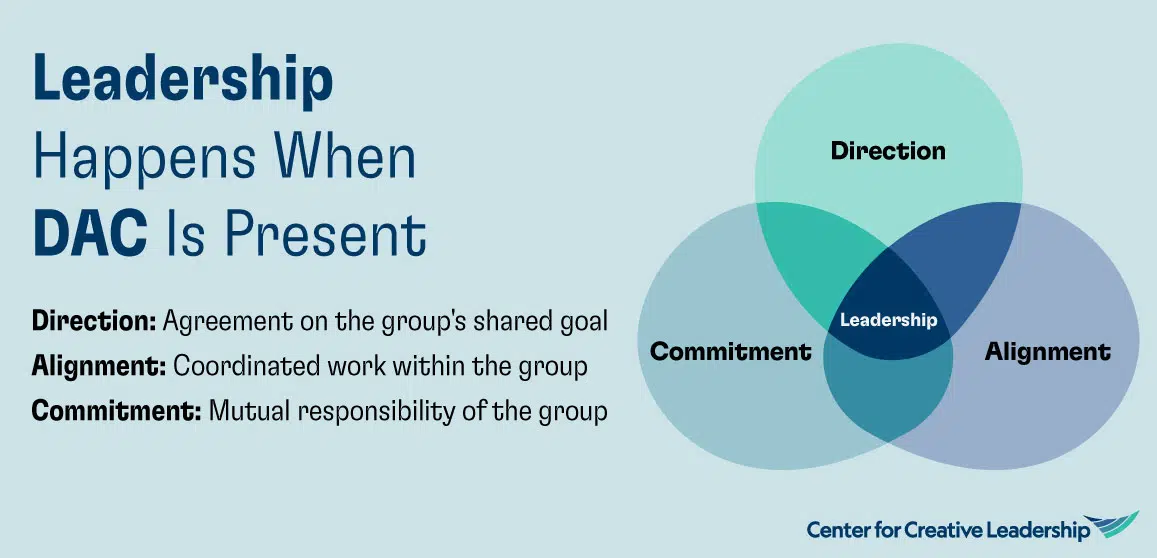
Research from organizations like the Center for Creative Leadership (CCL) distills the essence of leadership into three fundamental, interconnected elements: Direction, Alignment, and Commitment (DAC). This framework, known as the DAC model, shifts the focus from individual leaders to the shared outcomes of leadership. When Direction, Alignment, and Commitment are present, leadership is demonstrably occurring. This perspective emphasizes that leadership is not a solitary act but a collaborative, social process, with everyone contributing to its success.
Defining Leadership Through DAC Outcomes
The DAC model posits that leadership is the result of these three crucial elements, which are generated through the collective actions, interactions, and exchanges of multiple individuals. While organizational leaders play a pivotal role in establishing the environment for DAC to flourish, the responsibility for its creation is distributed across the entire group.
Direction: This element addresses the fundamental question, "Where are we going?" Direction represents a shared understanding and agreement within a group on its overarching goals and objectives. It provides a compass for setting shared goals, ensuring that individual and collective efforts are channeled effectively. When direction is clear, individuals can readily discern what to prioritize, what to decline, and where to allocate resources. They can see how their specific contributions fit into the larger organizational narrative, fostering a sense of purpose and focus. This goes beyond simply announcing targets; it involves purpose-driven leadership that cultivates clarity, inspiration, and motivation. For instance, a tech startup aiming to disrupt the renewable energy market must articulate a compelling vision for its future, ensuring every team member understands how their coding, marketing, or sales efforts contribute to this ambitious goal.

Alignment: If direction defines the destination, alignment describes the pathway to get there. It ensures that each individual understands their specific role and how it interlocks with the work of their colleagues. This fosters a sense of coordination and synchronization, minimizing confusion and miscommunication. Alignment leads to increased efficiency by reducing redundant tasks, duplicated efforts, and unnecessary oversight. In today’s increasingly dispersed work environments, characterized by remote and hybrid teams operating across different time zones, achieving alignment presents a significant challenge. Frustration can arise when team members feel disconnected, unable to contribute effectively, or uncertain about their role and ongoing developments. Effective leadership in these contexts necessitates a deliberate focus on both relationships and tasks, intentionally building trust and fostering interdependence to create robust alignment. A global manufacturing company, for example, must ensure that its design, production, and logistics teams, spread across continents, are seamlessly coordinated to meet product launch deadlines.
Commitment: This component signifies a mutual willingness to prioritize the success of the collective, recognizing that individual achievements are intrinsically linked to the group’s overall performance. Commitment implies a shared belief that everyone will exert the necessary effort for the group’s success, characterized by a balanced exchange of contributions. When a culture of mere compliance is replaced by a spirit of shared endeavor, the need for constant micro-management diminishes. Team members are motivated to go the extra mile, driven by accountability and a shared ownership mentality. This fosters an environment where change is embraced, shared goals are realized, and cultural transformation becomes achievable. Crucially, commitment cannot be mandated; it must be cultivated. Effective leaders understand the importance of respecting diverse perspectives and actively seek to comprehend their employees’ experiences, fostering a sense of belonging where contributions are valued. A non-profit organization tackling complex social issues relies heavily on the unwavering commitment of its staff and volunteers, who must feel a profound connection to the mission to sustain their efforts.
The Impact of a Refined Definition of Leadership
Adopting a clear and shared understanding of what leadership entails can significantly enhance its quality and consistency across an organization. When the meaning and importance of leadership are well-defined, it becomes easier to identify areas of strength and weakness, enabling targeted interventions to improve collaborative efforts and achieve desired outcomes.
Diagnosing Leadership Challenges Through DAC:
When progress falters within a team, project, or community initiative, viewing leadership as an outcome to be achieved through DAC can quickly pinpoint areas needing attention. Several key indicators can signal weaknesses in these areas:
- Direction: Ambiguity regarding goals, conflicting priorities, a lack of clear vision, or a feeling of working in silos.
- Alignment: Inefficient processes, duplicated efforts, communication breakdowns, lack of clarity on roles and responsibilities, or resistance to new initiatives.
- Commitment: Low engagement, minimal effort beyond basic requirements, a lack of accountability, a culture of blame, or a perceived disconnect between individual contributions and organizational success.
Incorporating Multiple Perspectives:
To gain an accurate assessment of the current state of DAC, it is vital to move beyond individual perspectives and actively engage team members. Candid conversations about the outcomes of leadership within the group can reveal crucial insights into existing challenges. Creating psychological safety is paramount in these discussions, ensuring that individuals feel comfortable sharing their candid observations about what is working well and what is not. This inclusive approach allows for a more holistic understanding of the issues at hand.
Implementing Targeted Actions:
Based on the insights gathered, specific actions can be taken to address identified issues. The nature of these actions will vary depending on the specific challenges faced. For instance, if a team demonstrates strong direction and commitment but struggles with chaotic processes, the focus should shift to improving alignment by refining systems and workflows. Conversely, if low commitment or unclear direction are the primary pain points, interventions should target fostering engagement and clarifying objectives. While there are no universal solutions, even small, deliberate changes can foster significant improvements in DAC levels. Examples include:
- Establishing clear communication channels and protocols.
- Implementing regular feedback mechanisms.
- Clarifying roles and responsibilities through project charters or RACI matrices.
- Celebrating small wins to boost morale and reinforce commitment.
- Providing opportunities for cross-functional collaboration to enhance understanding and alignment.
Investing in Leadership at All Levels
When everyone within an organization understands the meaning of leadership and how to contribute to DAC, the overall impact of leadership expands significantly. This leads to enhanced organizational performance, increased employee engagement, and improved retention rates.
Implications for Leadership Development:
This relational understanding of leadership underscores the critical importance of developing leadership capacity not just for those in formal leadership positions or identified as "high-potential," but for the collective – teams, workgroups, and the entire organization. Effective leadership at all levels does not emerge spontaneously; it requires intentional investment in learning and practice. This begins with recognizing individual starting points, fostering self-awareness, and nurturing leadership skillsets and mindsets. Simultaneously, cultivating a shared understanding of leadership within teams and groups creates a powerful ripple effect throughout the organization.
Amplifying Leadership Potential Through Development:
Providing timely and relevant learning opportunities for all employees, from individual contributors to senior executives, is fundamental to unlocking organizational performance, engagement, and retention. Key strategies include:
-
Encouraging Good Leadership and Accessible Development: Cultivating essential leadership qualities such as integrity, self-awareness, courage, respect, compassion, and resilience is paramount. When individuals hone these attributes, the social process of leadership becomes more fluid and effective. Access to professional and personal leadership development opportunities, coupled with a clear career path and supportive environment, significantly enhances employee commitment and engagement. Research indicates that access to such opportunities can be inequitable, highlighting the need for proactive measures to ensure fair access. This includes addressing systemic exclusion and providing equitable opportunities for growth.
-
Growing Teams Collaboratively: Building high-performing teams involves more than just assembling talented individuals. It requires focusing on all aspects of team effectiveness, including fostering strong direction, alignment, and commitment. When teams develop together, reinforcing these DAC elements, they operate more seamlessly, improve output, and expand their potential for collective impact.
-
Scaling for Organization-Wide Impact: Implementing leadership development initiatives across the entire enterprise can create a shared understanding of leadership, fostering a unified vision, language, and set of behaviors aligned with critical business needs. This broadens access to learning, promotes equitable development opportunities, builds enterprise-wide capabilities, and cultivates the social processes essential for effective leadership. Organizations that invest strategically in leadership development at scale consistently report improved organizational performance, increased employee engagement, and higher retention rates. Supplementing in-house training with external expertise can be an effective strategy for delivering high-impact development to large populations.
-
Creating a Societal Ripple Effect: As individuals, teams, and organizations embrace a deeper understanding of leadership and actively cultivate direction, alignment, and commitment, their leadership potential expands, creating positive impacts that extend beyond their immediate spheres. Addressing complex societal or community problems requires collective action, with numerous individuals working together to understand root causes and develop sustainable solutions. Embracing a relational and collective definition of leadership opens the door to transformational change, benefiting individuals, teams, organizations, and ultimately, society as a whole.
In conclusion, a nuanced understanding of leadership as a social process centered on achieving direction, alignment, and commitment offers a powerful framework for enhancing individual and collective effectiveness. By focusing on these outcomes, organizations can foster environments where people are inspired, coordinated, and dedicated to shared success, ultimately driving progress and achieving greater results together.