The enduring question of what constitutes effective leadership has occupied thinkers and practitioners for centuries. While terms like "management" and "leadership" are frequently used interchangeably, a deeper examination reveals distinct functions and focuses. Understanding these differences is crucial for fostering environments where individuals and organizations can thrive. At its core, leadership is not a solitary act performed by a chosen few, but rather a dynamic social process that generates specific, measurable outcomes: direction, alignment, and commitment. This perspective, championed by research from institutions like the Center for Creative Leadership (CCL), moves beyond individual charisma to emphasize the collective effort required to achieve shared goals.
Management Versus Leadership: A Crucial Distinction
While both management and leadership are essential for organizational success, their primary functions differ significantly. Managers are typically tasked with the operational aspects of an organization. Their responsibilities often include planning, organizing, executing tasks, and problem-solving. Effective managers excel at deploying resources efficiently, working through others to achieve goals, and ensuring that day-to-day operations run smoothly. They focus on maintaining standards, meeting deadlines, and ensuring employees fulfill their expected roles and responsibilities. Delegation, resource allocation, and conflict resolution are key skills for a manager.
Leaders, on the other hand, operate with a broader scope. Their focus extends to influencing, inspiring, and empowering others to reach their full potential. Leaders possess the ability to see the bigger picture, connect seemingly disparate elements, and identify and fill gaps in understanding or execution. They motivate teams toward a common vision, investing in both the people and the systems necessary for collective success. Key leadership attributes include setting a clear vision, fostering innovation, and championing the personal and professional growth of individuals. In essence, managers ensure things are done right, while leaders ensure the right things are done. Both are indispensable, and effective individuals often draw upon both skill sets depending on the context and their role.
Defining Leadership Through its Outcomes: Direction, Alignment, and Commitment (DAC)
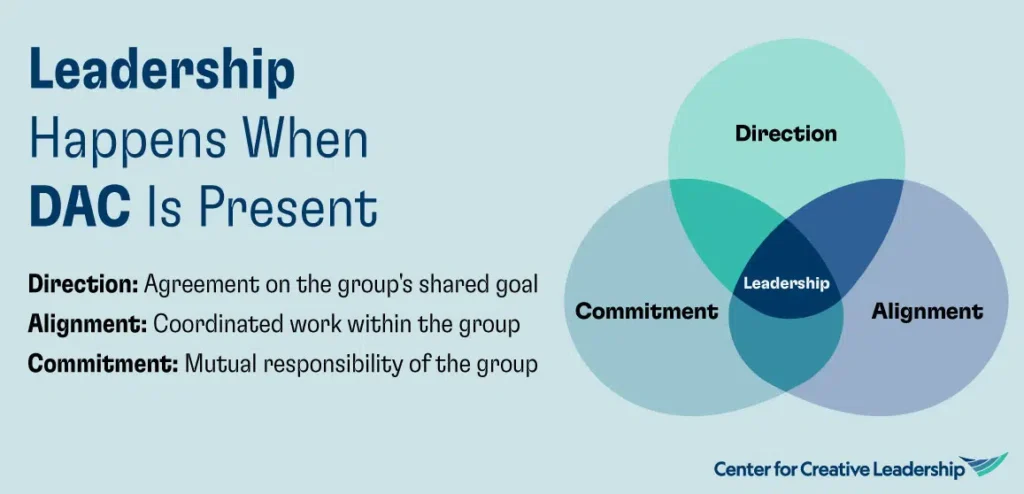
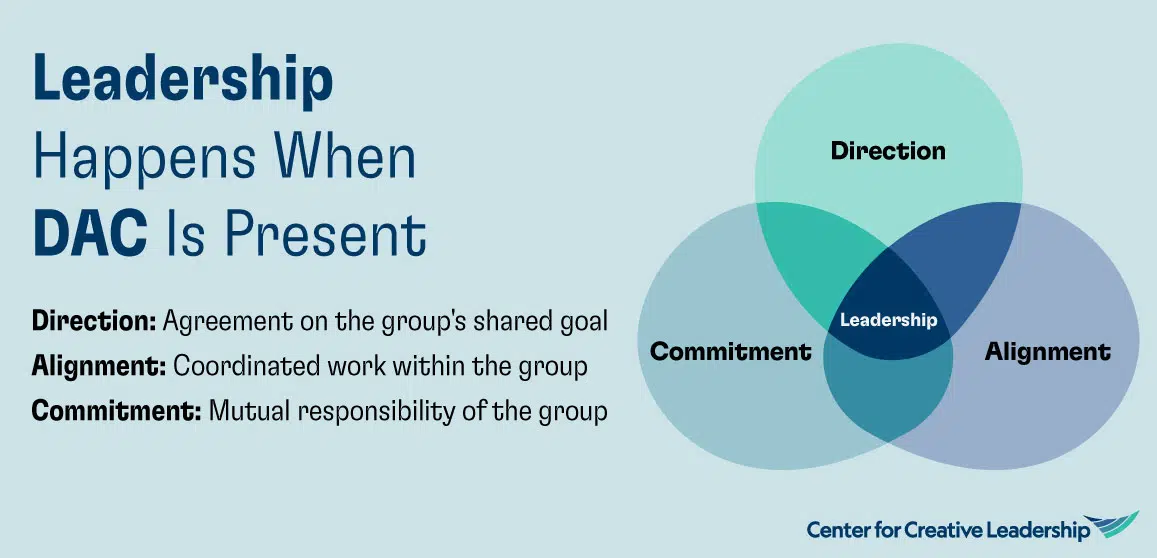
CCL’s extensive research has distilled the essence of leadership into three fundamental elements: direction, alignment, and commitment (DAC). This framework posits that leadership is demonstrably occurring when these three outcomes are present. This definition shifts the focus from the individual leader to the shared results of their collective efforts. When direction, alignment, and commitment are achieved, it signifies that leadership has been enacted, regardless of who initiated the actions.
The DAC model emphasizes that these outcomes are not the product of a single person but emerge from the interplay of actions, interactions, and exchanges among multiple individuals. While organizational leaders play a pivotal role in establishing the conditions for DAC to flourish, every member of a team or organization contributes to its creation. This perspective underscores leadership as a social process, acknowledging that everyone has the capacity to learn, grow, and contribute to shared direction, alignment, and commitment. This understanding accommodates diverse leadership styles, individual personalities, and cultural nuances, recognizing that effective leadership is defined by its observable results.
Direction: Charting the Course Together
Direction represents a shared understanding and agreement within a group regarding its overarching goals. It answers the fundamental question: "Where are we going?" This collective clarity on objectives guides the setting of shared goals and ensures that individual and collective energy is channeled effectively. When a clear direction is established, individuals understand what to prioritize, what to decline, and where to allocate resources. They can readily see how their contributions fit into the larger organizational or team objectives.
Establishing direction involves more than merely announcing targets or articulating a vision. It requires purpose-driven leadership that instills clarity, inspires motivation, and fosters a sense of shared destiny. For instance, in the aftermath of a significant market shift, a leader must not only communicate the new strategic imperative but also articulate the compelling "why" behind it, inspiring employees to embrace the new path. This often involves engaging in open dialogue, soliciting feedback, and ensuring that the articulated direction resonates with the values and aspirations of the team.
Alignment: Synchronizing Efforts for Efficiency
If direction defines "where" a group is headed, alignment describes "how" it will get there. Alignment ensures that each individual understands their specific role and how it interlocks with the work of their colleagues. It fosters a sense of coordination and synchronization, minimizing confusion and miscommunication. This leads to increased efficiency, fewer redundant tasks, and a reduction in duplicated efforts and unnecessary oversight.

The challenge of maintaining alignment has become particularly pronounced in the era of remote and hybrid workforces, where team members may be geographically dispersed and operating across different time zones. This can create a sense of disconnection, making collaboration difficult and leaving individuals feeling isolated or uncertain about their contributions. Effective leadership in such environments necessitates a dual focus on both relationships and tasks. Intentionally building trust, fostering open communication channels, and cultivating interdependence are critical for achieving robust alignment, especially within distributed teams. For example, implementing regular cross-functional team check-ins or utilizing collaborative digital platforms can help bridge geographical divides and ensure everyone is moving in the same direction.
Commitment: Cultivating Mutual Responsibility
Commitment signifies a willingness among individuals to prioritize the collective success of the group, recognizing that their own achievements are intrinsically linked to those of their peers. It fosters a sense of mutual trust, where individuals believe that everyone will exert the necessary effort to ensure the group’s success, underpinned by a balance of give and take. When a culture of minimal effort or resistance is replaced by a genuine sense of "being in it together," the need for constant oversight diminishes. Team members are more inclined to go the extra mile, driven by an increased sense of accountability and a shared ownership mentality. This fosters support for change, facilitates the achievement of shared goals, and enables profound cultural transformation.
Commitment cannot be mandated; it must be cultivated. Effective leaders understand the importance of respecting individual differences and actively seek to understand the diverse experiences of their employees. By fostering an environment where perspectives are valued and contributions are recognized, leaders build a sense of belonging that fuels genuine commitment. This can manifest in various ways, such as implementing recognition programs that highlight team successes or creating opportunities for employees to contribute to strategic decision-making processes.
Enhancing Leadership Through a Clearer Definition
A shared understanding of leadership’s meaning and importance can significantly elevate its quality and consistency within an organization. By clarifying what leadership entails, individuals and teams can better assess their strengths and weaknesses and identify areas for improvement. This diagnostic approach allows for targeted interventions, leading to more effective collaboration and the achievement of critical objectives.
To improve leadership, it’s essential to first diagnose challenges by observing the indicators of weak DAC. Signs of unclear direction might include frequent changes in priorities, a lack of consensus on goals, or a general sense of aimlessness. Poor alignment can be identified through duplicated efforts, conflicting tasks, communication breakdowns, and bottlenecks in workflows. Low commitment may manifest as a lack of initiative, disengagement, resistance to change, or a focus on individual rather than collective success.
Engaging multiple viewpoints is crucial for an accurate diagnosis. Candid conversations with team members, facilitated in an environment of psychological safety, can reveal how others perceive the current levels of direction, alignment, and commitment. This collective input provides a more comprehensive picture of existing issues and challenges.
Based on these insights, simple, targeted actions can be taken to address specific DAC deficits. If alignment is the primary concern, efforts might focus on improving processes, streamlining workflows, or enhancing communication protocols. If commitment is lacking, leaders might concentrate on fostering a stronger sense of purpose, recognizing contributions, or building a more inclusive culture. The key is to tailor interventions to the specific needs of the situation, recognizing that there are no one-size-fits-all solutions.
Investing in Leadership at All Levels
When every individual within an organization understands the meaning of leadership and actively contributes to fostering direction, alignment, and commitment, the collective capacity for leadership expands significantly. This leads to a range of positive outcomes, including enhanced organizational performance, increased employee engagement, improved retention rates, and a greater ability to navigate complex challenges.
The implications of this relational definition of leadership are profound for leadership development. It underscores the necessity of cultivating leadership capacity not just for those in formal positions of authority or identified as "high-potential," but for the entire collective – teams, workgroups, and the organization as a whole. This requires an intentional investment in nurturing leadership at every level.
This investment begins with honoring the unique starting points of individual leaders, fostering their self-awareness, and developing their skillsets and mindsets. Simultaneously, it involves cultivating a deeper understanding of leadership within teams and groups, creating a ripple effect that permeates the entire organization.
Amplifying leadership potential through development involves making learning accessible and encouraging good leadership practices. Leaders who consistently demonstrate integrity, self-awareness, courage, respect, compassion, and resilience create smoother and more effective social processes. However, knowledge alone is insufficient. Research indicates that individuals are more committed and engaged when they perceive a clear career path, ample development opportunities, and robust support for their growth.
Unfortunately, equitable access to these opportunities remains a significant challenge. Studies have revealed that a substantial percentage of professionals, particularly emerging leaders, feel that access to leadership development is inequitable. Addressing this requires proactive efforts to dismantle systemic barriers and ensure more equitable access to growth opportunities. This can involve a diverse range of programs, courses, and tools tailored to meet the needs of all employees.
Furthermore, fostering leadership within teams is paramount. Building high-performing teams requires more than just assembling talented individuals; it necessitates a focus on the collective dynamics that drive success. An effective team supports direction, alignment, and commitment, recognizing that leadership is fundamentally about people working together to achieve shared results. When teams grow together, with a strong emphasis on DAC, their ability to collaborate, improve outputs, and expand their potential for impact is significantly enhanced.
Scaling leadership development across an entire organization can unlock immense potential. A shared understanding of leadership, coupled with a unified vision, language, and behaviors linked to critical business needs, can transform organizational dynamics. When direction, alignment, and commitment are robust and consistently cultivated, organizations can achieve unprecedented levels of effectiveness. Enterprise-wide leadership development broadens access to learning, provides equitable opportunities for growth, builds new capabilities, and fosters the social processes essential for sustained success. Organizations that invest in leadership development consistently report improvements in innovation, agility, and the ability to adapt to change.
The impact of this relational understanding of leadership extends beyond organizational boundaries. As individuals, teams, and organizations develop a greater capacity for leadership, their influence can ripple outward, making a difference in the lives they touch and contributing to the resolution of complex societal challenges. Addressing "wicked problems" – those that are complex, interconnected, and resistant to simple solutions – requires a collective effort, where diverse perspectives converge to uncover root causes and forge sustainable solutions. Embracing a relational and collective definition of leadership opens the door to transformational change, benefiting individuals, teams, organizations, and ultimately, society as a whole.
What Does Leadership Mean to You?
With a research-based understanding of leadership as the cultivation of direction, alignment, and commitment, and the recognition that DAC empowers individuals to achieve more collaboratively than they ever could alone, each person can define what effective leadership means for themselves, their organization, their group, or their community. By identifying areas of strength and areas that present obstacles, targeted and intentional actions can be taken to develop individual and collective leadership capacity. The result is a greater realization of potential, accelerated progress, and the discovery of more effective solutions, achieved together.
Ready to Take the Next Step?
Organizations and individuals seeking to deepen their understanding and practice of leadership can access a wealth of resources, including research, tips, and insights, by subscribing to relevant newsletters and publications. Engaging with these materials provides ongoing support for cultivating leadership at all levels and driving meaningful change.