The landscape of corporate strategy is undergoing a fundamental transformation as organizations move away from traditional intuition-based leadership toward a model defined by evidence-based market intelligence. For decades, business growth was largely a product of executive experience, industry relationships, and historical knowledge. However, in an era where digital signals and artificial intelligence dictate the pace of market shifts, gut instinct is increasingly viewed as an insufficient tool for navigating complex buyer behaviors. Today, the fastest-growing enterprises are those that treat every digital interaction—from search queries to AI-generated recommendations—as a measurable signal of future demand.
The Shift from Intuition to Evidence-Based Strategy
The transition from intuition-driven to data-driven growth is not merely a change in tools but a shift in organizational philosophy. In the past, a CEO might decide to enter a new market based on a series of successful customer conversations or a perceived gap in the industry. While these qualitative insights remain valuable, they often lag behind the actual shift in buyer sentiment.
Modern market intelligence suggests that by the time a trend becomes "obvious" to human observers, the most lucrative opportunities for early-market capture have already passed. Digital footprints—the collective data points left by buyers as they research, compare, and engage with solutions—now serve as the primary indicators of where a market is heading. Organizations that leverage analytics, search intelligence, and the burgeoning field of Generative Engine Optimization (GEO) are finding they can identify rising demand months before their competitors.

A Chronology of Market Intelligence Evolution
To understand the current state of data-driven growth, it is essential to look at the timeline of how businesses have interpreted market signals over the last three decades:
- The Era of Intuition (Pre-2000s): Strategic decisions were primarily driven by executive experience, print media trends, and direct sales feedback. Data was siloed and often retrospective, focusing on quarterly earnings rather than real-time behavior.
- The Analytics Boom (2000s–2015): The rise of digital marketing introduced web analytics. Companies began tracking clicks, conversions, and bounce rates. The focus was on measuring the effectiveness of existing campaigns rather than predicting new market opportunities.
- The Search Intelligence Era (2015–2023): Search Engine Optimization (SEO) evolved from a technical checklist into a strategic intelligence tool. Businesses began using keyword volume and search intent to map the buyer’s journey and identify content gaps.
- The AI and GEO Integration (2024–Present): With the proliferation of Large Language Models (LLMs) like ChatGPT, Perplexity, Gemini, and Claude, the way buyers discover information has shifted again. Market intelligence now includes "AI visibility"—understanding how machines synthesize brand information to provide recommendations.
The Role of Analytics in Uncovering Hidden Demand
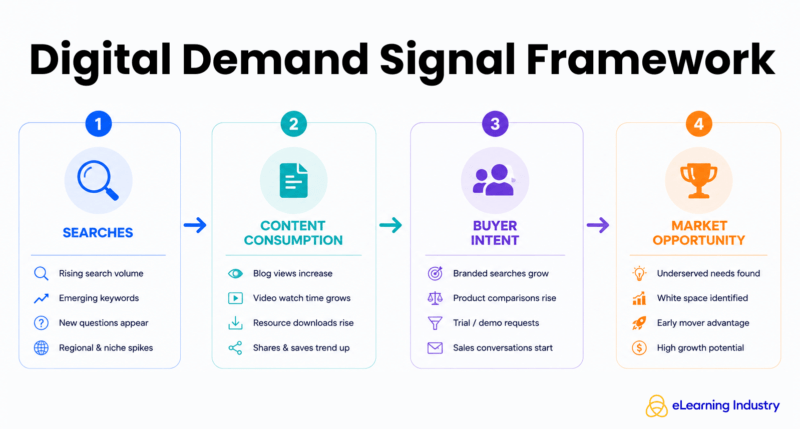
While many firms view analytics as a reporting mechanism for past performance, high-growth companies use it as a predictive resource. Customer behavior analytics can reveal unmet needs within an existing user base long before those users articulate their frustrations.
For instance, conversion path analysis often reveals that prospects are engaging with specific, non-promoted resources at a higher rate than flagship product pages. This behavior signals a shift in interest toward a specific problem-set that the company may not yet be fully addressing. Product analytics further enrich this view by showing how customers use software in unintended ways, often revealing entirely new use cases that can be turned into dedicated product lines or marketing segments.
Revenue analytics also play a critical role. By cross-referencing lifetime value (LTV) with specific acquisition channels and content types, organizations can determine which "digital footprints" lead to the most sustainable growth, allowing them to move resources away from high-volume but low-value activities.
SEO as a Strategic Intelligence Tool
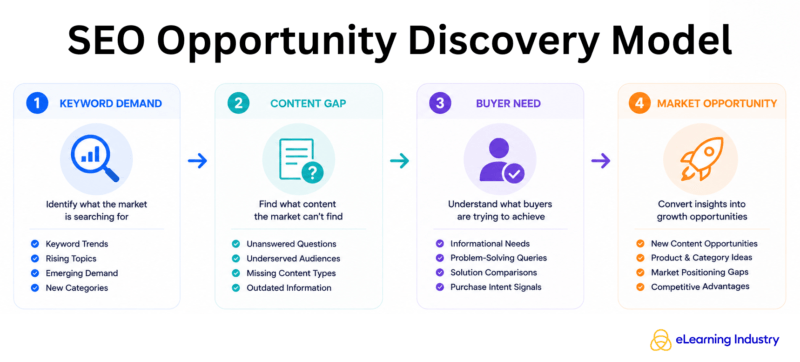
A common misconception in modern marketing is that SEO is purely a tactic for driving traffic. In reality, SEO data provides a real-time map of human curiosity and intent. Every search query is a recorded instance of a problem seeking a solution.
Keyword trend analysis allows businesses to observe the "velocity of demand." When search volumes for a niche term begin to grow at an exponential rate, it serves as an early warning system for a category shift. Competitive SEO analysis adds another layer, revealing where rivals are investing their resources and, more importantly, where they are failing to meet audience needs. By conducting a content gap analysis, a business can identify high-intent questions that remain unanswered by the current market leaders, providing a clear path for establishing authority.
The Rise of Generative Engine Optimization (GEO)
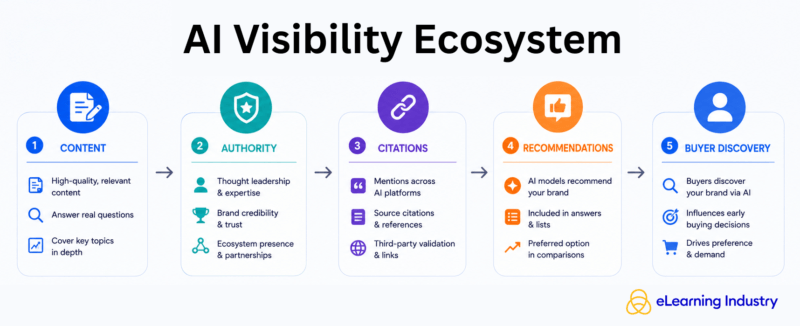
The most significant shift in the current landscape is the emergence of Generative Engine Optimization (GEO). As buyers increasingly bypass traditional search engines in favor of AI assistants, the mechanics of brand discovery are changing. AI platforms do not simply list links; they synthesize information to provide a definitive answer or a curated list of recommendations.
For a brand to remain visible in this ecosystem, it must understand how AI models perceive authority and trust. GEO involves optimizing content so that it is not only readable by humans and indexable by search engines but also "citational" for AI models. This means focusing on original research, expert-led insights, and high-quality citations from trusted industry publications.
Market analysts suggest that AI visibility is becoming a leading indicator of market share. If a vendor consistently appears in ChatGPT’s recommendations for "best enterprise CRM," that vendor is gaining a psychological and algorithmic advantage that traditional advertising cannot easily replicate.
The SIGNAL Framework: A Unified Growth Methodology
To operationalize these diverse data streams, strategic leaders are adopting the SIGNAL Framework, a structured approach to integrating behavioral data, search intelligence, and AI visibility:
- S – Search Demand: Monitoring the volume and velocity of queries to identify where the market is moving.
- I – Intent: Analyzing the "why" behind the data to distinguish between casual research and high-value purchase intent.
- G – Gaps: Identifying underserved customer needs where competitors have a weak digital presence.
- N – Narratives: Tracking the evolution of industry conversations across social media, forums, and AI platforms to anticipate the next "big idea."
- A – Authority: Measuring how often the brand’s expertise is cited by both human influencers and machine algorithms.
- L – Leverage: Translating these insights into rapid action, whether through product development, content creation, or strategic pivoting.
Real-World Implications and Case Studies
The efficacy of this data-driven approach is evidenced by recent shifts in the technology and service sectors.
In the learning and development (L&D) sector, several firms identified a massive spike in "AI literacy" and "AI skills gap" searches in late 2023. While traditional competitors continued to focus on generic leadership training, data-aware companies pivoted their entire content and product strategy toward AI adoption. By the time "AI readiness" became a standard corporate priority in 2024, these early movers had already established dominant SEO and AI visibility, capturing the lion’s share of the new market.
Similarly, in the HR tech space, smaller vendors have used GEO to challenge established incumbents. By producing highly authoritative, research-backed white papers that AI models frequently cite, these smaller players have gained a "Share of Voice" in AI recommendations that far exceeds their traditional brand awareness budgets.
New Metrics for the C-Suite
As the methodology of growth changes, so too must the metrics tracked by CEOs and CMOs. While traditional KPIs like Lead Conversion Rate and Customer Acquisition Cost (CAC) remain relevant, they are being supplemented by forward-looking indicators:
- AI Share of Voice: The frequency with which a brand is mentioned in AI-generated responses relative to its competitors.
- AI Citation Count: The number of times a brand’s original content is used as a reference source by LLMs.
- Demand Velocity: The rate of growth in search interest for specific strategic categories.
- Content Gap Coverage: A percentage-based metric measuring how many high-intent customer questions the brand has successfully addressed compared to the total market demand.
Broader Impact and Future Outlook
The future of business growth belongs to the "signal experts"—organizations that can synthesize human behavior and machine logic into a single strategic vision. The divide between "winners" and "losers" in the next decade will likely be defined by the speed at which a company can turn a digital signal into a market-ready solution.
As AI continues to reshape the internet, the concept of "visibility" will expand beyond the first page of Google. It will encompass the totality of a brand’s digital reputation as perceived by both people and the algorithms that advise them. For leaders, the mandate is clear: move beyond the dashboard of what happened yesterday and start building the intelligence systems that reveal what will happen tomorrow. Data-driven growth is no longer a competitive advantage; it is the baseline for survival in a digital-first economy.