
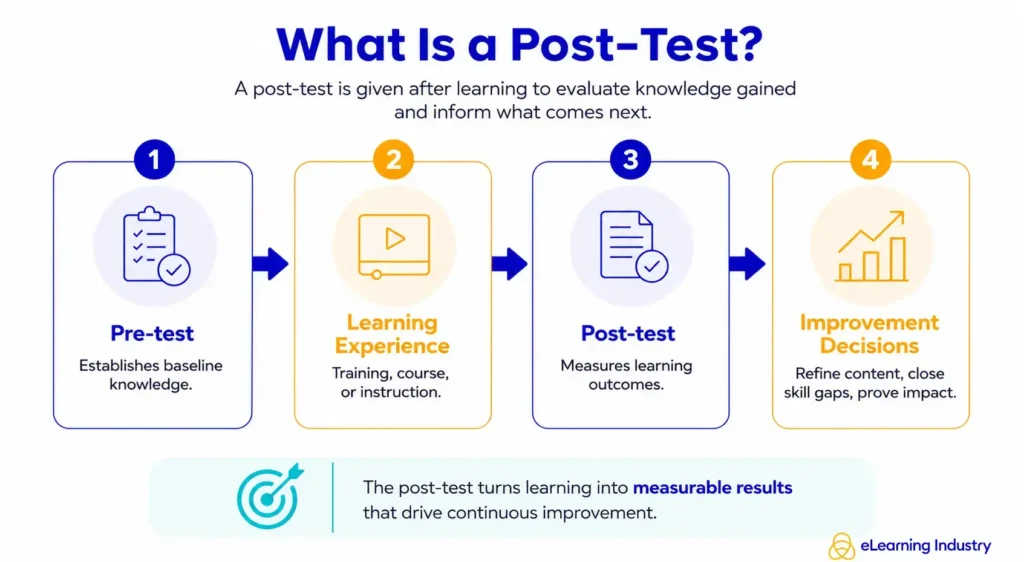
In an era where corporate budgets are under increasing scrutiny, Learning and Development (L&D) departments are undergoing a fundamental shift from measuring "vanity metrics"—such as course completion rates and "seat time"—to proving tangible behavioral change and knowledge retention. At the heart of this transformation is the post-test, a critical assessment tool that has evolved from a simple end-of-chapter quiz into a sophisticated data point used to validate training investments and ensure workforce competency. As organizations grapple with rapid technological shifts and the need for constant upskilling, the ability to measure the "delta" or the actual growth in knowledge between the start and finish of a program has become a non-negotiable requirement for leadership teams worldwide.
The Definitive Role of Post-Testing in Modern Industry
A post-test is defined as a formal assessment administered following a period of instruction to quantify the extent to which a learner has acquired specific knowledge, skills, or competencies. While its basic function is to determine if learning objectives were met, its strategic value is far broader. In a professional context, post-tests serve as a bridge between theoretical instruction and practical application, acting as a gatekeeper for certification and a safety net for compliance.
For many organizations, the post-test is the primary evidence required to satisfy regulatory bodies. In high-stakes industries such as healthcare, aviation, and finance, a post-test is not merely an educational milestone but a legal safeguard. It provides documented proof that an employee understands critical safety protocols or ethical guidelines, thereby mitigating institutional risk. Beyond compliance, these assessments offer a feedback loop for instructional designers, highlighting areas where training materials may be confusing, outdated, or ineffective.
The Strategic Synergy of Pre-Tests and Post-Tests
While a post-test measures the final outcome, its true value is unlocked when paired with a pre-test—an assessment given before instruction begins to establish a baseline of existing knowledge. This "sandwich" approach to assessment allows L&D leaders to move beyond static scores and instead focus on "learning gain."
Distinguishing the Two Pillars of Assessment
To understand the full scope of a dual-testing strategy, one must examine the functional differences between the two:
- Pre-Test (The Baseline): Conducted prior to instruction, it identifies what the learner already knows. This data is used to customize learning paths, allowing advanced learners to bypass redundant material while ensuring novices receive foundational support.
- Post-Test (The Validation): Conducted after instruction, it measures the mastery of the curriculum. It determines the effectiveness of the teaching intervention and confirms that the learner is ready for real-world application.
By comparing the results of these two tests, organizations can calculate a "knowledge lift" percentage. For instance, if a cohort averages 40% on a pre-test and 85% on a post-test, the organization can definitively claim a 45% increase in competency, providing a clear narrative for stakeholders regarding the program’s impact.
Chronology of Assessment: From Classrooms to Cloud-Based Analytics
The history of educational assessment has seen a significant transition over the last five decades. In the 1970s and 80s, workplace training was largely synchronous and classroom-based, with assessments often being informal or non-existent. The introduction of the Kirkpatrick Model of Evaluation provided a framework for this evolution, specifically Level 2 (Learning), which emphasizes the measurement of increased knowledge or capability.
With the advent of the internet in the 1990s and the subsequent rise of Learning Management Systems (LMS) in the 2000s, assessments became digitized. This shift allowed for the collection of massive datasets, moving testing from a "pass/fail" event to a diagnostic tool. Today, the integration of Artificial Intelligence (AI) and machine learning allows post-tests to be adaptive, changing the difficulty of questions in real-time based on the learner’s previous answers, thereby providing a more accurate reflection of their true "ceiling" of knowledge.
Data-Driven Insights: The ROI of Proving Learning
Recent industry data underscores the necessity of robust testing. According to various L&D benchmarks, organizations that utilize both pre- and post-testing see a 25% higher rate of knowledge retention compared to those that rely on post-tests alone. This is attributed to the "testing effect," a psychological phenomenon where the act of taking a pre-test primes the brain to recognize and retain key information during the subsequent training.
Furthermore, a study of Fortune 500 companies revealed that departments utilizing rigorous post-training assessments reported a 14% higher efficiency in onboarding new hires. By identifying "knowledge gaps" immediately through post-test data, managers can provide targeted coaching rather than broad, unnecessary retraining, saving thousands of man-hours annually.

Industry Perspectives and Leadership Reactions
The shift toward evidence-based learning has garnered significant support from industry veterans. Christopher Pappas, CEO and founder of eLearning Industry, emphasizes that the competitive advantage of modern firms lies not in the volume of training they provide, but in their ability to prove that training results in performance changes. "Organizations don’t gain a competitive advantage by delivering more training, but by proving that learning changes performance," Pappas noted. "Post-tests provide the evidence leaders need to invest with confidence."
This sentiment is echoed by Chief Learning Officers (CLOs) across the tech sector, who increasingly view L&D as a data science rather than a human resources function. The prevailing reaction among corporate leaders is one of cautious optimism; while the cost of developing high-quality assessments is higher, the resulting data provides a "shield" during budget cuts, as L&D can point to specific, measured improvements in workforce capability.
Best Practices in Designing High-Impact Post-Tests
Creating an effective post-test requires more than just a list of multiple-choice questions. It demands a scientific approach to "item design" and a deep understanding of the desired business outcomes.
1. Alignment with Behavioral Objectives
A successful post-test must be mapped directly to the learning objectives established at the beginning of the course. If the goal of a module is to reduce errors in a manufacturing process, the post-test should include simulations or "find the error" scenarios rather than simple vocabulary checks.
2. Prioritizing Application Over Memorization
In the modern workplace, information is always available via a quick search. Therefore, testing for rote memorization is increasingly obsolete. Effective post-tests focus on situational judgment and the application of knowledge. Scenario-based questions—where a learner must choose the best course of action in a hypothetical workplace conflict—provide far better insight into real-world readiness than fact-based questions.
3. Psychometric Integrity
Organizations are increasingly hiring psychometricians to ensure their tests are "valid" (measuring what they claim to measure) and "reliable" (producing consistent results). This includes analyzing the "distractors" (the incorrect options in a multiple-choice question) to ensure they are plausible, which forces the learner to truly understand the material to find the correct answer.
4. Utilizing Analytics for Continuous Improvement
The data gathered from a post-test should be used to "train the trainer." If 80% of learners fail a specific question regarding a new software feature, the fault likely lies with the training material, not the learners. Modern LMS platforms provide "item analysis" reports that allow instructional designers to pinpoint these weaknesses and iterate on the content immediately.
Broader Implications: The Shift Toward the Skills-Based Organization
The rise of rigorous post-testing is a symptom of a much larger trend: the transition toward the "skills-based organization." In this model, job titles are becoming less important than verified skills. A post-test serves as a "micro-credential," a digital proof-of-competency that can follow an employee throughout their career.
As AI continues to automate routine tasks, the "human" skills—critical thinking, ethical decision-making, and complex problem-solving—become the most valuable assets an employee can possess. Post-tests that can accurately measure these nuanced abilities will become the primary currency of the labor market.
Conclusion: Assessments as a Strategic Asset
Post-tests are no longer an afterthought or a mere formality at the end of a slide deck; they are a sophisticated tool for organizational health. By providing clear evidence of learning, they allow companies to invest in their people with the same level of data-driven confidence they apply to capital expenditures or R&D. When integrated into a comprehensive strategy that includes pre-testing and long-term retention checks, post-tests transform L&D from a cost center into a powerful engine for measurable growth. As the global economy becomes increasingly knowledge-based, the organizations that master the art of measuring what their employees know will be the ones best positioned to lead.






