
The modern HR technology stack, a seemingly robust collection of engagement surveys, performance review platforms, recognition tools, development planning systems, and an overarching HRIS, often presents a picture of comprehensive coverage. Each component functions adequately in isolation, fulfilling its designated purpose. However, a critical vulnerability emerges in the silent gaps between these systems, leading to a pervasive issue known as disconnected people data. This fragmentation prevents the seamless flow of vital information, obscuring crucial trends and hindering proactive decision-making. The consequences are significant, impacting everything from managerial effectiveness and talent retention to overall organizational productivity and financial health.
This pervasive challenge, often dismissed as a mere IT inconvenience, directly influences an HR leader’s ability to provide strategic counsel to their CHRO, to identify potential flight risks with sufficient lead time, and to dedicate valuable hours to data synthesis rather than actionable strategy. The good news is that addressing this requires not an influx of more data, nor a wholesale replacement of existing tools, but rather a strategic focus on enabling these disparate systems to communicate and share insights effectively. Understanding the silent drain of disconnected data and the transformative power of its integration is paramount for organizations aiming to optimize their human capital.
Understanding the Disconnected People Data Landscape
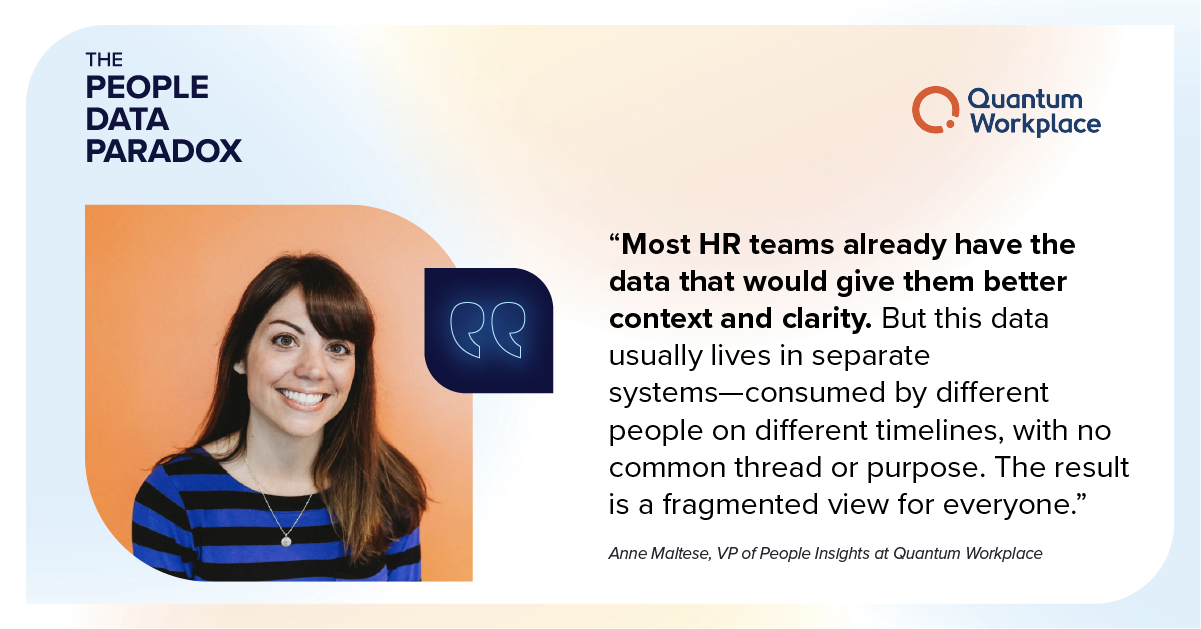
Disconnected people data arises when essential HR functions, such as engagement surveys, performance reviews, recognition activities, development plans, and core HRIS records, reside in separate, siloed platforms. These systems, often implemented independently and from various vendors, were not inherently designed for interoperability. Consequently, each platform captures a fragment of the employee experience and organizational dynamics, but no single system offers a holistic view. This results in scattered snapshots of employee sentiment and performance, placing the onus on HR professionals to manually stitch together these disparate pieces of information into a coherent narrative that can inform actionable strategies.
The proliferation of specialized HR technology solutions, while offering best-in-class functionality for individual tasks, has inadvertently exacerbated this problem. Research from Quantum Workplace indicates that HR leaders typically utilize between two and four distinct HR solutions from different providers. Despite this investment in technology, a striking 39% of these leaders report that their systems are not meaningfully integrated. This disconnect leads to a continuous accumulation of data without a corresponding increase in clarity or actionable intelligence.
The Substantial Financial Toll of Fragmented People Data
The ramifications of disconnected people data extend far beyond operational inefficiencies, translating into substantial financial losses for organizations. These costs manifest as lost productivity due to disengaged employees, avoidable turnover driven by unaddressed concerns, and missed opportunities to nurture and retain top talent. A mid-sized company with 2,500 employees can incur nearly $4 million annually in losses stemming from inadequately equipped managers and the departure of high-performing individuals, according to analysis linking disengagement to financial impact.
The familiar frustration of compiling reports from multiple systems to answer a single executive question underscores this challenge. While the necessary answers are embedded within the data, accessing them cleanly, rapidly, and with the confidence required for decisive action remains an elusive goal. This gap is not a reflection of individual HR capabilities or a simple technological glitch; rather, it is a systemic issue born from the fragmented nature of the data itself.
This fragmentation manifests most acutely in three critical areas:

The Cost of Underequipped Managers
Managers serve as the primary conduit for employee engagement and performance within an organization. Their effectiveness directly influences the productivity and well-being of their teams. When managers struggle, these challenges invariably cascade throughout their departments. The root of this struggle often lies not in a lack of inherent talent, but in the absence of the necessary tools and support for them to succeed. The average manager now juggles approximately 51% more responsibilities than is realistically manageable, with a significant portion (39%) having never received formal leadership training.
The business impact of this managerial deficit is profound. Studies reveal that managers in the top decile of leadership effectiveness generate double the net revenue of their counterparts. This considerable disparity between high- and low-performing managers represents not merely a developmental oversight but a tangible performance impediment silently impacting organizational output. Without integrated data that provides managers with timely insights into their team’s engagement, performance trends, and development needs, their ability to proactively address issues and foster a thriving environment is severely compromised.
The Cost of Overlooking High-Potential Talent
High-performing employees are not just valuable contributors; they are disproportionately so, generating between 400% and 800% more output than their average colleagues. Despite this critical importance, a concerning 57% of organizations lack a formal, systematic process for identifying these individuals. In the absence of connected data, talent identification often relies on subjective factors such as visibility and advocacy, leading to a scenario where the employees generating the most significant impact are not always recognized or prioritized. This oversight means that each quarter of unrecognized, outsized contribution represents a lost opportunity for the organization to fully leverage its most impactful talent.
Disconnected data systems fail to link an employee’s consistent high performance with their engagement levels, their proactive development efforts, or their contributions beyond formal metrics. This prevents a holistic view that could identify individuals who are not only performing well but are also demonstrating a strong commitment and a desire for growth, thereby signaling their high-potential status.
The Cost of Missing Retention Risk Signals
By the time a high-performing employee submits their resignation, the decision to leave has often been in motion for months. The subtle warning signs—a decline in survey sentiment, a cessation of development conversations, or a reduction in recognition—are typically present. Individually, these signals may not trigger an alarm. However, when viewed in conjunction, they paint a clear and urgent picture of potential attrition.
The financial burden of replacing an employee is substantial, ranging from 50% to 200% of their annual salary. Moreover, research indicates that a significant proportion of departing employees believe their exit could have been prevented. These critical retention risk signals are already embedded within an organization’s data, but their fragmentation across siloed systems renders them invisible. Without the ability to correlate dips in engagement with decreased performance feedback or a lack of development opportunities, HR teams are often blindsided by resignations that could have been averted with proactive intervention.
The Cumulative Impact of Fragmented Data
To illustrate the financial impact, consider an organization with 2,500 employees and 250 managers. If 50 of those managers are identified as underequipped, and as a result, 10% of their direct reports experience disengagement, the estimated annual loss in productivity can approach $1.7 million.
Adding the dimension of retention risk, if 10 high performers depart due to a lack of recognition or development, and their replacement costs are double their salaries, this incurs an additional $2 million in expenses. In total, this scenario reveals nearly $4 million in potential losses directly attributable to disconnected data. This calculation does not even encompass the broader organizational inefficiencies that arise when teams lack the optimal conditions to thrive, such as misdirected effort, slow skill development, and unrecognized potential.
The Transformative Power of Connected Data
Historically, bridging the gaps between fragmented systems and deriving actionable insights has been a resource-intensive and time-consuming endeavor. However, advancements in technology, particularly in the realm of artificial intelligence (AI), are revolutionizing this landscape. AI can now continuously analyze data across engagement, performance, development, and recognition platforms, cross-referencing it against benchmarks and surfacing patterns that were previously imperceptible.
This paradigm shift is not about collecting more data; it is about finally unlocking the inherent intelligence within the data that organizations already possess. When these interconnected signals are brought together, HR departments and executive leadership can begin to address some of their most pressing questions with newfound clarity and confidence.
The ability to connect disparate data points allows for proactive identification of at-risk employees before they consider leaving. It empowers managers with real-time insights into their team’s engagement and performance, enabling them to provide targeted support and development. Furthermore, it facilitates the systematic identification of high-potential employees based on a comprehensive view of their contributions and growth trajectory, rather than relying on anecdotal evidence. This integrated approach fosters a more engaged, productive, and stable workforce, ultimately driving significant improvements in organizational performance and financial outcomes.
From Fragmented Insights to Unified Talent Intelligence
The true value of a comprehensive view of people data lies in its ability to inform and shape subsequent actions. Quantum Workplace, a leader in this domain, addresses the challenge of fragmented systems by integrating engagement, performance, development, and recognition data into a unified platform. This consolidation empowers leaders to move beyond piecing together disparate information and instead gain a clear, actionable understanding of their teams’ dynamics.
AI-driven insights are deployed to reveal hidden patterns within the data. Crucially, each insight is accompanied by clear, prioritized next steps, contextualized by the organization’s specific goals and benchmarks, and delivered directly to leaders within their daily workflows. This approach ensures that data-informed decision-making becomes an integral part of operational management.
By transforming fragmented data into connected talent intelligence, HR teams can:
- Proactively identify and mitigate flight risks: By correlating declines in engagement with performance trends and recognition patterns, organizations can intervene before valuable employees consider leaving.
- Empower managers with actionable insights: Providing managers with a holistic view of their team’s engagement, performance, and development needs allows for more effective coaching and support.
- Systematically identify and nurture high-potential talent: Connected data enables the recognition of employees who consistently exceed expectations, demonstrate growth potential, and are engaged with their work and development.
- Improve overall employee engagement and productivity: By understanding the root causes of disengagement and addressing them proactively, organizations can foster a more motivated and productive workforce.
- Enhance strategic workforce planning: Integrated data provides a clearer picture of talent strengths, development gaps, and future needs, enabling more effective long-term planning.
The shift from disconnected data silos to a unified intelligence platform represents a fundamental evolution in how organizations manage their most critical asset: their people. It moves HR from a reactive, reporting function to a proactive, strategic partner, capable of driving significant business value through data-informed talent management.