Disruption has become the defining characteristic of the modern workplace, creating an environment that relentlessly depletes the very energy leaders need to foster growth within themselves, their teams, and their organizations. As artificial intelligence continues to reshape how we work, it is crucial to remember that human leaders remain the primary architects of organizational success. These leaders, often weighed down by a cascade of compounding challenges, possess a unique and powerful human superpower: psychological capital, or PsyCap. This intrinsic psychological fuel quietly powers organizations, enabling them to not only survive but thrive, even in the face of unprecedented change.
PsyCap, a concept increasingly recognized for its critical role in leadership effectiveness, is defined as an individual’s positive psychological state, underpinned by four core elements: efficacy, hope, resilience, and optimism. Efficacy, often referred to as self-efficacy, is the belief in one’s own ability to mobilize the motivation, cognitive resources, and courses of action necessary to meet situational demands. Hope involves a goal-directed thinking process that includes both the will (agency) and the way (pathways) to achieve desired outcomes. Resilience is the capacity to rebound or bounce back from adversity, uncertainty, conflict, failure, or even positive but stressful change. Finally, optimism is the positive attribution of positive events to internal, stable, and global causes, while attributing negative events to external, temporary, and specific causes.
These components work in concert to form a robust psychological foundation. Research consistently demonstrates that employees with higher levels of PsyCap exhibit greater commitment to their work, achieve superior performance, experience enhanced well-being, and are significantly less susceptible to burnout. For leaders, this translates into an invaluable asset, empowering them to achieve all that is humanly possible, even when navigating the most turbulent professional landscapes. PsyCap functions as the essential fuel for the organizational machine, sustaining the leaders who maintain its operational integrity and preventing systemic breakdown.
The Indispensable Role of Psychological Capital in Leadership
In an era defined by constant flux, leaders with robust PsyCap demonstrate a heightened capacity for authentic leadership behaviors. This includes a strong sense of self-awareness, relational transparency, and a clear moral perspective, all of which are directly linked to fostering higher levels of trust within their teams and driving improved performance outcomes. Leadership itself, broadly defined as a dynamic social process, fundamentally relies on human energy, sustained motivation, and a deep well of psychological capacity. Maintaining this capacity, particularly amidst growing complexity, requires more than just technical skills; it demands a profound inner fortitude.
Leaders require mental resources to not only persevere through challenges but also to adapt to evolving circumstances and ultimately, to thrive. This is precisely where psychological capital emerges as a critical differentiator. Decades of research into PsyCap have yielded compelling findings, indicating that it is a potent predictor of key organizational success metrics, including performance, employee engagement, and retention. PsyCap effectively encapsulates the uniquely human strengths that equip leaders to successfully navigate disruption and propel their organizations forward.
Crucially, PsyCap is not an immutable trait. It is a developable resource. Through intentional experiences, targeted coaching, and robust organizational support, leaders can actively cultivate and sustain their psychological capital over time. This development of PsyCap plays a pivotal role in driving long-term organizational outcomes and serves as a powerful indicator of the return on investment derived from leadership development initiatives.
Evidence-Based Growth: Leadership Development and PsyCap
Empirical evidence underscores the transformative impact of leadership development on psychological capital. Research conducted with participants in specialized leadership programs, such as the Center for Creative Leadership’s flagship Leadership Development Program (LDP)®, reveals that PsyCap is not merely a passive byproduct of development but a core mechanism through which development yields its effectiveness. Leaders who exhibit elevated levels of hope and optimism following program completion consistently report stronger goal attainment and enhanced team engagement. This suggests that a primary objective of effective leadership development should be the explicit cultivation of leaders’ psychological capital.

A consistent pattern observed across various leadership development interventions is that when leaders are provided with opportunities to step back, engage in introspection, receive candid feedback, and experiment with new approaches, they not only acquire new skills but also significantly bolster their inner resilience – the crucial "fuel" needed to effectively apply those skills when faced with adversity. In essence, their PsyCap grows.
The impact of such programs on PsyCap can be quantitatively measured. In a typical cohort undergoing intensive leadership development, the percentage of leaders reporting "high PsyCap" has been observed to surge dramatically, often rising from approximately 36% prior to the program to an impressive 79% upon its conclusion. This substantial increase highlights the tangible benefits of structured development in fortifying leaders’ psychological resources.
The question then arises: what specific elements within a development experience contribute to this enhancement of psychological capital? Deeper analysis reveals that the improvement is not always immediate. Data collected during intensive programs, for instance, has shown that PsyCap can experience a temporary dip in the middle of the program. This often occurs when leaders receive challenging feedback, perhaps through 360-degree assessments, which can heighten self-awareness but also momentarily destabilize confidence or optimism. However, this dip is typically followed by a rebound, with PsyCap growing beyond its initial levels as leaders acquire new skills and strategies to address their identified challenges. This temporary fluctuation underscores the reality that genuine growth often involves confronting difficult truths before emerging stronger.
The Catalytic Power of Coaching in Building PsyCap
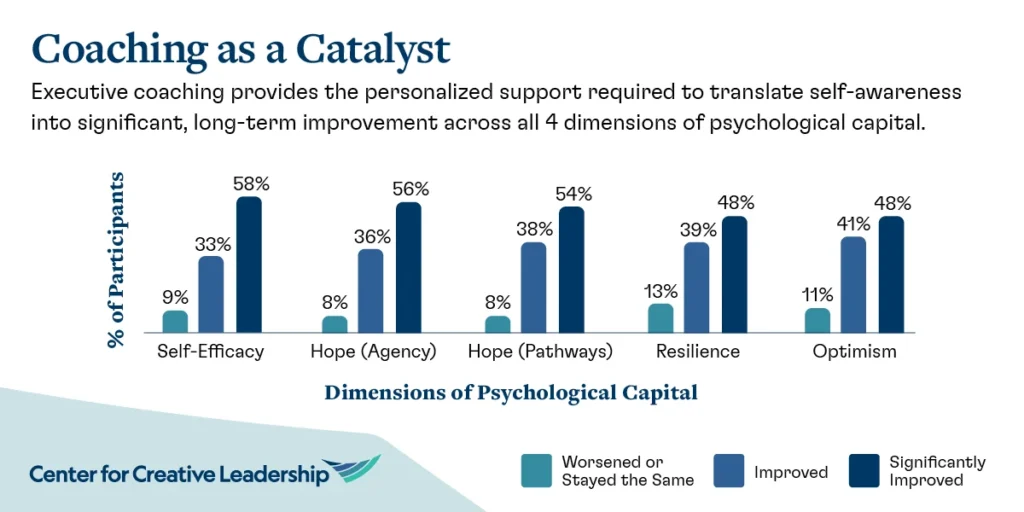
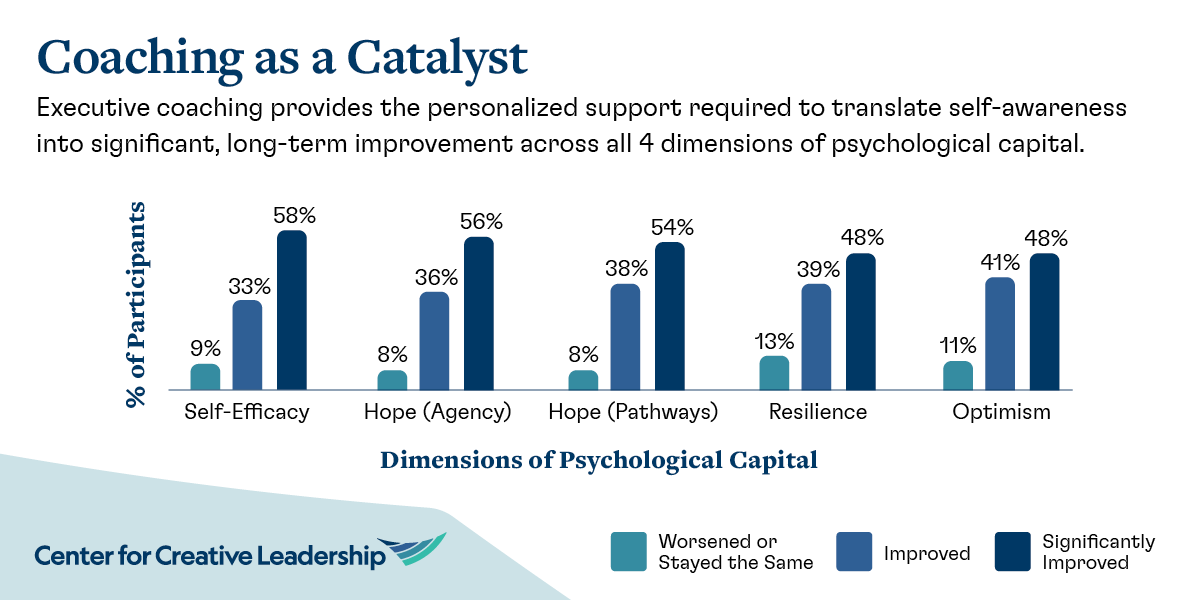
Coaching emerges as a particularly effective modality for providing leaders with the intentional support necessary to build and sustain their psychological capital. Evaluations of executive coaching services have demonstrated that this personalized approach enables leaders to effectively address their challenges, even beyond formal program completion, and to engage in goal-achieving behaviors that directly contribute to a positive trajectory in their PsyCap.
Even highly seasoned leaders participating in executive coaching often report significant improvements in their psychological capital. This aligns with the fundamental purpose of coaching: to move beyond skill-building and foster the self-awareness and internal work essential for more impactful leadership, while simultaneously replenishing the energy reserves of leaders who consistently apply these developed behaviors.
An infographic illustrating "Coaching as a Catalyst for Psychological Capital" visually represents how this process works, often involving a journey of self-discovery and skill integration. The data suggests that coaching facilitates a deeper internalization of learning, leading to a more robust and sustainable increase in confidence, hope, resilience, and optimism.
The Value of Scalable Interventions: Bite-Sized Learning for PsyCap
The cultivation of psychological capital is not exclusively dependent on lengthy, immersive in-person leadership development programs. Encouraging evidence indicates that it can also be effectively strengthened through shorter, more targeted online leadership training experiences, particularly when the learning is directly linked to a real-world work challenge.
A pilot study of a self-paced online course designed to build leaders’ PsyCap yielded statistically significant increases in psychological capital. Participants reported an average increase of just under one point on a 1-to-5 scale (specifically, +0.74), with an impressive 86% of leaders indicating an overall improvement in their psychological capital after completing the course. A key advantage of this format is its focus on the leader’s primary professional challenge, ensuring that personalized reflections and practice opportunities remain anchored in tangible, real-world situations. This makes the learning immediately applicable and highly relevant.
Neurodiverse Leaders and PsyCap: A Nuanced Perspective
A growing body of evidence highlights the significant benefits that organizations derive from neurodiverse leadership teams and workforces. However, research has also indicated that, when compared to their neurotypical counterparts, leaders who identify as neurodivergent (such as those with Attention Deficit Hyperactivity Disorder or autism) tend to report lower overall levels of psychological capital.
These findings do not, however, suggest a deficit in leadership potential. Instead, they underscore the reality that leaders bring diverse strengths and needs related to their psychological resources into their roles. For organizations, this reinforces the critical importance of creating supportive psychological conditions that enable all leaders, regardless of their neurotype, to sustain their impact and thrive. An infographic illustrating "PsyCap Among Neurodiverse Leaders" visually depicts these differences, emphasizing the need for tailored support.
Navigating Disruption: PsyCap as the Essential Navigator
Ultimately, leadership development initiatives must extend beyond mere skill acquisition in an environment of persistent disruption. They must actively provide the psychological fuel that leaders require to maintain their effectiveness in ambiguous, demanding, and rapidly evolving contexts. Psychological capital serves as this vital fuel, and empirical data confirms that it is demonstrably strengthened through effective leadership development.
Across various program formats, including immersive development programs, coaching engagements, and digital learning experiences, PsyCap grows when leaders benefit from an optimal blend of enhanced self-awareness, meaningful challenges, and supportive conditions that empower them to translate insights into concrete actions. This growth journey is not always linear; it frequently involves a temporary setback as leaders grapple with and internalize difficult feedback. However, with the appropriate support structures in place, this dip can serve as a pivotal turning point, enabling leaders to regain agency, clarity, and the confidence to adopt new and more effective ways of operating.
This phenomenon is not solely an individual one. While leadership sets the organizational tone, it is the pervasive organizational culture that channels and amplifies this psychological energy. When organizations cultivate cultures that actively support PsyCap – by normalizing feedback, celebrating progress, and championing recovery as much as performance – the impact is magnified. High-performing organizations foster environments where hope, self-efficacy, resilience, and realistic optimism gain momentum, radiating from leaders to their teams and throughout the wider organization.
However, it is crucial to recognize that developing psychological capital is not a panacea that enables individuals to endure unhealthy workloads or toxic cultures. Rather, leadership resilience and optimism reach their full potential when they are complemented by systemic support, robust psychological safety at work, and thoughtfully established boundaries. The ultimate aim is not to forge leaders who can passively endure adversity, but to cultivate the profound inner resources that empower leaders to confront difficult realities, devise innovative solutions, and inspire a future that benefits all stakeholders.
Charting the Path Forward: Investing in Leader PsyCap
The imperative to develop leaders’ psychological capital in today’s dynamic business environment is clear. Organizations that proactively invest in growing this essential inner resource will be better positioned to navigate disruption, foster innovation, and achieve sustained success. The commitment to exploring and enhancing the human element of leadership is paramount. Taking the next step in building this capacity, both within oneself and across the broader leadership spectrum of an organization, is a strategic imperative. Programs like the Leadership Development Program (LDP)® and executive coaching services are specifically designed to cultivate the psychological capital and inner resources that leaders need to perform at their peak, even when faced with the most formidable challenges.