Hybrid work has firmly established itself not as a fleeting trend, but as a fundamental operational model for a significant portion of today’s organizations. This paradigm offers a compelling duality, granting employees the autonomy and flexibility associated with remote work while preserving the invaluable in-person connection and collaborative synergy that fosters innovation and strong team dynamics. The notion that businesses must choose between the comfort of casual attire and the rigor of strategic planning sessions is rapidly becoming obsolete, as hybrid models demonstrate the feasibility of integrating both.
At its core, the hybrid work model is characterized by employees dividing their professional time between on-site and remote locations. This approach acknowledges a crucial reality: not all tasks, nor all individuals, perform optimally under identical conditions. Certain projects benefit immensely from direct, face-to-face interaction, while others can be executed with greater efficiency and focus in the more personalized environment of a home office. By accommodating these diverse needs, organizations can cultivate a supportive ecosystem that respects employee preferences while simultaneously safeguarding productivity and reinforcing a robust organizational culture. This article delves into the multifaceted nature of hybrid work, exploring its enduring appeal, the strategies employed by organizations to optimize its implementation, and the critical benchmarks for success, particularly within the mid-market sector. Ultimately, when employees feel genuinely supported in their chosen work environments, they exhibit heightened engagement, motivation, and a greater capacity to drive impactful results – a universally beneficial outcome for any workplace.
Hybrid Work Engagement Benchmarks for Mid-Market Firms
For leaders steering mid-market organizations, a primary challenge in the hybrid work landscape lies in accurately assessing the efficacy of the employee experience. While each company possesses unique characteristics, established engagement benchmarks offer valuable insights for HR leaders seeking to measure success.
According to research by the Achievers Workforce Institute (AWI), a mere 26% of employees globally report being engaged in their work. This statistic underscores a substantial opportunity for organizations to proactively strengthen interpersonal connections, refine communication channels, and cultivate a more cohesive culture within their hybrid frameworks.
For hybrid teams, fostering robust connection emerges as a paramount indicator of engagement. AWI’s findings reveal that employees within highly connected organizations are demonstrably more likely to experience positive outcomes. While specific quantitative data was omitted from the provided text, the implication is that enhanced connection directly correlates with improved performance and retention. These benchmarks hold particular significance for mid-market companies, where rapid growth can sometimes outpace deliberate efforts in culture-building. When workforces are distributed, the potential for communication breakdowns, feelings of isolation, and inconsistent employee experiences escalates.
Another critical metric is appreciation. Evidence consistently shows that employees who feel genuinely appreciated are significantly more likely to perceive their work as meaningful and express a strong commitment to a long-term career with their employer. The statistics cited – 12 times more likely to find work meaningful and 17 times more likely to envision a long-term career – are compelling indicators of a healthy and sustainable hybrid work culture.
What Good Hybrid Engagement Looks Like
In the context of mid-market organizations, high levels of hybrid engagement are typically characterized by employees who:
- Feel a strong sense of belonging, regardless of their physical location.
- Experience recognition for their contributions, both formally and informally.
- Maintain open and effective communication with their colleagues and leaders.
- Demonstrate high levels of productivity and commitment to their roles.
The most successful hybrid workplaces prioritize outcomes over mere physical presence. They measure engagement not by office attendance, but by tangible indicators such as connection, belonging, recognition, and overall performance. Consistent and meaningful recognition plays a pivotal role in reinforcing these four pillars, thereby fostering an environment where employees feel acknowledged, valued, and intrinsically motivated, irrespective of where they are working.
The Enduring Popularity of Hybrid Work
Hybrid work is not a transient phenomenon; it represents a thoughtful evolution in how work is organized, effectively answering the question of whether operations can be conducted more intelligently. The benefits are multifaceted: employees gain a more favorable work-life balance, organizations achieve enhanced business outcomes, and the need for artificial justifications for remote work days diminishes. The reasons for hybrid work’s sustained popularity and increasing adoption are compelling:
- Enhanced Employee Well-being: The flexibility offered by hybrid models significantly contributes to improved work-life balance, reduced stress, and greater overall employee satisfaction. This, in turn, can lead to reduced burnout and increased retention.
- Access to a Wider Talent Pool: By removing geographical constraints, organizations can recruit top talent from virtually anywhere, leading to a more diverse and skilled workforce.
- Increased Productivity and Focus: Employees can leverage the benefits of both environments – focused work at home and collaborative sessions in the office – potentially leading to higher output.
- Cost Savings: Organizations may realize cost reductions in real estate and office overhead, while employees can save on commuting expenses.
- Improved Employee Engagement and Retention: When employees feel trusted and empowered to manage their work arrangements, their loyalty and commitment to the organization often increase.
Hybrid Work vs. Remote Work: Clarifying the Distinction
While often used interchangeably, hybrid and remote work are distinct operational models. Understanding these differences is crucial for effective implementation.
Remote Work: In a purely remote model, employees work exclusively from a location outside of a traditional office environment, typically their homes. Communication and collaboration rely entirely on digital tools and platforms.
Hybrid Work: This model integrates elements of both on-site and remote work. Employees divide their time between working from home and working from a designated company office. The specific ratio and structure can vary widely depending on the organization’s needs and policies.
Both models necessitate the use of digital tools to facilitate seamless communication and collaboration. However, hybrid work retains the physical office as a vital space for in-person interactions, brainstorming sessions, team building, and providing a change of environment from the home office. It is not an either/or scenario but rather a strategic blend designed to offer employees flexibility while ensuring teams remain cohesive and connected.
Exploring the Diverse Landscape of Hybrid Work Models
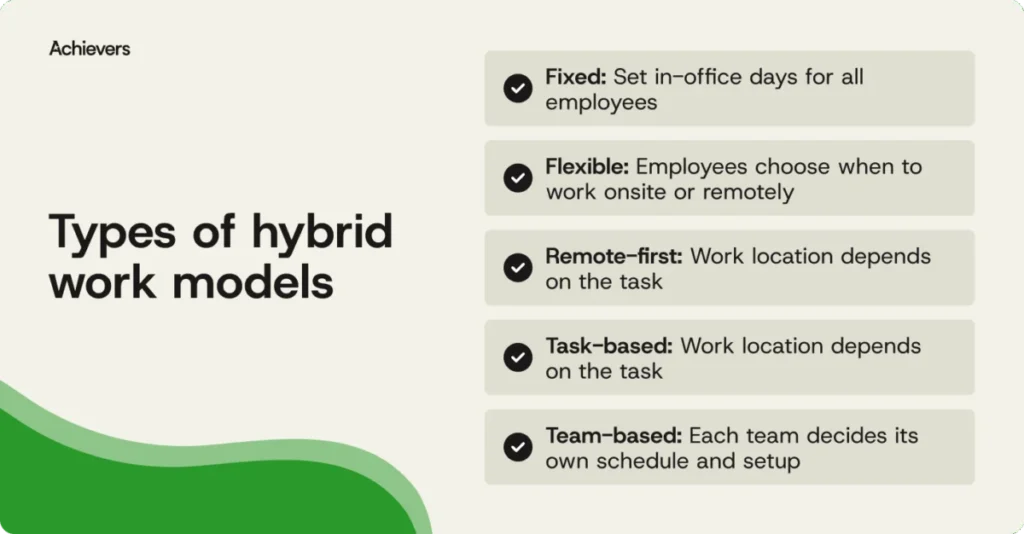
The effectiveness of hybrid work hinges on its adaptability, as a one-size-fits-all approach rarely succeeds. Recognizing that both organizations and individuals have unique requirements, there is no singular "correct" method for implementing hybrid work. The key lies in identifying a model that effectively balances flexibility, structure, and optimal employee productivity. The following outlines the most prevalent hybrid work setups:
Fixed Hybrid Model
This model incorporates a predetermined schedule, where employees allocate specific days or weeks to working from the office and other periods to remote work. Its predictable and structured nature allows teams to anticipate when and where colleagues will be present, fostering stability. However, it may offer less flexibility for individuals requiring more spontaneous adjustments to their work arrangements.

Flexible Hybrid Model
In this iteration, employees have greater autonomy to choose their work location and schedule, operating within pre-defined organizational guidelines. This model is highly favored for its contribution to work-life balance. However, it can present challenges for businesses that rely on synchronized team availability. Clear expectations and robust calendar management tools are essential for its successful implementation.
Remote-First Model
This model prioritizes remote work as the default arrangement, with the physical office serving as a venue for occasional team gatherings, project sprints, or collaborative workshops. It is particularly well-suited for organizations with geographically dispersed teams or those committed to maximizing flexibility. Effective digital communication and recognition platforms are indispensable, ensuring that company culture remains vibrant even when physical proximity is limited.
Task-Based Hybrid Model
This practical approach allows employees to select their work environment based on the nature of their current tasks. For instance, deep focus work might be best suited for a home environment, while a large group brainstorming session could necessitate an in-office setting. This model emphasizes matching the work environment to the task at hand, optimizing both the quality and efficiency of work.
Team-Based Hybrid Model
In this model, individual teams are empowered to determine their optimal hybrid work structure. Team managers are responsible for defining the appropriate blend of in-office and remote time, tailored to the specific needs and workflows of their group. This approach fosters flexibility and adaptability, trusting teams to self-organize and identify the most effective working arrangements for their unique dynamics.
Navigating the Challenges of Hybrid Work
While hybrid work offers numerous advantages, including enhanced flexibility, engagement, and employee satisfaction, it is not without its inherent complexities. Without proactive management, the very flexibility that defines hybrid work can devolve into frustration. Fortunately, with careful planning and the right technological support, common pitfalls can be effectively avoided. Key challenges to anticipate and address include:
- Maintaining Equity and Inclusion: Ensuring that remote employees are not at a disadvantage compared to their in-office counterparts in terms of visibility, opportunities, and career progression. This requires conscious effort in communication, meeting structures, and performance evaluations.
- Fostering Connection and Collaboration: Bridging the physical divide to maintain strong team bonds and facilitate spontaneous interactions that are crucial for innovation and problem-solving. This involves intentional strategies for virtual and in-person team building.
- Ensuring Effective Communication: Establishing clear communication protocols and leveraging appropriate tools to prevent information silos and ensure all team members are kept informed, regardless of their location.
- Managing Performance and Productivity: Developing performance metrics that accurately reflect contributions in a distributed environment, focusing on outcomes rather than hours spent in the office.
- Addressing Technology and Infrastructure Gaps: Ensuring all employees have reliable access to necessary technology, internet connectivity, and secure remote access to company systems.
- Combating Digital Fatigue: Recognizing and mitigating the potential for burnout associated with constant virtual interactions and screen time.
Six Strategies for Cultivating a Thriving Hybrid Work Culture
A successful hybrid workplace is not an accidental outcome; it is the result of a deliberate combination of flexibility, robust connection, and effective leadership. By implementing a few strategic initiatives, organizations can cultivate a hybrid culture where employees feel valued, supported, and empowered to perform at their best, irrespective of their work location.
1. Make Recognition a Universal Priority
In a hybrid environment, the spontaneous hallway "thank you" can become less frequent. It is imperative to prevent geographical distance from diluting the practice of appreciation. Recognition should be integrated into the daily fabric of work, especially within hybrid settings. Utilizing a dedicated recognition platform can streamline the process of celebrating achievements, integrate seamlessly with existing employee tools, and offer rewards that hold genuine value for recipients. This approach ensures that contributions are consistently acknowledged, reinforcing a culture of appreciation.
2. Empower Employees with a Genuine Voice
In a hybrid workplace, feedback mechanisms cannot be confined to in-office discussions. Establishing accessible and straightforward channels for employees to share their perspectives on what is working well and what requires improvement is essential. This can include the strategic deployment of pulse surveys, AI-powered chatbots for immediate feedback, and tools that translate qualitative input into actionable strategies. The efficacy of listening is amplified when organizations demonstrate a commitment to follow through on feedback received.
3. Develop Adaptable Policies that Serve Employees
The inherent nature of hybrid work is flexibility, and organizational policies must mirror this adaptability. Whether it involves implementing flexible hours, compressed workweeks, or diverse location options, providing employees with the latitude to work in ways that align with their personal lives is paramount. Rigid, one-size-fits-all policies are no longer conducive to modern work environments.
4. Deliver Training That is Fresh, Flexible, and Accessible
The transition to remote and hybrid work necessitates the development of new skill sets, ranging from proficiency with digital collaboration tools to effective time management strategies. Organizations should offer concise, self-paced learning modules and coaching resources that meet employees where they are, eliminating the need for lengthy, potentially disengaging webinars. This approach ensures that professional development is relevant and impactful.
5. Integrate Connection into the Daily Routine
Physical distance can inadvertently lead to disengagement, but a concerted effort can foster strong interpersonal bonds. Incorporating enjoyable, voluntary team activities, both virtual and in-person, is crucial. It is important to solicit employee input on preferred activities, moving beyond generic "team-building" exercises to create genuine opportunities for connection.
6. Equip Leaders to Effectively Manage Hybrid Teams
Effective leadership in the hybrid era requires a modern approach. This involves prioritizing results over direct supervision of hours worked and developing the capacity to communicate, coach, and foster connection across distributed teams. Providing managers with the necessary tools and training to lead hybrid teams with confidence is essential, moving away from outdated micromanagement practices.
Building a Hybrid Work Culture of Pervasive Connection
A thriving hybrid workplace is not an accidental byproduct of operational shifts; it is meticulously constructed through intentional efforts to foster genuine connection, consistent recognition, and active listening. Employees require assurance that they are seen, heard, and valued, regardless of their physical proximity to the office.
Achievers offers comprehensive solutions designed to support organizations in cultivating these essential elements. By integrating recognition into daily workflows, offering rewards that resonate with employees, and implementing straightforward mechanisms for gathering and acting upon feedback, organizations can forge a workplace where every individual feels connected and appreciated. Ultimately, when employees experience a profound sense of connection, their culture not only endures in a hybrid environment but flourishes, becoming a powerful driver of sustained success. The data from the Achievers Workforce Institute, indicating that 90% of employees are more likely to stay with an employer that recognizes them, further underscores the critical role of appreciation in building a resilient and engaged hybrid workforce.