
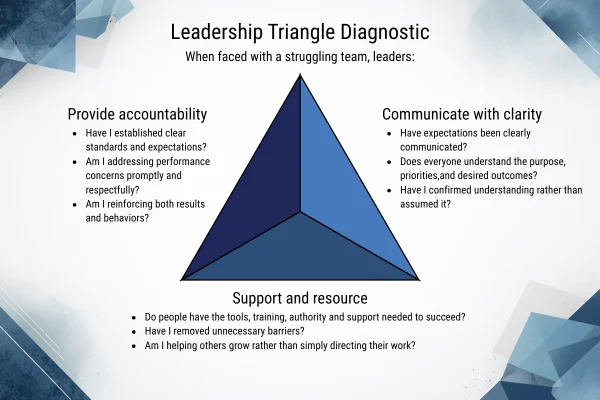
As global markets face an era of unprecedented disruption, corporate leadership has reached a point of critical complexity, characterized by rapid technological integration, workforce volatility, and shifting socioeconomic expectations. Organizations are currently grappling with the dual pressures of economic uncertainty and a fundamental transformation in the relationship between employers and employees. Amidst this backdrop, executive coaches and organizational psychologists are observing a recurring phenomenon: many leadership failures are not the result of a lack of sophisticated strategy, but rather a neglect of fundamental responsibilities. To address these systemic issues, industry experts are increasingly turning to a diagnostic and developmental framework known as the Leadership Triangle.
Rooted in the research of Dr. Justin Irving, the Leadership Triangle identifies three core competencies—clarity in communication, the provision of support and resources, and the enforcement of accountability—as the essential pillars of effective management. When these three elements are balanced, they create a stable environment for high performance; when one is neglected, organizational cohesion often begins to erode.
The Context of Modern Leadership Challenges
The current demand for a simplified, robust leadership framework is driven by a series of global workplace shifts. Following the "Great Resignation" and the subsequent rise of "Quiet Quitting," data from Gallup’s 2023 State of the Global Workplace report indicates that employee engagement remains a significant hurdle, with only 23% of employees worldwide feeling truly engaged at work. This lack of engagement is often traced back to a disconnect between executive vision and frontline execution.
Historically, leadership models have fluctuated between the rigid "Command and Control" structures of the mid-20th century and the highly relational, "Servant Leadership" models popularized in the 1990s and 2000s. However, in the 2020s, the rise of remote work and artificial intelligence has created a "clarity deficit." Leaders are no longer just managing tasks; they are managing the psychological safety and cognitive load of their teams. The Leadership Triangle serves as a response to this evolution, offering a streamlined approach to complex human capital problems.
Pillar One: The Imperative of Communicating with Clarity
The first side of the Leadership Triangle is the responsibility to create clarity through successful communication. In a journalistic analysis of corporate failures, a lack of transparent communication is frequently cited as the primary catalyst for project collapse and cultural decay. Communication in a professional context is not merely the act of transmitting information; it is the process of ensuring shared understanding.
Research consistently indicates that uncertainty is a primary driver of workplace anxiety. According to a study by the Harris Poll on behalf of Grammarly, poor communication costs U.S. businesses an estimated $1.2 trillion annually. This "communication gap" manifests when leaders assume that a single announcement or email suffices as clarity.
Effective leaders use communication to answer three fundamental questions for their workforce:
- What are we trying to achieve, and why does it matter?
- What is my specific role in achieving that objective?
- How will we measure success along the way?
When leaders fail to provide these answers, employees often fill the information void with speculation, which breeds rumors and reduces trust. For Chief Learning Officers (CLOs), developing communication as a leadership discipline involves training managers in active listening, feedback loops, and storytelling to ensure that organizational goals are not just heard, but internalized.
Pillar Two: Support and Resourcing as an Engine for Success
Clarity, while necessary, is insufficient if the workforce lacks the means to execute the vision. The second side of the triangle focuses on the leader’s role as a facilitator. This competency aligns with the research of Dr. Justin Irving, who posits that the primary function of a leader is to create the conditions that enable others to thrive.
In many contemporary organizations, there is a measurable "resource-expectation gap." Leaders may set ambitious Key Performance Indicators (KPIs) but fail to provide the necessary training, software, time, or administrative support required to reach them. This imbalance leads to burnout, a condition that the World Health Organization (WHO) now recognizes as an occupational phenomenon resulting from chronic workplace stress that has not been successfully managed.
Support and resourcing take several forms in a high-functioning organization:

- Technical Resources: Providing the right tools and technology to minimize friction.
- Educational Support: Investing in continuous learning and professional development.
- Psychological Support: Fostering an environment where it is safe to take risks and report failures.
- Authority: Empowering employees with the autonomy to make decisions within their scope of work.
By shifting the leadership mindset from "How do I get results?" to "How do I help my people succeed?", organizations can leverage the principles of servant leadership to drive long-term productivity. When employees feel supported, their loyalty and output typically increase, creating a virtuous cycle of growth.
Pillar Three: The Role of Accountability as Stewardship
The final side of the triangle—accountability—is often the most difficult for leaders to implement. In many corporate cultures, "accountability" is misconstrued as a synonym for punishment. However, in the context of the Leadership Triangle, accountability is viewed as stewardship. It is the process of ensuring that behaviors and performance remain aligned with the clear expectations established in the first pillar.
A 2021 study by Partners In Leadership found that 82% of managers felt they had limited to no ability to hold others accountable successfully. When accountability is absent, high-performing employees often feel undervalued as they see underperformance go unaddressed. This leads to a "race to the bottom" where standards gradually decline.
Effective accountability requires a balance of care and candor. It involves:
- Regular performance check-ins rather than annual reviews.
- Direct feedback regarding behaviors that deviate from organizational values.
- Consistent consequences, both positive and negative, based on performance outcomes.
Without the third side of the triangle, the first two pillars—clarity and support—can lead to a culture of "ruinous empathy," where people are happy but the organization fails to meet its objectives. Accountability provides the tension necessary to keep the structure of the triangle intact.
Chronology of Leadership Framework Evolution
To understand why the Leadership Triangle is gaining traction now, it is helpful to look at the timeline of management theory over the last century:
- 1910s-1940s (Scientific Management): Focus on efficiency and task-splitting. Communication was top-down and accountability was rigid.
- 1950s-1970s (Human Relations Movement): Recognition of social factors and employee satisfaction. Support began to enter the conversation.
- 1980s-2000s (Transformational & Servant Leadership): Emphasis on vision, inspiration, and serving the needs of the team.
- 2010s-Present (Complexity & Systems Thinking): The realization that no single style works in all scenarios. Frameworks like the Leadership Triangle emerge to provide a diagnostic tool for navigating "wicked problems" in real-time.
Organizational Impact and Systemic Integration
The Leadership Triangle is more than a behavioral guide for individual managers; it is a systemic framework that can be integrated into an organization’s entire talent management lifecycle.
For Talent Management professionals, the triangle offers a lens through which to evaluate candidates for leadership roles. Instead of looking solely at past sales figures or technical expertise, hiring committees can assess a candidate’s ability to communicate, resource, and hold others accountable.
In succession planning, the triangle acts as a checklist. If a potential successor is excellent at communication and support but avoids difficult conversations, their development plan can be tailored specifically to build the "courage" required for accountability. Similarly, performance management systems can be redesigned to measure not just what was achieved, but how the leader utilized the three sides of the triangle to get there.
Fact-Based Analysis: The Risks of Imbalance
When an organization fails to maintain the balance of the Leadership Triangle, specific pathological patterns emerge:
- The Confusion Gap (Support + Accountability – Clarity): Leaders provide resources and demand results, but employees are unsure of the direction. This leads to wasted effort and "spinning wheels."
- The Burnout Gap (Clarity + Accountability – Support): Employees know what to do and know they will be in trouble if they don’t do it, but they lack the tools or time. This is the fastest route to high turnover and mental health crises.
- The Entitlement Gap (Clarity + Support – Accountability): Employees know the goals and have the resources, but there are no consequences for failure. This leads to stagnation and the departure of high achievers who seek a high-performance environment.
Conclusion: Returning to Fundamentals in a Complex World
As organizations look toward the future, the integration of AI and the continued globalization of the workforce will only increase the "noise" that leaders must filter. In such an environment, the most effective leaders will likely be those who do not chase every new management fad, but instead master the fundamentals of the Leadership Triangle.
By consistently communicating with clarity, providing the necessary support and resources, and maintaining a culture of stewardship through accountability, leaders can build resilient teams capable of navigating any crisis. The Leadership Triangle serves as a reminder that while the context of work may change, the core needs of the human workforce—to understand, to be equipped, and to be held to a standard—remain constant. For the modern Chief Learning Officer and executive, the path forward involves a return to these three essential sides of leadership excellence.






