
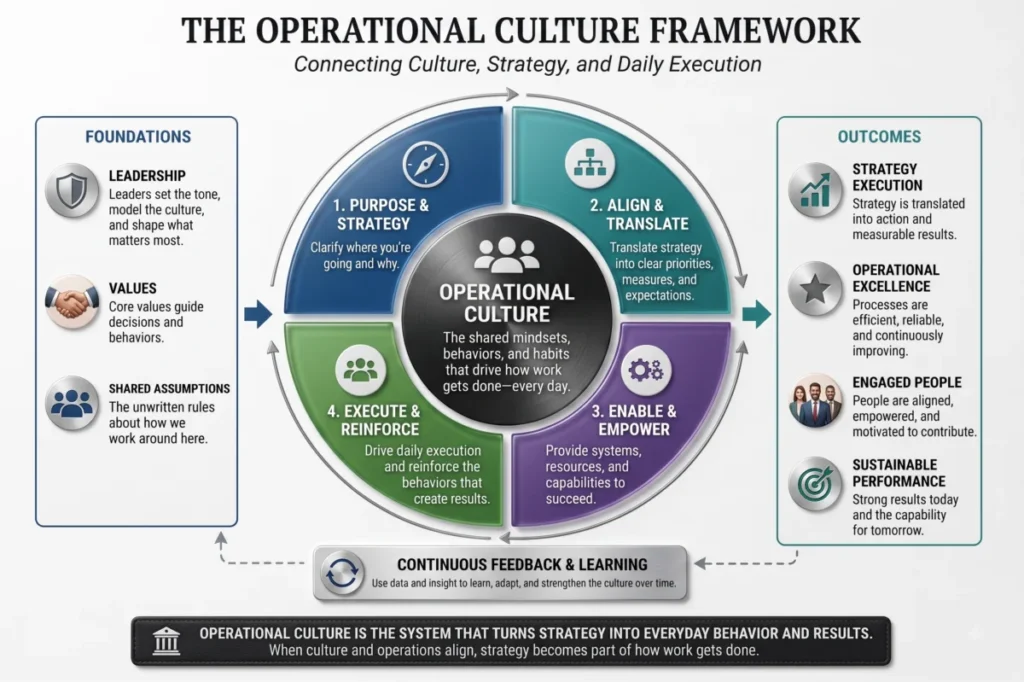
The disconnect between corporate strategy and frontline execution remains one of the most persistent challenges in modern management, leading to a phenomenon often described as "strategic drift." Every year, executive teams across the globe invest thousands of hours and millions of dollars in developing sophisticated strategic plans, articulating clear goals, and aligning resources. Yet, research suggests that a significant majority of these initiatives stall within the first six months. When departments begin moving in divergent directions, when meetings prioritize status updates over decisive action, and when momentum dissipates before measurable results are achieved, leadership teams frequently arrive at a singular diagnosis: a culture problem. However, emerging organizational theory suggests that this diagnosis is often an incomplete assessment of a much deeper structural issue.
The fundamental reality of organizational life is that culture itself does not execute strategy; rather, people do. On a daily basis, employees make hundreds of individual decisions that determine whether an organization’s stated mission becomes a reality or remains a theoretical exercise. These decisions involve prioritizing competing demands, determining when to collaborate across departmental silos, deciding whether to raise critical concerns, and choosing where to focus cognitive energy. Collectively, these seemingly mundane choices dictate the trajectory of the firm. Therefore, the critical question for leadership is not merely whether an organization possesses a "strong" culture, but whether it has established the specific organizational conditions that enable people to make decisions that advance the mission.
The Anatomy of Strategy Failure and the Execution Gap
The gap between strategy and results is well-documented in academic and business literature. In their foundational research on strategy execution, Robert Kaplan and David Norton, creators of the Balanced Scorecard, noted that as many as 90 percent of organizations fail to execute their strategies successfully. This failure is rarely due to a lack of talent or a poorly conceived vision. Instead, it stems from an inability to translate high-level strategic objectives into coordinated, day-to-day actions across the entire workforce.
Historically, organizational culture has been defined as a set of shared values, beliefs, and norms. This has led many organizations to focus their efforts on crafting mission statements, defining core values, and publishing behavioral expectations. While these symbolic efforts are necessary, they often overlook how employees actually experience culture. In a professional setting, culture is experienced less through what an organization says and more through what it consistently does. Culture reveals itself in the mechanics of decision-making, the priorities established by senior leaders, the behaviors that receive recognition, and the systems used to evaluate performance. Edgar Schein and Peter Schein, pioneers in the field of organizational psychology, describe culture as a set of shared assumptions developed as organizations solve problems over time. These assumptions are not accidental; they are shaped by leadership decisions and reinforced through tangible organizational systems.
Chronology of a Stalled Strategy
To understand where the "culture problem" originates, it is necessary to examine the typical lifecycle of a failing strategic initiative:
- The Formulation Phase: Leadership identifies market shifts or internal needs and develops a sound strategy. Resources are allocated, and the plan is vetted at the highest levels.
- The Launch Phase: The strategy is communicated via town halls, emails, and internal platforms. Momentum is high, and the organization expresses commitment to the new direction.
- The Implementation Phase: Frontline managers and employees attempt to integrate the new strategy into their existing workloads. However, existing systems—such as performance metrics and legacy workflows—often remain unchanged.
- The Emergence of Friction: Employees face "decision paralysis" as the new strategy conflicts with old priorities. Without clear guidance on trade-offs, departments begin to optimize for their own local goals rather than the organizational mission.
- The Drift: Six months in, the initiative loses visibility. Updates in meetings become repetitive, and the original urgency is replaced by the "business as usual" mindset.
- The Diagnosis: Leadership observes the lack of progress and labels it a "culture problem," often leading to another round of "values training" that fails to address the underlying systemic issues.
Supporting Data: The Cost of Misalignment
The financial and operational implications of this execution gap are staggering. According to a study by the Harvard Business Review, companies on average deliver only 63 percent of the financial performance their strategies promise. Furthermore, Gallup research indicates that only 22 percent of employees strongly agree that their leaders have a clear direction for the organization, and even fewer understand how their specific role contributes to that direction.
When priorities are unclear and ownership is inconsistent, even the most talented workforces struggle. High-performing organizations, conversely, do not rely on "heroic leadership" or extraordinary individuals alone. Instead, they intentionally design environments where people understand what matters and take ownership of outcomes. In these environments, execution becomes an organizational capability rather than a matter of individual effort.
The Operational Culture Framework: Four Essential Capabilities
To bridge the gap between strategy and execution, leaders are increasingly adopting what is known as the "Operational Culture Framework." This approach views culture not as a soft outcome of success, but as a hard operational capability that can be designed and refined. The framework is built around four core capabilities: Clarity, Accountability, Collective Intelligence, and Adaptability.

1. Clarity: The Foundation of Direction
Clarity is the mechanism that reduces uncertainty. People perform at their highest level when they understand what success looks like, how priorities are ranked, and how their specific tasks contribute to the mission. Clarity is not just about knowing the "what," but understanding the "why" and the "how." When clarity is absent, employees default to the safest or most familiar path, which is rarely the path of innovation or strategic change.
2. Accountability: From Compliance to Ownership
Accountability in a high-functioning operational culture is not about blame; it is about ownership. It requires leaders to establish clear responsibilities and, crucially, provide the authority needed to act. When accountability is integrated into the organization’s operating rhythm—rather than being relegated to an annual performance review—it fosters a sense of agency among the workforce.
3. Collective Intelligence: Leveraging Expertise
The most effective decisions are rarely made in a vacuum by a single leader. Collective intelligence involves intentionally leveraging the expertise of individuals across various functions. This requires the establishment of formal structures for surfacing dissent and specialized knowledge. A prerequisite for this capability is psychological safety—the shared belief that one can speak up without fear of retribution. Without psychological safety, the "open-door policy" remains a symbolic gesture rather than a functional tool.
4. Adaptability: Learning Faster Than the Rate of Change
Adaptability is the ability of an organization to learn and pivot as conditions evolve. This is distinct from mere "change management," which often treats change as a one-time event. True adaptability, as noted by leadership expert John Kotter, is a structural capability for continuous evolution. The classic case of Kodak illustrates this point: the company’s engineers invented the digital camera in 1975, but the organization lacked the capability to act on that knowledge because it threatened their existing film business. Adaptability is about the willingness to disrupt oneself before the market does.
Case Study: The Instructional Design Redesign
The practical application of this framework can be seen in a recent course-redesign initiative within a large educational institution. Instructional designers (IDs) were tasked with helping faculty meet new quality standards. Initially, the IDs operated in a silo, creating support materials based on their own interpretations of the requirements. The result was a disconnect: faculty viewed the IDs as a "compliance checkpoint" rather than partners, and the materials produced did not meet actual classroom needs.
The initiative stalled until the organization applied the principles of clarity and collective intelligence. By clarifying exactly what faculty needed to deliver and restructuring the relationship so that IDs and faculty solved problems together, the dynamic shifted. The work accelerated because the organizational conditions were finally aligned with the strategic goal.
The Role of Leadership and the Impact of AI
In the current era, the rise of artificial intelligence has added a new layer of complexity to strategy execution. While technology can automate tasks and provide data-driven insights, it cannot replace the human element of alignment and purpose. In fact, as AI handles more routine cognitive work, the premium on human decision-making, collaboration, and ethical judgment increases. Leaders must champion an operational culture where people are empowered to use these new tools to advance the shared mission rather than simply increasing the speed of misaligned actions.
Broader Impact and Implications for the Future
The organizations that will thrive in the coming decade will not necessarily be those with the most ambitious plans or the most capital. They will be the organizations that treat culture as a functional infrastructure. This shift requires leaders to move away from asking "How do we improve our culture?" and toward asking "What conditions are we creating that help our people succeed?"
When culture is defined as a specific, addressable set of capabilities, it ceases to be an amorphous excuse for failure and becomes a lever for growth. The symptoms of a failing operational culture—silos, slow decision-making, and lack of ownership—are early warning signs that the infrastructure of execution is breaking down. By focusing on the four pillars of the Operational Culture Framework, leaders can ensure that their strategic plans are not just documents on a shelf, but living realities reflected in the thousands of decisions made by their people every day. Strategy succeeds only when the organization is built to sustain it.






