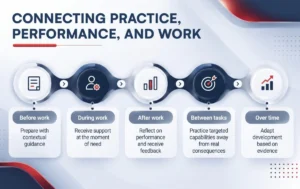
At 9:00 a.m., a corporate analyst receives a complex, fifty-page industry report. By 9:15 a.m., an artificial intelligence-powered assistant has digested the document, identified the three primary market risks, proposed a set of strategic recommendations, and drafted a formal executive summary. On the surface, this represents a triumph of modern corporate efficiency. The output is professional, the speed is unprecedented, and the immediate business need is met. However, for Learning and Development (L&D) professionals, this scenario prompts a critical investigation into the nature of human expertise: if the employee did not have to struggle with the data, what did they actually learn?
This tension between immediate performance and long-term capability is becoming the central challenge for global organizations as they integrate generative AI (GenAI) into their daily operations. While AI can eliminate repetitive tasks and provide instant access to high-level expertise, researchers warn that "performance" and "learning" are not synonymous. As organizations move deeper into the AI era, the distinction between a worker who can produce results with a tool and a worker who understands the underlying logic of those results is becoming a pivotal factor in long-term organizational resilience.
The Productivity-Learning Gap
The adoption of generative AI in the workplace has been characterized by a singular focus on speed. A randomized field experiment involving thousands of knowledge workers recently confirmed that GenAI provides measurable productivity benefits, particularly in document completion and administrative processing. However, L&D researchers have long cautioned that what a person does successfully during a task is not always a reliable indicator of what they will retain.
The distinction, famously explored by researchers Nicholas Soderstrom and Robert Bjork, separates "performance"—the observable behavior during a task—from "learning," which is the permanent change in knowledge or capability that persists after the task is finished. In an AI-enabled environment, an employee can achieve high performance by "offloading" the cognitive heavy lifting to an algorithm. This creates a "fluency illusion," where the ease of generating a result is mistaken for the mastery of the subject matter.
Consider the case of two financial analysts. The first analyst manually cleans a dataset, builds a model, tests various assumptions, and eventually arrives at a conclusion. The second analyst prompts an AI to perform the same steps and reviews the output. While both may arrive at the same high-quality recommendation, they have engaged in fundamentally different cognitive exercises. The first analyst has built "mental muscle" through trial and error, while the second has acted primarily as a supervisor of an automated process. If the AI tool were removed, or if it produced a subtle, high-stakes error, the first analyst would be significantly better equipped to identify and rectify the issue.
A Chronology of the AI Integration Shift
The current dilemma facing L&D leaders is the result of a rapid technological evolution that has outpaced traditional training methodologies.
- The Emergence (Late 2022 – Mid 2023): The public release of Large Language Models (LLMs) like ChatGPT triggered a rush toward "prompt engineering." The focus was almost entirely on how to get the machine to produce better outputs.
- The Integration Phase (Late 2023 – 2024): Major software providers integrated AI directly into word processors, spreadsheets, and coding environments. AI became a "ghostwriter" for nearly all digital work.
- The Cognitive Realization (2025): Organizations began to notice a "skills plateau." While entry-level workers were producing senior-level output with AI assistance, they were not developing the foundational judgment required for senior-level roles.
- The Strategic Pivot (Present): L&D leaders are now shifting from "AI Literacy" (how to use the tool) to "Cognitive Fortification" (how to ensure humans remain capable of critical thought despite the tool).
The Science of "Useful Difficulty"
Modern workplace technology is traditionally designed to reduce friction. In most business contexts, friction is viewed as a cost. However, in the context of learning, friction—or "productive cognitive load"—is a necessity.
Research into the "generation effect" has consistently shown that individuals remember information significantly better when they have to produce it themselves rather than simply reading or receiving it. A meta-analysis of 86 studies confirmed a substantial memory advantage for "generated" information. Further research has shown that the conditions under which people generate information—the effort involved—directly dictates the strength of the neural pathways formed.
L&D leaders are now tasked with distinguishing between "unproductive" difficulty (such as formatting a spreadsheet or searching for a file) and "useful" difficulty (such as synthesizing conflicting data points or defending a hypothesis). AI is highly effective at removing the former, but when it begins to remove the latter, the long-term intellectual capital of the organization begins to erode.
From Answer Engines to Learning Partners
The debate is not about whether AI is "good" or "bad" for learning, but rather how the interaction is designed. AI can function as an "Answer Engine," which effectively terminates the human thinking process by providing a finished product, or it can act as a "Learning Partner."
A 2025 study published in Scientific Reports demonstrated that a carefully designed AI tutor could produce stronger learning gains than traditional active learning environments. This was achieved because the AI did not provide answers; it was programmed to ask Socratic questions, challenge the student’s assumptions, and require the student to explain their logic before moving forward.
In a corporate setting, this means changing the "prompting" culture. Instead of asking an AI to "write a marketing strategy," a learning-focused approach would involve asking the AI to "critique my marketing strategy and identify three logical flaws" or "act as a skeptical client and challenge my proposed budget." This shifts the human role from a passive recipient of AI output to an active participant in a dialectic process.
The Redistribution of Critical Thinking
The nature of critical thinking itself is undergoing a fundamental shift. A 2025 study presented at the CHI Conference on Human Factors in Computing Systems analyzed over 900 real-world examples of GenAI use among knowledge workers. The findings suggested that as confidence in AI increases, the "effort" of critical thinking does not necessarily disappear—it redistributes.
Rather than spending hours "generating" a first draft, workers are spending more time on:
- Verification: Checking the factual accuracy of AI-generated claims.
- Integration: Ensuring the AI output aligns with specific organizational nuances that the model may not know.
- Supervision: Managing the "workflow" and ensuring the AI stays on track.
However, this shift requires a new set of skills: metacognition (thinking about one’s own thinking) and high-level judgment. If an employee has never learned how to write a sound argument from scratch, they may lack the "critical eye" required to spot a sophisticated but incorrect argument produced by an AI.
Five Strategic Questions for Chief Learning Officers
As organizations move toward "AI-Human Hybrid" workflows, Chief Learning Officers (CLOs) and L&D leaders must evaluate their training programs through a new lens. The following five questions serve as a framework for this transition:
- Is the primary objective performance, learning, or both? In high-volume, routine tasks, "cognitive offloading" to AI is efficient. However, in roles designed for leadership or innovation, the training must preserve human participation to build expertise.
- What specific cognitive process is the AI replacing? Is the tool replacing the "mechanics" of the work or the "judgment" of the work? Automation of judgment is the highest risk to organizational learning.
- Is the process being replaced essential for future independence? If a worker will eventually need to make decisions without the tool (e.g., in a high-stakes negotiation or a system failure), they must practice those decisions during training.
- Can the AI be configured to challenge before it assists? Training modules should be designed so that the AI acts as a coach—requiring the learner to attempt a solution or explain a concept before the AI provides the "correct" version.
- Can competence survive the removal of the tool? Periodic "analog" assessments are necessary to determine if the knowledge has actually been internalized or if it exists only as long as the software is running.
Implications for the Future Workforce
The responsibility of the L&D department is shifting from the delivery of content to the preservation of human capability. In the past, the goal was to provide employees with the knowledge they lacked. Today, knowledge is ubiquitous and instantly accessible via AI. The new goal is to provide employees with the judgment to use that knowledge wisely.
The long-term impact of AI on the workforce will likely be a "hollowing out" of middle-tier skills if organizations are not careful. If entry-level employees use AI to bypass the "grind" of early-career tasks, they may miss the foundational learning experiences that traditionally prepare them for senior leadership.
Ultimately, generative AI is a tool of immense power that can either accelerate human growth or cause it to atrophy. The difference lies in design. Organizations that prioritize "useful difficulty" and treat AI as a partner in the thinking process—rather than a replacement for it—will be the ones that maintain a competitive edge in an increasingly automated world. The goal is not to prove that humans are faster than machines, but to ensure that humans remain the masters of the machines they use.