
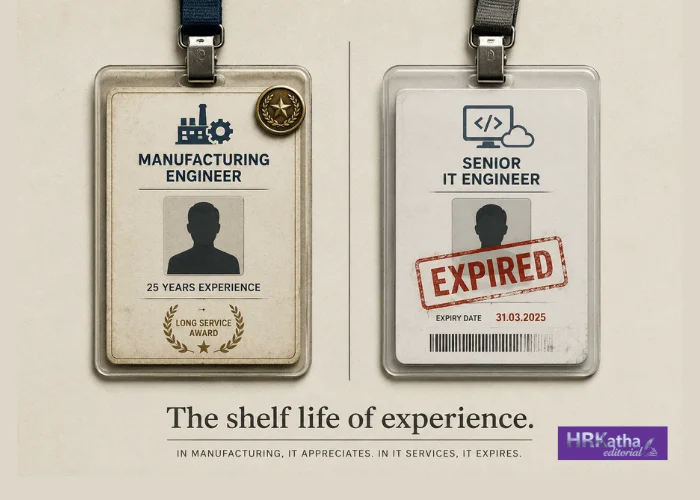
In a stark divergence across industries, the value assigned to accumulated professional experience presents a compelling paradox. While a manufacturing engineer with decades of service in an automotive plant is widely considered an invaluable asset—a repository of institutional knowledge, understanding intricate production nuances, critical tolerances, recurring failure modes, and the wisdom to avert costly errors—a software engineer of similar tenure within a large Indian IT services company often finds themselves in a precarious position. Far from being celebrated for their deep expertise, they are frequently perceived as an expensive overhead, potentially rigid, and vulnerable during periods of restructuring, with "not keeping up with technology" serving as a convenient, albeit often incomplete, justification for what is fundamentally a cost-driven decision. This fundamental difference is not primarily a matter of individual capability or the pace of technological change; it is deeply embedded in the distinct business models governing these sectors.
The Valued Veteran: Where Manufacturing Experience Compounds
In traditional manufacturing, experience is not merely accumulated; it compounds and appreciates over time, becoming an indispensable organizational asset. A senior process engineer in a steel plant, an aerospace facility, or an automotive assembly line embodies a depth of knowledge that defies rapid replication. They possess an intimate understanding of equipment behavior under immense stress, material tolerances that extend beyond standard manuals, and the subtle indicators that differentiate routine operational variations from impending, catastrophic failures. This profound insight is painstakingly acquired through years of direct observation, repetitive problem-solving in real-world scenarios, and continuous exposure to the unforgiving realities of large-scale production. A freshly graduated engineer, even with stellar technical training, cannot readily substitute for someone who has witnessed the lifecycle of complex systems across thousands of production cycles and weathered countless unforeseen challenges.
Organizations within the manufacturing sector intrinsically recognize and financially reward this invaluable expertise. Career trajectories are built on the premise that proficiency deepens with tenure, leading to promotions and compensation packages that reflect accumulated mastery. Retirement, when it eventually arrives, is typically a well-planned and ceremonial affair, often preceded by deliberate knowledge transfer initiatives, ensuring that critical institutional memory is effectively passed down to the next generation of engineers and technicians. The business model itself is predicated on rewarding continuity and consistency. Manufacturing companies produce tangible products whose quality, reliability, and market reputation hinge on unwavering consistency over extended periods. Institutional memory—encompassing detailed records of suppliers, critical design decisions, past production failures, and intricate operational trade-offs—is crucial in preventing the costly repetition of historical mistakes, ensuring product integrity and brand loyalty. For product-centric businesses, continuity is paramount, and continuity necessitates the presence of individuals who have been around long enough to remember, understand, and guide.
The IT Services Conundrum: Where Experience Depreciates
In stark contrast, the career trajectory for experienced professionals in large Indian IT services firms often follows a structurally different, and frequently challenging, path. The commonly cited explanation for this divergence centers on technological obsolescence. Proponents of this view argue that software languages, frameworks, and architectural paradigms evolve at a blistering pace. What was considered cutting-edge five years ago might now be legacy, with cloud-native architectures rapidly replacing on-premise systems and new development tools emerging constantly. The argument posits that experienced engineers, burdened by older mental models and potentially resistant to change, struggle to adapt, while younger employees arrive pre-trained in the latest frameworks and are inherently more "agile."
While this explanation holds a kernel of truth—technology indeed changes rapidly, and some specific skills do genuinely lose relevance (e.g., a developer who mastered COBOL in the 1990s and ceased learning thereafter would struggle in a modern cloud environment)—it remains an incomplete and often misleading narrative. The deeper, more pervasive driver is not solely the pace of technological change, but rather the underlying economics and business model of the Indian IT services industry itself.
Historically, and particularly at scale, many Indian IT services firms have operated as global labor providers. Clients, typically large multinational corporations, define the technology stack, the project scope, and the desired outcomes. The service provider’s primary role is to supply skilled engineers to execute within these predefined parameters. In this model, efficiency is rigorously measured through metrics such as billable hours, utilization rates, and the cost per resource. In such an environment, the profound depth of expertise and accumulated judgment often matters less than sheer cost-efficiency and rapid trainability. A junior engineer, who can be billed at a significantly lower rate and quickly trained in the specific, immediate technology required for a project, frequently becomes a commercially more attractive proposition than a senior engineer with broader, deeper experience but commensurately higher salary expectations. Even if a project necessitates a shift in technologies after a couple of years, requiring retraining for both, the junior engineer remains the more cost-effective option throughout the entire lifecycle. In essence, labor becomes largely fungible, and accumulated experience, ironically, transforms into an overhead cost rather than a strategic asset.
This dynamic creates a structural bias against tenure. The longer an engineer remains with a firm, the more expensive they become. Their accumulated understanding of complex system design, intricate architectural trade-offs, advanced debugging techniques, and navigating organizational complexities carries diminished value if the prevailing business model treats engineers primarily as interchangeable resources allocated to client-defined tasks. The irony is palpable: manufacturing, an industry often labeled as "labor-intensive," frequently treats its experienced workers as invaluable repositories of institutional knowledge, while significant segments of the Indian IT services industry, positioned as a "knowledge industry," increasingly view experienced engineers as expensive labor.
The "Learning Agility" Narrative and Its Economic Roots
When large-scale restructuring or layoffs occur in the IT services sector, the language employed is meticulously crafted to avoid direct references to cost-cutting. Organizations rarely explicitly state they are replacing expensive senior engineers with cheaper junior ones. Instead, the discourse shifts to concepts like "learning agility," "adaptability," and the imperative to "keep pace with changing technology." "Learning agility," a term notoriously difficult to quantify objectively, becomes a convenient and often invoked proxy for cost.
The underlying assumption is that younger engineers adapt faster and are unburdened by "legacy thinking," while senior engineers are perceived as slower and more rigid. While this generalization can sometimes hold true, it is frequently a flawed premise. An engineer who has successfully mastered multiple programming languages, complex frameworks, and diverse architectures over two decades often possesses a superior capacity for rapid learning and adaptation to new technologies than someone still learning their second or third. Their transferable judgment, honed by years of navigating diverse technical landscapes, remains immensely valuable even as specific technologies evolve. What is, however, undeniably true is that senior engineers command higher salaries. In a business model relentlessly driven by pricing pressure from clients and stringent utilization metrics, cost frequently eclipses the perceived value of deep, accumulated expertise.
The language of "agility" thus serves to reframe a financial decision as a capability decision, subtly shifting responsibility onto the employee. If an individual is let go, the implicit message is that they failed to remain relevant or agile, rather than acknowledging that the prevailing economic model no longer favors their salary band. This trend is not confined to mid-level engineers; even senior leadership layers, which expanded significantly during periods of rapid growth, are now quietly being trimmed in some large consulting and technology firms. The message is unequivocal: experience is celebrated during expansion cycles but rigorously scrutinized and questioned during periods focused on efficiency and cost optimization.
Consequences of Experience Erosion: What’s Lost
The long-term consequences of systematically cycling out experienced talent are insidious, manifesting slowly but profoundly impacting an organization’s capabilities. Institutional memory weakens considerably, leading to a phenomenon where teams repeatedly "rediscover" solutions or make similar mistakes because no one remains who remembers the rationale behind earlier decisions or the pitfalls encountered previously. Technical debt compounds silently because the individuals who truly understood the original architectural trade-offs, the compromises made, and the long-term implications have exited the system.
Mentorship, a cornerstone of professional development, becomes shallow and often inadequate. In some organizations, the most experienced engineer available to guide and nurture younger employees might have a mere seven or eight years of tenure, a far cry from the deep apprenticeship models found in sectors that value long-term experience. Knowledge transfer becomes compressed into short cycles focused on immediate project execution, rather than fostering deep, holistic understanding and strategic thinking.
This erosion of experience matters profoundly because the contribution of seasoned engineers often transcends raw coding speed. Their primary value lies in their judgment: recognizing failure patterns earlier, anticipating scaling problems before they become critical, and understanding which architectural compromises, if not carefully managed, will lead to future fragility and costly rework. These invaluable capabilities are cultivated through extensive exposure to complexity over time. When organizations systematically shed experienced talent, they inadvertently reduce the density of accumulated judgment and critical thinking within their operational ecosystem.
System-level thinking, crucial for building robust and scalable solutions, also erodes in quieter, less visible ways. Experienced engineers learn to perceive interactions and interdependencies rather than isolated tasks. They grasp how decisions made in one layer of a complex system will ripple through and create consequences elsewhere. This holistic perspective rarely develops in environments where careers are optimized for short project cycles, rapid technological churn, and a focus on modular, discrete tasks. Ultimately, whether these losses are deemed significant depends on an organization’s long-term aspirations. If the work primarily involves commoditized execution, deep continuity might appear unnecessary. However, organizations that aspire to build enduring products, develop complex, proprietary systems, or generate original intellectual property will inevitably confront the severe limitations imposed by shallow institutional memory and a lack of seasoned judgment.
The AI Factor: Amplifying the Tension
The advent of artificial intelligence, particularly generative AI models and advanced coding assistants, is accelerating and intensifying this existing tension. The immediate, often simplistic, assumption is that junior engineers, empowered with sophisticated AI tools capable of generating functional code from prompts, will become productive enough at significantly lower costs to displace experienced engineers with higher salaries.
However, this perspective fundamentally misunderstands where the true value of senior engineers often lies. Experienced engineers contribute judgment, architectural vision, and strategic decision-making far more than raw coding output. They understand which architectural decisions will scale, which shortcuts will inevitably lead to future instability, and which trade-offs are genuinely critical under pressure. These capabilities do not diminish or disappear when coding tools improve; if anything, they become even more valuable. As AI increasingly automates the more routine aspects of code generation, the premium shifts decisively towards system design, sophisticated architectural thinking, strategic problem-solving, and expert decision-making in ambiguous and complex scenarios.
The core problem, however, remains: these nuanced, high-value qualities—judgment, foresight, systemic understanding—are inherently harder to quantify and integrate into business models that are primarily optimized around measurable delivery metrics and billable hours. If clients continue to pay primarily for execution capacity rather than for deep engineering judgment, AI could, paradoxically, strengthen the economic case for replacing expensive experience with cheaper execution capacity augmented by automation. The risk is not merely technological displacement; it is a broader organizational simplification, where companies optimize for immediately measurable outputs while dangerously underestimating the long-term, compounding value of accumulated judgment until its absence manifests as visible and often catastrophic failure.
Structural Differences and Business Models
The fundamental difference in how manufacturing companies and IT services firms value experience stems from their distinct economic logics. Manufacturing companies build, own, and stand by their products. They bear the brand reputation, the design integrity, and the direct responsibility for customer experience. A product defect traceable to poor institutional knowledge or a lack of seasoned oversight directly damages the company’s brand and financial standing. Consequently, continuity, deep expertise, and institutional memory become commercially invaluable assets.
In contrast, large-scale IT services firms often operate under a different paradigm. The client typically owns the product, defines the architecture, and dictates the strategic direction. The service provider’s primary role is to supply execution capacity and talent. If experienced engineers become disproportionately expensive and clients remain highly cost-sensitive—a perennial feature of the outsourcing market—then replacing them with cheaper, technically proficient equivalents becomes an economically rational, albeit potentially shortsighted, decision for the service provider.
It is crucial to note that this dynamic is not universal across the entire technology sector. Product-focused technology firms, research-intensive organizations, specialized semiconductor companies, and deep-tech startups often place immense value on profound expertise. Engineers possessing rare and specialized technical skills in areas like core infrastructure, advanced AI systems, cybersecurity, or highly niche domains continue to command significant leverage and are highly sought after. However, the dominant large-scale Indian IT services model, particularly that catering to commoditized enterprise services, continues to prioritize cost efficiency and scalability over the continuity and deep institutional knowledge celebrated in other sectors. The enduring irony is that manufacturing, an industry often stereotyped as labor-intensive, frequently treats its experienced employees as irreplaceable repositories of knowledge, while significant segments of the technology industry, ostensibly knowledge-based, increasingly behave as though accumulated experience is a financial inconvenience.
Broader Implications and the Path Forward
The disparate valuation of experience across these industries is not fundamentally about whether technology evolves faster in one sector than another. Manufacturing, too, undergoes relentless technological transformation, driven by automation, advanced robotics, sophisticated supply-chain digitalization, and the development of new materials. The real differentiator lies in what each business model fundamentally rewards. "Body-shopping" or commoditized services models are inherently structured to reward cost efficiency and fungibility of labor. Product-oriented businesses, on the other hand, reward continuity, nuanced judgment, and deep institutional understanding.
This distinction explains the profoundly different emotions associated with tenure across sectors. In manufacturing, a long career signals accumulated value, reliability, and wisdom. In large sections of Indian IT services, extended tenure increasingly signals cost exposure, creating a pervasive sense of anxiety among seasoned professionals. This anxiety is not irrational; even engineers who diligently and continuously upskill themselves remain vulnerable if their compensation trajectory outpaces what cost-conscious clients are willing to pay for what they perceive as interchangeable services.
The larger, overarching question for the Indian IT services industry is whether this prevailing model is sustainable for an ecosystem that increasingly articulates aspirations of innovation, intellectual property creation, and building globally competitive products and platforms. An industry that systematically cycles out its most experienced talent every decade inevitably weakens its mentorship structures, erodes critical institutional memory, and diminishes its capacity for deep, systems-level thinking. These losses, while often invisible during periods of buoyant growth, become painfully apparent and significantly harder to ignore when organizations genuinely attempt to build complex, enduring technology rather than merely execute modular client work.
Manufacturing stands as a powerful testament that industries facing profound technological change can still profoundly value experience if continuity itself is explicitly treated as a strategic advantage. The core issue, therefore, is not whether technology evolves too quickly for long and fulfilling careers. Instead, it is whether organizations are fundamentally designed to perceive and treat accumulated knowledge as an invaluable asset or merely as an unavoidable cost. In large parts of the Indian IT services landscape, the answer to this question is becoming increasingly clear, and with it, a growing unease among its most seasoned professionals about their future trajectory and value. The challenge for the industry will be to reconcile its cost-driven model with its aspirations for innovation and sustained excellence, potentially by carving out new business models that actively champion and integrate the wisdom of experience.








