Belonging, the profound human need to feel connected, supported, and respected, is emerging as a critical organizational capability rather than a mere employee perk. In today’s dynamic professional landscape, where engagement hovers at a concerning 20% globally, according to Gallup, the absence of a strong sense of belonging creates a tangible "belonging gap." This gap, characterized by subtle yet persistent uncertainty, prevents employees from contributing their full potential, leading to significant detriments in engagement, retention, and overall performance. The foundational understanding of belonging extends beyond a simple question of "Do I fit in?" to encompass a complex interplay of feeling valued, seen, and integrated within the organizational fabric.
The Tangible Value of Workplace Belonging
The research unequivocally demonstrates that both a consistent sense of belonging and the pervasive uncertainty surrounding it wield significant influence over employee well-being and organizational success. When individuals consistently feel included and secure in their place at work, they are demonstrably more inclined to embrace calculated risks and are more comfortable seeking and offering assistance. This psychological safety, fostered by a strong sense of belonging, is the bedrock upon which open dialogue, innovative thinking, and unwavering commitment are built.
Beyond fostering a positive immediate environment, a robust sense of belonging is intrinsically linked to heightened resilience. Employees who feel they belong are more likely to persevere through challenges, rebound from setbacks, and navigate organizational shifts with greater fortitude. This resilience directly translates into reduced employee turnover. In a notable partnership with a leading global automotive manufacturer, researchers identified that employees’ perceptions of inclusion, the degree of uncertainty about their belonging, and their overall sense of belonging were the most potent predictors of intentions to leave, burnout, and the ability to integrate work and life effectively.
Further studies underscore the transformative power of connection. In one initiative, building camaraderie and a sense of belonging among participants was highlighted as one of the most valuable outcomes of leadership development programs. Similarly, an extensive study involving over 1,500 professionals and participants in a Leadership Development Program (LDP) revealed that nearly three-quarters reported tangible improvements in feeling valued, respected, heard, and trusted.
It is crucial to distinguish between inclusion and belonging, though they are closely intertwined. Inclusion can be understood as structural access – ensuring individuals have a seat at the table. Belonging, however, is the felt experience of connection, the assurance of being valued once at that table. While organizational systems and policies can champion inclusion, the cultivation of belonging is primarily an outcome of the sustained quality of human interactions over time. Research confirms that organizations and their leaders possess the agency to positively influence both belonging uncertainty and the overall sense of belonging within the workplace. By proactively diminishing uncertainty, leaders empower individuals to set aside anxieties and engage more fully in their work.
The Shadow of Belonging Uncertainty
The concept of belonging is often discussed as a singular entity, yet it exists on a spectrum, with belonging uncertainty representing its inverse. Employees experience this uncertainty when they are not consistently assured of their fit within the workplace. This fluctuating sense of security can stem from feeling distinct due to appearance, cultural background, or unique life experiences, particularly when one’s background diverges from the majority within a team. Such individuals may harbor concerns about encountering negative stereotypes or perceive subtle indicators that suggest certain individuals are not destined for success, thereby diminishing their sense of welcome. Those who do not perceive these subtle messages are often unburdened by this particular anxiety.
Belonging uncertainty frequently compels individuals to conceal aspects of their identity or to withhold their contributions, making its presence difficult to detect. A key indicator, however, can be hesitancy in participation, a signal that the environment may not feel entirely welcoming. Without intentional support, employees grappling with belonging uncertainty may feel as though they are carrying an immense weight, hindering their ability to engage fully, think creatively, and bring their authentic selves to work. This constant drain on cognitive and emotional energy manifests in diminished performance, strained collaboration, and reduced commitment.
Compelling examples of belonging dynamics in the workplace often involve not overt acts of exclusion, but rather the cumulative impact of seemingly neutral interactions, interpreted through the lens of uncertainty. Consider two employees delivering a significant presentation at a quarterly meeting, neither of whom receives applause upon completion. While one might dismiss the lack of reaction, the other, perhaps already experiencing belonging uncertainty, might interpret it as a personal failing or a sign of not being valued. Even if the latter employee engages in positive self-talk, the mental exertion required to counteract negative interpretations represents an added burden on top of their professional responsibilities. This burden can accumulate and magnify across teams and entire organizations when belonging uncertainty remains unaddressed.
Navigating Belonging in a Distributed, Global, and AI-Accelerated World
The traditional environments that naturally fostered workplace belonging – shared physical spaces, consistent proximity, and stable team structures – are increasingly becoming relics of the past for many organizations. In this new paradigm, a sense of belonging must be intentionally cultivated. As artificial intelligence takes on a greater volume of communication tasks, the significance of human interaction intensifies. It is precisely these human-led interactions that build or erode the foundation of belonging.
Global organizations face an additional layer of complexity: the perception of belonging varies dramatically across cultures. What signifies respect and inclusion in one cultural context may be interpreted differently in another. Common assumptions underlying many belonging initiatives, such as publicly sharing failures, enthusiastically participating in team social events, or bringing one’s "whole self" to work, do not always translate universally. Building belonging across diverse geographies necessitates a sophisticated blend of cultural intelligence and genuine relational intent. A shared set of organizational values, while important, does not automatically guarantee a collective sense of belonging, and global expansion without a deliberate cultural design risks undermining it.

Cultivating a Sense of Belonging: Practical Strategies for Leaders
The good news is that fostering workplace belonging does not necessitate grand or expensive gestures. The most impactful interventions are often characterized by their consistency and their fundamental human element – small acts of attention and inclusion that coalesce over time into a palpable sense of safety and connection. For maximum efficacy, these experiences should holistically address all facets of belonging: fostering peer connections, building trust, amplifying every voice, and actively reducing belonging uncertainty.
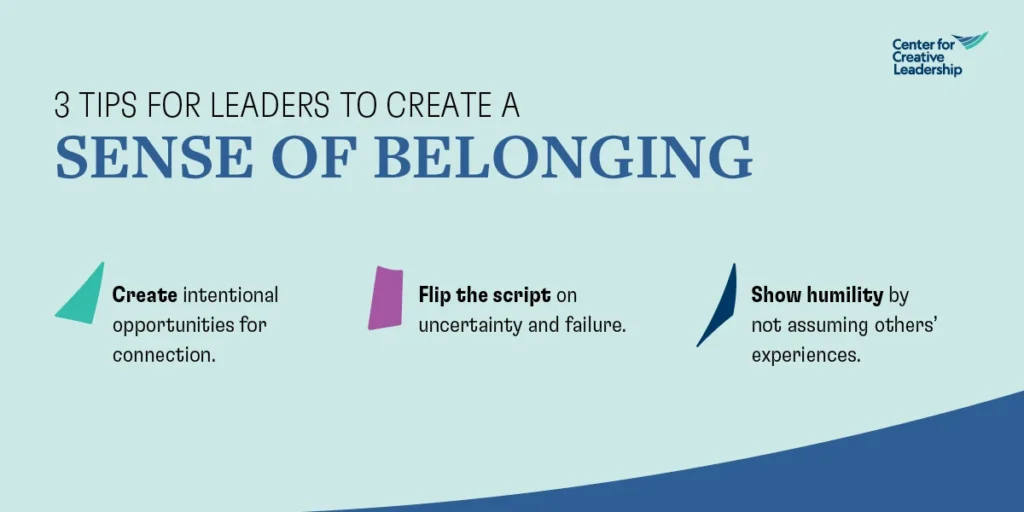
1. Forge Intentional Opportunities for Connection
Consistency is paramount. While many organizations initiate efforts by organizing team events, mixers, or social gatherings, their impact is often limited compared to the power of regular, smaller-scale opportunities for connection. This can range from dedicating brief moments at the commencement of meetings for personal sharing, facilitating cross-group dialogues, to creating dedicated spaces for peer interaction across different departments and hierarchical levels. The objective is to foster sustainable, authentic interaction, not performative unity.
In distributed and hybrid work environments, this intentionality is non-negotiable. Belonging flourishes in moments where individuals feel genuinely seen and welcomed, and these moments must be deliberately engineered. Furthermore, belonging is shaped by the systemic structures that support leaders. When promotion criteria, performance metrics, and meeting protocols are designed to reinforce connection rather than undermine it, belonging has fertile ground to grow. Conversely, when these systems are misaligned, belonging uncertainty can proliferate irrespective of individual leaders’ intentions. The design of the organizational environment holds as much sway as the intentions of its people.
2. Reframe Uncertainty and Failure
When individuals lack a sense of belonging, they often feel isolated in their experience. Belonging uncertainty can lead people to believe they are the sole individuals questioning their fit, when in reality, many have navigated similar doubts throughout their careers. When leaders and colleagues openly share their uncertainties or even their failures, they normalize these feelings and diminish their power. This approach is particularly impactful when articulated by individuals further along in their career trajectories. A manager recounting their early-career struggles, for instance, creates a permissive environment for others to acknowledge their own uncertainties.
Within global organizations, it is vital to recognize that the acceptable expression of vulnerability varies significantly across cultures. What might be perceived as authentic and open in one context could be considered overly personal or professionally inappropriate in another. Leaders in global roles must cultivate cross-cultural awareness to calibrate their approach, fostering an environment of honesty without imposing a universal standard for openness. Mentorship stands out as a potent belonging intervention during periods of transition, such as onboarding, promotions, or assuming new managerial responsibilities. These moments of heightened belonging uncertainty are met with direct relational investment. When a more experienced colleague shares their insights and offers ongoing support, belonging uncertainty diminishes, and commitment escalates.
3. Practice Humility by Avoiding Assumptions
Leaders should proactively create avenues for others to share their experiences. Those who consistently foster spaces for connection and openly discuss their own self-doubts are more likely to cultivate an environment where employees feel psychologically safe, subsequently encouraging them to share their experiences with belonging and belonging uncertainty. This is particularly crucial for individuals who are frequently overlooked or underestimated.
Power dynamics can significantly influence group settings, with individuals holding more senior positions or privileged social identities often dominating conversations. Research indicates that simply being designated as a "leader" can increase speaking time by 150-300%. Counteracting this requires active, intentional listening – not merely creating space but actively safeguarding it. When an individual shares an experience, resist the urge to redirect the conversation to your own perspective. A well-timed silence coupled with a genuine follow-up question communicates more about belonging than almost any other action a leader can take. It is essential to avoid pressuring employees to disclose more than they are comfortable with; the leader’s role is to provide the platform. Furthermore, discourage individuals from speaking on behalf of others by encouraging everyone to focus on their personal experiences, thus giving individuals the agency to share their own perspectives.
From Individual Practice to Organizational Design: Architecting Belonging
The cultivation of workplace belonging is an ongoing process, woven into the fabric of both significant and subtle interactions. However, it cannot be solely reliant on individual efforts to achieve scale. Organizations that successfully foster workplace belonging treat it as a strategic leadership imperative. This involves a critical assessment of their systems, structures, and development investments to ensure they consistently reinforce the conditions under which individuals feel connected, valued, and secure. This necessitates examining what is measured, what is rewarded, and how leadership development programs are designed at every organizational level.
The most profound examples of workplace belonging emerge from leaders who demonstrate attentiveness, active listening, and a commitment to creating environments where individuals can authentically show up. When belonging is integrated into the very essence of leadership development – not as an isolated module or a standalone initiative, but as an expected outcome of effective leadership training – it transcends a mere cultural aspiration and transforms into a tangible performance advantage.
Organizations are increasingly recognizing that equipping leaders to cultivate inclusive cultures that genuinely support every individual is paramount, ensuring that employees move beyond mere adequacy to a state of thriving. This realization is driving the creation of comprehensive leadership resources focused on compassion, well-being, and belonging, drawing upon extensive research to provide actionable strategies.
Taking the Next Step Towards a More Connected Workplace
To embark on a meaningful journey toward enhancing belonging within your organization, initiating open conversations with colleagues is a vital first step. By downloading a dedicated conversation guide, teams and leaders can engage in structured discussions, fostering a deeper understanding and collective commitment to building a more inclusive and connected work environment. This proactive approach empowers individuals and teams to identify opportunities, address challenges, and collaboratively architect a workplace where everyone truly belongs.