
A robust performance review template transcends mere administrative paperwork; it serves as a critical instrument for cultivating clarity, fostering trust, and enabling genuine professional development within an organization. When meticulously designed, these templates ensure managers and employees are synchronized on expectations, concentrate on impactful behaviors and tangible results, and engage in fair, productive dialogues. The consistent application of a well-crafted employee review template fosters transparency, which in turn drives enhanced development and engagement across the entire workforce.
The Cornerstone of Effective Performance Management: Constructive Feedback
At the heart of any successful performance review lies constructive feedback. This essential component is pivotal in elevating employee performance and accelerating professional growth. It empowers managers to guide their teams toward improvement, development, and skill enhancement. Effective feedback is characterized by its specificity, timeliness, actionability, and a balance between acknowledging strengths and identifying areas for development. Research by Quantum Workplace underscores the significant impact of frequent feedback, indicating that employees who receive it are twice as engaged, three times less likely to seek other employment, and 1.4 times more inclined to remain with their current organization. This highlights that helpful feedback is not merely a suggestion; it is a fundamental driver of employee engagement and retention.

Understanding the Performance Review Template
A performance review template is, in essence, a standardized framework designed to structure and guide evaluations of employee performance. It ensures consistency in how managers assess performance, articulate expectations, and document progress against clear, predefined criteria. A well-designed template ensures employees have a clear understanding of how their contributions are evaluated, what they are excelling at, and where opportunities for growth exist. The consistent use of such templates streamlines the evaluation process, making it more focused and manageable for both managerial staff and employees.
For Human Resources departments, the standardization provided by templates is invaluable. It helps mitigate bias in evaluations, ensures that performance conversations are equitable across the organization, strengthens compliance documentation, and generates clean, comparable performance data. This data facilitates the identification of organizational trends, supports managers in their development efforts, and ultimately leads to improvements in the overall performance management system.
The Indispensable Role of Performance Review Templates
The adoption of performance review templates significantly simplifies the process for managers, enabling them to better understand the purpose of performance reviews and deliver feedback that genuinely contributes to employee development. A structured employee review template or form ensures that evaluation conversations remain focused, impartial, and consistent.

These templates also equip managers with the tools to provide constructive feedback effectively, highlighting both strengths and areas requiring improvement in a manner that motivates employees. For HR professionals, this consistency is paramount, guaranteeing that every employee receives clear, actionable guidance, fostering fair evaluations, and simplifying the tracking and analysis of performance data across the organization.
Key Elements of an Effective Performance Review Template
Best practice dictates that a performance review form should incorporate clear and specific performance criteria. It should include examples of both employee accomplishments and areas where improvement is needed, adopting a balanced perspective. While a rating system can be included, it should not be the sole focus of the evaluation. Ample space for comments and feedback from both the reviewer and the employee is crucial. Furthermore, the template should be future-oriented, guiding employees toward goal setting and development plans to fuel their growth.
An effective performance review process encompasses several key components, each contributing to meaningful, transparent, and fair evaluation conversations. A well-designed performance appraisal template provides organizational consistency and alleviates the administrative burden on managers, empowering them to initiate effective discussions with greater ease.
Pitfalls to Avoid in Employee Performance Review Templates
Several common pitfalls can undermine the effectiveness of performance reviews. Performance review templates can be instrumental in addressing and mitigating these issues:
- Vagueness: Ambiguous language can lead to misinterpretation and frustration. Templates should encourage specific, observable examples.
- Recency Bias: Focusing too heavily on recent events rather than the entire review period. Structured templates can prompt reflection on the full performance cycle.
- Halo/Horn Effect: Allowing a single positive or negative trait to unduly influence the overall assessment. Templates with multiple evaluation criteria can counteract this.
- Lack of Future Focus: Failing to set clear goals and development plans for the future. Effective templates integrate goal-setting as a core component.
- One-Sided Conversations: When reviews become a monologue rather than a dialogue. Templates that encourage employee input and reflection are essential.
- Subjectivity: Relying solely on personal opinions without objective evidence. Incorporating specific performance metrics and behavioral examples helps.
A Spectrum of Performance Review Templates for Diverse Needs
Employee review templates offer consistency, clarity, and structure to performance conversations. They support managers and employees through guided questions, aligned goals, and opportunities for thoughtful reflection. Leveraging a variety of employee review templates throughout the performance cycle can foster a consistent rhythm of meaningful, growth-focused interactions.
1. The GOOD Performance Review Template: A Monthly Pillar
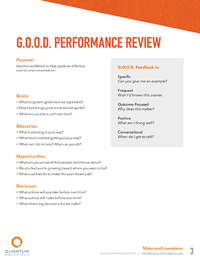
Quantum Workplace utilizes its proprietary GOOD template for its internal monthly manager-employee performance discussions, highlighting its importance within their company culture. GOOD is an acronym representing Goals, Obstacles, Opportunities, and Decisions. This template is particularly effective for monthly one-on-one meetings, enabling managers and employees to step back and review the broader context of their work.
- Goals: This section prompts a review of current objectives and progress made. It encourages employees to articulate what they aim to achieve in the short term.
- Obstacles: Here, the focus is on identifying any challenges or roadblocks preventing progress towards goals. This allows for proactive problem-solving.
- Opportunities: This segment encourages forward-thinking, exploring potential areas for growth, innovation, or new initiatives.
- Decisions: This final component focuses on actionable steps and commitments made during the conversation, ensuring accountability and forward momentum.
Pros: This template actively encourages dialogue, deep reflection, and forward-looking planning.
Cons: It does not explicitly include metrics for measuring or comparing employees, though the company philosophy is not to encourage such comparisons.
2. Quarterly Check-In Template: Maintaining Momentum
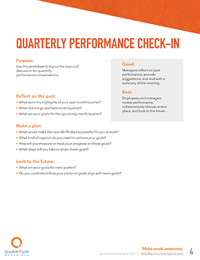
For organizations where monthly reviews are not feasible, quarterly check-ins serve as a vital alternative. This template guides employees and managers in collaboratively reviewing performance, developing action plans, and looking ahead.
- Reflect on the Past: This section typically involves a review of achievements, challenges, and key learnings from the preceding quarter.
- Make a Plan: Focuses on outlining specific actions and strategies to address identified areas for improvement or capitalize on opportunities.
- Look to the Future: This part of the template centers on setting objectives for the next quarter and aligning them with broader team or organizational goals.
Pros: Allows for more immediate action on performance insights and adjustments.
Cons: May not always maintain a strong focus on long-term organizational objectives and individual career trajectories.
3. Mid-Year Performance Review Template: Course Correction
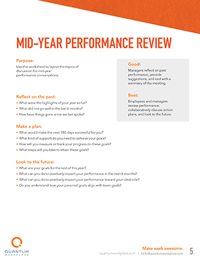
The mid-year performance review is a critical juncture for assessing progress toward annual goals and making necessary adjustments. This template typically covers key highlights, obstacles encountered, and a strategic plan for the remainder of the year.
- Reflect on the Past: A review of performance during the first half of the year, including successes and challenges.
- Make a Plan: Development of concrete steps to improve performance or overcome obstacles identified in the first half.
- Look to the Future: Setting revised goals or reinforcing existing ones for the second half of the year, ensuring alignment with year-end objectives.
Pros: Provides a crucial opportunity for recalibration before the end of the performance cycle.
Cons: If this is the only formal review conducted, it leaves a significant gap between evaluation periods.
4. Annual Performance Review Template: Comprehensive Evaluation
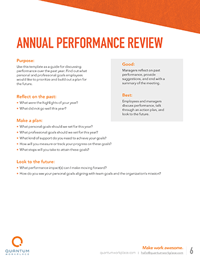
The annual performance review serves as a summative assessment of an employee’s performance over the entire year. It is also an opportune moment to identify employee aspirations for the upcoming performance cycle.
- Reflect on the Past: A detailed summary of performance, achievements, and contributions throughout the year.
- Make a Plan: Establishing new goals and development objectives for the next year, often linked to career aspirations.
- Look to the Future: Setting a clear direction for the employee’s growth and contribution in the upcoming year.
Pros: Offers a holistic view of an employee’s performance over an extended period.
Cons: Reviewing an entire year’s performance in a single conversation can be challenging and may lack the depth of more frequent check-ins.
5. One-Page Performance Review Template: Simplicity and Speed
For organizations seeking a concise evaluation, a one-page template offers a streamlined approach. These templates often feature a defined rating scale for quick assessment.
Pros: Efficient and straightforward, suitable for brief evaluations.
Cons: May offer limited space for in-depth feedback or encourage a less interactive discussion.
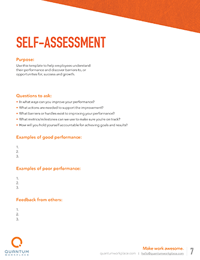
6. Self-Assessment Template: Employee Ownership
A self-assessment empowers employees to reflect on their own performance, identify barriers, and recognize opportunities for discussion with their managers. This process encourages employees to take ownership of their career paths and provides managers with valuable insights for coaching.
- Key Questions: Prompts that encourage introspection on responsibilities, accomplishments, and areas for development.
- Examples of Good Performance: Employees articulate specific instances where they demonstrated strong performance.
- Examples of Areas for Improvement: Employees identify situations or skills where they can enhance their effectiveness.
Pros: Fosters reflective habits and encourages employees to be proactive about their performance.
Cons: Does not incorporate feedback from peers or managers, offering only a singular perspective.
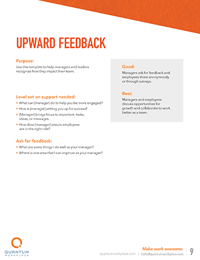
7. Upward Feedback Template: Managerial Accountability
It is crucial for managers to solicit feedback on their own effectiveness. Upward feedback allows employees to share their perspectives on their manager’s performance, typically with the manager’s supervisor. This process enables managers to identify areas for improvement and collaborate with their teams for collective growth.
- Support Needed: Employees articulate the support they require from their manager to succeed.
- Soliciting Feedback: Direct questions about the manager’s leadership, communication, and support.
Pros: Opens channels for constructive, two-way conversations about managerial effectiveness.
Cons: Employees may harbor concerns about potential repercussions for providing candid feedback.
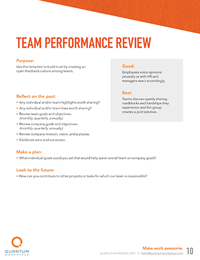
8. Team Performance Review Template: Collective Success
High-performing teams are fundamental to organizational success. This template is designed to foster an open feedback culture within teams, enabling them to discuss performance openly, share challenges, and collaboratively develop solutions.
- Reflect on the Past: A review of team accomplishments and challenges during the period.
- Review Team Goals: Assessment of progress against monthly, quarterly, or annual team objectives.
- Make a Plan: Development of strategies to improve team collaboration and effectiveness.
- Look to the Future: Setting future team goals and initiatives.
Pros: Provides insight into the overall performance of a team, not just individual contributions.
Cons: The results can be skewed by exceptionally high or low performers within the team.
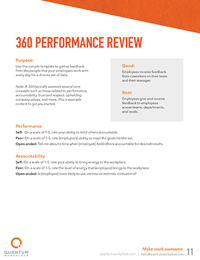
9. 360 Performance Review Template: Holistic Perspective
A 360-degree review gathers feedback from an employee’s peers, direct reports, and managers, providing a comprehensive view of their performance. This approach sheds light on strengths and challenges that might not be apparent through a manager’s direct observation alone.
- Performance and Accountability: Evaluation of the employee’s ability to meet expectations and take responsibility.
- Trust and Respect: Assessment of interpersonal dynamics and professional conduct.
- Upholding Company Values: Review of how the employee embodies organizational principles.
Pros: Offers a well-rounded perspective on an employee’s actions and impact.
Cons: May be challenging for some individuals to provide accurate and objective assessments of their colleagues.
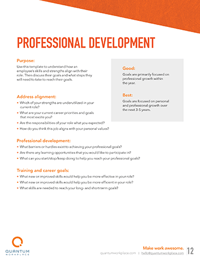
10. Professional Development Template: Cultivating Growth
Professional development and career growth are significant drivers of employee engagement and retention. This template facilitates discussions on aligning employee strengths, skills, and goals with their current roles and future career aspirations, typically over a 3-5 year horizon.
- Address Alignment: Assessing the congruence between an employee’s capabilities and their job responsibilities.
- Discuss Development: Identifying areas for skill enhancement and career progression.
- Training and Goals: Outlining specific training programs and developmental milestones.
Pros: Promotes aligned expectations and fosters long-term career planning.
Cons: Can sometimes be general, requiring specific follow-up to ensure concrete actions.
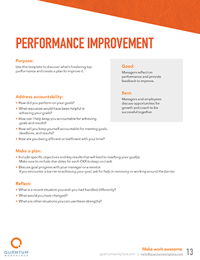
11. Performance Improvement Template: Addressing Underperformance
When an employee is not meeting expectations, a performance improvement plan (PIP) is often necessary. This template helps identify the root causes of performance issues and establishes a structured plan for improvement.
- Accountability: Clearly defining the performance gaps and the expected standards.
- Make a Plan: Outlining specific, measurable, achievable, relevant, and time-bound (SMART) goals for improvement.
- Reflect: Regular check-ins to monitor progress and provide support.
Pros: Provides a structured approach to address declining performance and offers employees a fair opportunity to improve.
Cons: Requires significant commitment and follow-through from both the manager and the employee.
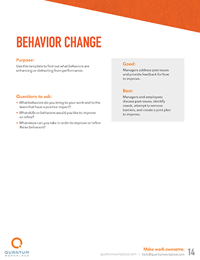
12. Behavior Change Template: Shaping Workplace Conduct
Employee behaviors significantly impact individual and team success. This template assists in understanding and addressing behaviors that either enhance or hinder performance.
- Questions to Ask: Prompts designed to explore the impact of specific behaviors and identify underlying motivations.
- Action Planning: Developing strategies to foster positive behavioral change.
Pros: Facilitates collaborative identification of issues, needs, and barriers related to workplace behavior.
Cons: The effectiveness of the conversation is heavily dependent on the employee’s willingness to engage and self-reflect.
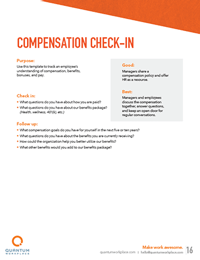
13. Compensation Check-In: Transparency and Alignment
Open communication regarding compensation is vital. This template facilitates discussions about salary, benefits, bonuses, and pay equity, ensuring employees and managers are aligned and addressing any questions or concerns.
- Check-in: Initial discussion to understand employee expectations and current compensation structure.
- Follow-up: Subsequent conversations to discuss progress, performance impacts on compensation, and future considerations.
Pros: Promotes pay transparency and reinforces a culture of open dialogue around compensation.
Cons: It is not always possible to meet every employee’s compensation expectations.
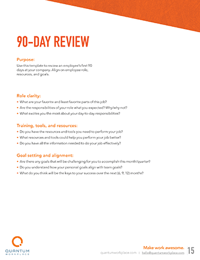
14. 90-Day Review Template: Onboarding Success
For new hires, the first 90 days are critical for integration and understanding. This template provides an early assessment of their performance, helps set short-term goals, and aligns them with the company’s vision.
- Role Clarity: Ensuring the new hire fully understands their responsibilities and expectations.
- Training, Tools, and Resources: Assessing whether the employee has the necessary support to succeed.
- Goal Setting and Alignment: Establishing initial performance objectives and ensuring they align with team and organizational goals.
Pros: Offers crucial clarity and early performance feedback for new employees, enhancing their integration experience.
Cons: Primarily focused on the initial onboarding period and may not be suitable for long-term performance evaluation.
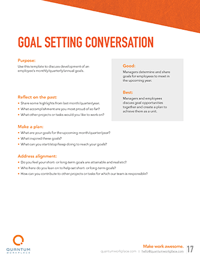
15. Goal Setting Conversation Template: Defining the Path Forward

Effective goal-setting is a cornerstone of performance management. This template guides managers and employees in establishing clear, measurable, and aligned goals at the monthly, quarterly, or annual level.
- Reflect on the Past: Reviewing previous goals and their outcomes.
- Make a Plan: Defining new SMART goals for the upcoming period.
- Address Alignment: Ensuring individual goals are connected to team and organizational objectives.
Pros: Facilitates the creation of aligned and measurable objectives, providing a clear roadmap for employees.
Cons: Requires regular follow-up and discussion throughout the performance cycle to remain effective.
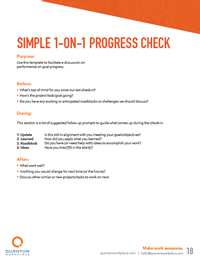
16. Simple 1-on-1 Progress Check: Continuous Communication

While formal reviews are important, regular weekly check-ins are essential for ongoing communication. This template facilitates brief, focused conversations to address immediate obstacles and monitor progress in real-time.
- Key Discussion Points: A brief agenda covering progress, challenges, and immediate priorities.
Pros: Enables quick and frequent communication, fostering agility and real-time problem-solving.
Cons: Requires managers to allocate dedicated time for each employee’s weekly check-in.
Elevating Performance Reviews from Administrative Tasks to Strategic Initiatives
Performance reviews, when approached strategically, serve to align teams with organizational objectives, drive employee and business success, and bolster engagement and culture. By emphasizing the value of feedback, these reviews transform into powerful tools for development and career advancement. Well-designed performance review templates empower HR and managers by:
- Ensuring Consistency and Fairness: Standardizing evaluation processes across the organization.
- Facilitating Meaningful Conversations: Guiding discussions toward development and growth.
- Providing Clear Documentation: Creating a reliable record of performance and feedback.
- Driving Accountability: Setting clear expectations and tracking progress.
- Identifying Talent Trends: Offering insights into organizational strengths and development needs.
How Quantum Workplace Streamlines Performance Reviews
Performance conversations need not be arduous. Quantum Workplace’s platform ensures managers and employees remain synchronized through engaging performance reviews. Their performance review software provides teams with reliable context, enabling more objective and productive discussions. Key features include:
- Customizable Reviews: Flexible review modules can be tailored to specific organizational needs and cultural nuances.
- Managerial Habit Building: Integration into existing workflows helps managers develop consistent coaching practices and formalize conversation cycles.
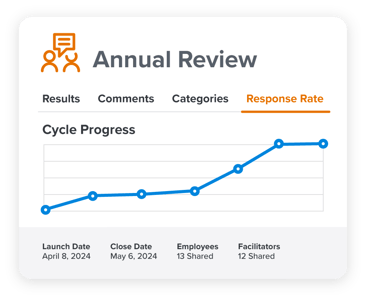
- Response Rate Tracking: Real-time monitoring of review cycle status ensures accountability and timely completion.
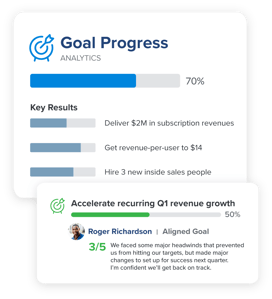
- Embedded Performance Goals: Direct integration of goals into performance evaluations facilitates objective, growth-oriented conversations.
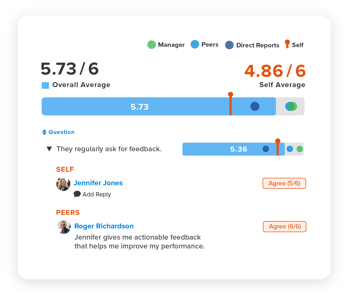
- Multi-Rater Feedback: Incorporation of feedback from various sources provides a holistic view for development-oriented discussions.
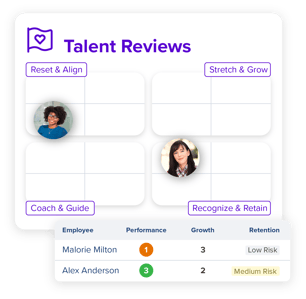
- Performance Data Visualization: Talent dashboards offer a comprehensive organizational overview, aiding in strategic talent management decisions.
Performance Review Template FAQs
What are the most important sections in an employee review template?
Effective templates include sections for self-assessment, manager assessment, goal achievement review, development planning, and overall performance summary. These elements ensure comprehensive evaluation and forward-looking strategy.
How to write a good performance review template?
A good template should be clear, concise, and future-focused. It needs to define performance expectations, prompt reflection on achievements and challenges, and facilitate the creation of actionable development plans. Balancing structure with flexibility is key.
What is an example of a good performance review?
A strong performance review highlights achievements with specific examples, evaluates progress against defined goals, and sets clear expectations for future performance and development. Quantum Workplace’s GOOD template exemplifies this approach.
What are the 5 words for a performance review?
The widely recognized G.O.O.D. model by Quantum Workplace stands for Goals, Obstacles, Opportunities, and Decisions, providing a framework for structured and productive performance conversations.
How can HR create effective performance review templates?
HR teams should design templates that promote fairness, clarity, and strategic alignment. This involves defining desired outcomes, incorporating structured feedback mechanisms, ensuring legal compliance, and making the process user-friendly for both managers and employees.
By embracing a strategic approach to performance reviews, organizations can transform these evaluations from routine administrative tasks into powerful drivers of employee growth, engagement, and overall business success.