The landscape of enterprise artificial intelligence is undergoing a profound transformation, moving beyond traditional software paradigms to embrace dynamic, learning entities. At the forefront of this evolution are AI Agents and Superagents, which are not merely systems or applications but rather extensions of a company’s operational fabric. These intelligent agents learn, adapt, and increasingly "become the company" by internalizing its unique operational nuances, historical data, and tacit knowledge. This paradigm shift holds immense implications for how businesses operate, innovate, and maintain their competitive edge.
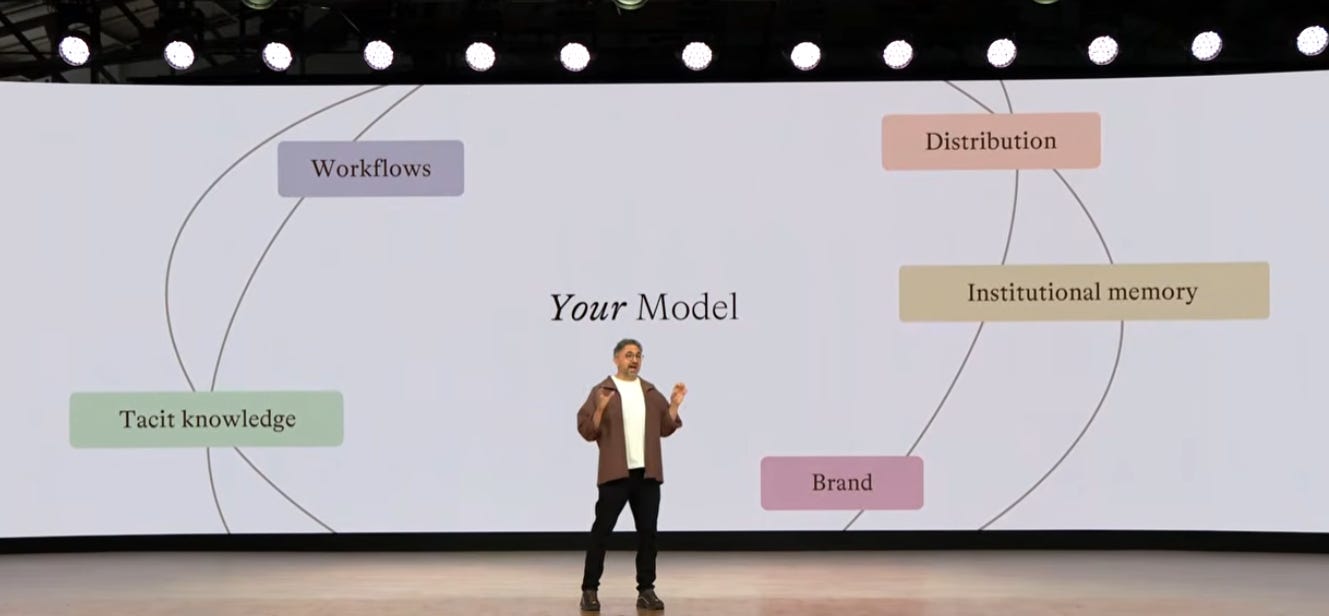
The core of this disruptive shift lies in the ability of AI agents to go beyond generic functionalities and deeply understand an organization’s specific context. Consider the wealth of "tacit knowledge" embedded within a company: decades of accumulated experience, unwritten policies, cultural norms, and unique risk management practices. These elements, often implicit and difficult to codify, represent a significant competitive advantage. Traditional software struggles to capture and leverage this intricate knowledge. However, AI agents, through advanced learning mechanisms, can ingest, process, and internalize this information, effectively becoming repositories of a company’s institutional memory and operational DNA.
A pivotal development in this domain was demonstrated through a collaboration between Josh Bersin’s research and Microsoft. By embedding Bersin’s extensive "Galileo" intelligence into Microsoft Copilot, the system was able to ingest and retrain itself on proprietary intellectual property. The HR team at Microsoft conducted rigorous testing of this implementation, reporting astoundingly positive results. The AI-powered Copilot proved to be not just a tool but a highly informed and trusted HR business partner and consultant, capable of providing detailed insights and citing its knowledge sources. This marked a significant step towards AI acting as a deeply integrated, knowledgeable extension of the enterprise.
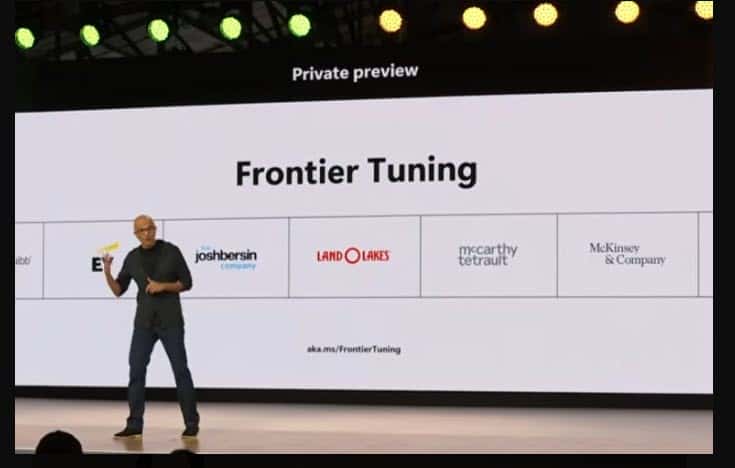
Microsoft has since formalized this capability, making it accessible to businesses through its "Frontier Tuning" initiative. This allows organizations to "fine-tune" their Copilot instances, enabling IT and HR departments to directly embed company-specific policies, hiring guides, compensation structures, onboarding procedures, and other critical operational data. This process "institutionalizes" this information, embedding it directly into the AI system and ensuring that its responses and actions are aligned with the company’s unique framework.
Frontier Tuning: Beyond Retrieval, Towards True Learning
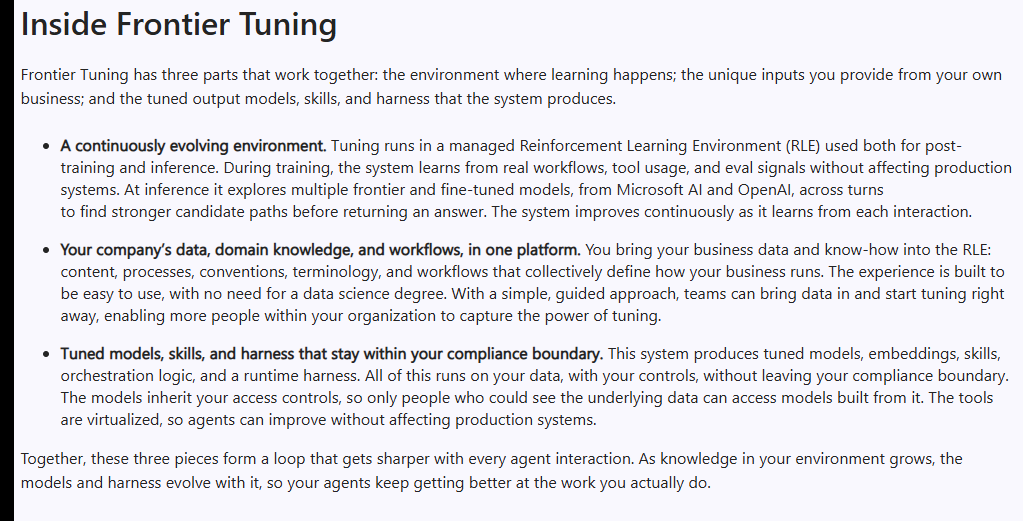
What distinguishes Microsoft’s Frontier Tuning approach from simpler Retrieval-Augmented Generation (RAG) implementations is its capacity for autonomous learning. While RAG systems primarily retrieve information from a knowledge base, Frontier Tuning, through what Microsoft terms the "Reinforcement Learning Environment," allows the AI agent to learn and improve over time based on real-world feedback. This means the AI doesn’t just access information; it actively refines its understanding and operational effectiveness through continuous interaction and evaluation.
This capability was a key highlight at the recent Build 2026 conference in San Francisco, where demonstrations showcased the power of this self-improvement mechanism. The Reinforcement Learning Environment enables the AI agent to receive feedback on the utility and accuracy of its actions, allowing it to adapt and update its knowledge base autonomously, mirroring the way humans learn and gain expertise.
An illustrative example of this autonomous learning in action comes from Microsoft’s internal crisis management agent. Initially effective, the agent encountered new challenges with the onset of complex global events like the war in Ukraine and subsequent conflicts, which introduced unforeseen scenarios such as employees facing internet outages or requiring family relocation. The Reinforcement Learning feature allowed this agent to update itself by learning from these new situations and incorporating necessary policy adjustments, thereby enhancing its preparedness and response capabilities for future crises.
A New Era of Enterprise AI Personalization
Satya Nadella, Microsoft’s CEO, has emphasized this strategic direction, asserting in his keynote address to the CEO council that the true value of an AI model lies in its customization and uniqueness to a specific company, rather than its broad dissemination online. This philosophy is now being productized, making it easier for IT and HR departments to tune, optimize, and personalize AI systems.
The new "harness" layer within MS Copilot is designed to facilitate this personalization. It allows Copilot to host not only proprietary Microsoft models but also those from OpenAI and Anthropic, as well as custom-tuned models developed by individual organizations. This opens up possibilities for specialized AI agents tailored to specific departmental needs. For instance, R&D teams could leverage their own fine-tuned models, trained on confidential internal data, to accelerate innovation without compromising intellectual property.
Microsoft’s Strategic Expansion: Launching Proprietary AI Models
Beyond enabling customer-driven AI personalization, Microsoft is also making significant strides in developing its own advanced AI models. A recent announcement by Mustafa Suleyman revealed the launch of seven new AI models, specifically optimized for various business use cases. This strategic move marks a departure from Microsoft’s previous reliance on its partnership with OpenAI, enabling the company to develop competitive alternatives to models like Anthropic’s Claude and OpenAI’s GPT series.
These new Microsoft-developed models are designed for high efficiency and offer a clean, licensed foundation for enterprise AI solutions. Crucially, they are built without relying on the scraping of internet content, a common practice that can raise intellectual property concerns. For business leaders, this offers a more secure and ethically sound AI infrastructure.
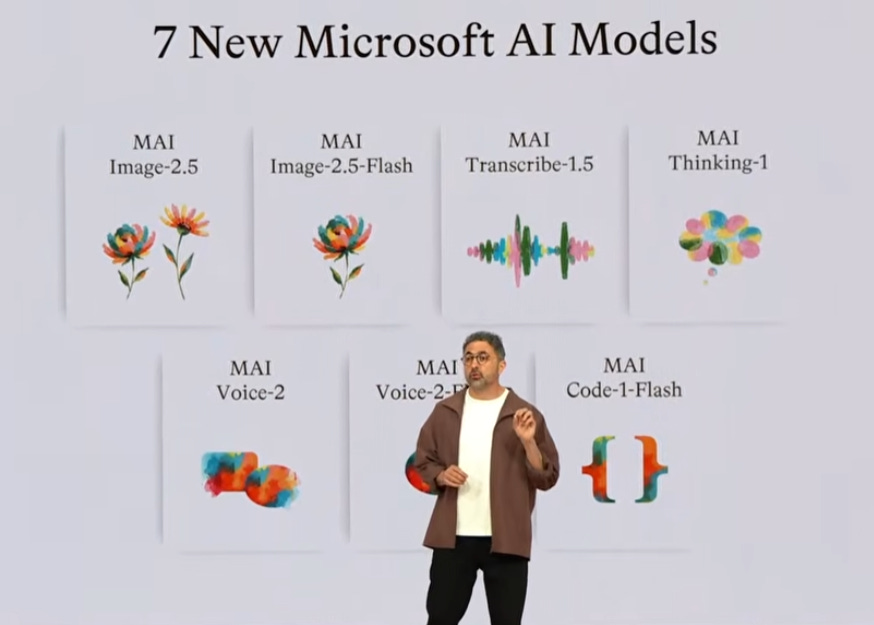
A key differentiator highlighted by Suleyman is the assurance that these proprietary models do not share customer intellectual property with other users. This contrasts with some existing AI services, where opting out of data sharing for model training might be an explicit user action. For organizations handling sensitive data, such as intellectual property or confidential research, this assurance is paramount. The ability to build solutions that do not inadvertently leak proprietary information is a significant advantage in the competitive enterprise AI market.
Real-World Impact and Industry Adoption
The implications of this shift are already being observed across various sectors. Mayo Clinic, for instance, is collaborating with Microsoft to develop a specialized "New Frontier Model for Healthcare." This model aims to integrate deep clinical practices and best-practice knowledge, making it accessible to clinicians and doctors for enhanced patient care and operational efficiency. This mirrors the approach in human capital management, where best practices are observed, studied, and documented to drive organizational excellence.
In another compelling use case, Land-O-Lakes has been piloting Microsoft’s MAI-Thinking-1 reasoning model. Through fine-tuning with thousands of internal documents, Teams messages, and Outlook emails, the company customized the model for its butter formulation process. According to Microsoft senior product manager Tanaya Yadav, this tailored version of MAI-Thinking-1 demonstrated superior accuracy and a tenfold cost-efficiency advantage over OpenAI’s GPT-4.5. This highlights the tangible benefits of deeply embedding proprietary data and processes into AI models for specific business challenges.
For organizations operating within the Microsoft ecosystem, this presents a compelling opportunity. The ability to fine-tune Copilot with internal data and leverage self-improving AI agents promises to enhance employee self-service capabilities and streamline various HR and operational functions. Companies are encouraged to engage with Microsoft and its partners to explore these solutions.
Broader Implications and Future Outlook
The strategic direction taken by Microsoft in the enterprise AI space appears robust, supported by strong leadership and a commitment to continuous innovation. The focus on personalized, self-improving AI agents, coupled with the development of proprietary, secure AI models, positions the company to play a dominant role in the future of enterprise AI. This approach has the potential to unlock significant value for businesses by transforming how they leverage data, knowledge, and human expertise.
The ongoing advancements in AI, particularly in areas like frontier tuning and reinforcement learning, signify a move towards AI that is not just a tool but a strategic partner. As AI agents become increasingly sophisticated in understanding and internalizing unique organizational contexts, they will undoubtedly reshape business operations, drive greater efficiency, and unlock new avenues for innovation. The journey from traditional systems to intelligent, learning agents is well underway, and Microsoft’s initiatives appear poised to be a major catalyst in this ongoing revolution.
Additional Information and Resources:
For those seeking deeper insights into these developments, several resources are available:
- Podcast: A discussion on the high cost of AI, frontier fine-tuning, edge computing, and Microsoft and Nvidia’s roles can be found at joshbersin.com/podcast/addressing-high-cost-of-ai-frontier-fine-tuning-edge-computing-microsoft-and-nvidia/.
- Research and Podcasts: A comprehensive collection of research and podcasts related to enterprise AI is available on the Galileo platform at getgalileo.ai.
- Related Articles:
- "The Reinvention of Workday: From System of Record to Platform of Agents" (joshbersin.com/2026/04/the-reinvention-of-workday-from-system-of-record-to-platform-of-agents/)
- "Could Microsoft Win The War For Enterprise AI?" (joshbersin.com/2026/04/could-microsoft-win-the-war-for-enterprise-ai/)
- "The AI vs. Labor Economy, Why Benefits Are Being Cut, The Role of Legacy Systems" (joshbersin.com/podcast/the-ai-vs-labor-economy-why-benefits-are-being-cut-the-role-of-legacy-systems/)
- "The Context Layer (Semantic Layer) In Enterprise AI (And Where Business Rules Go)" (joshbersin.com/podcast/the-context-layer-semantic-layer-in-enterprise-ai-and-where-business-rules-go/)
- "The Superagent for HR: Galileo Mars Release" (getgalileo.ai)