The global market for professional development, encompassing training, certification, and upskilling, is a colossal industry valued at over $400 billion. A significant portion, nearly a third of this market, is dedicated to skills and technologies that transcend specific company needs. For decades, this demand has been met by a diverse array of training providers, including online course libraries, video platforms, simulation tools, expert assessments, and various forms of professional certification and accreditation. This sector has historically been resilient to economic downturns, as continuous professional growth and skill enhancement are perpetual requirements for individuals and organizations striving for career advancement and competitive advantage.
However, the landscape of online learning is undergoing a rapid and fundamental transformation, driven by technological advancements and evolving consumption patterns. Prominent players that once defined the digital learning space, such as Udacity (now part of Accenture), Coursera, Udemy (recently acquired by Coursera), LinkedIn Learning, SkillSoft, and Pluralsight, alongside platforms like MasterClass, TEDx, and BigThink, are finding their established models challenged. Recent market movements, including the significant stock price declines of publicly traded learning companies and the consolidation of major platforms like Coursera and Udemy, signal a seismic shift. This is not attributed to a lack of managerial acumen, but rather to a profound alteration in the technological infrastructure and how individuals consume learning content.
The Shifting Paradigm: From Course Sales to Holistic Growth
The core demand for professional development remains robust. Every individual, irrespective of their job function—be it in IT, sales, marketing, finance, support, or HR—possesses career aspirations that necessitate continuous skill acquisition. This demand can be broadly categorized into five distinct levels of professional growth, a framework that helps delineate the evolving needs of learners.
Level 1: Foundational Understanding – The Entry Point
At the entry level, individuals new to a profession, role, or career path seek foundational knowledge and often "certification" in the basics. While historically, professional certifications from bodies like SHRM or HCI held significant weight, their perceived value can fluctuate, with some employers placing less emphasis on them as market dynamics evolve. This stage requires learning fundamental concepts, industry jargon, core principles, and an overview of essential tools.
Level 2: Building Competence – The Experienced Professional
Professionals with two to three years of experience possess foundational knowledge but often lack the depth to tackle complex challenges. This level demands exposure to case studies, advanced use-case scenarios, and training that pushes their cognitive boundaries. For instance, a recruiter aiming to become a senior recruiter would need to delve into advanced sourcing strategies, sophisticated skills assessment techniques, candidate marketing, and the integration of artificial intelligence in recruitment.
Level 3: Deepening Expertise – Specialization and Breadth
This stage is characterized by professionals who have deep expertise in a narrow field but lack breadth across related areas. A recruiter specializing in tech hiring, for example, might need to develop skills in executive search or sales team recruitment. The need here is for exposure to global markets, multi-industry experiences, or diverse technological applications. Often, individuals at this level seek to move beyond their niche, transitioning into leadership roles such as "Head of Recruiting." This transition itself represents training for a new career trajectory, opening doors to further learning opportunities.

Level 4: World-Class Advancement – Continuous Innovation
Professionals at this advanced level, possessing decades of experience, are driven to stay ahead of emerging trends, identify cutting-edge technologies, and broaden their industry perspectives. Senior leaders, for instance, might find their expertise confined to a specific industry. Shifting to a new sector can provide invaluable exposure to novel approaches, fostering greater wisdom, perspective, confidence, and enhanced value creation. This level also encompasses moves into senior executive roles, transitions from large corporations to startups, or exploration of vast new technological or scientific domains. The desire for depth in adjacent fields often leads these professionals to seek deep dives into parallel or "T-shaped" skill development.
Level 5: Thought Leadership – Shaping the Future
The pinnacle of professional development is occupied by a select group of senior, tenured experts—the "10X engineers" or "C-level gurus." Having proven their expertise and impact, they seek to elevate their influence by teaching, mentoring, coaching, or writing. Their motivation is not fame, but a desire to connect with peers, contribute to professional communities, engage in deep research, and learn from a global network of fellow experts and advanced case studies.
The AI Catalyst: Reimagining Learning Delivery
The traditional professional development market, characterized by packaged solutions, often struggles to precisely align its offerings with the nuanced needs of advancing professionals. An "advanced" course might introduce unfamiliar topics, but its efficacy diminishes if it doesn’t cater to the specific developmental stage of a Level 3 or Level 4 professional. This is precisely where Artificial Intelligence (AI) is poised to revolutionize the industry by enabling the custom assembly of learning experiences tailored to individual goals.
The widespread adoption of AI tools like ChatGPT, with millions of users weekly, highlights a significant trend: a substantial portion of interactions, estimated at 40% or more, are driven by learning objectives—seeking information, developing skills, or solving problems. This surge in AI-driven learning has outpaced traditional Learning & Development (L&D) platforms in a remarkably short period. Two primary factors underpin this rapid growth:
-
Intuitive Inquiry-Based Learning: AI’s ability to facilitate natural language queries makes learning feel as intuitive as childhood exploration. The ease of asking questions and receiving immediate, relevant responses encourages curiosity and self-directed learning, mirroring our innate human drive to explore and understand.
-
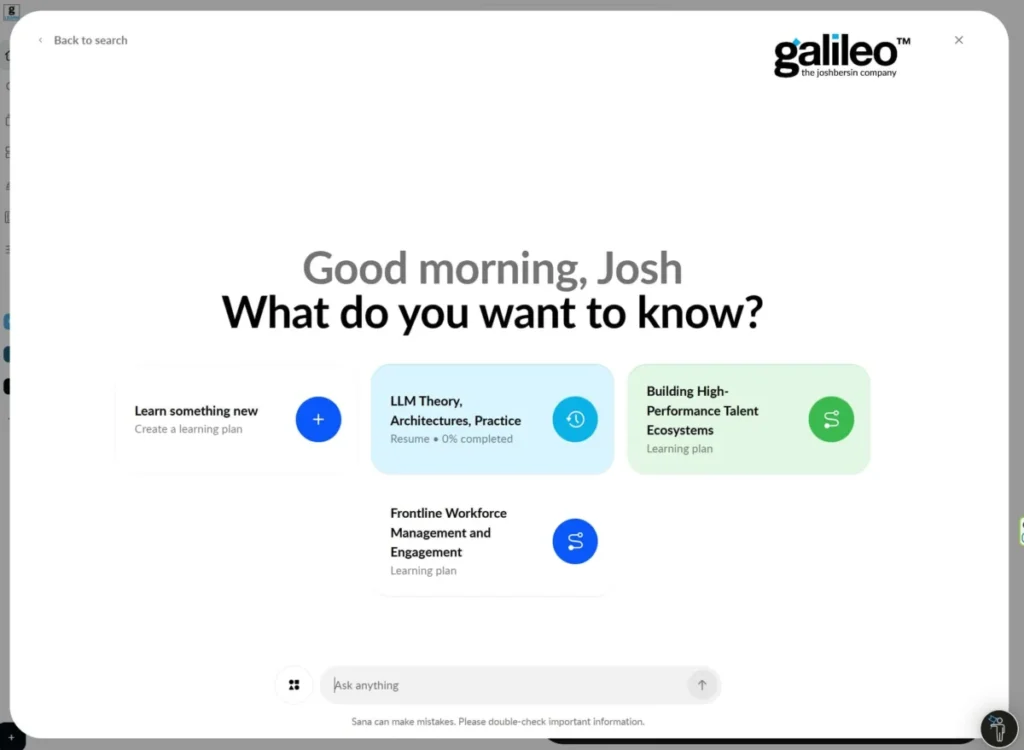
Holistic Information Interconnection: Advanced AI models, like those powering platforms such as Galileo, interconnect information through AI embeddings. This creates a systemic and holistic knowledge base, liberating learners from rigid, linear learning paths. Users can dynamically ask for explanations, delve deeper into specific topics, or skip sections as needed, significantly enhancing the speed and quality of their learning journey.
Platforms like Galileo are designed to offer examples, scenarios, challenges, and simulations on demand. Users can opt for structured courses or engage with an AI "Supertutor" that intelligently provides new information and experiences based on their role, past interactions, and other contextual data. This dynamic, personalized approach represents a breathtaking evolution in how professional development is delivered.

Market Disruption: From Publishing to Dynamic Content Delivery
This fundamental shift from "publishing courses" to "dynamically delivering content" is fundamentally reshaping the professional development market. The industry can be segmented into five key areas: learning platforms (LMS, LXP), learning content (course libraries, executive education), content development tools, certifications (testing and accreditation), and learning consultants. Each of these segments must adapt to an AI-native infrastructure. This is not a minor adjustment but a discontinuous, rapid evolution.
The "old model" of online learning, prevalent since the late 1990s, was a publishing paradigm. It involved identifying needs, engaging subject matter experts, designing courses, and then "publishing" them onto platforms for users. While this model disrupted traditional classroom training and continues to serve high-end executive education, the majority of professional development is migrating.
The new AI-First or AI-Native model leverages AI for content collection, generation, translation, and delivery. AI-native platforms can curate and synthesize vast amounts of information, including proprietary company content, to create highly personalized learning experiences. This process automates complex tasks previously requiring extensive human effort, such as instructional design, translation, and video production. Features like career pathways, learning paths, skills taxonomies, and assessments can now be machine-generated, transforming the vendor’s role from simply selling content and platforms to offering an optimized, personalized, and highly valuable user experience.
For instance, the ability of AI tools to automatically generate chapters and summaries from video content, as seen with YouTube’s integration of features that leverage AI like Gemini, demonstrates the potential for democratizing educational content. Furthermore, AI’s capacity to discern a user’s reading level, learning preferences, and technical interests allows for hyper-personalized learning journeys. Platforms that integrate user data, including meeting transcripts and communication styles, can create learning experiences that are deeply attuned to an individual’s professional context.
Innovation Unleashed: The Future of Learning
The online learning industry, which had experienced a period of stagnation in innovation, is now brimming with possibilities thanks to AI. This resurgence opens doors for hundreds of novel approaches and solutions.
Implications for Professionals, HR, and L&D Buyers
Every entity involved in training, certification, and professional education must confront this paradigm shift. While existing course libraries and subscriptions won’t vanish overnight, the emergence of personalized, AI-centric providers will likely lead to the acquisition of legacy vendors.
The future workplace will increasingly feature AI agents integrated into employee workflows, accessible via smartphones and personal computers. This ubiquitous presence means that engaging employees with learning content will become more seamless, provided the backend infrastructure can effectively feed these agents. This mirrors the revolution brought about by Google Search, which fundamentally altered how users accessed information, rendering portals less critical if they weren’t search-enabled.
As employees begin utilizing internal AI agents for various tasks, from accessing HR benefits to understanding tax statements, they will inevitably pose questions like, "What is my path to promotion?" This presents a transformative opportunity to reimagine learning deployment. Imagine an hourly worker being informed by their agent that upskilling in a particular area could qualify them for a higher-paying shift. Such use cases are now readily achievable with AI.
Organizations are actively exploring AI-powered tools for leadership coaching, assessments (from vendors like Skillable), content creation (including video and audio generation), and course development. The coming year presents a critical juncture for L&D leaders to fundamentally re-engineer their strategies. The traditional L&D landscape, once burdened by extensive manual work in areas like translation, skills architecture, LMS publishing, and metadata management, is being streamlined. AI-driven automation is poised to eliminate many of these laborious tasks. Companies that have strategically re-engineered their L&D programs, incorporating AI, have reported significant cost reductions—up to 40%—coupled with a demonstrably more personalized employee learning experience.
For vendors and consultants, the message is clear: embrace innovation. Partnering with, building, or acquiring necessary AI platforms is crucial for survival and growth. This era offers an unparalleled opportunity to redefine how individuals are developed and supported, with an unprecedented demand for effective solutions.
The evolving landscape promises continued innovation, with upcoming research on L&D maturity models and in-depth case studies poised to offer further insights. Early adoption of AI-fueled professional development platforms, such as Galileo, provides immediate access to this transformative future. The professional development market is not just changing; it is being fundamentally rebuilt, driven by the relentless power of artificial intelligence to personalize, optimize, and democratize learning for every professional.