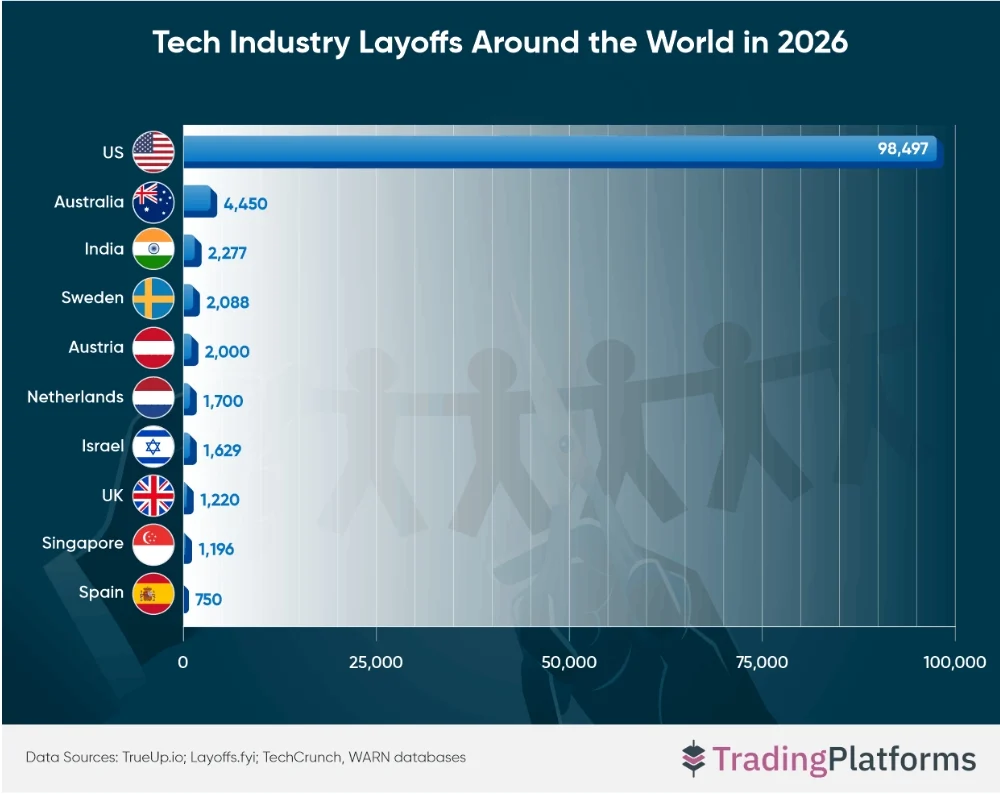
Since the dawn of 2026, the technology sector has witnessed a significant wave of workforce reductions, with at least 127,998 employees laid off, according to a comprehensive new analysis by TradingPlatforms. This substantial figure represents a critical inflection point for an industry often perceived as a bastion of perpetual growth. While broader economic headwinds have undeniably played a role, the research from TradingPlatforms points to a more nuanced and increasingly prevalent driver: the accelerating adoption of artificial intelligence (AI) and automation.
The findings reveal a striking correlation, with approximately 60% of these redundancies directly attributed to AI integration, rather than solely economic downturns. Specifically, the data indicates that 76,979 of the recorded layoffs are linked to companies investing in AI and automation infrastructure, suggesting a deliberate strategic shift in operational paradigms. This trend signals a profound reshaping of the tech workforce, moving beyond cyclical economic adjustments to a more fundamental alteration of job functions and skill requirements.
The AI Narrative: A Closer Examination
While the pronouncements from many tech companies often frame these layoffs as a direct consequence of AI adoption, Stanislava Savisheva, an analyst at TradingPlatforms, urges a more critical perspective. She posits that the reality behind these announcements is considerably more complex, with AI often serving as a convenient, yet not entirely complete, explanation.
"Artificial intelligence has become the defining narrative behind this year’s tech sector layoffs, but the picture is more complex than the headline suggests," Savisheva stated in the research findings. "In some cases, it is genuinely reshaping workflows and reducing the need for entire operational layers, particularly in areas such as customer support, basic coding, moderation, and back-office functions." These are indeed areas where AI-powered tools can automate repetitive tasks, analyze large datasets, and provide rapid responses, thereby diminishing the human capital traditionally required for such operations.
However, Savisheva also highlights a less transparent aspect of this trend: "In other cases, ‘AI restructuring’ is being used to justify large-scale cost reductions." This suggests that the embrace of AI may, in some instances, be a cover for broader financial consolidation or a strategic move to streamline operations under the guise of technological advancement. This dual narrative underscores the challenge for both employees and observers in discerning the precise motivations behind workforce reductions in the current tech landscape. The fact that these cost-cutting measures are occurring even as companies continue to increase investment in core infrastructure, cloud computing, and automation further complicates the narrative, indicating a selective reallocation of resources rather than a universal retreat.
A Timeline of Tech Layoffs in 2026 (Hypothetical Chronology Based on Research Scope)
While the TradingPlatforms research covers the period from January 2026 onwards, understanding the trajectory of these layoffs provides crucial context. The initial months of 2026 saw a steady trickle of announcements from various tech firms, often citing "economic headwinds" and "restructuring." By the second quarter, the volume of layoffs began to escalate, with an increasing number of companies explicitly mentioning AI and automation in their official statements.
- January 2026: Early reports of layoffs begin to surface, with many companies attributing them to post-pandemic economic adjustments and a cooling venture capital market.
- February – April 2026: The pace of layoffs picks up. Several prominent tech giants begin to announce significant workforce reductions, with some starting to link these actions to "efficiency drives" and "strategic realignments" that include AI integration.
- May 2026: The TradingPlatforms research period begins, capturing a significant surge in layoffs directly tied to AI investment. Companies involved in cloud infrastructure, customer relationship management (CRM) software, and AI development platforms are among those reporting substantial cuts.
- June – August 2026: The trend solidifies. Layoff announcements become more frequent and more explicit in their connection to AI. Companies are observed to be not only reducing headcount but also actively restructuring teams to align with AI-centric strategies. This period also sees an increase in discussions around the impact on junior roles and the demand for specialized AI talent.
- September – December 2026: The year concludes with the cumulative impact of these layoffs reaching the figures reported by TradingPlatforms. The narrative shifts from reactive cost-cutting to proactive strategic repositioning, with companies outlining long-term plans that heavily feature AI and automation.
This hypothetical chronology illustrates a shift in the stated reasons for layoffs, moving from generalized economic concerns to a more specific focus on technological transformation, particularly AI.

The Shifting "Talent Pyramid": Where Investment is Flowing
The TradingPlatforms data not only quantifies layoffs but also sheds light on the strategic reallocation of talent and investment within the tech industry. Companies are actively reshaping what is often referred to as their "talent pyramid." Traditionally, this pyramid has been characterized by a broad base of entry-level and junior employees, with progressively fewer employees at higher, more specialized levels. The current trend suggests a move towards a narrower base and a more concentrated pool of highly skilled professionals at the top.
This reshaping signifies a reduced reliance on large, junior-heavy workforces. The implication is a growing challenge for Human Resources departments in managing early-career hiring pipelines, succession planning for mid-level roles, and fostering internal mobility pathways that are no longer as clearly defined. The traditional ladder of progression, where employees gain experience in foundational roles before moving into more specialized areas, may be becoming obsolete for many.
Simultaneously, many firms are demonstrably reallocating significant investment towards higher-skilled positions. This includes roles directly involved in the development, implementation, and maintenance of AI systems, as well as those in critical areas like cybersecurity and advanced cloud infrastructure. This strategic pivot creates a growing tension between the ongoing layoffs and concurrent hiring efforts.
HR leaders are thus faced with the complex decision of whether to prioritize reskilling existing employees to meet these new demands or to hire externally for specialized talent. This dynamic necessitates a careful balancing act, particularly as companies navigate the challenging terrain of managing internal perceptions and maintaining employee trust amidst such significant organizational shifts. The perceived fairness and transparency of these decisions will be crucial for long-term employee morale and retention.
Implications for the Future of Tech Employment
Savisheva’s analysis points to a fundamental alteration in the job market dynamics within the tech sector. "The shift is reducing demand for entry-level roles while concentrating hiring in higher-skilled technical positions, even as parts of the workforce adapt to new AI-focused career paths," she observed. This suggests that traditional job architecture and compensation structures, which were often built around a predictable, linear progression from entry-level to senior roles, may require substantial revision.
The implications are far-reaching:
- Education and Training: Educational institutions and corporate training programs will need to adapt their curricula to equip individuals with the skills demanded by an AI-driven industry. This includes not only technical proficiency in AI development and data science but also critical thinking, problem-solving, and adaptability.
- Career Development: Employees will need to embrace a mindset of continuous learning and upskilling. The concept of a static career path is likely to be replaced by a more fluid model, where individuals must proactively seek out new skills and adapt to evolving job requirements.
- Hiring Strategies: Companies will need to refine their hiring strategies to identify and attract individuals with the specific, high-level skills required for AI-related roles. This may involve more rigorous assessment processes and a greater emphasis on demonstrable expertise.
- Societal Impact: The concentration of high-skilled jobs could exacerbate existing inequalities if access to the necessary education and training is not equitable. Policymakers and industry leaders will need to address this potential widening of the skills gap.
- Employee Morale and Trust: The continuous cycle of layoffs, even when framed by technological advancement, can erode employee morale and trust. Companies will need to invest in transparent communication, robust support systems for displaced workers, and clear pathways for career development to mitigate these negative effects.
The current wave of layoffs in the tech sector, driven significantly by AI adoption, is not merely a cyclical downturn but a harbinger of a more profound transformation. As companies continue to integrate artificial intelligence and automation, the demand for specialized skills will intensify, while the nature of many traditional roles will fundamentally change. The ability of the tech industry, its workforce, and educational institutions to adapt to this evolving landscape will determine the future of employment in this critical sector. The challenge lies in navigating this transition in a way that fosters innovation, supports a skilled workforce, and mitigates the potential for increased economic disparity.