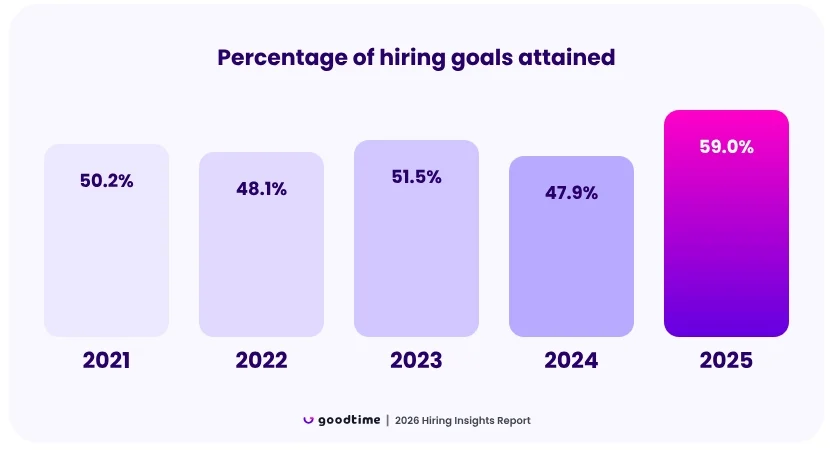
New research paints a stark picture of the hiring landscape in 2025, revealing that an overwhelming nine out of ten companies fell short of their recruitment targets. The findings, detailed in GoodTime’s comprehensive "2026 Hiring Insights Report," indicate that a significant portion of these organizations missed their goals by a substantial margin. Crucially, the primary culprit was not a scarcity of qualified applicants or a lack of effort from talent acquisition teams, but rather systemic operational inefficiencies that are hamstringing the hiring process. This report, which surveyed 504 senior talent acquisition leaders across the United States, highlights the critical need for a fundamental re-evaluation of how organizations approach recruitment, moving beyond traditional task-based methods to embrace strategic, system-driven solutions.
The report, commissioned by enterprise interview scheduling platform GoodTime, identifies interview scheduling as the single largest operational burden within the hiring funnel. Talent acquisition professionals revealed that, on average, they dedicated a staggering 38% of their time to this single function. This significant time sink directly contributes to the widespread failure to meet hiring objectives, creating a cascading effect of delays that can have profound implications for both the organization and potential hires.
The Pervasive Impact of Scheduling Bottlenecks
The research meticulously details the common points of friction that plague interview scheduling. These include protracted scheduling delays, the perennial challenge of limited interviewer availability, the disruption caused by frequent cancellations, and the intricate web of conflicts arising from hiring manager schedules. For any organization that relies on a timely and efficient hiring process, these bottlenecks are more than mere inconveniences; they are significant impediments to success. Each rescheduled interview can easily translate into multi-day delays, and a slow response time to candidates significantly increases the risk that a top-tier prospect will accept an offer from a competitor. In the competitive talent market of recent years, this has become an increasingly acute problem, impacting not only the speed of hiring but also the quality of candidates who remain engaged throughout a protracted process.
The report’s findings are particularly salient in the context of the evolving talent market. While concerns about candidate shortages have been a recurring theme in recent years, the GoodTime report suggests that for many companies, the issue lies not in the availability of talent, but in the organization’s capacity to effectively engage and process that talent. This distinction is critical, as it shifts the focus of improvement from external market dynamics to internal operational strategies.
AI Agents Emerge as a Scheduling Success Story
Amidst these widespread challenges, the research highlights a clear differentiator for organizations that are successfully navigating the hiring maze: the strategic adoption of technology, particularly AI agents for interview scheduling. Companies that have treated interview scheduling as a robust system, rather than an ad-hoc task, are demonstrably outperforming their peers.
The data is compelling: teams that leveraged automated or AI-driven scheduling tools were 1.6 times more likely to achieve near-perfect hiring goal attainment. Specifically, 13% of these technologically advanced teams reported hitting between 90% and 100% of their hiring goals, a significant improvement over the 8% achieved by organizations that did not utilize such tools. This indicates a strong correlation between efficient, automated scheduling and overall recruitment success.
Furthermore, the study revealed that organizations prioritizing scheduling efficiency through AI were also less reliant on other, potentially less effective, automated tools for candidate engagement. These high-performing teams were 40% less likely to depend on sourcing bots and 56% less likely to employ chatbots for early-stage candidate interaction. This suggests a more sophisticated approach to talent acquisition, where AI is strategically deployed to streamline core operational functions rather than being used as a broad, and often impersonal, engagement mechanism.
The implication here is that by automating the complex and time-consuming process of interview scheduling, organizations free up their human talent acquisition professionals to focus on more strategic and high-value activities. This could include building stronger candidate relationships, refining talent pipelines, and developing more sophisticated engagement strategies, rather than being mired in the logistical complexities of calendar management.
The Double-Edged Sword of AI: Inhibiting Quality Hiring
While AI agents are proving to be a boon for scheduling efficiency, the broader integration of artificial intelligence into the hiring process presents a new and significant challenge: the rise of fake or AI-assisted candidates. This emerging threat is poised to become a leading concern for talent acquisition teams in 2026, potentially eclipsing even the persistent issues of skills gaps and candidate shortages that dominated 2025.
Hung Lee, founder of Recruiting Brainfood and a contributor to the GoodTime report, articulates the gravity of this situation. "Resumes, answers to application questions, even online portfolios… have all lost value in the era of gen AI," Lee states. He emphasizes that "It’s one of the most urgent tasks of TA teams today to find methods of assessment which are suitable for this era."

The ability of generative AI to produce highly convincing, yet entirely fabricated, application materials means that traditional methods of candidate vetting are rapidly becoming obsolete. Nearly a quarter of talent acquisition leaders surveyed already recognize AI-generated applicants as a current issue, a problem that is intensifying the pressure on hiring pipelines and making the crucial stage of candidate evaluation significantly more complex and error-prone.
Becky McCullough, vice president of talent acquisition and mobility at HubSpot, underscores the heightened need for robust verification processes in her commentary within the report. "A single background check at the end of the process isn’t enough anymore," she asserts. "TA teams now have to confirm identity and authenticity at multiple points." This necessitates a fundamental shift in vetting strategies, moving towards continuous verification and the implementation of advanced identity and authenticity checks throughout the recruitment lifecycle.
The implications of this trend are far-reaching. Organizations that fail to adapt their verification protocols risk onboarding unqualified or even fraudulent candidates, leading to wasted resources, compromised project integrity, and potential reputational damage. The very AI tools that can streamline hiring operations are also creating new avenues for deception, demanding a sophisticated and multi-layered approach to ensuring candidate integrity.
Strategic Growth: Building Better Systems, Not Bigger Teams
Perhaps one of the most surprising revelations from the GoodTime research is the approach taken by top-performing talent acquisition teams. Contrary to what might be expected, these high-achieving teams were less likely to increase headcount compared to their underperforming counterparts. While a substantial 60% of underperforming teams expanded their recruiting staff, fewer than half of the top performers followed suit.
Instead of simply scaling up their human resources, high-performing teams focused on optimizing their existing structures. They achieved this by reorganizing roles, strategically reassigning coordinators from purely logistical tasks to areas that demanded more human-centric skills, such as enhancing candidate experience and engaging in more strategic talent planning. Their success was driven by the development of more efficient systems and processes, rather than by the addition of more personnel.
This organizational philosophy suggests a mature understanding of operational leverage. By investing in systems and refining workflows, these teams were able to achieve greater output with existing resources, demonstrating that the key to scaling talent acquisition lies in intelligent design and process optimization, not simply in increasing team size.
Measuring What Matters: Shifting Focus to Quality of Hire
The metrics that top-performing talent acquisition teams prioritize also reveal a strategic divergence from underperforming groups. The research indicates that high achievers are significantly more likely to anchor their performance measurement in outcomes, particularly the "quality of hire." They were 42% more likely to identify quality of hire as their paramount metric, a stark contrast to the 21% of underperforming teams who placed this crucial indicator at the top of their measurement priorities. Conversely, underperforming teams were more inclined to focus on cost-per-hire, a metric that, while important, can sometimes incentivize speed over substantive quality.
This emphasis on quality of hire suggests a long-term perspective on recruitment. It acknowledges that the ultimate success of a hire is not solely determined by the speed or cost of the onboarding process, but by the candidate’s contribution to the organization’s goals, their retention rate, and their overall impact on team performance and productivity. By prioritizing this metric, top-performing teams are aligning their recruitment efforts with broader business objectives, ensuring that every hire contributes meaningfully to the company’s success.
Key Takeaways for HR Leaders
The GoodTime "2026 Hiring Insights Report" offers a series of actionable recommendations for HR leaders seeking to enhance their hiring processes. These insights underscore the critical need for a proactive and technologically adept approach to talent acquisition.
The report implicitly points to several areas where organizations can conduct a critical self-assessment of their current hiring practices:
- Process Optimization: The pervasive scheduling bottleneck highlights the urgent need to re-evaluate and streamline interview scheduling processes. This may involve the adoption of advanced scheduling software, the implementation of clear interviewer guidelines, and the development of strategies to manage interviewer availability more effectively.
- Technological Integration: The success of AI agents in scheduling underscores the potential of technology to alleviate operational burdens. Organizations should explore how AI and automation can be strategically deployed across various stages of the hiring funnel, from initial candidate screening to post-hire engagement.
- Verification and Authenticity: The rise of AI-generated candidates necessitates a fundamental overhaul of verification protocols. HR departments must implement multi-point verification systems that go beyond traditional background checks to ensure candidate identity and the authenticity of their qualifications.
- Strategic Metric Alignment: A shift in focus from transactional metrics like cost-per-hire to outcome-oriented metrics like quality of hire is crucial. This alignment ensures that recruitment efforts are directly contributing to long-term organizational success.
- Systemic Thinking: The success of top-performing teams in building better systems rather than larger teams emphasizes the importance of a holistic, systemic approach to talent acquisition. This involves analyzing the entire hiring process as an interconnected workflow and identifying opportunities for optimization at every touchpoint.
Shelby Wolpa, founder of Shelby Wolpa Consulting, succinctly captures the core issue: "Recruiters aren’t slow, scheduling is," she states in the report. "Until companies adopt systems that absorb complexity instead of pushing it onto humans, scheduling will remain the single biggest bottleneck in hiring." This sentiment resonates throughout the research, emphasizing that the path to successful hiring in the modern era lies in embracing technological solutions that can manage complexity and empower human talent acquisition professionals to focus on strategic engagement and candidate experience. The findings serve as a critical call to action for organizations to modernize their hiring infrastructure and embrace a more intelligent, efficient, and outcome-driven approach to talent acquisition.