For entrepreneurs who have dedicated years to building a business from the ground up, the decision to transition leadership to a professional management team marks a significant milestone. This evolution, however, often necessitates a fundamental recalibration of how executive compensation is perceived and structured. Founders accustomed to modest personal salaries may find themselves confronting the reality that attracting experienced presidents, chief financial officers (CFOs), or chief operating officers (COOs) requires compensation packages substantially exceeding their previous personal earnings. Even a seasoned CEO, while often benefiting from significant equity incentives, may need to allocate more resources to secure executives possessing critical, specialized capabilities essential for scaling.
New research from Chief Executive Group underscores this evolving landscape, providing concrete data on the compensation paid to senior leadership within private companies and illustrating how these figures escalate with company growth. The findings, detailed in the 2026-2027 CEO & Senior Executive Compensation Report, reveal a median total compensation of $354,608 for presidents of U.S. private companies in 2025. Chief Operating Officers (COOs) earned a median of $282,940, while CFOs received a median of $272,434. These national averages, however, represent a broad overview, with significant variations emerging when analyzed by company size.
The Escalating Investment in Senior Leadership
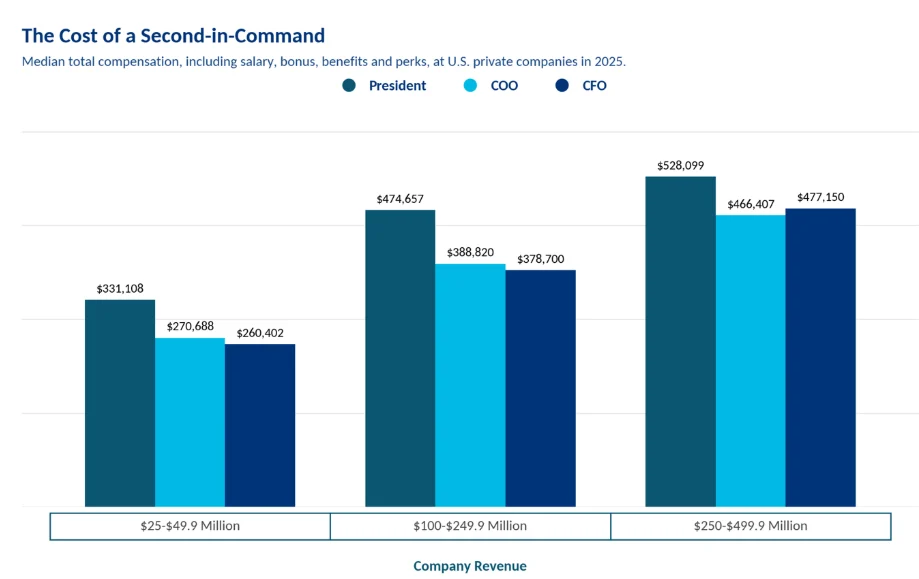
The financial commitment required to onboard top-tier executive talent becomes more pronounced as companies expand their revenue streams. For private companies generating between $25 million and $49.9 million in annual revenue, the median total compensation for presidents stood at $331,108 in 2025. Correspondingly, COOs in this revenue bracket earned a median of $270,688, and CFOs, $260,402.
A substantial leap in compensation is observed in companies with revenues ranging from $100 million to $249.9 million. Here, median compensation for presidents surged to $474,657, with COOs earning a median of $388,820, and CFOs, $378,700. The financial investment intensifies further for larger enterprises. Companies reporting annual revenues between $250 million and $499.9 million saw median compensation reach $528,099 for presidents, $466,407 for COOs, and $477,150 for CFOs.
It is crucial to note that these reported figures encompass a comprehensive compensation structure, including base salary, bonuses, equity awards, benefits, and other perquisites. Furthermore, these data points represent medians, indicating the midpoint of compensation. They do not necessarily reflect the upper echelon of what might be required to attract an executive with exceptional experience or highly specialized skills. For instance, among CFOs at companies with revenues between $100 million and $249.9 million, the top quartile of total compensation reached an impressive $596,198, significantly exceeding the median of $378,700. This suggests that companies planning to recruit such talent should budget based on the higher end of the compensation range, acknowledging that half of the market compensation already surpasses the midpoint.
Navigating the Cost of Strategic Growth
The challenge for business owners and CEOs extends beyond simply being able to afford higher cash compensation for new executives compared to their own packages. The more pertinent question revolves around identifying the specific capabilities a business requires for its next phase of growth and accurately assessing the market value of those capabilities. Often, bringing in a key executive from a larger, more established organization—where compensation structures are typically more robust—can be a strategic imperative. These executives often possess a proven track record and a depth of experience that can directly translate into enhanced organizational capabilities and accelerated growth.
Consider a company poised for expansion into new international markets. This scenario might necessitate the recruitment of a president with a demonstrated history of managing larger, more complex global operations. Alternatively, a founder preparing for a potential sale or seeking substantial outside investment will likely require a CFO with profound expertise in corporate finance, intricate reporting standards, transaction execution, and capital raising strategies. Similarly, a rapidly scaling manufacturing firm might require an operations leader capable of instilling greater discipline and efficiency into its production processes and supply chain management. Each of these specialized roles presents a distinct compensation challenge, demanding a tailored approach.
The Chief Executive Group’s research also highlights the material impact of industry, ownership structure, and profitability on executive compensation. For example, companies backed by private equity firms often present more competitive compensation packages, particularly through performance-based bonuses and equity incentives, compared to many other privately held businesses. This competitive pressure can compel founders seeking top talent to look beyond base salary and explore a broader spectrum of incentives, including performance bonuses, long-term equity awards, and other mechanisms designed to reward executives for their role in building substantial enterprise value.
Rethinking Compensation Benchmarks: Beyond the Founder’s Paycheck
A fundamental distinction often exists between the compensation of a founder-CEO and that of a hired senior executive: ownership stake. Founders typically possess a significant equity interest in the business, which represents a substantial portion of their potential financial return from years of dedicated effort and risk-taking. Hired senior executives, without a comparable ownership percentage, will naturally evaluate an opportunity through a different financial lens. Their primary return on investment is often tied more directly to their salary, bonuses, and short-term incentives.
There is no singular, universally applicable formula for determining the appropriate compensation for a second-in-command. Moreover, simply offering a higher salary does not automatically guarantee superior leadership or performance. As chief executives strategize for their company’s future growth trajectory, relying on their own current compensation as the sole benchmark for attracting essential executive talent can be a misleading approach.
A more effective and insightful strategy involves benchmarking against what comparable companies pay for similar capabilities and structuring compensation packages to align with the specific, measurable results the business expects from its senior leaders. This data-driven approach ensures that investment in executive talent is strategic, competitive, and directly contributes to achieving organizational objectives.
The 2026-2027 CEO & Senior Executive Compensation Report by Chief Executive Group serves as a vital resource, offering detailed benchmarks for presidents, COOs, CFOs, and other senior executive roles. These benchmarks are segmented by company size, industry, ownership structure, and performance metrics, providing a comprehensive and actionable guide for private companies navigating the complex terrain of executive compensation and strategic talent acquisition. By leveraging such data, leaders can make informed decisions that foster sustainable growth and maximize the potential of their organizations.