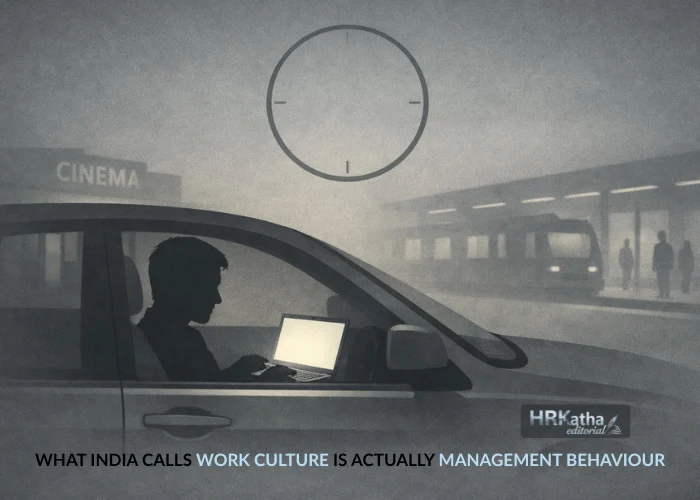
The visual evidence is pervasive and increasingly normalised across India’s professional landscape: a corporate employee balancing a laptop in a parked car, meticulously joining a video conference call between errands; another crouched in a darkened cinema hall, urgently responding to emails just moments before a film begins; a third captured on a bustling metro platform, intently reviewing a presentation on a phone screen. These vignettes, far from being isolated instances of individual dedication, serve as potent indicators of a systemic malaise within India’s contemporary work culture. While often interpreted through the lens of "hustle," "commitment," or "personal choice," a deeper analysis reveals these behaviors are not born of individual preference but are symptomatic of profound structural deficiencies, primarily failures in management to establish clear boundaries, prioritise tangible outcomes over mere visibility, and effectively differentiate genuine urgency from a pervasive expectation of performative availability.
The Genesis of a Culture: From Policy to Practice
India’s work culture challenges are not abstract concepts confined to the theoretical realm of human resources policy documents. While most organisations possess comprehensive HR policies outlining working hours, leave entitlements, and mental health support—often well-crafted and compliant—the practical reality often diverges sharply. The chasm between written policy and daily practice is predominantly bridged, or rather widened, by the decisions and expectations set by immediate managers. For instance, an 11 p.m. message from a manager, tacitly or overtly expecting an immediate response, effectively nullifies any official declaration of working hours. When an employee’s perceived productivity is conflated with their visibility and constant online presence, the result is a workforce perpetually tethered to their devices, unable to truly disconnect. Furthermore, a system that rewards the speed of response over the quality of output invariably makes working from a parked car, a metro, or a cinema hall a rational, albeit unsustainable, choice for employees seeking to meet these skewed expectations. HR departments, despite their best intentions and meticulously drafted policies, are often powerless to enforce what managers themselves do not model or uphold. As one industry observer succinctly put it, "The system does not lack commitment; it misdefines it."
Why Managers Perpetuate Unsustainable Conditions
The perpetuation of these demanding work conditions by managers is rarely accidental; it is, in many cases, a rational response to existing incentive structures. Managers are typically evaluated and rewarded based on delivery metrics—targets met, deadlines adhered to, and output achieved. Factors such as team sustainability, equitable workload distribution, or the overall health and well-being of their team members often carry significantly less weight, if any, in their performance appraisals. In an environment where a missed deadline due to an employee’s unavailability directly impacts the manager’s accountability, the safest and most pragmatic approach becomes ensuring that every team member is perpetually reachable.
This dynamic is further exacerbated by micromanagement, a pervasive issue in many Indian workplaces. Managers who lack sufficient trust in their teams often demand constant updates, real-time visibility into ongoing tasks, and immediate responses to queries. Any perceived disconnection is frequently interpreted as disengagement, fostering a culture of anxiety and over-reporting. Consequently, the prevailing system rewards managers who can extract maximum output, often at the expense of employee well-being and long-term team sustainability. It fails to adequately recognise or incentivise those who meticulously cultivate resilient, healthy, and high-performing teams through judicious workload management and respect for boundaries.
The Global Hierarchy of Work: A Structural Imbalance
The contours of India’s work culture are not shaped in isolation within organisational walls; they are also heavily influenced by India’s position within the global hierarchy of work. This asymmetry becomes particularly stark in multinational teams spanning diverse geographies like India, the United States, and Europe. It is almost invariably the Indian employee who is expected to adjust their working hours, extending their availability into late evenings or early mornings, and demonstrating flexible boundaries to accommodate global time zones. This expectation of extended availability is treated as a standard operating procedure, while the reverse—a US or European counterpart routinely adjusting their schedule to India’s time zone—remains a rare occurrence.
While sometimes attributed to cultural deference, the explanation for this pattern is more fundamentally structural. Teams positioned as execution support, often concentrated in India, are inherently expected to adapt to the rhythms and demands of teams positioned as revenue owners, client relationship managers, or market decision-makers. Geography certainly plays a role, but hierarchical positioning within the global value chain is a more dominant factor. In many global organisations, Indian teams disproportionately occupy roles in delivery, operations, and support functions, with a comparatively smaller representation in strategic planning, product ownership, or direct market-facing roles.
The prevailing labour market conditions in India further reinforce this dynamic. In an environment characterised by a high supply of talent and intense competition for professional opportunities, the perceived cost of refusing unreasonable expectations or asserting boundaries is significantly elevated. Employees often comply not out of genuine preference, but because the alternatives—such as seeking new employment or risking professional repercussions—appear limited or daunting. While this phenomenon is not exclusive to India, its visibility and amplification are particularly pronounced here due to the sheer scale of the workforce and the intensity of the competitive landscape.
This structural reality is then frequently legitimised through cultural narratives. Long working hours are recast as a testament to unwavering dedication; extreme flexibility is lauded as a virtue; and an individual’s capacity for endurance becomes inextricably linked to their professional identity. The net result is a system where constant availability is not merely tolerated but normalised, not because it represents an optimal mode of operation, but because it has become an entrenched expectation. Genuine change, therefore, is unlikely to emerge from mere appeals to cultural shifts. It will necessitate fundamental alterations in the underlying asymmetry: a greater integration of Indian teams into core decision-making processes, a tightening of labour markets in specific high-skill areas, and a deliberate organisational shift towards valuing tangible output over mere time-zone compliance. Until such structural transformations occur, the burden of adjustment will continue its unidirectional flow, and Indian managers, operating within this entrenched asymmetry, will continue to transmit these demanding expectations downward, treating late-night availability not as a dysfunction but as an indispensable requirement.
The Performance of Productivity: An Illusion of Engagement
What ultimately emerges from this complex interplay of incentives and structural pressures is a work culture where the appearance of working diligently often supersedes the actual work itself. Logging in conspicuously early in the morning signals commitment; responding to emails late into the night demonstrates seriousness; and being available even on weekends becomes irrefutable proof of dedication. In this warped paradigm, genuine output, efficiency, and effectiveness become secondary to the mere act of being seen to work.
Employees, being rational actors, adapt quickly to these unwritten rules. It becomes professionally safer to appear perpetually busy and available than to work efficiently, achieve results, and then disconnect. The act of explicitly stating "I am unavailable," even when company policy ostensibly permits it, often carries an inherent, unspoken professional risk. Consequently, the images of professionals working from the confines of their cars, the fleeting moments in cinema halls, or the jostle of metro platforms transcend mere necessity; they become powerful, albeit subconscious, signals. They communicate an unspoken commitment forged through personal sacrifice, reinforcing the very system that created the necessity. Managers, often unintentionally, perpetuate this cycle: the employee who consistently responds from anywhere and at any time invariably becomes the default recipient for the next "urgent" request, thus sustaining the pattern indefinitely. This system, therefore, is not suffering from a lack of commitment; rather, it is operating under a gravely misdefined notion of what true commitment entails.
The Normalisation of the Abnormal: A Gradual Erosion of Boundaries
Over time, what were once exceptions to the norm progressively solidify into entrenched expectations. Working beyond formal contractual hours transitions from an occasional necessity to a routine occurrence. Taking leave often requires elaborate justification, and the very idea of truly disconnecting from work feels inherently risky, precisely because availability has become the primary metric by which an employee’s commitment is gauged.
This insidious erosion of boundaries leads employees to check messages during family meals, respond to work queries during precious personal time, and even push through illness—not because they are explicitly commanded to, but because the cumulative weight of the system has made the consequences of not doing so abundantly clear. This is the subtle mechanism through which organisational culture undergoes profound shifts: not through singular, dramatic decisions, but through a multitude of repeated, small adjustments that, over time, become the unquestioned norm. The language itself reflects this shift, with phrases like "quick call" at 9 p.m., "just a question" on a Sunday, or "when you have a moment" sent at midnight. This phrasing, while designed to soften the intrusion and make the request appear less demanding, does nothing to diminish the actual encroachment upon an individual’s personal time and mental space.
Technological Enablers and Amplified Tensions
Modern technology, while not the root cause, undeniably acts as a powerful enabler of this boundary-less work culture. Smartphones ensure an unprecedented level of constant access to work, effectively blurring the lines between professional and personal life. Messaging platforms and video conferencing tools collapse geographical distances and temporal boundaries, making it possible to be "at work" virtually anywhere, at any time. However, the fundamental driver underpinning this phenomenon remains a management culture that stubbornly equates accessibility with productivity and responsiveness with commitment.
Paradoxically, the very technology that facilitates this pervasive connectivity also serves to expose its mounting human costs. Social media platforms, for instance, frequently become conduits for circulating the very images—of professionals working from cars, cinema halls, or metros—that earlier generations might have quietly normalised. What was once absorbed silently is now increasingly critiqued publicly by newer generations entering the workforce. India’s unique workplace dynamics amplify this tension further. The deeply embedded societal belief that long hours are inherently virtuous continues to hold sway, occasionally formalised through public discussions advocating for extended work weeks. Yet, the rigid hierarchical structures within many organisations make overt resistance exceedingly difficult. Voicing dissent or setting firm boundaries often carries significant professional risk, frequently misinterpreted as a lack of dedication or commitment. The outcome is predictably circular: managers establish expectations, employees, fearing repercussions, comply, and HR policies, despite their formal existence, remain largely disconnected from the lived reality of the workforce.
Towards a Sustainable Work Culture: Redefining Metrics and Incentives
The prevailing system, in essence, is not failing; it is, in fact, operating precisely as it was designed to, driven by its inherent reward structures. Rectifying this deep-seated issue is not a matter of simply correcting individual employee behaviour. Instead, it necessitates a fundamental re-evaluation of what organisations choose to measure and reward.
Firstly, managers must be evaluated not solely on the quantity of their team’s output but critically on how that output is delivered. Metrics such as team sustainability, employee attrition rates, and effective boundary management must be integrated and carry significant weight in performance appraisals and promotion decisions. Organisations must cultivate the discernment to distinguish between genuine urgency and mere convenience. Not every request, particularly in a digital age, warrants an immediate response. When every communication is treated as an emergency, the concept of true urgency itself loses all meaning and impact.
Leadership behaviour plays an indispensable role in shaping culture. Leaders who routinely send emails late into the night, whether intentional or not, inadvertently establish and reinforce the norm for the entire organisation. Conversely, leaders who visibly prioritise disconnecting from work during non-work hours, or actively encourage their teams to do so, create a powerful permission structure for others to follow suit. Crucially, a culture of trust must supplant one of surveillance. Managers who genuinely trust their teams to deliver high-quality work are more likely to enable an output-based work model, fostering autonomy and respect for boundaries. Those who lack this trust, however, will inevitably create systems that demand constant visibility and micro-reporting, perpetuating the very problem they seek to control. None of these changes are inherently difficult or technologically complex. They primarily demand a conscious, strategic shift in what organisations fundamentally choose to value and reward.
The Generational Divide: A Catalyst for Unforeseen Pressure
A significant factor making this contemporary moment distinct is not merely policy shifts, but an accelerating demographic transformation within the workforce. In many Indian organisations, the current managerial cohort is predominantly comprised of millennials, often overseen by Gen X leadership. Their teams, however, are increasingly populated by Gen Z professionals. Gen Z has entered the professional arena with a markedly different set of expectations regarding work-life integration. For this generation, professional boundaries are not perceived as an entitlement to be negotiated, but rather as a non-negotiable baseline. Constant availability is not automatically equated with unwavering commitment in the same way it might have been by previous generations. This cohort often demonstrates a structurally higher willingness to push back against unreasonable demands, to disengage when appropriate, or even to seek alternative employment that better aligns with their values.
This generational divergence creates palpable tension within organisational systems that were meticulously built upon older assumptions and expectations. Managers who equate constant responsiveness with peak performance now encounter teams that are less willing to accept perpetual availability as a default operating mode. What might superficially appear as a decline in commitment is, in reality, often a reflection of a fundamentally different definition of what constitutes effective work: an emphasis on tangible output and demonstrable effectiveness over mere physical presence or instantaneous responsiveness.
It is important to clarify that this is not a generational virtue argument. Gen Z is not inherently superior at boundary setting, nor are millennials uniquely responsible for their erosion. The critical difference lies in tolerance. Previous generations, facing different socio-economic pressures, often absorbed unsustainable expectations and, through sheer repetition, normalised them. Gen Z, shaped by a different global context and greater awareness of mental health and well-being, is demonstrably less willing to do so. This recalibration does not signify a lack of commitment; indeed, Gen Z employees often exhibit intense dedication and high-quality output when engaged. What they actively resist, however, is the expectation of performative availability—the need to appear busy rather than simply be productive. While the ascent of Gen Z into managerial roles may eventually shift some patterns, the underlying incentive structures remain largely unchanged. Organisations continue to primarily evaluate managers on delivery, rather than on the sustainability and ethicality of how that delivery is achieved. The generational shift thus creates significant pressure for change but offers no inherent guarantee of its implementation.
The Real Human and Economic Cost
The widely circulated images of professionals working from cars, cinema halls, and metro platforms are not badges of honour signalling exceptional dedication. They are, unequivocally, stark visual evidence of systemic failure. They speak to an organisational failure to establish and uphold clear professional boundaries, a management failure to evaluate leaders based on the sustainability of their teams, and a collective failure to differentiate between genuine productivity and its mere performative appearance. Employees caught in this relentless cycle are not making these choices freely; they are responding rationally to a complex web of incentives that disproportionately reward visibility and actively penalise disconnection.
While HR departments can meticulously design and disseminate policies, and employees can articulate their concerns, fundamental change remains elusive unless and until managers are held genuinely accountable for the manner in which they lead their teams. The pertinent question, therefore, is not whether employees are sufficiently committed—their actions consistently demonstrate an abundance of commitment, often to their own detriment. The true question is whether organisations possess the foresight and ethical fortitude to cease rewarding management practices that conflate exhaustion with engagement and tragically misinterpret healthy boundaries as a sign of weakness.
In the current paradigm, managers will continue to optimise for raw output, driven by their own performance metrics. Employees, in turn, will continue to optimise for visibility, driven by the perceived necessity of appearing constantly available. And in this ongoing, unsustainable cycle, the performance of dedication will continue to overshadow and ultimately replace genuine, sustainable productivity. The core of the problem lies not with HR policy, nor with the inherent resilience of the workforce. It resides squarely within the realm of management and the entrenched systems that continue to reward its unsustainable practices.