Measuring employee engagement is a critical indicator of organizational health and a key driver of productivity, innovation, and retention. In today’s dynamic work environment, where remote and hybrid models are increasingly prevalent, understanding how employees genuinely feel invested is paramount. Beyond surface-level enthusiasm, genuine engagement signifies a deep connection to one’s role, team, and the company’s mission. This article explores the multifaceted approach to measuring employee engagement, highlighting key metrics, effective strategies, and the transformative impact of a robust engagement framework.
The Imperative of Employee Engagement
Employee engagement is not merely a buzzword; it’s a fundamental element of a thriving workplace. When employees are engaged, they are more likely to be productive, go the extra mile, and contribute positively to the company culture. Conversely, disengagement can lead to decreased performance, higher turnover rates, and a negative work environment. According to the Achievers Engagement and Retention Report, a significant 72% of employees would opt for a role where they feel valued over one with a higher salary but lacking support or recognition. This statistic underscores the profound impact of appreciation and a supportive atmosphere on employee loyalty and motivation, often outweighing financial incentives.
Engagement metrics serve as a vital diagnostic tool, offering a comprehensive view of an organization’s internal landscape. They provide a roadmap, illuminating areas of strength, identifying potential weaknesses, and guiding strategic interventions to foster a more motivated and committed workforce. This proactive approach ensures that employees remain invested in their roles and the company’s success, moving beyond simply being on the payroll.
Key Metrics for Gauging Employee Engagement
To effectively measure employee engagement, organizations must identify and track specific, actionable metrics. These metrics provide quantifiable insights into employee sentiment and behavior, enabling targeted improvements.
1. Employee Net Promoter Score (eNPS)
A widely adopted metric, eNPS gauges an employee’s likelihood to recommend their company as a desirable place to work. It serves as a swift and reliable indicator of overall sentiment and the health of the organizational culture. A high eNPS score suggests a positive work environment, while a low score signals potential issues that require further investigation. This metric is a crucial barometer for understanding whether employees are genuinely content or merely enduring their current roles.
2. Recognition Frequency and Reach
Recognition is not merely a perk; it’s a leading indicator of engagement. Tracking the frequency with which employees are recognized, the sources of this recognition (e.g., peer-to-peer, manager-led), and its distribution across teams is essential. A robust recognition culture, characterized by frequent and widespread appreciation, particularly from peers, is a strong predictor of employee connection, motivation, and retention. This suggests that feeling seen and appreciated is deeply intertwined with job satisfaction.
3. Real-time Feedback Activity
In an era of constant change, "always-on" feedback mechanisms provide a continuous pulse on employee sentiment. Monitoring the frequency of employee input, the responsiveness of managers to this feedback, and the subsequent actions taken is crucial. High participation rates in feedback channels often indicate a trusting environment where employees feel their voices are heard. Conversely, low participation can signal a lack of trust or a perception that feedback goes unheeded.
4. Sentiment Trends Over Time
While a single data point can offer a snapshot, analyzing trends over time provides actionable intelligence. Whether examining survey scores, recurring themes in comments, or patterns in recognition activity, identifying shifts in sentiment can highlight growing confidence, emerging frustrations, or areas requiring managerial attention before they escalate into significant challenges. This longitudinal perspective is vital for understanding the evolving dynamics of the workforce.
5. Manager Effectiveness Scores
Managers play a pivotal role in shaping the employee experience. Effective managers remove obstacles and facilitate growth, while less effective ones can inadvertently create barriers. Tracking metrics related to manager effectiveness, such as clarity of communication, provision of support, coaching quality, and the consistency of recognition and follow-through, is essential. This data can inform leadership development programs and identify areas where additional resources or training may be beneficial.
6. Turnover and Retention Indicators
Employee engagement and retention are inextricably linked. Monitoring early warning signs, such as a decline in recognition activity, lower satisfaction scores, or reduced participation in feedback channels, can help organizations intervene proactively. These insights allow teams to address potential issues before employees begin exploring external opportunities, as evidenced by the phrase "just to see what’s out there."
7. Participation in Development and Growth Opportunities
Engaged employees are invested in their professional development. Tracking participation in learning programs, internal mobility initiatives, and career conversations provides insight into employees’ long-term commitment to the organization. When employees actively engage with growth pathways, it signifies that they perceive a future within the company, extending beyond the immediate benefits of their paycheck.
Strategic Approaches to Measuring Engagement
Beyond identifying key metrics, organizations must adopt effective strategies for gathering and analyzing engagement data. A multi-pronged approach ensures a holistic understanding of the employee experience.
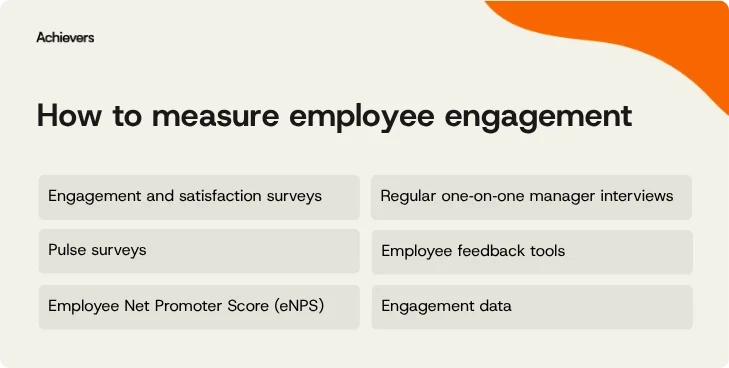
1. Engagement and Satisfaction Surveys
Regularly administered engagement and satisfaction surveys offer a comprehensive view of employees’ feelings about their work, leadership, and overall experience. Well-designed surveys establish a baseline for cultural health and pinpoint areas where support, clarity, or recognition may be lacking. However, the challenge lies in the infrequency of such surveys; the 2026 Engagement and Retention Report indicates that only 38% of organizations provide feedback at least weekly, highlighting a gap in continuous listening.
How to use them: Implement engagement surveys on a consistent schedule and leverage the results to set clear priorities. Focus on a limited number of high-impact themes and utilize other listening methods for deeper exploration.
2. Pulse Surveys
Pulse surveys are concise, frequent check-ins designed to monitor sentiment in real-time. They enable organizations to track how engagement fluctuates in response to changes, such as new leadership or increased workloads. Their true value lies in consistency and follow-through, providing early signals to leaders and assuring employees that their feedback leads to tangible actions.
How to use them: Employ pulse surveys to observe engagement shifts over time, particularly during periods of transition or uncertainty. Keep questions focused and relevant, and communicate high-level findings to employees. Develop clear action plans based on the results, sharing them with teams or the broader organization.
3. Employee Net Promoter Score (eNPS)
As previously mentioned, eNPS is a widely recognized metric for assessing overall engagement and culture health. Its simplicity makes it an accessible tool for many organizations.
How to use it: Focus on tracking eNPS trends rather than treating the score in isolation. Combine eNPS results with qualitative feedback to understand the underlying drivers of employee sentiment. This approach encourages a deeper dive beyond the numerical score.
4. Regular One-on-One Manager Interviews
Consistent one-on-one conversations foster trust, provide clarity, and facilitate meaningful feedback. Despite their importance, data from the Achievers Workforce Institute (AWI) reveals that only 20% of employees have regular one-on-one meetings with their managers.
How to use them: Establish one-on-one meetings as a consistent expectation for managers. Encourage leaders to use engagement insights as context for these discussions, focusing on support, priorities, and development.
5. Employee Feedback Tools
Integrated feedback tools streamline the process of sharing input throughout the workday, through quick polls, open comments, and recognition-based insights.

How to use them: Embed feedback tools into daily workflows to ensure easy and timely participation. Crucially, close the feedback loop by acknowledging input and communicating the actions being taken.
6. Engagement Data Aggregation
Comprehensive engagement data synthesizes signals from surveys, feedback channels, recognition activities, and participation trends. These insights empower organizations to move from guesswork to prioritizing actions that demonstrably improve performance, connection, and retention.
How to use it: Identify patterns within the data rather than focusing on isolated points. Use aggregated engagement data to prioritize interventions, reinforce desired behaviors, and identify areas where leaders may require additional support.
7. Manager Effectiveness Tools
Manager effectiveness tools assess how well leaders support, recognize, and coach their teams. This is critical, as managers significantly influence the day-to-day employee experience. AWI data indicates that 53% of employees report that a supportive manager helps them navigate unexpected challenges.
How to use them: Utilize manager effectiveness data to understand which leadership behaviors foster engagement and which require attention. Provide constructive feedback to managers, linking insights to clear expectations for recognition, communication, and support. Employ this data to guide coaching, professional development, and ongoing check-ins, enabling managers to focus on improving team engagement.
Foundational Questions for Measuring Engagement
To gain a profound understanding of what drives or hinders engagement, organizations should consider posing fundamental questions:
- How likely are you to recommend this company as a great place to work? This question directly assesses the Employee Net Promoter Score (eNPS), offering a quick gauge of overall sentiment and the health of the company culture.
- How well do you understand the company’s goals and mission? Employees seek purpose and clarity. If the company’s direction is unclear, motivation can wane. This question probes alignment with organizational objectives.
- How happy are you in your role? While subjective, job satisfaction often reflects a solid foundation of clear expectations, meaningful work, and supportive teams. Declining happiness can signal burnout, misalignment, or a lack of recognition.
- Do you feel valued for your contributions? Recognition is a powerful driver of connection. When employees feel seen and appreciated by managers, peers, and leadership, they are more likely to remain engaged and committed.
- Do you have the support and resources you need to do your job well? This question addresses employee empowerment. Lacking necessary tools, clarity, or coaching can rapidly diminish engagement. Effective managers ensure employees are equipped to succeed.
Best Practices for Strategic Engagement Measurement
According to Gallup’s State of the Global Workplace Report, employee engagement globally fell to 21% last year, a stark reminder for organizations to prioritize this critical aspect of their operations. Measuring engagement effectively is not a perfunctory task but a strategic imperative for building a workplace where individuals thrive.
Leading with transparency, purpose, and a commitment to action transforms engagement measurement from a mere metric into a cornerstone of a culture where individuals feel seen, heard, and empowered to contribute.
The Indispensable Role of Employee Engagement Software
Understanding and improving employee engagement necessitates robust tools. Guesswork is insufficient; therefore, employee engagement software plays a pivotal role. Achievers offers a comprehensive, always-on platform that aggregates feedback from diverse channels—including quick polls, open comments, and recognition activities—translating them into actionable, real-time insights. Customizable reporting provides a complete picture, moving beyond raw data to strategic understanding.
Achievers distinguishes itself by offering:
- Integrated Recognition and Rewards: Facilitating timely and meaningful appreciation.
- Always-On Feedback Mechanisms: Providing continuous insights into employee sentiment.
- AI-Powered Analytics: Uncovering hidden trends and actionable insights.
- Global Rewards Marketplace: Offering a diverse range of rewards to motivate employees.
- Customizable Reporting and Dashboards: Enabling tailored analysis and communication of engagement data.
Organizations that fully embrace platforms like Achievers have reported up to a five-fold increase in engagement, productivity, and retention. This is because when feedback is easily provided, data is readily interpretable, and action is readily implementable, engagement becomes an actively shaped outcome rather than just a measured statistic.
Leveraging eNPS to Quantify Engagement ROI
While many organizations track employee engagement, fewer effectively link this data to tangible business outcomes. Employee Net Promoter Score (eNPS) offers a straightforward method for achieving this. eNPS, which measures the likelihood of employees recommending their organization as a workplace, serves as a valuable leading indicator of engagement ROI when considered alongside retention, productivity, and recognition data.
Using eNPS to Measure Engagement ROI:
The eNPS calculation involves a single question: "How likely are you to recommend this organization as a great place to work?" Employees respond on a scale of 0 to 10, categorizing them as promoters, passives, or detractors. This score provides a simple benchmark for tracking progress over time.
The true power of eNPS lies in correlating its trends with business outcomes. Organizations can analyze eNPS scores against:
- Retention Rates: A higher eNPS often correlates with lower voluntary turnover.
- Productivity Metrics: Engaged employees, as indicated by eNPS, tend to be more productive.
- Recognition Activity: A strong recognition culture can drive up eNPS scores.
- Customer Satisfaction Scores: Engaged employees often lead to more satisfied customers.
When eNPS improvements align with positive trends in recognition, retention, or productivity, leaders gain concrete evidence that their engagement initiatives are yielding measurable returns.
A Practical Framework for Tracking Engagement ROI with eNPS:
- Establish Baselines: Regularly calculate eNPS to understand the current state.
- Identify Drivers: Analyze qualitative feedback associated with eNPS scores to pinpoint key influencing factors.
- Link to Business Outcomes: Correlate eNPS trends with other key performance indicators (KPIs) such as retention, productivity, and customer satisfaction.
- Develop Action Plans: Use these insights to implement targeted initiatives aimed at improving the employee experience.
- Measure Impact: Continuously track eNPS and associated business metrics to assess the effectiveness of interventions.
This framework transforms eNPS from a standalone metric into a powerful tool for evaluating the impact of employee experience strategies.
Recognition as a Catalyst for eNPS Improvement
When eNPS data reveals declining engagement, recognition often emerges as one of the most effective and immediate levers for improvement. Employees who feel valued and connected to their work are more likely to become advocates for their employer. By integrating eNPS tracking with a strategic recognition and rewards program, organizations can move beyond merely measuring engagement to actively enhancing it. This creates a clearer connection between employee sentiment, workplace culture, and critical business outcomes.
Pro Tip: The focus should not solely be on achieving a higher eNPS score but on understanding the reasons behind score fluctuations. Successful organizations utilize eNPS as an ongoing listening tool, pairing insights with meaningful action, recognition, and a commitment to continuous improvement.
Conclusion: Cultivating a Culture of Engagement
Measuring employee engagement is the foundational step toward fostering a more positive and productive workplace. However, the true impact lies in the subsequent actions: recognizing desired behaviors, acting decisively on employee feedback, and cultivating a culture where every individual feels seen, heard, and valued.
Achievers provides a comprehensive solution that integrates recognition and real-time feedback directly into the workflow, simplifying the process of understanding employee motivations and implementing impactful actions. From AI-driven insights to a global rewards marketplace, the platform is meticulously designed to strengthen connections, boost retention, and shape a desired company culture. By making engagement an integral part of daily operations, organizations can transform it from a mere metric into a living, breathing aspect of how their business functions.