
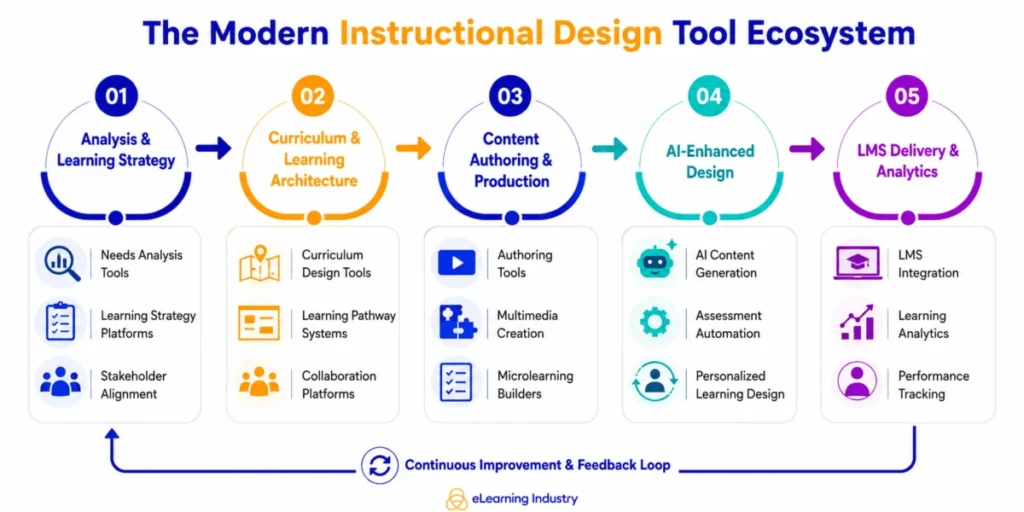
The definition of instructional design (ID) tools has undergone a fundamental transformation, moving away from isolated software applications toward integrated, multi-layered ecosystems. In the current professional landscape, these tools are no longer merely instruments for building slides or recording video; they are the strategic engines driving organizational performance, curriculum architecture, and data-driven learning experiences. As digital transformation accelerates across global industries, the instructional design market is witnessing a shift where scalability, automation, and artificial intelligence (AI) define the competitive edge.
Industry analysts observe that the modern instructional design environment now encompasses a broad spectrum of platforms. These support every phase of the development lifecycle, including initial needs analysis, collaborative storyboarding, rapid authoring, and complex delivery via Learning Management Systems (LMS) and Learning Experience Platforms (LXP). This evolution reflects a broader trend in Corporate Learning and Development (L&D), where the focus has moved from "content completion" to "capability development."
The Chronological Evolution of Instructional Design Technology
To understand the current state of instructional design tools, it is necessary to examine the technological trajectory of the field over the past three decades. In the late 1990s and early 2000s, ID tools were largely synonymous with basic presentation software and early iterations of Computer-Based Training (CBT) authoring packages. These tools were often desktop-bound, required significant technical expertise, and offered limited interactivity.
By the mid-2010s, the rise of cloud computing introduced a new era of collaborative authoring. Tools began to offer web-based interfaces that allowed multiple designers to work on a single project simultaneously. This period also saw the standardization of SCORM (Sharable Content Object Reference Model) and the emergence of xAPI, which allowed for better tracking of learner data across different platforms.
Today, the industry has entered its third major phase: the Ecosystem Era. In this stage, instructional design tools are expected to be "interoperable." This means a tool used for skills gap analysis must be able to communicate seamlessly with a curriculum mapping tool, which in turn feeds into an AI-powered authoring suite. The timeline of this evolution suggests that the role of the instructional designer is shifting from a content creator to a systems architect.
Strategic Infrastructure: Needs Analysis and Performance Mapping
Modern instructional design begins long before a single pixel is placed on a screen. The first category of essential tools involves needs analysis and learning strategy. Successful programs are now built around measurable business goals and performance outcomes rather than the mere dissemination of information.
Stakeholder and Skills Gap Analysis
In high-stakes corporate environments, instructional designers utilize stakeholder analysis tools to gather qualitative insights from Subject Matter Experts (SMEs) and leadership. These platforms facilitate the identification of performance "pain points." Simultaneously, skills gap analysis platforms have become critical for comparing current employee competencies against future industry requirements. By leveraging data-driven insights at this stage, organizations ensure that their training investments are targeted toward actual deficiencies.
Survey and Feedback Integration
Pre-development data collection is now a standard part of the ID workflow. Advanced survey tools go beyond simple multiple-choice questions, employing sentiment analysis to gauge learner motivation and engagement trends. This data forms the bedrock of the learning strategy, ensuring that the resulting curriculum is relevant to the target audience’s specific needs.
Curriculum Architecture and Learning Design Systems
A significant distinction has emerged between instructional design software and learning design software. While the former focuses on the tactical creation of content, the latter supports the broader learner journey. Modern platforms now allow designers to map out complex learning architectures that span months or years, rather than just minutes or hours.
Curriculum Mapping and Pathway Builders
Curriculum design tools allow for the organization of learning pathways around specific competencies. In industries such as healthcare or aviation, where compliance and precision are paramount, these tools ensure that foundational knowledge is mastered before a learner progresses to advanced applications. Learning pathway builders enable the creation of "stacked" credentials, where small modules of learning accumulate into larger professional certifications.
Sequencing and Documentation Frameworks
The structure of a learning experience is often as important as the content itself. Sequencing frameworks help designers determine the optimal flow of information to prevent cognitive overload. To document these strategies, teams use design blueprints and storyboards. These serve as the "architectural drawings" of the learning world, providing a visual and functional outline of the learner experience—including interactions, assessments, and multimedia elements—before expensive production begins.
The Authoring Engine: Content Creation in the Digital Age
Authoring tools remain the core of the instructional design toolkit, acting as the execution engines for digital training. However, the capabilities of these tools have expanded to meet the demands of a mobile-first, time-constrained workforce.

Interactive Development and Microlearning
Modern authoring suites allow designers to create branching scenarios and complex simulations without needing to write custom code. There is also a growing emphasis on microlearning builders. As the average attention span in digital environments fluctuates, L&D teams are increasingly producing modular content that can be consumed in three- to five-minute "bursts." This reflects a shift toward "just-in-time" learning, where employees access information exactly when they need it to perform a task.
Visual and Multimedia Tools
The aesthetic quality of learning materials is no longer optional. Instructional designers now use a suite of visual content tools, including animation software, high-end video editors, and infographic builders. These tools are used to simplify complex data and improve knowledge retention through visual storytelling.
The AI Revolution in Instructional Design
The most significant disruption in the field today is the integration of Artificial Intelligence. AI tools are no longer experimental; they are being embedded directly into the ID workflow to accelerate production and personalize the learner experience.
Automated Content Generation
AI-powered platforms can now generate initial drafts of lesson plans, create quiz questions based on uploaded documents, and even produce realistic voiceovers and avatars. This automation allows instructional designers to bypass the "blank page" stage, moving directly to the refinement and strategy phases. For global organizations, AI-driven translation and localization tools have reduced the time required to deploy training across multiple languages from months to days.
Predictive Analytics and Personalization
Beyond content creation, AI is being used to analyze learner behavior. Adaptive learning systems can identify when a learner is struggling with a specific concept and automatically provide supplementary resources or adjust the difficulty level of the material. This level of personalization was previously impossible to achieve at scale.
Delivery Systems and Performance Tracking
The final stage of the ID tool ecosystem is delivery. The relationship between instructional design and the Learning Management System (LMS) has become more symbiotic.
LMS and LXP Integration
Modern LMS platforms are no longer just storage vaults for SCORM files. They are integrated with design tools to allow for "one-click publishing" and real-time content versioning. This ensures that if a compliance regulation changes, the instructional designer can update the source file and have it immediately reflected across the entire organization.
Learning Experience Platforms (LXPs) have further evolved this space by offering a Netflix-style interface where content is recommended based on the learner’s role and past activity. This shift from "pushed" training (assigned by the company) to "pulled" learning (sought out by the employee) represents a major change in how instructional design tools are evaluated.
Evaluating the Impact: Data and Market Trends
The investment in instructional design tools is backed by significant market data. According to recent industry reports, the global corporate e-learning market is projected to grow at a Compound Annual Growth Rate (CAGR) of over 15% through 2028. Organizations are increasingly shifting their budgets from external "off-the-shelf" content to internal "bespoke" development enabled by these advanced tools.
Efficiency gains are also measurable. Companies utilizing AI-integrated ID platforms report a 30% to 50% reduction in development time for standard e-learning modules. However, experts warn that the proliferation of tools can lead to "platform fatigue." The most successful organizations are those that focus on integration rather than the sheer number of features.
Conclusion: The Future of the Instructional Designer
The evolution of instructional design tools has fundamentally redefined the profession. Today’s instructional designer must be a polymath—part data analyst, part cognitive psychologist, and part software architect. The tools they use are no longer peripheral to the business; they are central to how an organization learns, adapts, and competes in a global economy.
As AI continues to mature and the boundaries between "work" and "learning" blur, the most effective tools will be those that disappear into the workflow, providing learners with the right information at the right time. For L&D leaders, the challenge lies not just in selecting the best software, but in building a connected ecosystem that supports the continuous development of human capability. The shift from isolated tools to integrated platforms is not just a technological change; it is a strategic imperative for the modern enterprise.






