
The global corporate landscape is currently witnessing an unprecedented surge in artificial intelligence investment, yet a growing disconnect between capital expenditure and workforce capability is raising alarms among C-suite executives. Despite a staggering $252.3 billion spent on AI in 2024 alone, organizations are finding that the transition from pilot programs to tangible business impact is fraught with structural hurdles. Within the sector of Learning and Development (L&D), this "AI learning gap" has become a central focus for Chief Human Resources Officers (CHROs) and Chief Learning Officers (CLOs) who are struggling to translate technological speed into measurable human performance.
Recent data from Boston Consulting Group (BCG) indicates that 74% of organizations have yet to realize significant business value from their AI investments. This sentiment is echoed by the MIT 2025 GenAI in Business study, which found that 95% of Generative AI (GenAI) pilots fail to demonstrate a positive impact on profit and loss (P&L) statements. The volatility of this transition is further underscored by S&P Global, which reported that 42% of companies abandoned the majority of their AI initiatives in 2025, a sharp increase from the 17% abandonment rate recorded just one year prior.
The Shift from Efficiency to Systemic Transformation
The primary challenge facing modern L&D functions is the tendency to treat AI as a mere tool upgrade rather than a fundamental system shift. Traditionally, L&D has focused on the rapid production of content—generating courses, assessments, and localized materials. AI has undeniably accelerated these processes, reducing tasks that once took 40 hours to just four. However, industry experts argue that producing mediocre content at a faster rate does not solve the underlying issue of workforce capability.
The current learning ecosystem is largely built on legacy architectures, such as SCORM (Sharable Content Object Reference Model) packages, PDFs, and linear video formats. These structures were designed for one-way delivery rather than dynamic machine interaction. When AI is layered on top of these static models, the result is often a "broken system accelerated." Modern learners increasingly demand support embedded within the flow of work—contextual, just-in-time assistance—rather than isolated modules launched from a traditional Learning Management System (LMS).
Chronology of the AI Learning Pivot: 2022–2025
The evolution of AI in the workplace has moved through three distinct phases over the last three years:
- The Exploration Phase (Late 2022 – 2023): Following the public release of advanced LLMs, organizations focused on "low-hanging fruit," such as using AI for copyediting, basic content outlines, and automated translations.
- The Pilot Proliferation (2024): Enterprises launched thousands of internal pilots. This period saw record spending ($252.3 billion) as companies raced to integrate AI into every facet of the L&D workflow. However, this phase also revealed the "pilot trap," where initiatives looked impressive on dashboards but failed to scale across the enterprise.
- The Rationalization and Infrastructure Phase (2025): The current period is defined by a "back-to-basics" approach. High-maturity organizations have begun pulling back from superficial AI tools to focus on "roots"—the underlying content architecture and data governance required to make AI outputs reliable and actionable.
Critical Failure Patterns in Modern L&D Strategies
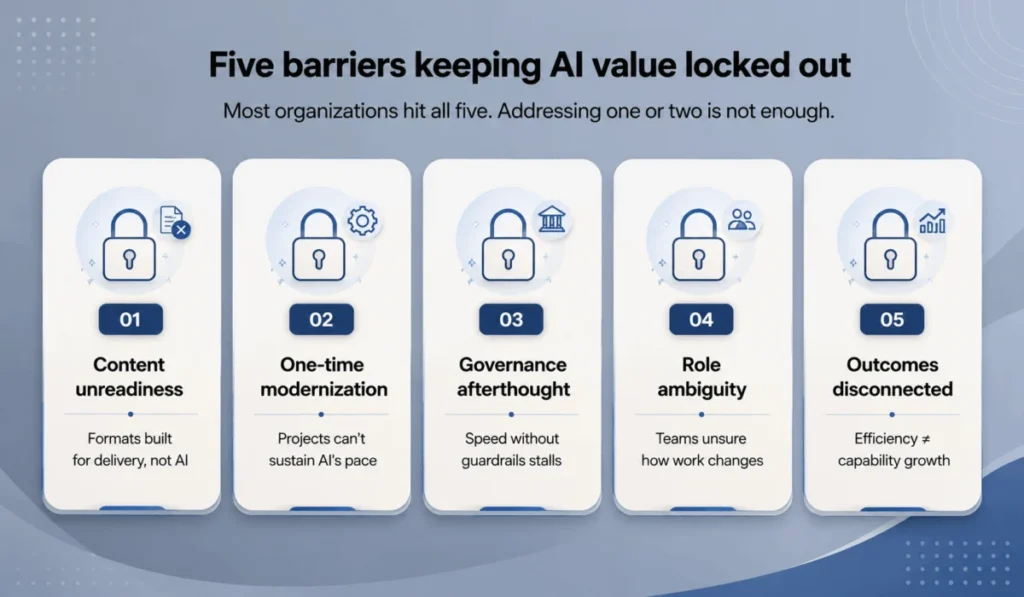
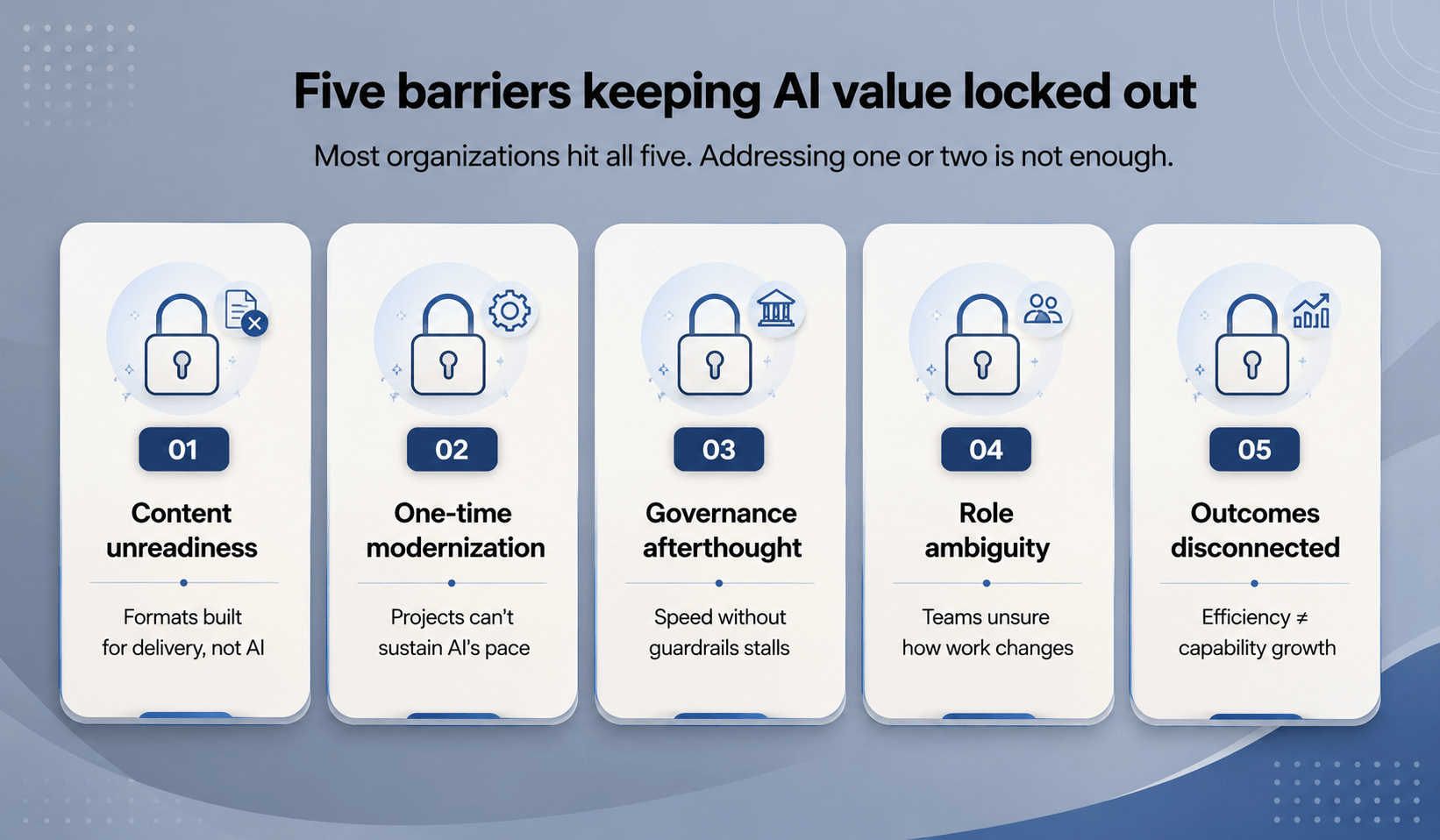
Through extensive consultation with digital publishers and enterprise learning teams, Harbinger Group and other industry analysts have identified five recurring patterns that prevent AI from delivering value:

Content Unreadiness and Technical Debt
Most existing learning content is "opaque" to AI. Without structured metadata and modular architecture, AI systems cannot accurately parse or retrieve information to provide contextual answers. This leads to "hallucinations" or inaccuracies, which McKinsey’s 2025 State of AI report notes has led to negative AI-related incidents in 51% of organizations, particularly in highly regulated sectors like healthcare and finance.
The Myth of One-Time Modernization
Many organizations treat digital transformation as a finite project with a clear end date. In an AI-driven environment, content must be dynamic. Organizations that fail to implement continuous modernization workflows find their AI models quickly becoming obsolete as business strategies and technical requirements evolve.
Governance and Risk Management
The speed enabled by AI introduces significant compliance risks. Many organizations hesitate to scale because they lack robust frameworks for auditing AI-generated content. Without clear protocols for error detection and correction, the liability of AI-generated misinformation outweighs the efficiency gains.
Role Ambiguity and Workforce Friction
The introduction of AI necessitates a redesign of the operating model. Instructional designers, Subject Matter Experts (SMEs), and Quality Assurance (QA) teams often face uncertainty regarding their evolving responsibilities. This ambiguity creates internal friction, slowing adoption not due to a lack of technology, but due to a lack of clear human-centric workflows.
Disconnection from Business Outcomes
A persistent criticism from executive leadership is that L&D metrics remain focused on "vanity" stats—such as hours of training completed or the number of courses produced—rather than actual skill acquisition or internal mobility. According to LinkedIn’s 2025 Workplace Learning Report, 49% of talent professionals say their executives remain concerned that employees lack the skills necessary to execute current business strategies.
Case Studies: System Design as a Catalyst for Value
Evidence suggests that organizations seeing the highest returns on AI are those that prioritized infrastructure over features.
In the clinical education sector, a large-scale initiative involved the automation of 6,000 courses. Rather than simply migrating old content into an AI tool, the organization restructured its entire library into "reusable learning objects" enriched with deep metadata. This structural foundation allowed for an 80% automation rate in content updates and a 10x increase in production speed. Because the content was modular, it could be updated once and automatically pushed across various formats, from mobile apps to VR simulations.
Similarly, a leadership development organization transitioned from static PDFs to a single-source content model. Once the content became machine-readable, the organization was able to deploy AI-powered coaching simulations and adaptive assessments. These advanced applications were only possible because the "roots"—the content architecture—were established first.
The Dual-Maturity Model: Content and Operations
A practical framework for assessing AI readiness involves measuring two dimensions: Content Maturity and Operating Model Maturity.
- Low Maturity: Characterized by unstructured content (PDFs, long-form video) and project-based workflows. In this quadrant, AI typically creates more rework than value, as humans must constantly intervene to correct AI errors.
- Medium Maturity: Organizations have begun to structure their content and use metadata, improving consistency. However, without changing the operating model, they remain limited by traditional "course-centric" thinking.
- High Maturity: These "Career Development Champions" connect learning directly to career pathways and business outcomes. LinkedIn data shows these organizations are 32% more likely to offer AI training and 51% more likely to be frontrunners in GenAI adoption. They treat content as infrastructure, allowing AI to act as a natural extension of the system.
Implications for the Future of Workforce Enablement
As the industry moves deeper into 2025, the focus is shifting toward "Capability Building" rather than "Content Production." Professional associations and digital publishers are increasingly adopting frameworks like the CLEAR Content Audit, which scores organizations on content quality, AI readiness, and library rationalization.
The transition requires instructional designers to evolve into "experience architects" and SMEs to become "knowledge validators." Governance is no longer a bottleneck but an embedded function that ensures trust and compliance. For the C-suite, the measure of success is no longer the adoption of AI itself, but the measurable closing of skills gaps that drive competitive advantage.
Conclusion: Preparing the Foundation
The consensus among digital transformation experts is clear: AI cannot transform a broken system; it can only expose its flaws more rapidly. For an AI L&D strategy to succeed, it must be built on a foundation of structured, modular, and machine-readable content, supported by an operating model that prioritizes continuous delivery over one-off projects.
The organizations that will lead the next decade of workforce development are not necessarily those that spent the most on the latest software, but those that invested in their "roots" first. By treating content as infrastructure and aligning learning with business outcomes, enterprises can finally bridge the gap between AI investment and real-world workforce capability. AI is a powerful engine for change, but only for those whose systems are engineered to handle the power.






