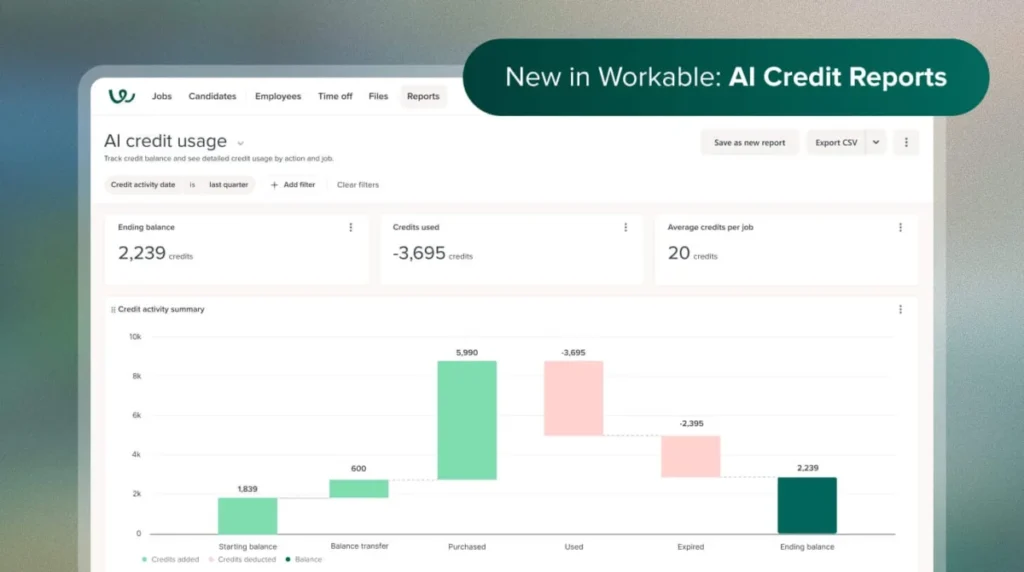
Workable, a leading global hiring platform, has introduced a comprehensive AI credits report, providing account administrators with unprecedented visibility into their artificial intelligence resource consumption. This new feature, seamlessly integrated into the existing suite of recruiting reports and available across all plans without additional setup, allows organizations to meticulously track the lifecycle of their AI credits—from purchase and real-time usage to expiration—and pinpoint the specific jobs and activities driving AI-related expenditure. This development marks a significant step towards greater financial accountability and operational efficiency in the rapidly evolving landscape of AI-powered recruitment.
The Rise of AI in Recruitment and the Demand for Transparency
The integration of artificial intelligence into human resources, particularly in talent acquisition, has accelerated dramatically over the past decade. AI tools are now integral to various stages of the recruitment funnel, from automating candidate sourcing and screening through resume analysis, to streamlining interview scheduling, generating personalized job descriptions, and enhancing candidate engagement through chatbots. These technologies promise to boost efficiency, reduce time-to-hire, improve candidate quality, and mitigate unconscious bias, fundamentally reshaping how companies attract and secure top talent.
However, the rapid adoption of AI has also introduced new complexities, particularly concerning cost management. Many AI-powered platforms operate on a credit-based or usage-based model, where organizations purchase credits that are then consumed by various AI actions. This model, while flexible, can obscure the true cost of specific recruitment activities, making it challenging for HR and finance departments to accurately forecast budgets, justify expenditures, and measure the return on investment (ROI) of their AI tools. A 2023 report by Gartner predicted that by 2025, 60% of organizations would have integrated AI into their HR functions, underscoring the critical need for transparent cost tracking mechanisms to manage these growing investments effectively. Without clear visibility into how and where AI credits are being utilized, businesses risk overspending, misallocating resources, and failing to fully leverage the strategic potential of their AI tools.
Recognizing this growing demand for clarity, Workable has engineered its new AI credits report to empower account administrators with the granular data necessary to navigate the financial intricacies of AI-driven recruitment. This initiative reflects a broader industry trend towards greater accountability and data-driven decision-making in HR technology.
Key Features: A New Era of Financial Clarity
The newly launched AI credits report offers a suite of functionalities designed to provide a holistic view of AI credit balance and consumption, meticulously broken down by job, action, and time. This level of detail represents a substantial upgrade in financial oversight for Workable users.
Comprehensive Balance Tracking: From Purchase to Expiration
The report provides a complete, start-to-finish ledger of AI credit movement within an account. Administrators can now clearly see the total number of credits purchased, the volume of credits actively being used, the remaining balance, and, critically, any credits that have expired. This chronological tracking capability allows organizations to manage their credit inventory more effectively, preventing waste from unused or expired credits and informing future purchasing decisions. For instance, an account admin can observe seasonal spikes in credit usage tied to hiring surges, allowing them to optimize credit purchases to align with recruitment cycles and avoid unnecessary expenditures during quieter periods. This real-time financial dashboard moves beyond mere balance checks, offering dynamic insights into the flow of capital invested in AI resources.
Granular Consumption Insights: Pinpointing AI-Driven Activities
One of the most powerful aspects of the new report is its ability to identify precisely what is consuming AI credits. Whether credits are being used for AI-powered job description generation, advanced candidate matching algorithms, automated outreach campaigns, or intelligent resume parsing, the report provides a breakdown of consumption by specific actions. This granular detail is invaluable for understanding which AI features are most heavily utilized and, by extension, which are delivering the most perceived value. For a talent acquisition team, understanding that a significant portion of credits is spent on AI-driven candidate matching for specialized roles, for example, allows them to evaluate the effectiveness of that specific AI function against hiring outcomes for those roles. It facilitates a deeper analysis of operational efficiency, enabling adjustments to AI tool usage to maximize impact and minimize redundant or low-value activities.
Job-Level Attribution: Unlocking Project-Based Cost Analysis
The ability to drill down to the job level represents a significant leap forward in cost allocation. Account administrators can now link AI credit consumption directly to individual job requisitions. This means that if AI is used to craft a job description for a "Senior Software Engineer" role or to screen candidates for a "Marketing Manager" position, the corresponding credit spend can be attributed specifically to that job. This feature is crucial for companies that manage multiple hiring projects simultaneously or have distinct departmental budgets. It allows for accurate project-based cost analysis, enabling HR and finance teams to assess the true cost of hiring for specific roles, departments, or even geographical locations. This level of detail empowers managers to make data-driven decisions about resource allocation, optimize recruitment strategies for different job types, and identify areas where AI is providing the most cost-effective solution.
Flexible Filtering and Custom Reporting: Tailored Insights for Strategic Decisions
To enhance usability and analytical depth, the Workable AI credits report includes robust filtering capabilities. Administrators can filter data by various parameters, including specific timeframes (e.g., weekly, monthly, quarterly), job categories, departments, or even individual users. This flexibility allows for the generation of highly customized reports tailored to specific analytical needs. For example, a CFO might require a quarterly report on total AI spend across the organization, while a hiring manager might need to see credit consumption for all roles within their department over the last month. The ability to segment and analyze data in multiple ways supports more informed strategic planning, budget reconciliation, and performance reviews. This adaptability ensures that stakeholders across the organization can access the precise information they need to manage AI investments effectively.
Seamless Integration and Operational Simplicity
Workable has designed the AI credits report for maximum accessibility and ease of use. The report is not a standalone module but is built directly into the existing "Recruiting reports" section that account administrators already utilize. This seamless integration eliminates the need for separate logins, complex data exports, or additional training, ensuring that the new functionality is immediately available and intuitive for current Workable users. Its availability on "every plan" without any "extra setup required" further underscores Workable’s commitment to democratizing financial transparency across its user base, from small businesses to large enterprises. This operational simplicity is key to fostering rapid adoption and ensuring that the insights provided by the report are readily accessible to those who need them most.
Strategic Implications for Account Administrators and Beyond
The introduction of Workable’s AI credits report carries significant implications for account administrators, HR leaders, and financial controllers, fundamentally enhancing their capacity for strategic oversight and resource management.
Enhanced Financial Control and Budgeting Accuracy:
For account administrators, the report transforms AI credit management from a reactive, opaque process into a proactive, transparent one. By providing real-time data on consumption patterns and remaining balances, it enables more accurate budget forecasting and expenditure tracking. This heightened financial control minimizes unexpected costs and allows for better allocation of resources, ensuring that AI investments align with broader organizational financial goals. A finance department can now project future AI spend with greater precision, integrating these costs more effectively into overall operational budgets.
Optimized AI Utilization and Maximized ROI:
With detailed insights into which AI features are consuming credits and for which activities, organizations can identify inefficiencies and optimize their AI usage. For example, if a specific AI function is consuming a large number of credits but not yielding proportionate results in terms of candidate quality or hiring speed, administrators can investigate and adjust their approach. This data-driven optimization ensures that every credit spent translates into maximum value, thereby improving the overall ROI of AI investments in recruitment. It empowers teams to experiment with different AI applications, measure their effectiveness, and scale successful strategies.
Demonstrating Value and Justifying Investment:
In an era where technology investments are constantly scrutinized, the ability to clearly demonstrate the value of AI tools is paramount. The AI credits report provides tangible data to justify AI spend to senior leadership and stakeholders. By linking credit consumption to specific job outcomes or recruitment metrics, HR leaders can articulate the direct contribution of AI to achieving hiring targets, reducing costs per hire, or improving candidate experience. This evidence-based approach strengthens the case for continued investment in AI technologies and reinforces HR’s strategic role within the organization.
Compliance and Accountability:
For larger organizations or those operating in regulated industries, maintaining clear records of technology expenditure is crucial for compliance and internal auditing purposes. The detailed reporting offered by Workable provides a robust audit trail for AI credit usage, ensuring transparency and accountability. This can be particularly important for tracking spend against departmental budgets or grants, and for demonstrating responsible resource management.
Inferred Statements and Industry Reactions
While Workable has not released specific executive statements regarding this launch in the provided context, the strategic importance of this feature would likely prompt enthusiastic responses from key stakeholders. A Workable Product Lead might state, "We constantly listen to our customers, and the demand for greater transparency in AI utilization has been clear. This new report is a direct response, empowering our users to not just leverage AI’s power, but to understand and optimize its financial impact."
From an organizational perspective, an HR Director at a large enterprise might comment, "Managing AI costs has become a significant challenge. This Workable report is a game-changer for our budget planning and allows us to truly assess the ROI of our AI tools across various hiring initiatives." Similarly, a Chief Financial Officer (CFO) could infer, "Granular insight into AI spend, broken down by specific recruitment activities and jobs, enables us to integrate these costs into our financial models with unprecedented accuracy. This is crucial for strategic resource allocation and ensuring every technology investment drives measurable value."
Broader Industry Trends and Future Outlook
The launch of Workable’s AI credits report is indicative of a maturing HR technology market where foundational capabilities are increasingly augmented by sophisticated analytics and financial oversight tools. As AI continues to embed itself deeper into operational workflows, the expectation for transparent, quantifiable data on its usage and cost will only grow. This move by Workable aligns with broader industry trends focusing on data-driven HR, where every aspect of the employee lifecycle, including the tools used to manage it, is subject to rigorous analysis and optimization.
Looking ahead, this development sets a precedent for other HR tech vendors to enhance their own cost transparency mechanisms. The competitive landscape will likely see an increased emphasis on platforms that not only offer powerful AI features but also provide robust tools for managing and understanding the financial implications of those features. Future iterations of such reports could potentially integrate predictive analytics to forecast credit needs based on historical hiring patterns, or offer benchmarking data against industry averages to further optimize AI spend. This push towards greater transparency empowers HR professionals to evolve from operational implementers to strategic partners, equipped with the financial insights necessary to drive impactful business decisions.
Seeing the Solution in Action
For current Workable customers eager to explore the capabilities of the new AI credits report, direct engagement with their account manager is recommended. Prospective clients or those interested in understanding the practical applications of this feature can also arrange for a comprehensive demonstration with one of Workable’s product specialists. This direct engagement pathway ensures that organizations can fully grasp how this innovative reporting system can be tailored to meet their specific financial oversight and recruitment optimization needs, cementing Workable’s commitment to equipping its users with the tools for smarter, more efficient, and financially transparent AI-powered hiring.