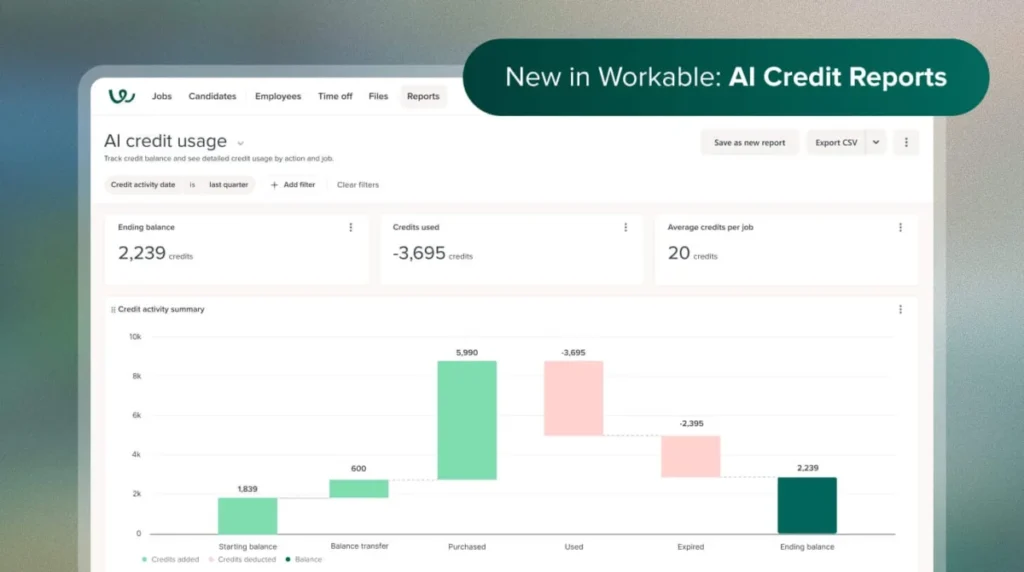
Workable, a leading global hiring platform, has announced the launch of a sophisticated new AI Credit Reporting feature, integrated directly into its existing suite of Recruiting reports. This development provides account administrators with comprehensive, real-time insights into the full lifecycle of AI credit consumption, encompassing purchases, usage, expiration, and the specific jobs and activities driving this expenditure. Available on every Workable plan without additional setup, this innovation addresses a critical need for transparency and control in the rapidly evolving landscape of AI-powered recruitment.
The introduction of this dedicated AI credits report marks a significant step forward in helping organizations manage their burgeoning investments in artificial intelligence tools. As AI increasingly permeates every facet of the recruitment process, from candidate sourcing and screening to interview scheduling and offer management, understanding and optimizing the associated costs has become paramount. Workable’s new reporting mechanism offers a granular view, breaking down credit balance and consumption by individual job postings, specific AI-driven actions, and custom timeframes, thereby transforming opaque expenditures into actionable intelligence.
The Evolution of AI in Recruitment and the Growing Need for Transparency
The recruitment sector has witnessed a dramatic acceleration in AI adoption over the past five years. Driven by a desire to enhance efficiency, reduce time-to-hire, improve candidate experience, and mitigate unconscious bias, HR and talent acquisition teams have embraced a myriad of AI-powered solutions. These tools range from sophisticated resume parsing algorithms and predictive analytics for candidate matching to AI-driven chatbots for initial candidate engagement and automated scheduling systems. According to recent industry analyses, the global HR technology market, heavily influenced by AI integration, is projected to reach over $40 billion by 2027, with AI components forming a substantial and growing segment of this expenditure.
However, this rapid integration has also presented new challenges, particularly concerning cost management and return on investment (ROI). Many organizations struggle to accurately track their AI spending, often encountering issues such as "shadow IT" expenses, fragmented budget allocations, and a lack of clear metrics to tie AI tool usage directly to tangible hiring outcomes. Without precise data on how AI credits are consumed, account administrators and HR leaders find it difficult to make informed decisions about resource allocation, identify areas for optimization, or justify further investment in AI technologies. The absence of such transparency can lead to inefficiencies, budget overruns, and a hindered ability to fully leverage the strategic potential of AI.
Recognizing these industry-wide challenges, Workable has positioned its new AI Credit Reporting feature as a direct response to the demand for greater financial oversight. This functionality is not merely about tracking expenses; it is designed to empower organizations to strategically deploy their AI resources, ensuring that every credit contributes effectively to their recruitment objectives.
Core Functionalities of the New AI Credit Reporting Feature
The Workable AI Credit Reporting feature is engineered to provide a holistic view of AI credit activity, integrating seamlessly with existing reporting dashboards that administrators are already familiar with. Its key functionalities include:
1. Comprehensive Credit Lifecycle Tracking:
Account admins can now observe the entire journey of their AI credits within the Workable platform. This includes detailed records of when credits were purchased, the specific quantities involved, and the associated costs. Furthermore, the report meticulously tracks credit usage, showing precisely when and how credits are expended across various AI-powered actions. A critical component of this tracking is the visibility into expired credits, allowing administrators to understand any unused capacity and adjust future purchasing strategies to minimize waste. This end-to-end view ensures that no credit goes unaccounted for, providing a clear financial ledger for AI investments.
2. Granular Consumption Analysis by Activity:
Beyond simply showing credit usage, the report delineates what activities are consuming these credits. Workable’s AI tools support a range of functions, including automated candidate sourcing through intelligent search algorithms, AI-powered resume parsing for efficient candidate evaluation, generation of optimized job descriptions, AI-assisted outreach to potential candidates, and intelligent scheduling assistance. The new report allows administrators to see which of these specific actions are utilizing the most credits. For instance, an admin can determine if a significant portion of credits is being spent on proactive candidate sourcing for niche roles versus on refining job descriptions. This level of detail is crucial for identifying which AI applications deliver the most value and where adjustments might be necessary to improve efficiency.
3. Drill-Down Capability to the Job Level:
One of the most powerful aspects of this new report is its ability to break down credit consumption by individual job postings. This means an administrator can analyze the AI credit expenditure for a specific "Senior Software Engineer" role versus a "Marketing Specialist" position. This granular insight enables HR teams to assess the AI investment per hire for different roles, evaluate the effectiveness of AI tools in specific recruitment campaigns, and identify patterns. For example, if a particular job consistently consumes a high volume of AI credits without a proportional increase in qualified candidates or successful hires, it may signal an opportunity to re-evaluate the AI strategy for that specific role or department. Conversely, high-performing jobs can serve as benchmarks for optimizing AI usage across the organization.
4. Flexible Filtering and Reporting:
Understanding that different organizations have varying analytical needs, Workable has designed the report with robust filtering capabilities. Account admins can customize their views based on several parameters:
- Date Ranges: Analyze credit usage over specific periods, such as weekly, monthly, quarterly, or custom date ranges, to identify trends and seasonal variations.
- Job Filters: Focus on specific departments, locations, or types of roles to understand targeted AI spending.
- Activity Filters: Isolate credit consumption related to particular AI features, allowing for focused analysis on specific tool efficacy.
- User Filters: While not explicitly mentioned in the snippet, it’s a logical extension to track usage by individual recruiters or teams, fostering accountability and identifying best practices.
These filtering options empower administrators to generate highly relevant reports tailored to their strategic inquiries, supporting data-driven decision-making at every level.
How the AI Credit Reporting Feature Integrates
Workable has ensured that the new AI Credit Reporting feature is not an isolated tool but an integral part of its comprehensive platform. It resides within the familiar "Recruiting reports" section, meaning existing account administrators can access it immediately without any additional configuration or learning curve. This seamless integration underscores Workable’s commitment to user-friendly design and maximizing the value of its platform for its diverse customer base. The reports are designed to be intuitive, presenting complex data in clear, digestible formats, often leveraging visual aids such as charts and graphs to highlight key trends and insights at a glance.
Why This Matters for Account Admins and Strategic HR Leaders
The implications of Workable’s new AI Credit Reporting feature extend far beyond simple expense tracking. For account administrators and strategic HR leaders, this tool offers a multitude of benefits:
- Enhanced Budget Control and Forecasting: With precise data on credit consumption, admins can better forecast future AI spending, optimize credit purchases, and prevent budget overruns. This enables more accurate financial planning and resource allocation across the talent acquisition function.
- Improved ROI Measurement: By linking AI credit usage directly to recruitment activities and, by extension, hiring outcomes, organizations can more effectively measure the return on investment for their AI tools. This data empowers HR leaders to demonstrate the tangible value of AI in recruitment to executive leadership and justify continued or increased investment.
- Strategic Decision-Making: The granular insights provided by the reports allow leaders to identify which AI tools and strategies are most effective for different types of roles or recruitment challenges. This data can inform strategic decisions, such as reallocating AI credits to high-impact areas, adjusting recruitment processes, or investing in further AI training for specific teams.
- Operational Efficiency and Optimization: Understanding where credits are being used most effectively can lead to process improvements. For instance, if a particular AI-driven screening process is consuming excessive credits without yielding superior candidates, the team can pivot to a more cost-effective approach. Conversely, highly efficient AI applications can be scaled across the organization.
- Accountability and Governance: The transparency offered by the reports fosters greater accountability within recruitment teams regarding AI resource utilization. It provides a clear framework for governance, ensuring that AI tools are used responsibly and in alignment with organizational goals.
- Competitive Advantage: Organizations that can efficiently manage and optimize their AI investments are better positioned to leverage cutting-edge technology to attract top talent, ultimately gaining a competitive edge in the talent market.
Industry Reactions and Broader Impact
While specific statements from Workable executives were not provided in the original content, the release of such a feature would typically be accompanied by strong endorsements. One could infer a statement from Workable’s Head of Product or CEO emphasizing the company’s commitment to empowering HR and talent acquisition professionals with the tools needed for data-driven decision-making in an AI-first world. "Our customers are increasingly relying on AI to streamline their hiring processes, and with that comes a critical need for transparency and control over their investments," a hypothetical Workable executive might state. "This new AI Credit Reporting feature is a direct response to that need, providing unprecedented visibility that enables our users to optimize their AI spend, prove ROI, and ultimately make smarter, more strategic hiring decisions."
Furthermore, account administrators and HR professionals across the industry are likely to welcome such a development. Sarah Chen, a hypothetical Head of Talent Acquisition at a large tech firm and a Workable user, might comment, "Managing AI tool expenses has always been a challenge, often feeling like a ‘black box.’ Having a clear, detailed report built right into Workable that shows exactly how our AI credits are being used, down to the job level, is a game-changer. It will undoubtedly help us refine our AI strategy and ensure we’re getting the maximum value from our technology investments."
The broader impact of this feature underscores a significant trend in HR technology: the convergence of operational efficiency with financial accountability. As AI tools become more sophisticated and integral to business operations, the demand for robust analytics that can translate technical usage into financial performance metrics will only intensify. Workable’s proactive approach in providing this level of detailed reporting positions it as a leader in offering not just powerful AI tools, but also the crucial oversight mechanisms necessary for their strategic deployment and sustained value generation. This move aligns with the increasing emphasis on data governance, cost management, and demonstrable ROI across all enterprise software expenditures.
A Look Ahead
The introduction of Workable’s AI Credit Reporting feature is more than just a new dashboard; it represents a foundational shift towards intelligent, data-driven management of AI resources in recruitment. As organizations continue to deepen their reliance on AI to navigate complex talent markets, tools that offer clarity, control, and actionable insights will become indispensable. By empowering account administrators with a complete picture of their AI credit movements and consumption patterns, Workable is enabling its customers to not only optimize their current AI investments but also to strategically plan for future technological adoption, ensuring that AI serves as a powerful, transparent, and cost-effective engine for talent acquisition success.
For organizations interested in exploring the capabilities of the new AI Credit Reporting feature and understanding its potential impact on their recruitment operations, Workable encourages engagement with their account managers or scheduling a product demonstration with one of their specialists. This proactive step can unlock significant efficiencies and strategic advantages in the competitive landscape of modern talent acquisition.