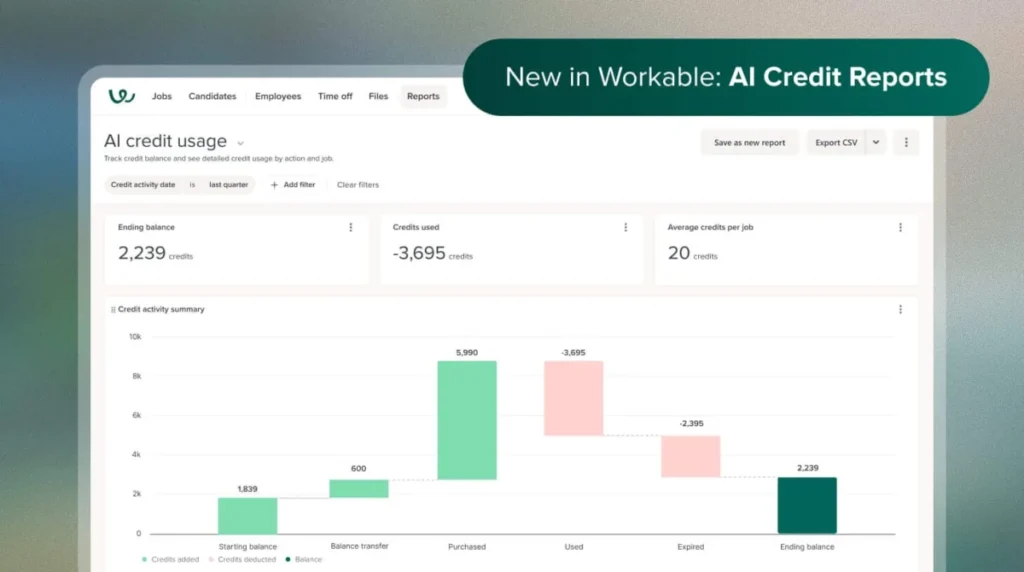
Workable, a leading global hiring platform, has officially launched a comprehensive AI credits report designed to provide account administrators with unprecedented visibility into their artificial intelligence (AI) resource consumption. This new feature, seamlessly integrated into Workable’s existing Recruiting reports and available on every plan without additional setup, addresses a critical need for enhanced transparency and granular control over AI-driven activities within talent acquisition processes. Account admins can now meticulously track AI credit movement—from purchase to usage and expiration—and precisely identify which jobs and activities are driving associated expenditures, empowering organizations to optimize their AI investments and refine their recruitment strategies.
The Evolving Landscape of AI in Recruitment
The integration of artificial intelligence into human resources and talent acquisition has rapidly transformed how companies identify, attract, and onboard candidates. AI-powered tools are now commonplace, assisting with everything from automated candidate sourcing and screening to personalized outreach, resume analysis, and even the optimization of job descriptions for broader reach and diversity. The global HR technology market, valued at approximately $29 billion in 2023, is projected to grow significantly, with AI-driven solutions being a primary catalyst. Industry reports suggest that AI in recruitment alone could reach a market size of over $6 billion by 2028, reflecting its widespread adoption and perceived value in enhancing efficiency and effectiveness.
However, the rapid proliferation of AI tools, particularly those operating on a credit-based consumption model, has introduced new complexities for businesses. While AI promises significant gains in productivity and cost reduction by automating repetitive tasks and providing data-driven insights, managing its usage and understanding its true cost-effectiveness can be challenging. Many organizations grapple with a lack of clear visibility into how these credits are consumed, leading to difficulties in budgeting, inefficient resource allocation, and an inability to accurately measure the return on investment (ROI) for their AI initiatives. This opaque consumption model can hinder strategic planning and prevent companies from fully leveraging their AI capabilities. Workable’s introduction of a dedicated AI credits report directly responds to this evolving challenge, aiming to demystify AI usage for its extensive client base.
Addressing a Critical Need: The Genesis of the AI Credits Report
The development of Workable’s AI credits report is a direct response to the increasing demand from organizations for greater accountability and control over their technology expenditures, particularly in the realm of AI. While Workable has progressively integrated sophisticated AI capabilities into its platform—such as AI-powered candidate matching, automated email composition, and intelligent job description generation—the underlying consumption of these features required a more robust tracking mechanism. Historically, administrators could monitor overall credit balances, but lacked the granular detail needed to attribute usage to specific operational activities or individual job requisitions. This gap often left HR and finance teams guessing about the precise drivers of AI credit consumption.
The decision to build this new reporting tool underscores Workable’s commitment to empowering its users with actionable data. Over the past year, as AI adoption surged across its client base, Workable noted a significant increase in inquiries regarding detailed credit usage. This feedback from account administrators, talent acquisition leaders, and financial controllers highlighted a critical need for a tool that could break down usage by specific parameters, rather than just offering a top-level summary. The engineering and product teams at Workable initiated development of the report several months ago, prioritizing ease of access and comprehensive data visualization. The aim was to deliver a solution that not only presented raw data but also offered insightful analytics, enabling proactive management rather than reactive problem-solving. This release marks a significant milestone in Workable’s product evolution, reflecting its agile response to market demands and its dedication to fostering transparency in an increasingly AI-driven recruitment landscape.
Unpacking the Features: Granular Insights for Strategic Management
The newly launched AI credits report offers a multifaceted view of AI consumption, providing account administrators with the tools necessary for meticulous oversight and strategic optimization. This comprehensive reporting functionality is designed to eliminate guesswork, offering clear, actionable data across various dimensions.
-
Seamless Credit Lifecycle Tracking: At its core, the report provides a complete financial ledger for AI credits. Admins can now visualize the entire lifecycle of their credits, from the moment of purchase to their eventual consumption or expiration. This includes detailed records of "what’s been purchased," showing the total credits acquired over a specific period; "what’s been used," outlining the exact volume of credits expended on various AI features; and "what’s expired," highlighting any unused credits that have passed their validity period. This end-to-end visibility is crucial for budget forecasting, ensuring that organizations can optimize their purchasing cycles and prevent the wasteful expiration of costly resources. Proactive management of credit balances allows businesses to align their AI credit procurement with actual operational needs, thereby minimizing financial leakage and maximizing value.
-
Pinpointing Consumption Drivers: One of the most significant advancements is the ability to identify precisely "which jobs and activities are driving that spend." The report breaks down credit usage by specific AI-powered actions within the Workable platform. For instance, an admin can see how many credits were spent on AI-driven candidate sourcing, automated email generation, or intelligent resume parsing. This granular breakdown enables organizations to understand the efficiency and impact of different AI features. If a particular AI activity is consuming a disproportionate amount of credits without yielding commensurate results, administrators can investigate and adjust their strategies. Conversely, highly effective AI applications can be identified and scaled, ensuring that resources are allocated to the most impactful areas of their recruitment funnel. This insight moves beyond mere tracking to genuine performance analysis.
-
Job-Level Accountability and Optimization: The report introduces the crucial capability to "drill down to the job level." This means that credit consumption can be directly attributed to individual job requisitions. For a large organization managing hundreds of concurrent hiring processes, this feature is invaluable. An HR manager can now see how much AI was utilized for hiring a Senior Software Engineer versus a Marketing Specialist. This level of detail supports internal chargeback models, allowing departments or projects to be accurately billed for their AI usage. More importantly, it facilitates comparative analysis: administrators can identify which types of jobs benefit most from AI intervention, or conversely, which jobs might be over-reliant on AI without sufficient returns. This insight can drive best practices, optimize AI application for specific roles, and even inform decisions about the necessity of AI for certain hiring challenges.
-
Customizable Reporting for Diverse Needs: Recognizing that different stakeholders require different perspectives, the report offers robust filtering capabilities. Admins can "filter it their way" by various parameters, including timeframes (daily, weekly, monthly, quarterly), specific job titles or departments, and types of AI activities. This flexibility allows for highly customized reports tailored to the needs of different departments—finance teams can generate quarterly expenditure reports, HR operations can analyze AI efficiency across different recruitment stages, and individual recruiters can monitor their personal usage to optimize their workflow. The ability to export this data for further analysis in external tools further enhances its utility, enabling deeper integration with broader financial and operational reporting systems.
Integration and Accessibility: A Seamless User Experience
Workable has engineered the AI credits report to integrate seamlessly into the existing administrative interface, ensuring minimal disruption and a rapid adoption curve for users. The report is not a standalone application but rather a new, dedicated section within the "Recruiting reports" module that account admins already utilize regularly. This strategic placement means that administrators can access AI credit data alongside other critical recruitment metrics, such as time-to-hire, source effectiveness, and candidate pipeline health, providing a holistic view of their talent acquisition performance.
The "no extra setup required" aspect is a testament to Workable’s commitment to user-friendliness. Account administrators do not need to configure complex settings, install plugins, or undergo extensive training. Upon release, the report becomes immediately accessible, drawing data automatically from existing AI usage logs within the platform. This plug-and-play functionality is vital for busy HR and finance professionals who require immediate insights without additional administrative overhead. By embedding this powerful new tool within a familiar environment, Workable ensures that its clients can swiftly leverage its benefits, driving faster decision-making and more efficient management of AI resources.
Industry Perspectives and Expert Commentary
The introduction of Workable’s AI credits report is seen by industry analysts as a significant step towards greater transparency in the HR technology sector. "As AI becomes an indispensable component of talent acquisition, platforms that offer clear, granular insights into usage and cost will gain a substantial competitive advantage," stated Dr. Alistair Finch, a prominent analyst specializing in HR technology at Data Insights Group. "This move by Workable addresses a growing pain point for enterprises: the need to justify AI investments with hard data. It’s no longer enough to simply offer AI; companies must also provide the tools to measure its efficacy and cost."
Workable’s leadership has underscored the strategic importance of this new feature. "Our mission at Workable has always been to simplify and enhance the hiring process," commented Nikos Moraitakis, CEO of Workable. "With the rapid adoption of AI, that mission now extends to providing unparalleled clarity and control over how our customers utilize these powerful tools. The new AI credits report underscores our unwavering commitment to providing our clients with unprecedented transparency and control over their recruitment operations, enabling them to make smarter, data-driven decisions that directly impact their bottom line and talent strategy."
Customers who have previewed the feature have also expressed enthusiastic support. "The new AI credits report is a game-changer for our budgeting and strategic planning," remarked Sarah Jenkins, Head of Talent Acquisition at Nexus Innovations, a long-standing Workable client. "Previously, we had a general idea of our AI spend, but now we can pinpoint exactly which initiatives are driving costs and where we’re seeing the best ROI. This level of detail allows us to optimize our usage, reallocate resources effectively, and ultimately, hire more efficiently within our budget." These sentiments highlight the immediate practical benefits that organizations anticipate from this enhanced reporting capability.
Strategic Implications for Businesses and the HR Tech Sector
The launch of Workable’s AI credits report carries significant strategic implications, not only for its direct users but also for the broader HR technology ecosystem. For businesses leveraging Workable, the most immediate benefit is enhanced financial governance. By providing clear, verifiable data on AI consumption, organizations can better manage their budgets, predict future expenditures, and justify AI investments to stakeholders. This move from opaque spending to transparent accountability aligns with best practices in corporate finance and resource management, especially critical in today’s cost-conscious business environment. It enables businesses to confidently scale their AI usage, knowing they have the tools to monitor and control costs effectively.
Beyond financial control, the report fosters operational excellence. Talent acquisition teams can now conduct in-depth analyses of their AI-powered workflows. They can identify inefficiencies, such as over-reliance on AI for tasks that could be handled manually at lower cost, or conversely, areas where AI could be further leveraged to boost productivity. This data-driven approach allows for continuous process improvement, leading to optimized time-to-hire, reduced recruitment costs per hire, and potentially improved candidate experience by intelligently applying AI where it adds the most value. It also empowers HR leaders to demonstrate the tangible ROI of their technology stack, moving beyond anecdotal evidence to concrete metrics.
For Workable itself, this feature strengthens its market position as a forward-thinking and customer-centric platform. By proactively addressing a key challenge associated with AI adoption, Workable enhances customer loyalty and differentiates itself in a competitive market. It signals a commitment to not just providing innovative tools but also equipping users with the intelligence needed to maximize their value. This could set a new industry standard, prompting other HR tech vendors to develop similar transparency features for their AI offerings, thereby contributing to the overall maturation and accountability of the AI in HR landscape. As organizations become more sophisticated in their use of AI, the demand for such granular reporting will only grow, making this a strategic long-term play for Workable.
The Future of AI Cost Management in Talent Acquisition
The release of the AI credits report represents a foundational step in Workable’s ongoing commitment to supporting its clients in an AI-first world. Looking ahead, this initial offering could evolve to incorporate even more advanced analytics. Future iterations might include predictive modeling for credit consumption, offering insights into anticipated usage based on hiring forecasts and historical data. Integration with broader enterprise resource planning (ERP) or financial management systems could also be on the horizon, allowing for seamless data flow and consolidated reporting across an organization’s entire technology spend. The ability to benchmark AI usage against industry averages or internal departmental performance could also provide additional layers of strategic insight.
As AI continues to become more sophisticated and deeply embedded in every aspect of the talent lifecycle, the need for robust, transparent, and actionable reporting will only intensify. Workable’s new AI credits report positions its clients at the forefront of this evolution, providing them with the necessary tools to navigate the complexities of AI adoption confidently and strategically.
For account administrators interested in exploring the full capabilities of the new AI credits report, Workable encourages them to contact their dedicated account manager or request a personalized demonstration from one of the company’s product specialists. This direct engagement ensures that users can fully understand how to leverage the feature to its maximum potential, driving efficiency and strategic advantage in their talent acquisition efforts.