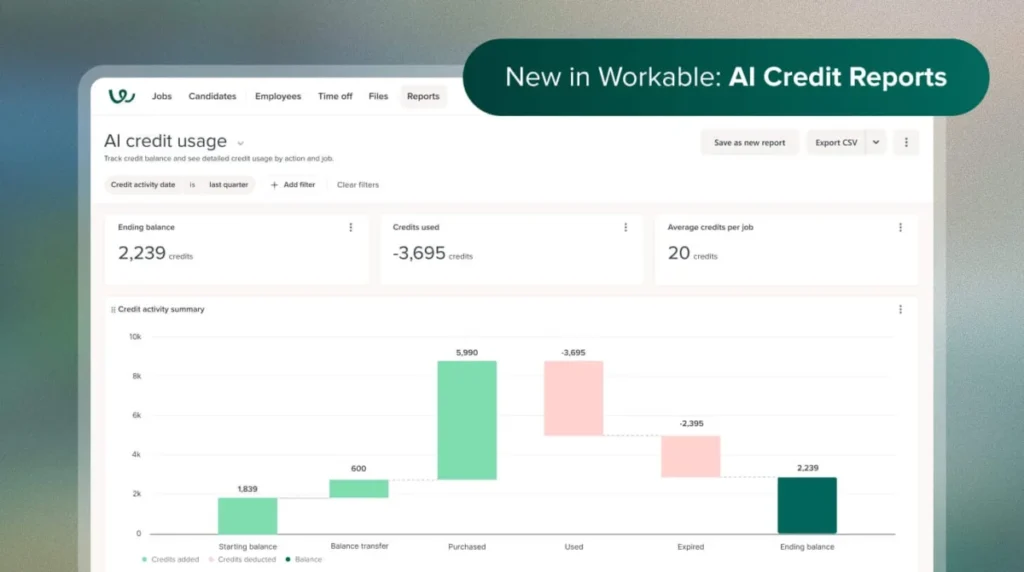
Workable, a leading provider of hiring software, has announced the immediate launch of a groundbreaking AI Credits Report, offering account administrators unprecedented visibility into their artificial intelligence expenditure and usage. This new feature, seamlessly integrated into Workable’s existing Recruiting Reports suite, provides a detailed breakdown of AI credit consumption, empowering organizations to meticulously track, manage, and optimize their investment in AI-driven recruitment tools without requiring any additional setup. The report is designed to demystify AI costs, showing precisely what has been purchased, utilized, expired, and, critically, which specific jobs and recruitment activities are driving this spend, thereby enabling a more strategic approach to talent acquisition budgets.
The Evolving Landscape of AI in Recruitment: A Contextual Overview
The introduction of Workable’s AI Credits Report arrives at a pivotal moment for the human resources technology sector. Over the past five years, artificial intelligence has rapidly transformed recruitment processes, moving from experimental applications to becoming an indispensable component of modern talent acquisition strategies. AI-powered tools are now widely employed for tasks ranging from automated candidate sourcing and initial screening to personalized outreach, resume analysis, and even intelligent interview scheduling. According to a recent report by Grand View Research, the global HR artificial intelligence market size was valued at USD 1.5 billion in 2022 and is projected to grow at a compound annual growth rate (CAGR) of 29.7% from 2023 to 2030, underscoring the escalating reliance on these technologies.
The benefits of AI in recruitment are well-documented: enhanced efficiency, reduced time-to-hire, improved candidate experience, and the potential to mitigate unconscious bias by standardizing initial evaluation criteria. However, as organizations increasingly leverage these powerful tools, a new challenge has emerged: managing the associated costs and demonstrating a clear return on investment (ROI). Many AI functionalities within recruitment platforms operate on a credit-based system, where specific actions consume a certain number of credits. Without clear tracking mechanisms, account administrators often struggle to understand the precise allocation and impact of these credits, leading to potential budget overruns or underutilization. Workable’s new report directly addresses this critical need, providing a transparent ledger for AI operations within the recruitment funnel.
A Chronology of Workable’s AI Integration and Feature Evolution
Workable has been at the forefront of integrating AI into its hiring platform for several years, continually enhancing its offerings to meet the dynamic needs of the recruitment market.
- Early 2020s: Initial AI Explorations: Workable began its journey by introducing foundational AI capabilities designed to streamline routine recruitment tasks. This included features like smart candidate recommendations based on job descriptions and automated parsing of resumes to extract key skills and experiences. These early integrations laid the groundwork for more sophisticated AI applications.
- Mid-2020s: Expansion of AI-Powered Tools: Recognizing the growing demand for intelligent automation, Workable significantly expanded its AI suite. This phase saw the introduction of AI-powered job description generators, which helped recruiters craft compelling and optimized job postings, and advanced candidate matching algorithms that went beyond keywords to understand semantic relevance. AI also began to assist with personalized candidate outreach, helping teams engage with potential hires more effectively and at scale. The introduction of these features, while boosting efficiency, also marked a rise in the use of credit-based models for certain premium AI operations.
- Late 2020s: Responding to User Feedback and Market Demands: As Workable’s AI functionalities matured and adoption grew, account administrators increasingly sought greater transparency into their AI credit consumption. Feedback indicated a clear need for granular reporting that could tie specific AI actions to costs and outcomes. This user-driven demand, coupled with a broader industry trend towards greater financial accountability in SaaS subscriptions, spurred Workable’s development team to prioritize a dedicated AI credits reporting solution. The development cycle involved extensive internal testing and collaboration with early adopters to ensure the report met real-world operational requirements.
- Current Launch: The AI Credits Report: The culmination of this strategic development is the official launch of the AI Credits Report. This release signifies Workable’s commitment not only to innovation in AI-powered recruitment but also to empowering its users with the tools necessary for effective resource management and strategic decision-making.
Key Features and Enhanced Functionality of the AI Credits Report
The newly introduced AI Credits Report offers a suite of functionalities designed to provide unparalleled transparency and control to account administrators. These features move beyond simple credit balances, offering deep insights into the entire lifecycle of AI credit usage.
- Comprehensive Balance Movement Tracking: Administrators can now observe the full journey of their AI credits, from initial purchase and allocation to active consumption and eventual expiration. This comprehensive overview includes a clear dashboard displaying the total credits available, credits used within a specified period, and any credits that have expired. This "start to finish" visibility ensures that no credit goes unnoticed, facilitating proactive management and preventing wastage. It allows for an immediate understanding of credit flow, crucial for budgeting and forecasting.
- Granular Consumption Insights by Action: The report delineates precisely what actions are consuming AI credits. Instead of a general usage figure, administrators can see breakdowns by specific AI functionalities, such as "AI-generated job descriptions," "AI candidate profile enrichment," "AI-powered automated outreach messages," or "AI-driven resume screening scans." This granular detail is vital for identifying which AI tools are most frequently utilized and, consequently, which contribute most significantly to overall expenditure. For instance, if a team is heavily using AI for candidate profile enrichment but seeing limited conversion, this report can highlight that inefficiency.
- Job-Level Attribution for Targeted Analysis: A standout feature is the ability to drill down into credit consumption at the individual job level. This means an administrator can view how many AI credits were used for a specific "Senior Software Engineer" role or a "Marketing Manager" position. This level of detail is invaluable for evaluating the AI investment for particular hiring initiatives. It allows for performance comparison between different roles or departments, identifying which types of hires benefit most from AI augmentation and where AI credit usage might be optimized. It also provides data for post-hire analysis, linking AI spend to successful recruitment outcomes.
- Flexible Filtering and Custom Reporting: To cater to diverse analytical needs, the report incorporates robust filtering capabilities. Account admins can customize their views based on specific date ranges, departmental assignments, job categories, or types of AI activities. This flexibility allows for highly targeted analysis, whether it’s reviewing monthly AI expenditure across the entire organization or examining the credit usage for a specific project team over a quarter. The ability to filter ensures that the data presented is always relevant to the administrator’s immediate query, making the report a dynamic tool for ongoing optimization.
- Seamless Integration with Existing Reporting Infrastructure: Workable has ensured that the AI Credits Report sits naturally alongside the existing suite of recruiting reports that administrators already rely on. This integration minimizes the learning curve and provides a unified platform for all recruitment analytics. The familiarity of the interface and the absence of extra setup requirements mean that users can immediately leverage the new insights without operational disruption.
Supporting Data and Market Context: The Imperative for Financial Transparency
The demand for financial transparency in cloud-based software, particularly for consumption-based services like AI, has surged in recent years. A 2023 survey by Flexera found that 82% of enterprises are concerned about cloud spend, with many reporting significant wastage. While this often pertains to broader cloud infrastructure, the principle extends to SaaS platforms that incorporate credit-based features. For HR departments, which are increasingly expected to operate as strategic business units, demonstrating the ROI of technology investments is paramount.
- Cost Optimization and Budget Adherence: The AI Credits Report directly supports cost optimization efforts. By understanding where credits are being spent, administrators can identify areas of high consumption that may not be yielding proportional results. For example, if extensive AI credits are used for candidate sourcing in a particular market but without significant interview conversions, the strategy can be adjusted. This granular insight helps organizations adhere to budgets more effectively and prevent unexpected expenditures.
- Justifying AI Investment: In an era where every departmental expenditure faces scrutiny, the ability to present detailed data on AI usage and its link to recruitment activities is crucial for justifying ongoing investment. Administrators can now demonstrate how AI credits are being deployed to accelerate hiring, improve candidate quality, or reduce manual workload, providing concrete evidence of value to executive leadership. This shifts the conversation from "AI is expensive" to "AI is a strategic investment with quantifiable impact."
- Enhanced Operational Efficiency: Beyond financial transparency, the report also offers insights into operational efficiency. By identifying which AI tools are most heavily used and by whom, organizations can better understand their team’s adoption patterns and provide targeted training or reallocate resources. For instance, if one team is underutilizing a beneficial AI feature, the report can highlight this, prompting intervention to maximize tool effectiveness.
Statements and Industry Reactions
"The launch of our AI Credits Report is a testament to Workable’s unwavering commitment to empowering our users with complete transparency and control over their recruitment operations," stated Spyros Magiatis, CEO of Workable. "As AI becomes more integral to talent acquisition, understanding its cost drivers and optimizing its usage is no longer a luxury but a necessity. This report provides the granular data needed for our clients to make informed, strategic decisions, ensuring their AI investments translate into tangible hiring success and operational efficiency."
Industry analysts have also lauded Workable’s initiative. "In the burgeoning landscape of AI-driven HR tech, Workable’s move towards transparent credit reporting is a critical development," commented Dr. Eleanor Vance, a leading HR technology consultant. "Companies are keen to leverage AI, but the black box of consumption-based pricing has often been a point of friction. This report sets a new standard for accountability, allowing HR leaders to truly understand their AI footprint and align it with their strategic hiring goals. It’s a proactive step that will resonate strongly with finance-conscious organizations."
Furthermore, early feedback from Workable clients indicates a strong positive reception. "Managing AI credits used to be a guessing game, especially across multiple hiring teams," shared Sarah Chen, Head of Talent Acquisition at a fast-growing tech firm and an early adopter of the report. "Workable’s new report has completely transformed our ability to track usage, allocate budgets, and even identify best practices for using AI in different departments. It’s an invaluable tool for strategic planning and cost control."
Broader Impact and Future Implications
The introduction of Workable’s AI Credits Report carries significant broader implications for the HR technology market and the strategic management of talent acquisition.
- Elevated Budgeting and Forecasting Accuracy: For many organizations, predicting AI-related expenditures has been challenging. With precise historical data on credit consumption, account admins can now create far more accurate budgets and forecasts for future recruitment cycles, leading to greater financial stability and predictability within the HR function.
- Optimized AI Strategy and Adoption: The report facilitates a data-driven approach to AI strategy. Organizations can now analyze which AI functionalities provide the best ROI for specific job types or recruitment stages. This insight enables them to refine their AI adoption, focusing resources on high-impact areas and potentially re-evaluating or adjusting usage in less effective ones. It transforms AI from a generic tool into a strategically deployed asset.
- Strengthening Responsible AI Governance: Transparency in AI usage and cost is a cornerstone of responsible AI governance. By providing clear visibility into how AI is consumed, Workable is helping organizations adhere to principles of accountability and ethical deployment. This fosters trust in AI tools and allows for proactive identification of any usage patterns that might warrant further review or adjustment.
- Setting a New Industry Standard: Workable’s comprehensive approach to AI credit reporting has the potential to set a new benchmark within the HR tech industry. As AI adoption continues to accelerate, other platform providers may be compelled to offer similar levels of transparency, ultimately benefiting end-users across the board by fostering greater competition in value and accountability.
- Potential for Future Enhancements: While already robust, the data gathered through this report opens avenues for future enhancements. Workable could potentially leverage anonymized, aggregated data to offer industry benchmarks for AI credit usage, allowing organizations to compare their consumption patterns against peers. Further integrations with broader financial planning tools or even predictive analytics for future credit needs based on hiring forecasts could also be on the horizon, continually evolving the strategic value of the platform.
In conclusion, Workable’s new AI Credits Report represents a significant advancement in recruitment technology, directly addressing the growing need for transparency and control over AI investments. By providing detailed, actionable insights into AI credit consumption, Workable empowers account administrators to manage budgets more effectively, optimize AI strategy, and ultimately drive more efficient and successful hiring outcomes in an increasingly AI-driven world. Organizations keen to explore the full capabilities of this new feature are encouraged to contact their account manager or request a demonstration from Workable’s product specialists.