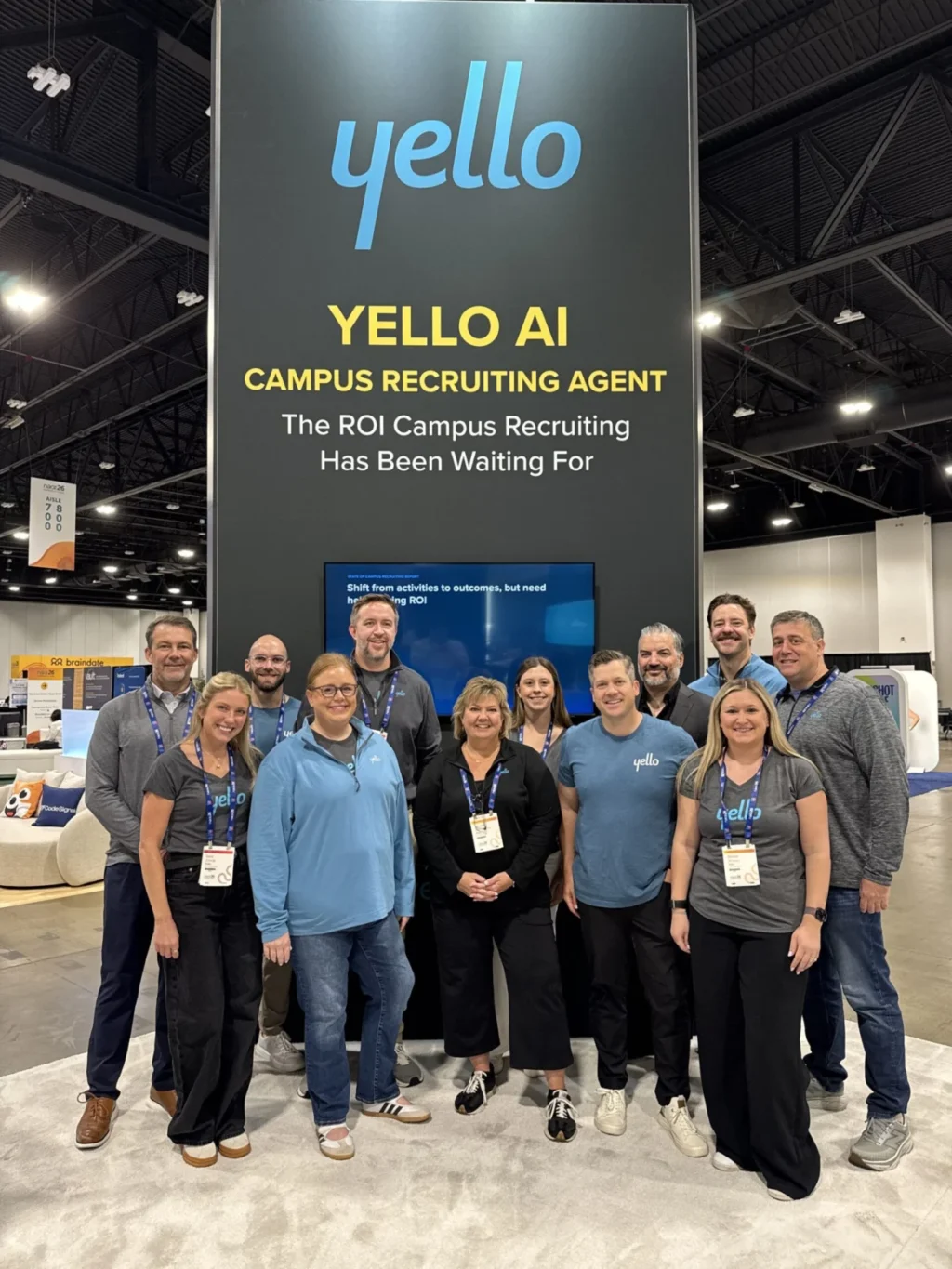
Denver, CO – The National Association of Colleges and Employers (NACE) 26th annual conference recently concluded in Denver, serving as a pivotal gathering for leaders in university relations and early talent acquisition. Amidst a dynamic landscape shaped by technological advancements and evolving candidate expectations, Yello, a prominent provider of early talent recruitment software, marked its presence as a platinum sponsor, leveraging the event to debut its innovative AI Campus Recruiting Agent and announce a strategic partnership with Symplicity. These announcements, alongside critical discussions on the future of recruitment, underscored a significant industry shift towards more strategic, data-driven, and relationship-centric approaches to engaging with early career talent.
NACE26: A Confluence of Early Talent Innovators
NACE, the National Association of Colleges and Employers, is a leading professional organization that connects college career services professionals and HR/staffing professionals who recruit college students. Its annual conference, NACE26, is a cornerstone event for the early talent community, bringing together thousands of professionals to share best practices, discuss emerging trends, and explore new technologies. The 2024 edition in Denver was particularly focused on navigating the complexities introduced by artificial intelligence, changing candidate behaviors, and the persistent challenge of talent retention. Yello’s extensive participation, including multiple speaking sessions, a dedicated exhibition booth, and networking events, positioned it at the forefront of these discussions, offering solutions tailored to the pressing needs of campus recruiters.
The Dawn of Autonomous Recruiting: Yello’s AI Campus Recruiting Agent
A centerpiece of Yello’s presence at NACE26 was the official launch of its AI Campus Recruiting Agent. This new solution is designed to fundamentally redefine how recruiting teams manage their workflows, promising to automate a substantial portion of the administrative burden that often detracts from meaningful candidate engagement. The agent’s capabilities span event building, candidate sourcing, campaign management, and interview scheduling, effectively allowing recruiters to delegate repetitive, time-consuming tasks to an intelligent system.
The industry has long grappled with the dichotomy of needing efficiency while maintaining a human touch in recruiting. Yello’s internal "State of Campus Recruiting report," referenced during the conference, highlighted that while 26% of current AI usage in campus recruiting is concentrated in sourcing and 25% in candidate communications—primarily top-of-funnel activities—there remains a significant gap in leveraging AI for deeper data analysis and proving return on investment (ROI). This gap was a recurring theme in Denver, with recruiters expressing a clear preference for AI that augments their capabilities rather than making autonomous decisions. The consensus leaned towards technology that frees up time for strategic interactions, mentorship, and building genuine relationships.
This sentiment was explicitly addressed in a Yello-hosted session titled "Can Campus Recruiting Be Autonomous? The Answer Is Complicated." Panelists Tamara Welch from LPL Financial, Matthew Brink of NACE, and Dan Bartfield from Yello delved into the nuanced question of whether the ultimate goal is fully autonomous recruiting or empowering recruiters to focus on higher-value work. The audience firmly favored the latter, emphasizing that for AI to be truly effective, it must be purpose-built to address the unique challenges and requirements of campus recruiting. By automating manual processes, recruiters gain invaluable time to concentrate on crucial aspects such as personalized candidate engagement, which is paramount in a competitive talent market.
Moreover, the discussions brought to light a critical consideration: candidate perception. Matthew Brink from NACE underscored that students exhibit wariness towards employers who over-rely on AI in their hiring processes, particularly if such usage is not transparently disclosed. An impersonal, algorithm-driven experience can alienate highly qualified candidates and subtly erode an employer’s brand reputation, making the ethical and strategic deployment of AI a paramount concern. The Yello Campus Recruiting Agent seeks to navigate this by focusing on automation of logistics, thereby facilitating more human interaction, rather than replacing it. Its core functionality enables recruiters to arrive at events with pre-scheduled interviews with best-fit candidates, effectively "flipping the model" from hopeful discovery to strategic engagement.
Expanding Reach: The Symplicity Partnership
Complementing the AI agent’s launch, Yello announced a significant partnership with Symplicity, a leading global provider of student success and engagement platforms. This collaboration grants Yello customers unparalleled access to Symplicity’s expansive network of over 600,000 early talent candidates. For employers utilizing the Yello Campus Recruiting Agent, this means the ability to match against active candidates from the Symplicity database, significantly broadening their talent pool beyond their existing Applicant Tracking Systems (ATS), Yello database, WayUp, and other web-based sources.
The partnership represents a strategic move to address the increasing demand for diverse and qualified early talent. By integrating Symplicity’s robust network, Yello enhances the AI agent’s sourcing capabilities, allowing for more precise and efficient identification of candidates who align with specific roles and organizational cultures. This synergy is anticipated to streamline the initial stages of the recruitment funnel, ensuring that recruiters are connecting with a higher volume of relevant candidates from the outset, thereby improving overall recruitment efficiency and effectiveness. The implication is a more comprehensive and inclusive approach to candidate discovery, reducing the likelihood of overlooking promising talent due to limited data access or siloed platforms.
Rethinking Event Strategy for Enhanced ROI
Beyond the technological innovations, NACE26 also served as a forum for candid discussions on evolving recruitment methodologies. A prominent theme was the need for employers to fundamentally rethink their event strategies. In a session titled "Purpose Over Presence: Rethinking Your Event Strategy for Better ROI," panelists Vincent Bond from Synchrony, Kristin Leek from Boeing, and Christopher Cantu from Marathon Petroleum illuminated a pervasive challenge: escalating application volumes that paradoxically make qualified candidates harder to surface. This phenomenon, they noted, is partly attributable to the proliferation of AI-assisted resume tools, which can homogenize candidate profiles, creating a situation where "AI is fighting AI."
The response from these industry leaders was a strategic pivot towards earlier and more intentional investment in relationships, primarily through targeted in-person events. The traditional model of attending numerous career fairs with the hope of encountering a few suitable candidates, measured by sheer activity, is giving way to an outcomes-based approach. Employers are now meticulously evaluating which events yield the highest return on investment, translating directly into quality hires. As Christopher Cantu articulated, career fairs are increasingly viewed as the "end zone"—the point of closing the deal—rather than the starting line for candidate engagement. The foundational work, including targeted events and consistent touchpoints, is now understood to occur months, or even years, prior. This emphasis on building "relationship equity" is emerging as a critical competitive differentiator in campus recruiting, offering a robust defense against rising application volumes and the challenges of candidate fraud. This shift aligns with a broader industry trend where authentic engagement and long-term relationship nurturing are prioritized over transactional interactions, ensuring a more sustainable pipeline of talent.
Combating the Renegade Offer Challenge
Another pervasive challenge discussed at NACE26 was the persistent issue of offer reneges. In today’s competitive talent market, an accepted offer no longer guarantees a done deal. The most successful organizations are those that treat the post-offer period as an active and crucial phase of recruitment. Consistent, personalized communication between the offer acceptance and the candidate’s start date has become an indispensable strategy for retaining top talent. Panelists reiterated that strong relationship-building efforts, initiated well before the offer stage through events and sustained engagement, are highly effective in mitigating renege rates.
In a virtual session, "Designing the Complete Journey: From Pre-Boarding to Off-Boarding," Yello’s Ahva Sadeghi introduced the "KEEP framework" as a comprehensive solution for employers to maintain candidate engagement throughout the entire journey. KEEP, an acronym for Kick Off, Engage, Enable, and Perform, outlines four pillars designed to seamlessly transition a candidate from offer acceptance to their first day on the job. Sadeghi delved into the underlying reasons why candidates renege, highlighting the significant financial and operational costs incurred by employers—estimates often place the cost of a renege at tens of thousands of dollars per hire, factoring in lost productivity, recruitment expenses, and team morale. She also shared compelling data on how Symba customers have successfully reduced their renege rates by more than 55% by implementing structured engagement strategies, demonstrating the tangible benefits of a proactive approach to post-offer communication and onboarding. This framework underscores the importance of a holistic candidate experience that extends far beyond the initial hiring decision, fostering loyalty and commitment.
Broader Implications for Early Talent Acquisition
The insights and announcements from NACE26, particularly those from Yello, signal a clear trajectory for early talent acquisition: a move towards intelligent automation, strategic partnerships, and a renewed focus on authentic human connection. The integration of AI tools, like Yello’s Campus Recruiting Agent, is poised to transform the operational efficiency of recruitment teams, freeing them from mundane tasks to dedicate more time to high-value interactions. This shift is not about replacing recruiters but augmenting their capabilities, allowing them to act more as strategic advisors and relationship builders.
The partnership with Symplicity exemplifies the growing necessity for broader, more integrated sourcing strategies. As the talent landscape becomes increasingly fragmented, leveraging diverse data sources and networks will be crucial for identifying and attracting a wide array of qualified candidates. This expanded reach, coupled with AI-driven matching, promises to create a more equitable and efficient talent pipeline.
Furthermore, the emphasis on evolving event strategies and proactive renege mitigation highlights a maturation in the understanding of candidate engagement. Recruiters are moving away from volume-based metrics towards quality outcomes, recognizing that every interaction, from initial contact to post-offer communication, contributes to the overall candidate experience and employer brand. The competitive nature of the early talent market demands a sustained, personalized approach, where technology facilitates human connection rather than overshadowing it.
Ultimately, NACE26 underscored that the future of early talent acquisition lies in a sophisticated blend of cutting-edge technology and time-honored human principles. Companies like Yello are striving to provide the tools that enable this balance, empowering recruiters to navigate the complexities of the modern talent landscape with greater efficacy, empathy, and strategic foresight. The discussions in Denver laid the groundwork for a more intentional, data-driven, and candidate-centric approach to bringing the next generation of talent into the workforce.