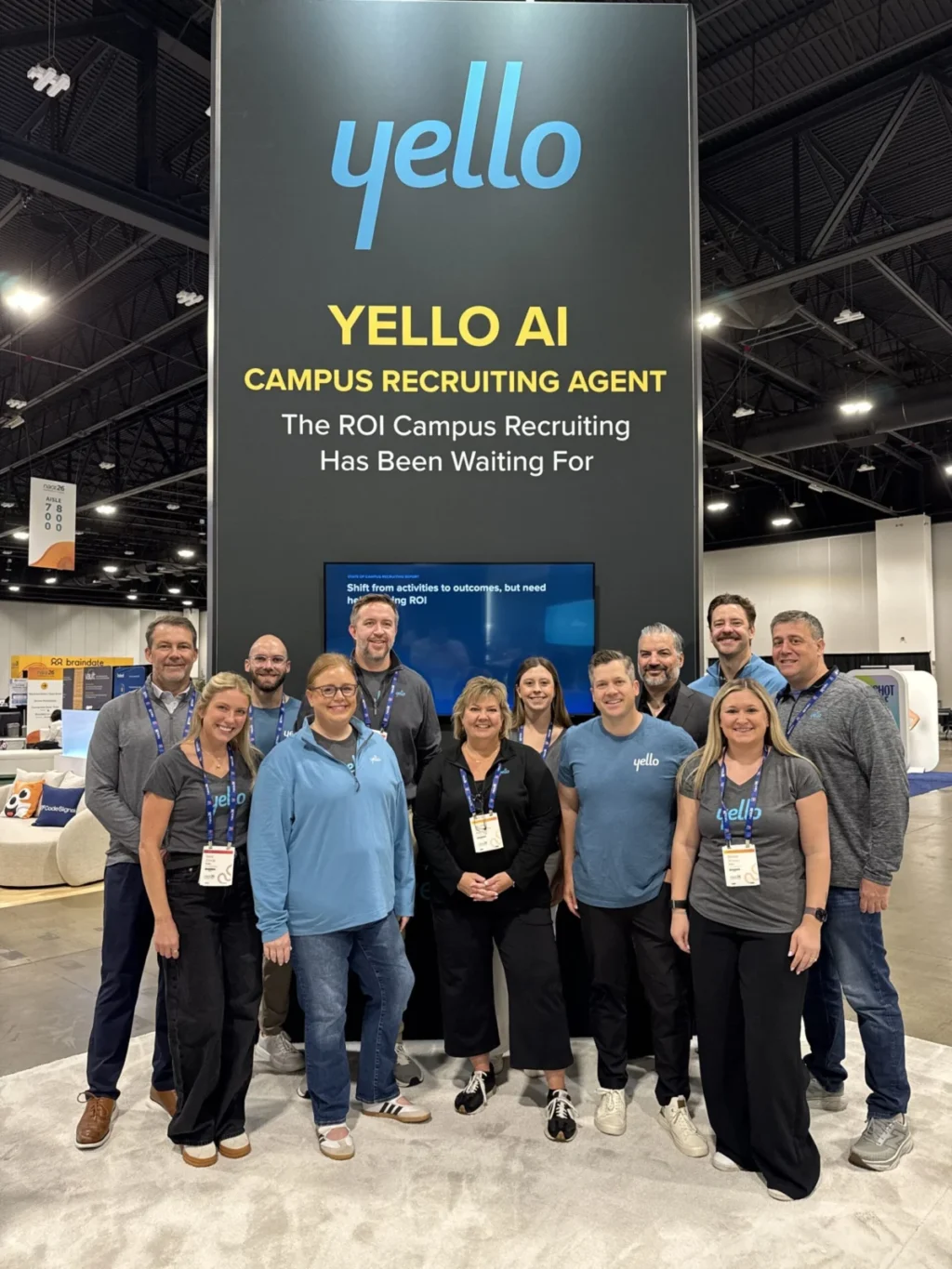
Denver, CO – The National Association of Colleges and Employers (NACE) Annual Conference, NACE26, recently concluded in Denver, serving as a critical forum for collegiate career services and employer recruiting professionals to converge, exchange insights, and chart the future of early talent acquisition. Amidst a backdrop of dynamic shifts in the labor market and technological advancements, Yello, a leading platform in campus recruiting, played a prominent role as a platinum sponsor. The company leveraged its significant presence to unveil two major strategic initiatives: the debut of its AI Campus Recruiting Agent and a new partnership with Symplicity, a widely recognized provider of student engagement and career services platforms. These announcements underscored Yello’s commitment to addressing the evolving challenges faced by campus recruiters, particularly in an era demanding greater efficiency, deeper engagement, and measurable return on investment.
The NACE Annual Conference, a cornerstone event for the early talent community, brings together hundreds of professionals annually. Its agenda typically covers the latest trends, best practices, and innovative solutions in recruiting recent graduates and interns. This year’s iteration, NACE26, held particular significance as organizations continue to navigate the complexities of a post-pandemic talent landscape characterized by hybrid work models, intensified competition for top talent, and the rapid integration of artificial intelligence into recruitment processes. Discussions across the conference floor, in dedicated sessions, and during informal networking, repeatedly highlighted key areas of concern and opportunity for early talent teams.
The AI Imperative: Redefining Campus Recruiting Workflows
A central theme dominating conversations at NACE26 was the transformative potential and practical application of artificial intelligence in recruiting. While AI has become an undeniable force across various industries, its specific impact on campus recruiting remains a nuanced topic. According to Yello’s recent State of Campus Recruiting report, a significant portion of current AI usage among campus teams, specifically 26%, is concentrated in sourcing, with another 25% allocated to candidate communications – predominantly top-of-funnel activities. This data suggests that while AI is being adopted, its application is largely confined to preliminary stages, missing crucial opportunities for deeper analytical integration.
The report further illuminated a critical gap: the area where AI could yield the most substantial impact, namely data analysis and proving ROI, is where its adoption remains largely absent. This disconnect resonated deeply with attendees in Denver. Recruiters voiced a clear preference: they are not seeking AI that makes autonomous hiring decisions, but rather tools that alleviate the burden of administrative tasks and recurring manual processes. This desire stems from a fundamental need to reclaim valuable time that can then be redirected towards more meaningful interactions with candidates, fostering genuine connections that are vital in early talent acquisition.
This very dichotomy was explored in depth during Yello’s session, "Can Campus Recruiting Be Autonomous? The Answer Is Complicated." The panel, featuring Tamara Welch from LPL Financial, Matthew Brink from NACE, and Dan Bartfield from Yello, delved into whether the ultimate objective of AI integration should be fully autonomous recruiting or merely empowering recruiters to concentrate on higher-value, strategic work. The audience’s unequivocal response favored the latter, emphasizing that AI’s effectiveness hinges on its purpose-built design to meet the unique challenges of campus recruiting. By automating tasks such as scheduling, initial outreach, and data aggregation, AI can free recruiters to engage more deeply, personalize interactions, and ultimately enhance the candidate experience.
However, the discussion also brought to light important ethical considerations. Matthew Brink from NACE underscored a burgeoning sentiment among students: a wariness towards employers who excessively rely on AI in their hiring processes, especially when such usage is not transparently disclosed. A recruitment journey that feels impersonal or opaque due to undisclosed AI intervention risks alienating qualified candidates and could subtly but significantly erode an employer’s brand reputation. This highlights the delicate balance between technological efficiency and maintaining a human-centric approach in the competitive early talent market.
Strategic Evolution of Event Engagement: Purpose Over Presence
Beyond AI, NACE26 also served as a platform for critical discussions on the evolving role and effectiveness of recruitment events. In Yello’s second session, "Purpose Over Presence: Rethinking Your Event Strategy for Better ROI," panelists Vincent Bond from Synchrony, Kristin Leek from Boeing, and Christopher Cantu from Marathon Petroleum articulated a shared perspective that many campus teams are currently experiencing. They described a scenario where application volumes continue to escalate, yet the challenge of identifying genuinely qualified candidates has become increasingly difficult. A significant contributing factor to this phenomenon is the widespread use of AI-assisted resume tools by candidates, leading to a proliferation of highly optimized, often indistinguishable resumes. As Vincent Bond succinctly put it, "every resume looks the same now. AI is fighting AI."
In response to this "AI versus AI" dynamic, these industry leaders advocated for a fundamental shift in event strategy. Their approach involves investing earlier and more intentionally in relationship building, predominantly through targeted in-person events. The traditional model of attending numerous career fairs, engaging with a high volume of candidates, and hoping to serendipitously discover a few suitable matches is rapidly being superseded. Instead, employers are adopting an outcomes-based approach, meticulously evaluating which events yield the highest return on investment and consistently result in quality hires.
Christopher Cantu’s analogy of career fairs as the "end zone" – the point where offers are closed, rather than where relationships begin – resonated strongly. He emphasized that the foundational groundwork for successful recruitment now occurs months, or even years, prior to a career fair. This involves a sustained series of targeted events and consistent candidate touchpoints. In today’s highly competitive landscape, "relationship equity" has emerged as the true competitive differentiator in campus recruiting. This proactive, relationship-centric strategy is proving instrumental in combating the twin challenges of escalating application volumes and the rising specter of candidate fraud, ensuring that employers connect with authentic, engaged talent.
Addressing the Renegotiation Challenge: The Post-Offer Imperative
Another prominent and persistent challenge discussed extensively at NACE26 was the issue of offer reneges. In a robust talent market where candidates often receive multiple offers, an accepted offer no longer guarantees a done deal. This reality has forced campus recruiting teams to re-evaluate their post-offer strategies, recognizing that the period between offer acceptance and the candidate’s start date must be treated as an active and crucial phase of recruitment.
Consistent, personalized communication during this interim period is no longer a luxury but a fundamental requirement for retaining top talent. Panelists at the conference shared their experiences, noting a direct correlation between their sustained relationship-building efforts initiated at events and lower renege rates. This reinforces the idea that nurturing a relationship from initial contact through to the onboarding process significantly enhances candidate commitment.
In a dedicated virtual session titled "Designing the Complete Journey: From Pre-Boarding to Off-Boarding," Yello’s Ahva Sadeghi introduced the innovative KEEP framework. This strategic model is designed to help employers maintain candidate engagement throughout the entire journey, from offer acceptance to the first day of employment and beyond. KEEP stands for Kick Off, Engage, Enable, and Perform – four pillars that guide organizations in creating a seamless and supportive experience for new hires. Sadeghi also provided valuable insights into the underlying reasons why candidates renege, the substantial financial and operational costs these reneges impose on employers, and presented compelling evidence of how Symba customers have successfully reduced their renege rates by over 55% through effective engagement strategies. These discussions underscored the critical need for comprehensive, proactive post-offer engagement to safeguard talent investments.
Yello’s Strategic Alliances: Expanding Reach and Efficiency
NACE26 served as a pivotal moment for Yello, marking the official launch of two significant developments poised to redefine efficiency and reach in campus recruiting.
Firstly, Yello unveiled its AI Campus Recruiting Agent. This innovative, AI-powered agent is engineered to automate a multitude of manual tasks, thereby streamlining the entire recruitment process. Its capabilities extend to simplifying event creation, candidate sourcing, campaign management, and interview scheduling. The core objective is to liberate recruiting teams from administrative overhead, allowing them to dedicate more time and resources to meaningful candidate engagement.
The Yello Campus Recruiting Agent fundamentally reorients the traditional campus recruiting model. Historically, recruiters would attend events hoping that the right candidates would visit their booth. Yello’s agent flips this paradigm: it proactively identifies best-fit candidates and pre-schedules interviews before the event even commences. This eliminates the uncertainty and inefficiency of traditional methods. The agent handles the heavy lifting of event building and management, candidate matching and prioritization, targeted outreach, and interview scheduling. Recruiters can now arrive at an event with a pre-populated interview schedule, ensuring that their time is spent engaging with highly qualified individuals who are genuinely aligned with their roles, maximizing the return on their event investment.
Secondly, Yello announced a strategic new partnership with Symplicity, a collaboration designed to significantly expand candidate access for campus recruiters. This alliance grants Yello customers seamless access to Symplicity’s extensive network of over 600,000 early talent candidates. The integration is particularly powerful when combined with the Yello Campus Recruiting Agent. Employers utilizing the agent can now match against active candidates from the Symplicity database, augmenting their existing candidate pools from their own Applicant Tracking Systems (ATS), Yello’s proprietary database, WayUp, and over 35 other diverse online sources. This comprehensive sourcing capability empowers recruiters to cast a wider net, identify more diverse talent, and connect with a broader array of qualified candidates more efficiently than ever before.
Broader Market Implications and Future Outlook
The announcements from Yello at NACE26, coupled with the prevailing themes of the conference, signal a profound transformation in early talent acquisition. The pervasive influence of AI is forcing a re-evaluation of recruiter roles, shifting the focus from transactional, administrative tasks to strategic engagement, relationship building, and insightful data analysis. Recruiters are increasingly becoming talent strategists, leveraging technology to amplify their impact rather than being replaced by it.
The evolving approach to recruitment events, prioritizing "purpose over presence," underscores a broader industry trend towards outcomes-based strategies. This shift is driven by the need for measurable ROI in an increasingly competitive and cost-conscious environment. Organizations are no longer content with mere activity metrics; they demand tangible results in the form of quality hires and reduced time-to-fill.
Furthermore, the persistent challenge of offer reneges highlights the critical importance of candidate experience extending beyond the offer acceptance. The concept of the "active recruiting phase" post-offer is gaining traction, emphasizing personalized, sustained communication as a key differentiator in securing and retaining top talent. The financial and reputational costs associated with reneges necessitate robust engagement frameworks like Yello’s KEEP.
Yello’s AI Campus Recruiting Agent and its partnership with Symplicity represent a strategic response to these evolving market dynamics. By automating low-value tasks, enhancing candidate matching, and expanding access to diverse talent pools, Yello aims to empower campus recruiters to be more effective, efficient, and strategic. These innovations not only promise to optimize the recruitment process but also contribute to building stronger employer brands and fostering more meaningful connections with the next generation of professionals. As the early talent landscape continues to evolve, the integration of intelligent technology and strategic partnerships will be paramount for organizations striving to secure a competitive edge in the global war for talent.