
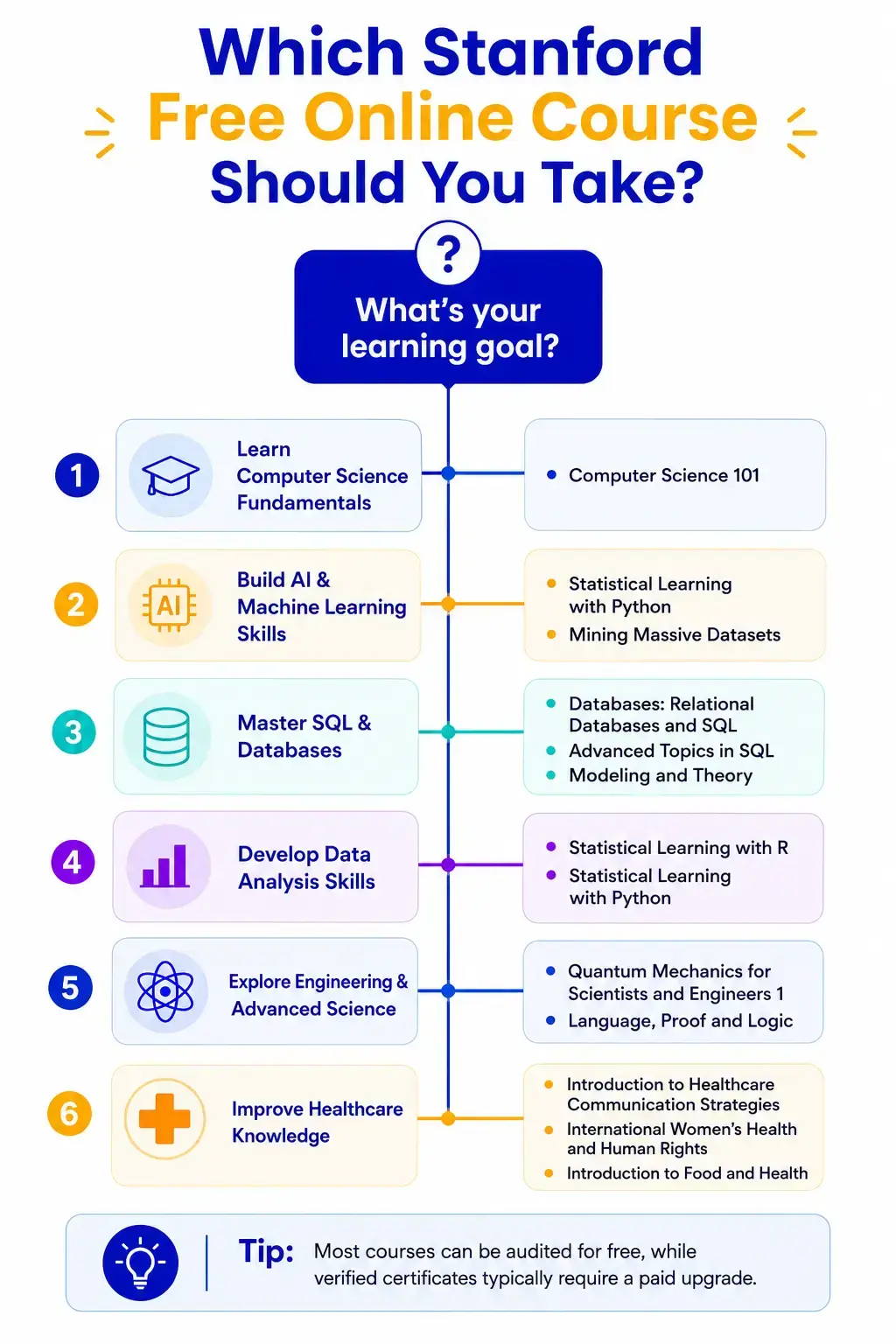
The landscape of professional development has undergone a seismic shift over the last decade, transitioning from traditional classroom settings to a decentralized, digital-first ecosystem. Stanford University, a cornerstone of Silicon Valley’s innovation engine, has been at the forefront of this transformation. By offering a curated selection of free online courses, the institution provides global professionals with access to university-level instruction in high-demand fields such as artificial intelligence, data science, and organizational leadership. As industries grapple with the rapid integration of automation and digital tools, these resources have become essential for maintaining a competitive edge in an increasingly volatile labor market.
The Evolution of Stanford Online: A Chronological Context
The genesis of Stanford’s robust online offering can be traced back to 2011, a year often cited by educational historians as the "Year of the MOOC" (Massive Open Online Course). It began when Stanford professors Sebastian Thrun and Peter Norvig opened their "Introduction to Artificial Intelligence" course to the public, attracting over 160,000 students from 190 countries. This experiment proved that there was a massive, global appetite for high-quality, rigorous academic content delivered outside the traditional campus walls.
Following this success, Stanford faculty members founded platforms like Coursera and Udacity, while the university itself developed Stanford Online. Over the subsequent decade, the university expanded its digital catalog to include hundreds of courses, ranging from niche engineering subjects to broad humanitarian topics. Today, Stanford Online operates through a multi-platform strategy, hosting content on its proprietary site as well as through partnerships with edX and Coursera, ensuring that its pedagogical reach extends to millions of learners worldwide.
Navigating the "Freemium" Model of Online Education
While the term "free" is often used in the context of these courses, it is important for professionals to understand the "freemium" structure that governs most modern MOOCs. Stanford typically offers a "Verified Track" and an "Audit Track."
The Audit Track allows learners to access video lectures, course readings, and some discussion forums at no cost. This is an ideal route for individuals seeking knowledge for personal enrichment or internal skill-building. However, auditing a course usually does not include graded assignments or a final credential.
The Verified Track requires a financial investment, typically ranging from $50 to $200. In exchange, students receive graded assessments and a formal certificate of completion. For professionals seeking to bolster their LinkedIn profiles or provide evidence of upskilling to employers, the verified track is often the preferred choice. It is also worth noting that Stanford’s "Professional Programs" are distinct from these free-to-audit courses; the former are instructor-led, intensive, and designed specifically for executive education, carrying a significantly higher price point.
Detailed Analysis of 15 Essential Stanford Courses
The following 15 courses represent the most impactful offerings currently available for free or audit. They are categorized by their relevance to the modern workforce.
Technical Foundations and Computer Science
1. Computer Science 101
As digital literacy becomes a prerequisite for nearly every corporate role, CS101 serves as a vital entry point. Designed for those with no prior programming experience, the course demystifies how computers work, the nature of software, and the basics of internet security. For HR leaders and non-technical managers, this course provides the vocabulary necessary to communicate effectively with engineering teams.
2. Algorithms: Design and Analysis (Parts 1 and 2)
Taught by renowned computer scientist Tim Roughgarden, these advanced courses are a staple for software engineers. They cover the fundamental principles of algorithm design, including "divide and conquer" strategies and greedy algorithms. In an era where algorithmic efficiency dictates the profitability of tech products, mastering these concepts is critical for senior developers.
3. Databases: Relational Databases and SQL
Structured Query Language (SQL) remains the gold standard for data retrieval. This course provides a comprehensive introduction to relational database management systems, a skill that is increasingly required not just for IT professionals, but also for marketing analysts and product managers.
4. Databases: Advanced Topics in SQL and Semistructured Data
For those who have mastered the basics, these intermediate-to-advanced modules explore complex queries, database theory, and the management of JSON and XML data. This is particularly relevant for professionals working with cloud-based architectures and large-scale data integrations.
Data Science and Artificial Intelligence
5. Statistical Learning with Python
6. Statistical Learning with R
Statistical learning is the backbone of modern machine learning. These courses, based on the landmark textbook An Introduction to Statistical Learning, teach professionals how to model and understand complex datasets. By offering versions in both Python and R, Stanford caters to the two most dominant languages in the data science community.
7. Mining Massive Datasets
As organizations move from "Big Data" to "Extreme Data," the ability to extract meaningful patterns from petabytes of information is a high-value skill. This course focuses on the computational techniques used in web searches, recommendation systems, and social network analysis.
Healthcare and Public Health
8. Introduction to Healthcare Communication Strategies
Effective communication in healthcare is not merely a soft skill; it is a clinical necessity that impacts patient outcomes. This course is designed for clinicians and healthcare administrators looking to optimize team dynamics and patient-provider interactions.

9. International Women’s Health and Human Rights
This course provides a global perspective on the socio-economic and legal factors affecting women’s health. It is an essential resource for professionals in the non-profit sector, policy-making, and international development.
10. Introduction to Food and Health
Addressing the global epidemic of diet-related diseases, this course offers a science-based approach to nutrition. It is widely utilized by educators and wellness professionals to promote evidence-based lifestyle changes.
Logic, Physics, and Specialized Engineering
11. Language, Proof, and Logic
This course bridges the gap between philosophy and computer science, focusing on formal logic. It is highly beneficial for researchers and those working in artificial intelligence, where logical consistency is paramount.
12. Quantum Mechanics for Scientists and Engineers
As quantum computing moves from theoretical research to practical application, understanding the underlying physics is becoming necessary for hardware engineers and high-level researchers. This course provides a rigorous mathematical foundation in quantum theory.
Supporting Data: The Rising Demand for Micro-Credentials
The surge in interest for Stanford’s online courses is mirrored by broader industry trends. According to the World Economic Forum’s Future of Jobs Report, an estimated 44% of workers’ skills will be disrupted by 2027. The report emphasizes that "analytical thinking" and "technological literacy" are the fastest-growing core skills.
Furthermore, a 2023 LinkedIn Learning report indicated that 94% of employees would stay at a company longer if it invested in their career development. For Learning and Development (L&D) professionals, Stanford’s free courses offer a cost-effective way to bridge the "skills gap" without the exorbitant costs associated with traditional corporate training retreats or executive MBA programs.
Strategic Implications for HR and L&D Leaders
From an organizational standpoint, the availability of university-level content for free changes the calculus of talent retention and recruitment.
Skills-Based Hiring: HR professionals are increasingly moving away from "degree-based" hiring toward "skills-based" hiring. A candidate who has audited and completed Stanford’s "Statistical Learning" course demonstrates a level of initiative and technical rigor that can be more relevant than a decade-old degree.
Curated Learning Pathways: Instead of offering employees a generic library of thousands of videos, L&D leaders can create "Stanford-backed" pathways. For example, a "Digital Transformation" track for middle managers might include CS101, SQL basics, and Healthcare Communication Strategies.
AI Readiness: As companies rush to implement generative AI, the fundamental understanding of machine learning—provided by Stanford’s statistics and algorithm courses—becomes a safeguard against the "black box" problem, where employees use AI tools without understanding their limitations or ethical risks.
Expert Analysis: The Impact on Global Education Equity
The democratization of Stanford’s curriculum has profound implications for global equity. Historically, the "Stanford brand" was a walled garden, accessible only to those who could afford the tuition or secure a highly competitive residency in Palo Alto. By moving this content online, Stanford has enabled a software developer in Nairobi or a data analyst in Jakarta to learn from the same professors as a student in California.
However, critics point out that while the content is free, the context—the networking, the peer-to-peer interaction, and the prestige of a full degree—remains exclusive. Nevertheless, as a tool for economic mobility, these courses provide a low-risk, high-reward mechanism for individuals in emerging markets to align their skills with global standards.
Conclusion: Integrating Lifelong Learning into Professional Practice
The 15 courses highlighted in this guide are more than just educational videos; they represent a shift toward a model of "lifelong learning" that is now mandatory for professional survival. Whether an individual is a technical expert seeking to master quantum mechanics or an HR leader trying to understand the basics of computer science, Stanford’s online ecosystem provides a roadmap for growth.
The most successful professionals of the next decade will be those who view their education not as a finite period of their youth, but as a continuous process of "upskilling" and "reskilling." By leveraging the resources of institutions like Stanford, workers can ensure that their skill sets remain relevant in a world where the only constant is technological change. The key to success lies in choosing courses that fill specific, identifiable gaps in one’s professional toolkit, transforming theoretical knowledge into practical, business-driving results.






