
A stark paradox sits at the apex of the corporate hierarchy, illuminated with unsettling clarity by Gallup’s 2026 ‘State of the Global Workplace’ report: corporate leaders, while evaluating their lives more positively than their subordinates, experience significantly worse day-to-day emotional well-being. This counter-intuitive finding challenges deeply entrenched assumptions about the rewards of seniority and demands a re-evaluation of leadership roles in the modern enterprise.
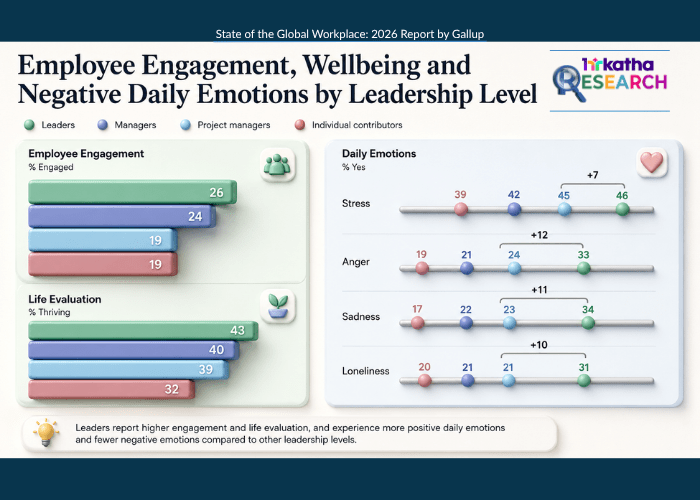
The comprehensive global study, a cornerstone of workplace insights, reveals that despite their elevated status and influence, leaders are disproportionately afflicted by negative emotions. Compared to individual contributors, they are 12 percentage points more likely to report anger, 11 points more likely to report sadness, and 10 points more likely to report loneliness. Furthermore, a significant seven-point increase in reported stress underscores the pervasive emotional toll. This data directly confronts the long-held belief that climbing the corporate ladder inherently brings greater control, satisfaction, and overall well-being. Instead, Gallup’s analysis suggests a more complex reality: leadership enhances abstract life evaluation while simultaneously diminishing the quality of daily emotional experience.
Differentiating Evaluative and Experiential Well-being
To fully grasp this dichotomy, it’s crucial to understand Gallup’s framework for well-being, which separates it into two distinct dimensions. The first, evaluative well-being, pertains to how individuals assess their lives overall—a reflective, often aspirational judgment. The second, experiential well-being, captures how people actually felt yesterday, a snapshot of their immediate emotional state.
On the evaluative front, leaders indeed demonstrate robust health. They are more likely than their managerial counterparts or individual contributors to describe themselves as "thriving," indicating a positive and hopeful outlook on their lives. This group also reports higher engagement levels and greater satisfaction with their lives, aligning with traditional perceptions of successful careers. The perceived benefits of leadership—such as prestige, higher compensation, autonomy, and the ability to shape strategy—contribute significantly to this positive self-assessment. Leaders often derive a sense of accomplishment and purpose from their positions, which boosts their overall life satisfaction. This aligns with broader sociological research indicating that higher socio-economic status often correlates with greater perceived life satisfaction, even if daily stressors increase.
However, the experiential data paints a dramatically different and considerably darker picture. Nearly half of all leaders, specifically 46 percent, reported experiencing stress for a significant portion of the previous day. This figure stands in stark contrast to 39 percent of individual contributors. The prevalence of anger among leaders reached 33 percent, a substantial leap from 21 percent among employees lower in the hierarchy. Sadness affected 34 percent of leaders, compared to 23 percent of individual contributors, while loneliness was reported by 31 percent of leaders versus 21 percent of their team members. These are not minor statistical variances but consistent, significant differences observed across every negative emotional category measured by Gallup. Compounding these findings, leaders were also less likely than individual contributors to report having smiled or laughed a lot the previous day, and less likely than managers to report experiencing enjoyment. This emotional landscape suggests that the daily reality of leadership is far removed from the abstract sense of thriving.
The Structural Roots of Leadership Strain
The explanation for this pervasive emotional strain appears to be structural rather than purely psychological. While leadership undoubtedly confers status, influence, and significant decision-making authority, it also inherently creates distance. As individuals ascend the corporate ladder, their peer group shrinks. Conversations become more guarded, often devoid of the unfiltered honesty common among colleagues at lower levels. Feedback, critical for growth and self-awareness, becomes increasingly filtered, diluted, or entirely absent, leaving leaders in a potential informational vacuum.
Moreover, the decisions leaders are tasked with carry immense and often profound consequences, impacting not just financial outcomes but the livelihoods and well-being of thousands of employees. Layoffs, restructurings, strategic pivots, and difficult trade-offs are all part of the leadership mandate. The authority that defines a leadership role is inextricably linked to the weighty emotional burden of these responsibilities. The "loneliness at the top" is not merely a cliché but a psychological reality, amplified by the perceived need for leaders to project an image of unwavering strength and control, often at the expense of vulnerability and genuine connection. Studies on executive burnout frequently highlight the isolation that comes with high-level decision-making, where the stakes are high and the support network can feel thin. This emotional isolation can be particularly acute in dynamic and uncertain business environments, where leaders are expected to navigate complex challenges with limited precedents.
The Engagement Protection Effect: A Crucial Mitigation
Amidst these challenging findings, the Gallup report identifies a critical mitigating factor: leader engagement. The data reveals that when leaders themselves are engaged at work, the emotional burden they carry diminishes sharply. Engaged managers report significantly lower levels of stress, anger, sadness, and loneliness than individual contributors. Furthermore, they are 14 percentage points more likely to be thriving overall than the average leader.
This finding is profoundly significant, as it suggests that the emotional costs of leadership are not immutable. Instead, they are heavily influenced by whether leaders feel a strong connection to purpose, receive adequate support in their roles, and are genuinely energized by their work. An engaged leader is likely to experience their work as meaningful, to feel a sense of accomplishment, and to possess the psychological resources to cope with demands. This "engagement protection effect" underscores a critical oversight in many organizational strategies.
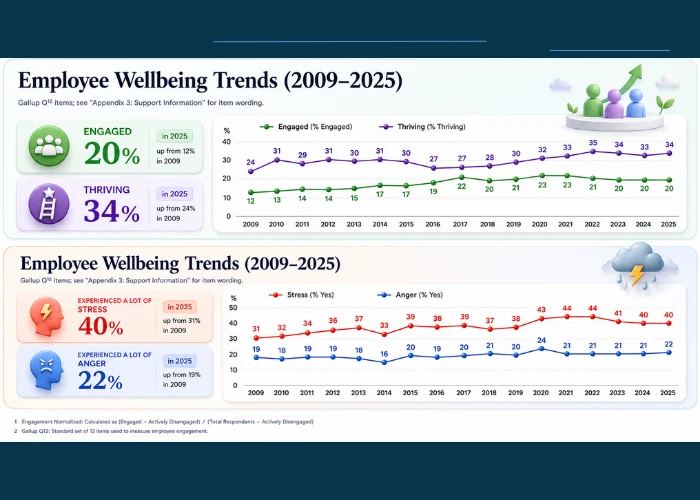
Traditionally, employee engagement programs primarily target frontline employees and middle management, often operating under the implicit assumption that senior leaders are inherently self-sustaining—driven by ambition, prestige, and financial rewards. Gallup’s data decisively challenges this assumption, indicating that such an approach is increasingly risky. The emotional well-being of senior leaders is not a luxury but a strategic imperative. The need for robust engagement strategies at the executive level is further highlighted by the disturbing trend of declining global engagement. Global employee engagement plummeted to 20 percent in 2025, a significant drop from 23 percent in 2022, marking the lowest level since the pandemic period. Even more concerning, manager engagement has fallen even faster, from 31 percent in 2022 to a mere 22 percent in 2025. This means that the very individuals carrying the heaviest emotional load within organizations are simultaneously becoming less connected and less energized by their work, creating a dangerous and unsustainable feedback loop.
South Asia’s Warning Signal: A Regional Case Study
The global picture of declining engagement and increasing leader strain is particularly acute in certain regions, with South Asia emerging as a critical warning signal. The region recorded the world’s lowest thriving rate at just 16 percent, a stark contrast to Latin America and the Caribbean at 56 percent, Australia and New Zealand at 55 percent, and Europe at 49 percent. Simultaneously, South Asia experienced one of the sharpest declines in manager engagement globally.
The reasons for this regional disparity are multifaceted, but largely structural. Organizations across various sectors in South Asia, particularly in technology and services, have increasingly adopted flatter management structures. This often means that remaining leaders are expected to supervise significantly larger teams, known as expanded spans of control, while simultaneously navigating rapid, AI-driven technological change and intense market pressures. Gallup’s research consistently demonstrates a direct correlation: as spans of control expand, engagement declines. Managers overseeing increasingly large teams face a multiplying burden of coordination work, heightened emotional labor in supporting more individuals, and crucially, less time for meaningful coaching, mentorship, and strategic thinking. The result is a leadership layer in South Asia that is absorbing immense pressure from both above (strategic demands, market volatility) and below (larger teams, employee needs), leading to a deeply unsustainable situation. This regional context serves as a powerful illustration of the global trends at play, intensified by specific market dynamics and organizational practices.
The AI Pressure Multiplier: A New Layer of Complexity
The accelerating adoption of Artificial Intelligence (AI) is adding another significant layer of complexity and pressure to the leadership role. Gallup’s Q1 2026 workforce data identifies manager support as the single strongest driver of successful AI adoption within organizations. Among employees who frequently use AI, a remarkable 79 percent strongly agree that their manager actively supports the technology. This figure plummets to 46 percent among infrequent users, highlighting the critical role of leadership in technological transformation.
Furthermore, employees whose managers actively champion AI are 8.7 times more likely to believe that AI has fundamentally transformed how work gets done and 7.4 times more likely to feel that AI helps them focus on higher-value work. This underscores that the technology itself is not the primary differentiator; rather, it is manager behavior, guidance, and active support that unlock AI’s transformative potential. Yet, a significant gap exists: fewer than one-third of employees in organizations implementing AI strongly agree that their managers actively support its use.
This creates a compound leadership challenge. Organizations are simultaneously reducing management layers, thereby increasing individual leader responsibilities, while expecting these remaining managers to spearhead technological transformation, maintain employee engagement, absorb considerable uncertainty, and support increasingly anxious teams grappling with new technologies. Each of these demands is formidable on its own; taken together, they are fundamentally reshaping leadership into a role with significantly higher emotional intensity than ever before. Leaders are not just managing people and processes; they are navigating uncharted waters, acting as interpreters of technological change, and providing psychological anchors for their teams, all while often lacking adequate support themselves.
The Succession Question Organizations Are Avoiding
The cumulative weight of these findings raises an uncomfortable, yet unavoidable, question that looms large over the future of corporate structures: if leadership roles are becoming increasingly emotionally exhausting, who will genuinely desire these jobs? This question is particularly pertinent given the evolving priorities of younger generations entering the workforce.
Recent workforce studies consistently indicate that younger employees, including Millennials and Gen Z, place growing importance on emotional experience, flexibility, work-life integration, and day-to-day well-being. Gallup’s findings present leadership as a path to status and influence, but also to higher stress, increased loneliness, and demonstrably worse daily emotional outcomes. This stark contrast between traditional career aspirations and modern workplace realities could lead to a significant pipeline problem.
Historically, ambitious employees accepted managerial stress as an inherent price of advancement, justified by the promise of greater autonomy, enhanced job security, and considerable prestige. However, if younger generations increasingly prioritize quality of life over hierarchical progression, organizations may soon discover a dwindling pool of talent willing to absorb the emotional trade-offs that leadership now demands. This potential reluctance to ascend could create a profound structural problem that extends far beyond individual well-being, impacting organizational resilience, innovation, and long-term strategic capabilities. Companies that have not yet proactively addressed who their next generation of leaders will be, and whether those individuals actually want the job under its current conditions, are carrying an unquantified risk that does not yet appear on any balance sheet. The absence of a robust succession plan, exacerbated by unattractive leadership conditions, poses a critical threat to future organizational stability.
The Hidden Organizational Cost: A Performance Imperative
The imperative to address leader well-being is not merely a welfare argument—a benevolent gesture towards those at the top. It is, fundamentally, a performance argument with tangible business implications. Leaders are the architects of organizational culture; they dictate the speed of decision-making, the quality of internal communication, and crucially, the level of team engagement. A disengaged, stressed, or emotionally drained leader not only suffers a decline in their own productivity but also casts a long shadow over the experience and output of every employee reporting to them. Their state directly influences team morale, motivation, and overall effectiveness.
Gallup’s broader data already quantifies the staggering global productivity cost of disengagement at nearly $10 trillion annually, which represents approximately 9 percent of global GDP. The findings on leadership well-being strongly suggest that a significant portion of this immense cost originates at the very highest echelons of organizational structures. When leaders are struggling, the ripple effect throughout the organization can be catastrophic, leading to decreased innovation, higher employee turnover, and a general stagnation of progress.
The prevailing image of leadership—one of unwavering control, unshakeable confidence, and undisputed authority—remains only partially true. Gallup’s data presents a more nuanced and modern reality: leaders may indeed evaluate their lives positively due deriving satisfaction from their status and influence, but they simultaneously experience their working days under a significantly heavier emotional strain. The crown, it turns out, looks considerably lighter and more appealing from a distance than it feels when worn up close, heavy with the weight of responsibility, isolation, and unacknowledged emotional burden. Addressing this profound disparity is not just about supporting individuals; it is about safeguarding the future health and performance of organizations worldwide.








