The rapid proliferation of artificial intelligence in the corporate sector has created a significant paradox: while investment in AI technologies is reaching record highs, the majority of these initiatives are failing to deliver their promised value. Recent industry research, including comprehensive studies by McKinsey & Company, indicates that approximately 70 percent of AI projects fail to reach full-scale production. This high rate of attrition is rarely attributed to technical limitations or the inadequacy of the models themselves. Instead, the failure points are consistently identified as organizational challenges, specifically a lack of internal alignment, poor change management, and the absence of a cohesive implementation strategy that integrates human behavior with technological capability.
The Landscape of AI Stagnation
In the current economic climate, enterprises are transitioning from a phase of speculative experimentation to a demand for tangible returns on investment. However, many organizations have mistaken the adoption of individual AI tools—such as chatbots or automated content generators—for a comprehensive AI strategy. This tactical approach often results in "pilot purgatory," where promising projects remain stuck in the testing phase because the organization lacks the infrastructure or cultural readiness to scale them across departments.
Industry analysts observe that the primary hurdle is a "people and process" challenge. When AI is introduced as a standalone solution rather than an integrated component of existing workflows, it frequently encounters resistance from employees who fear displacement or find the new tools disruptive to their established routines. To move beyond this impasse, companies must redefine their implementation steps to prioritize human-centric design and operational clarity.
A Chronology of AI Integration: From Pilot to Production
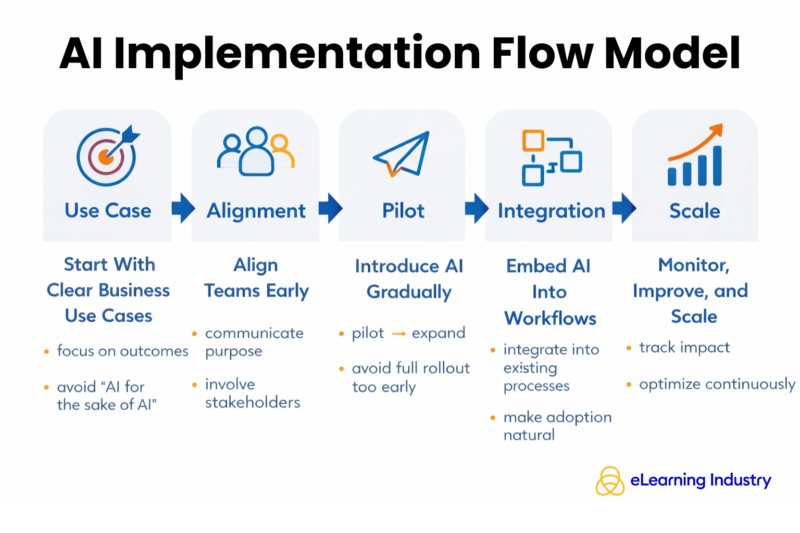
The evolution of a successful AI rollout typically follows a specific chronological path, though many companies attempt to skip stages, leading to eventual project collapse.

- The Identification Phase: Organizations begin by identifying high-value use cases. This involves moving away from "AI for AI’s sake" and focusing on specific business problems, such as reducing customer support latency or automating high-volume data entry.
- The Alignment Phase: Before a single line of code is deployed, leadership must align on priorities. This stage involves cross-departmental communication to ensure that the goals of IT are in sync with the needs of frontline operations.
- The Pilot Phase: Small-scale testing allows for the identification of technical bugs and, more importantly, "friction points" in the user experience.
- The Integration Phase: This is where many projects fail. It requires embedding the AI tool into the software and habits that employees already use daily, rather than forcing them to switch to a new, isolated platform.
- The Scaling and Optimization Phase: Once a pilot is proven, the system is expanded across the enterprise, with continuous monitoring to adjust for shifts in user behavior or data accuracy.
Supporting Data: The Cost of Misalignment
Data from global consultancy firms highlights the financial and operational risks of a fragmented AI approach. Organizations that prioritize technology over change management report a 30 percent slower adoption rate among staff. Furthermore, when employees are not included in the transition process, trust in the AI’s output drops significantly.
A lack of transparency regarding how AI makes decisions can lead to "algorithmic aversion," where human workers ignore the tool’s recommendations, effectively nullifying the investment. Conversely, companies that implement robust training programs and clear feedback loops see a 40 percent increase in operational efficiency within the first 18 months of full-scale deployment. These statistics underscore the fact that AI performance is inextricably linked to the proficiency and confidence of the human workforce using it.
Identifying the Core Risks of Implementation
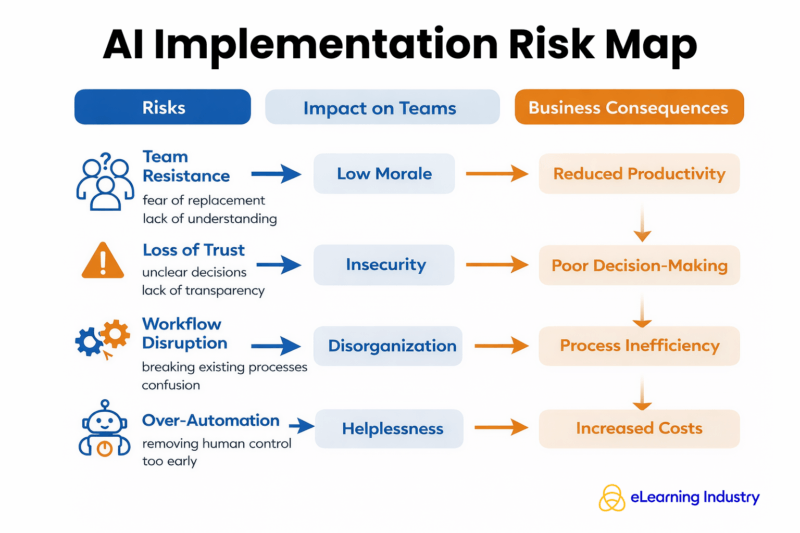
The risks associated with AI deployment extend far beyond wasted capital. If handled poorly, AI implementation can cause lasting damage to organizational culture and operational stability.
- Erosion of Trust: When leadership fails to communicate the "why" behind AI adoption, employees often assume the worst—typically job elimination. This leads to a defensive work culture where innovation is viewed with suspicion.
- Workflow Fragmentation: Introducing AI without mapping existing processes can break established chains of command and communication. If an automated system generates an error that no human is assigned to monitor, the resulting bottleneck can halt production.
- The Skills Gap: There is a growing disparity between the capabilities of modern AI systems and the digital literacy of the average workforce. Without a dedicated upskilling initiative, the most sophisticated tools remain underutilized or are used incorrectly, leading to data integrity issues.
- Loss of Human Context: Over-automation can lead to "de-skilling," where humans lose the ability to apply critical judgment in nuanced situations. Maintaining a "human-in-the-loop" model is essential for long-term risk mitigation.
The Five-Step Strategic Model for Sustainable AI
To circumvent these risks, industry experts recommend a structured five-step model for AI implementation that focuses on longevity and scalability.
Step 1: Define Clear Business Use Cases
Strategy must begin with the end goal. Whether the objective is faster decision-making or reduced manual labor, the use case must be quantifiable. Leaders should focus on a narrow set of high-impact priorities rather than attempting to automate every department simultaneously.
Step 2: Early Stakeholder Alignment
Alignment is not merely a top-down directive; it requires horizontal buy-in. By involving department heads and end-users in the planning stages, organizations can identify potential roadblocks before they become expensive failures. Feedback channels should be established early to ensure that the tools being built actually solve the problems faced by the staff.
Step 3: Gradual and Iterative Rollout
The "big bang" approach to software deployment is rarely successful with AI. A gradual rollout allows for the collection of usage data, which often reveals that employees are using the tools in ways the designers did not anticipate. These insights allow for iterative improvements that make the final version of the tool much more effective.
Step 4: Seamless Workflow Integration
AI should be invisible where possible. This means integrating AI capabilities into existing Enterprise Resource Planning (ERP) or Customer Relationship Management (CRM) systems. When AI functions as a feature of a familiar tool rather than a new destination, resistance drops and productivity rises.
Step 5: Continuous Monitoring and Human Oversight
Post-deployment is not the end of the strategy. AI models can drift over time, and business needs evolve. Organizations must treat AI as a living system that requires ongoing governance, ethical oversight, and performance auditing to ensure it remains aligned with corporate values and goals.
The Human Side: Managing Change and Building Trust
The most successful AI transformations are those that treat the technology as a partner to human intelligence rather than a replacement. This requires a shift in how companies approach Human Resources and Learning and Development (L&D).
Statements from HR technology leaders suggest that training must evolve from one-time "how-to" sessions into a continuous culture of enablement. This involves teaching employees how to prompt AI, how to audit its results, and how to use the time saved by automation to focus on creative and strategic tasks. When employees see AI as a tool that removes the "drudgery" from their day, they become the strongest advocates for its adoption.
Transparency is the cornerstone of this trust. Leaders must be honest about which tasks will be automated and what new roles will be created as a result. By maintaining a "human-centric" narrative, companies can minimize the psychological friction that often stalls digital transformation.
Broader Impact and Future Implications
The long-term implications of successful AI implementation go beyond mere efficiency. Companies that master the art of AI execution will hold a significant competitive advantage in the coming decade. This advantage will manifest in the ability to scale operations without a linear increase in costs and the ability to extract actionable insights from data at a speed that manual processes cannot match.
However, the "execution gap" remains the greatest threat to this future. As AI continues to evolve toward more autonomous agents and sophisticated generative models, the complexity of implementation will only increase. Organizations that fail to build a strategic foundation today will find themselves increasingly unable to catch up with competitors who have prioritized the human and process elements of technology.
In conclusion, the path to a successful AI-driven enterprise is paved with clear communication, strategic alignment, and a commitment to ongoing learning. By moving away from a tool-centric mindset and toward a strategy-centric one, businesses can ensure that their AI investments translate into sustainable growth and a resilient, future-ready workforce. The focus must remain on clarity before scale; without a solid plan, even the most advanced technology is destined to become part of the 70 percent of failed initiatives.