
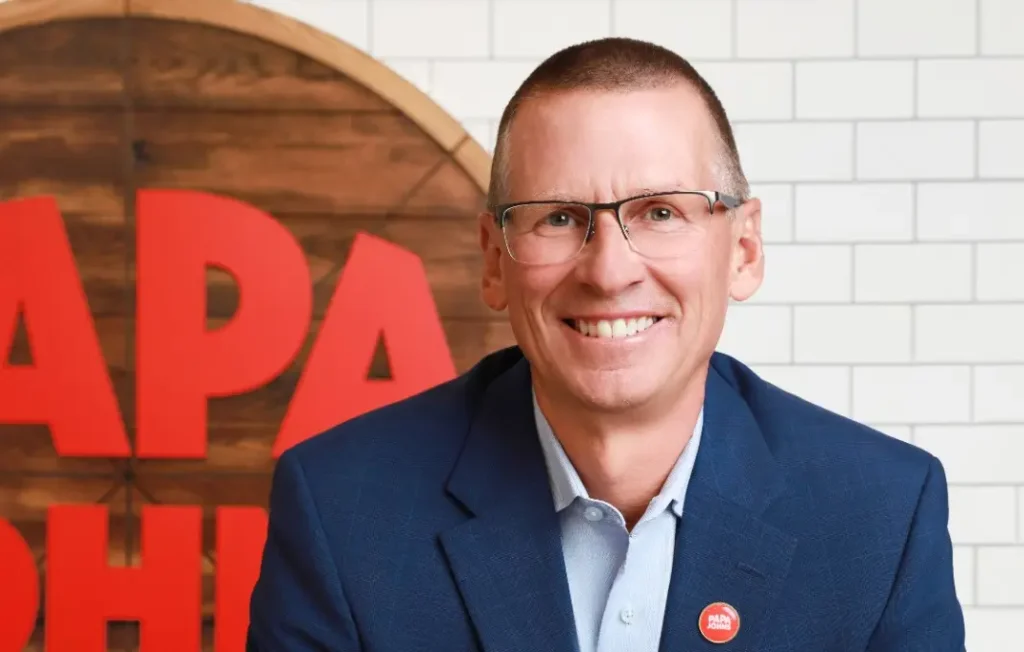
Papa John’s CEO Todd Penegor, a seasoned executive with over two decades of experience in the dynamic food service industry, has articulated a leadership philosophy that diverges sharply from conventional archetypes. In a recent appearance on the Corporate Competitor Podcast, Penegor eschewed the typical comparison of a CEO to a star quarterback, instead drawing a parallel to the often-unsung heroes of the football field: the offensive linemen. This analogy underscores his deeply held belief that true leadership is cultivated not in the spotlight of individual achievement, but in the foundational work and collective support of the team. Penegor’s perspective emphasizes the importance of "leading from the trenches," a principle he has demonstrably applied throughout his distinguished career, most recently in his return to steer the helm of the renowned pizza chain.
The Offensive Lineman as a Leadership Metaphor
Penegor’s unconventional analogy of the CEO to an offensive lineman resonates with his core belief that success is a shared endeavor, built on enabling others to excel. Unlike the quarterback, whose individual performance is often the most visible and celebrated, the offensive linemen operate with a singular focus: creating opportunities and providing protection for their teammates. They are the unseen force that allows the quarterback to execute plays and the running backs to gain yardage.
"In football, it’s the linemen who open holes for the other players. It’s the linemen who protect the QB so he can do his job," Penegor explained during the podcast. "In that way, Papa John’s CEO believes, leadership starts in the trenches." This perspective suggests a leader’s primary role is to facilitate the success of their team, ensuring they have the resources, support, and environment to perform at their best, rather than solely focusing on their own metrics or public image.
This philosophy is rooted in Penegor’s extensive experience. Prior to his tenure at Papa John’s, he held executive positions at prominent companies such as Wendy’s and Kellogg’s, accumulating over 20 years of executive leadership in the food service sector. His approach is characterized by a willingness to engage directly with the operational realities of the business, a stark contrast to a detached, high-level oversight.
A Return to the Trenches
Penegor’s journey to his current role at Papa John’s is a testament to his commitment to this hands-on leadership style. After a period of retirement, which he described as a brief five-month interlude, he was drawn back to the industry, specifically to lead Papa John’s. His motivation, he stated, was not financial or driven by a need for the prestige of the position, but by a genuine desire to work with people and, crucially, to foster the development of future leaders.
"You learn more in a day in a restaurant than you do in a week in the office," Penegor remarked, highlighting his conviction that deep understanding of an organization’s operations is forged on the front lines. This statement suggests that invaluable insights into customer experience, employee morale, and operational efficiency are often gained through direct observation and participation in the daily grind of the business. This hands-on approach is particularly relevant in the fast-paced and customer-facing food service industry, where subtle operational nuances can have a significant impact on brand perception and profitability.
The decision to return to a high-pressure executive role after retirement underscores Penegor’s passion for mentorship and team building. It indicates a leadership style that prioritizes the growth and success of individuals within the organization, believing that a strong, well-supported team is the ultimate driver of corporate achievement.
The Unit: A Philosophy of Collective Success
Penegor’s leadership philosophy centers on the concept of the "unit," emphasizing that success is a collective achievement, encompassing all roles within an organization, from those in highly visible positions to those performing essential but less glamorous tasks. This holistic view of team dynamics is a cornerstone of his strategy.
"No one is bigger than the brand," Penegor asserted. This statement reinforces his belief that individual accolades or contributions, while important, must ultimately serve the greater purpose of the brand’s success. It’s a philosophy that encourages humility and a focus on collective goals, ensuring that every member of the team understands their vital role in the overall mission.
This emphasis on the "unit" extends to his approach to team building, which he outlined as fostering a cohesive group rather than merely assembling a collection of individual stars. The goal is to cultivate an environment where individuals are interconnected and work harmoniously towards shared objectives.
Key Pillars of Penegor’s Leadership Framework
During his Corporate Competitor Podcast interview, Penegor elaborated on several key tenets of his leadership approach:
Stay Team-First
Penegor’s concept of team-building is not about assembling a roster of individual All-Stars. Instead, he advocates for the creation of a unified "unit" of connected individuals who collaborate effectively. This means prioritizing synergy and mutual support over individual brilliance that might not translate into collective progress. This approach is often seen in highly successful organizations where cross-functional collaboration and a shared sense of purpose are paramount. Data from numerous studies on organizational performance consistently shows that cohesive teams outperform disparate groups of talented individuals, particularly in complex and dynamic environments.
Leadership Ain’t Easy
The role of a leader, according to Penegor, is inherently challenging, demanding difficult decisions and actions that may not always be popular. The ultimate objective, however, is to earn respect. He posits that this respect is cultivated through sound decision-making and the consistent delivery of results – "putting some runs on the board," as he metaphorically put it. This implies a results-oriented leadership style, where strategic choices are followed by diligent execution and measurable outcomes. The credibility of a leader is often built on a track record of successful initiatives and the ability to navigate adversity, which can foster trust and buy-in from the team.
Get Uncomfortable
Penegor advocates for embracing discomfort as a catalyst for growth and success. He believes that easy changes are rarely transformative and that genuine progress requires risk-taking. To lead at a higher level, individuals must be willing to bet on themselves and step outside their comfort zones. This philosophy aligns with innovation and adaptability, essential traits in today’s rapidly evolving business landscape. Companies that encourage calculated risks and learning from failures are often better positioned to innovate and maintain a competitive edge. The inherent uncertainty of such endeavors can be a source of anxiety, but Penegor suggests it’s a necessary component of achieving significant breakthroughs.
The Papa John’s Context: Navigating a Competitive Market
Penegor’s leadership philosophy is particularly relevant given the competitive nature of the global pizza market. Papa John’s, like its rivals such as Domino’s Pizza and Pizza Hut, operates in an environment characterized by intense price competition, evolving consumer preferences, and the constant need for innovation in product offerings and delivery services.
The company has faced its share of challenges, including leadership changes and brand perception issues in recent years. Penegor’s return and his emphasis on foundational principles and team cohesion can be seen as a strategic effort to rebuild and strengthen the organization from within. His focus on operational excellence and employee development suggests a long-term vision for sustainable growth, aiming to create a resilient brand that can withstand market fluctuations.
Data from the food service industry indicates that employee engagement and operational efficiency are directly linked to customer satisfaction and profitability. For instance, a study by Gallup found that highly engaged business units achieve 21% higher profitability. Penegor’s philosophy, by emphasizing the importance of the "trenches" and the well-being of the entire team, is likely aimed at boosting these crucial metrics.
Broader Implications and Future Outlook
Todd Penegor’s leadership perspective offers a valuable counterpoint to the often-heroic portrayal of CEOs. By championing the offensive lineman as a model of effective leadership, he highlights the critical importance of support, collaboration, and a deep understanding of operational realities. This approach, when effectively implemented, can foster a more inclusive and resilient organizational culture, where every member feels valued and empowered to contribute to collective success.
His return to Papa John’s and his commitment to developing future leaders suggest a strategic focus on long-term organizational health. The implications of his philosophy could extend beyond the food service industry, offering a blueprint for leaders in various sectors who seek to cultivate genuine team spirit and achieve sustainable success by empowering those on the front lines. As Papa John’s navigates the competitive landscape, Penegor’s "trenches" leadership approach may prove to be a defining factor in its future trajectory, demonstrating that true strength often lies not in individual brilliance, but in the robust foundation of a united and well-supported team.








