While most organizations acknowledge the importance of saying "thank you," few truly grasp the profound implications of employee recognition. Beyond mere appreciation, recognition stands as a powerful, yet often underutilized, source of invaluable talent insights. When seamlessly integrated into the very systems where work is conducted, recognition transforms into a dynamic, real-time signal layer, forging vital connections between individuals, their performance, and their latent potential.
The recent advancement, Workday Recognition provided by Achievers, represents a significant stride in this direction. By bringing this crucial signal directly into the Workday platform, it embeds recognition into daily workflows. This integration effectively converts employee contributions into actionable intelligence, thereby enhancing performance, refining decision-making processes, and ultimately driving more favorable talent outcomes. This partnership between Achievers and Workday aims to bridge the critical gap between raw talent data and tangible business results, positioning recognition as the pivotal element that has been missing from organizational strategies.
Unlocking the Power of Recognition: From Gratitude to Actionable Intelligence
Every act of recognition, no matter how small, carries a narrative. It doesn’t just signify that an employee performed well; it elucidates what they accomplished, the manner in which they achieved it, and the impact of their efforts. Historically, these vital moments have been fragmented, residing in isolated systems such as separate HR platforms, informal email threads, or even verbal acknowledgments lost to time. This fragmentation has prevented organizations from aggregating and analyzing this rich data effectively.
However, with recognition now directly integrated into platforms like Workday, these valuable moments are no longer lost. They are systematically captured as contributions occur, feeding directly into the trusted systems that leaders already utilize. This creates a real-time layer of people intelligence, meticulously connecting an individual’s skills, behaviors, and performance metrics to overarching business objectives. This shift fundamentally redefines recognition from a singular event to a continuous stream of data that leaders can actively leverage.
Peer-Validated Skills: Uncovering What Formal Profiles Miss
Traditional talent data, characterized by structured formats, static information, and often incomplete profiles, provides a foundational understanding of an employee’s qualifications. Job titles, certifications, and performance ratings indicate what an employee should be proficient in. Recognition, on the other hand, reveals what they are actually excelling at in the present moment.
The integration of Achievers and Workday offers a powerful synergy in this regard:
- Real-time Skill Identification: Recognition highlights specific skills and competencies that employees demonstrate daily, often beyond their formal job descriptions. This allows for a more nuanced and dynamic understanding of an individual’s capabilities.
- Behavioral Insights: It captures the "how" behind successful outcomes, illuminating soft skills, teamwork, problem-solving approaches, and leadership qualities that are crucial for organizational success but difficult to quantify through traditional metrics.
- Proactive Talent Identification: By surfacing individuals who consistently go above and beyond, recognition can act as an early indicator of high potential, enabling proactive talent development and succession planning.
- Enhanced Employee Engagement: When employees see their contributions acknowledged, it fosters a sense of value and belonging, directly boosting morale and engagement levels.
When integrated with Workday’s Skills Cloud, recognition data becomes a central repository of peer-validated skills. This is particularly significant because skills are not merely acquired; they are actively demonstrated through consistent action and validated by colleagues. This provides a more accurate and dynamic representation of an organization’s collective talent pool than static, self-reported profiles.
Connected Platforms, Clearer Insights: A Holistic View of Performance
The seamless flow of recognition data between Achievers and Workday empowers leaders with a connected, contextualized view of performance that few standalone systems can offer. Instead of relying on disparate data sources, organizations can now consolidate:
- Formal Performance Data: Traditional metrics, review scores, and objective achievements.
- Informal Contributions: The everyday actions and behaviors that drive progress, as captured through recognition.
- Skills and Competencies: Both formally recognized and peer-validated.
- Development Activities: Progress in learning and skill enhancement.
This integrated approach enables teams to:
- Enrich Performance Conversations: Ground feedback in concrete examples of positive contributions and observed behaviors, making discussions more constructive and impactful.
- Surface Peer-Validated Skills: Identify and leverage the unique talents of individuals that might otherwise remain hidden.
- Elevate Human Potential: By understanding and amplifying the behaviors that lead to success, organizations can foster a culture of continuous improvement and growth.
This integration moves recognition beyond a mere insight, transforming it into actionable intelligence that leaders can utilize to:
- Optimize Team Composition: Assemble teams with the right mix of skills and collaborative strengths.
- Drive Strategic Initiatives: Identify and empower individuals who demonstrate the behaviors critical for achieving business goals.
- Personalize Employee Development: Tailor growth plans based on demonstrated strengths and areas for improvement, informed by recognition data.
- Improve Retention: Recognize and reward employees for their contributions, fostering loyalty and reducing turnover.
The Evolving HCM Landscape: Where Signals Emerge
The fundamental shift in Human Capital Management (HCM) platforms is undeniable. They are rapidly evolving from mere data repositories to dynamic systems that actively shape employee behavior in real time. Within this transformative landscape, a critical question arises: Where do these vital signals originate? Recognition effectively fills this void.

Recognition operates at the intersection of individual effort and organizational impact, providing crucial insights because it:
- Captures In-the-Moment Contributions: It documents achievements and positive behaviors as they happen, offering a timely and accurate reflection of an employee’s engagement and effectiveness.
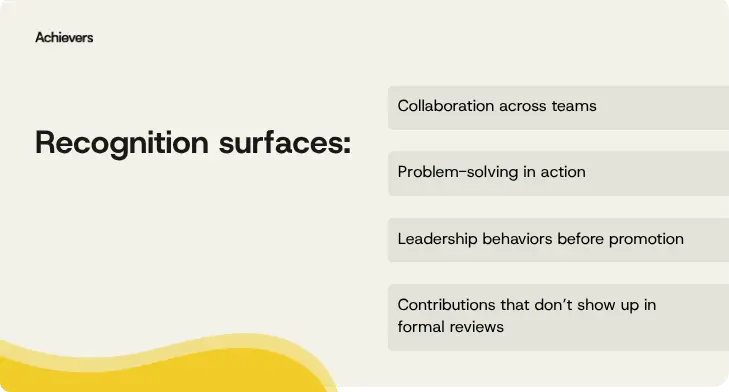
- Reflects Organic Behaviors: It highlights the everyday actions, collaboration, and initiative that systems often overlook, providing a more authentic picture of an employee’s contribution.
- Is Driven by Peer and Managerial Observation: It leverages the collective intelligence of the organization to identify and validate valuable behaviors and achievements.
- Is Contextualized by Work: Recognition is inherently tied to specific tasks, projects, and challenges, providing rich context for understanding performance.
Recognition highlights:
- Key Contributors: Individuals who consistently deliver exceptional results or embody company values.
- Collaborative Champions: Employees who excel at teamwork and foster positive working relationships.
- Innovative Thinkers: Those who propose novel solutions or drive process improvements.
- Resilient Performers: Individuals who demonstrate grit and overcome challenges effectively.
This is precisely why recognition is increasingly recognized as the indispensable link between raw talent data and demonstrable business outcomes. Without it, leaders are left with a structured but incomplete picture of their workforce. With it, they gain a profound understanding of actual behavior and its impact.
Reinforcing Learning and Development Through Recognition
Employee development is not an isolated event; it is a continuous process that flourishes when learning is visible, consistently reinforced, and effectively shared. Recognition plays a pivotal role in this reinforcement loop, especially when integrated with platforms like Workday Learning.
Through this integration:
- Learning Milestones are Celebrated: Employees are acknowledged for completing training modules, acquiring new certifications, or demonstrating new skills learned through development programs.
- Application of Learning is Highlighted: Recognition can specifically call out instances where employees have successfully applied newly acquired knowledge or skills in their daily work, demonstrating practical impact.
- Development Efforts are Incentivized: By publicly acknowledging and rewarding engagement with learning resources, organizations encourage a culture of continuous growth and upskilling.
- Knowledge Sharing is Promoted: When employees are recognized for sharing their expertise or mentoring others, it fosters a collaborative learning environment.
Recognition helps to:
- Increase Learning Engagement: By making learning visible and rewarding, employees are more motivated to participate in development opportunities.
- Improve Knowledge Retention: Reinforcing learned concepts through practical application and acknowledgment solidifies understanding.
- Accelerate Skill Development: By incentivizing and celebrating the acquisition and application of new skills, organizations can more rapidly build a capable workforce.
Organizations can effectively celebrate learning milestones and incentivize development actions directly within the flow of work. The outcome is a transformation where learning ceases to be a solitary endeavor and instead becomes a dynamic force that builds momentum across teams and throughout the organization.
The Imperative for Real-Time Talent Intelligence
The way organizations understand and manage their talent is undergoing a profound metamorphosis. The traditional role of HCM as a system of record is rapidly giving way to its function as a system of insight. In this evolving paradigm, merely tracking roles, skills, and performance cycles is no longer sufficient. Leaders require a real-time understanding of how work is actually accomplished and what truly drives business results.
This is precisely where recognition data fundamentally alters the equation. Unlike traditional HCM signals, recognition captures the nuanced, everyday behaviors that are often invisible to standard systems: how individuals contribute, how teams collaborate effectively, and which specific actions propel work forward. It transforms fleeting moments of appreciation into a continuous, invaluable stream of insight, providing a real-time reflection of performance rather than a retrospective analysis months after the fact.
As HCM continues its trajectory toward more dynamic, AI-driven decision-making, these granular signals become absolutely critical. They empower leaders to see not just who their employees are on paper, but how they actively demonstrate their capabilities in practice – and, crucially, how to replicate and scale the behaviors that yield significant impact.
The Future of Talent Intelligence is Here
The strategic partnership between Achievers and Workday transcends a simple integration of recognition features. It signifies a redefinition of what organizations can perceive and achieve with their people data. By seamlessly connecting recognition, behavior, skills, performance, and ultimately, business outcomes within the everyday systems that leaders already depend on, this integration unlocks unprecedented potential.
When recognition is connected, visible, and actionable, the simple phrase "thank you" evolves into profound insight. This insight, in turn, drives informed action, and ultimately, tangible performance improvements. The future of talent intelligence is not a distant concept; it is a present reality, powered by the strategic leverage of employee recognition.