Accurate and fair are not the same thing. This fundamental distinction lies at the heart of a new approach to artificial intelligence in hiring, as championed by the Eightfold Talent Intelligence Platform. While a model might boast impressive overall accuracy, its performance can vary dramatically across different demographic subgroups. For instance, a system could correctly identify qualified candidates 92% of the time for one gender but only 78% for another. Individually, these numbers might appear acceptable when averaged, but in practice, they represent a significant and potentially discriminatory disparity.
Eightfold AI asserts that fairness is not an afterthought, a feature to be layered on after a model has been trained. Instead, it is a structural imperative, deeply integrated into the platform’s design and continuously evaluated at every stage of development and deployment. This commitment means that fairness is benchmarked against prior versions and measured across multiple dimensions before any model is released to customers. This article delves into the framework underpinning this approach and illuminates why specific fairness metrics hold greater significance for AI systems employed in the hiring process.
The company’s CEO and Co-Founder, Ashutosh Garg, has been a vocal proponent of responsible AI, emphasizing its critical role in building trust and equity in technology. His discussions often highlight the inherent complexities of AI development, particularly when applied to human-centric processes like recruitment.
Understanding the Eightfold Talent Intelligence Platform: A Foundation for Fairness
To grasp the significance of Eightfold’s fairness-centric approach, it’s crucial to understand how its Talent Intelligence Platform operates. The platform does not generate an isolated score for an individual candidate. Instead, it produces a "match score" specifically for a candidate-position pairing. This score quantifies how well a particular candidate aligns with the requirements of a defined role, as calibrated against the hiring organization’s needs. Consequently, the same candidate will receive different scores for different positions, and a single position will yield varying scores for different candidates.
This nuanced approach fundamentally shapes the evaluation of fairness. The relevant question shifts from "Does the model score Group A higher than Group B?" to a more pertinent inquiry: "For a given position, does the model identify qualified candidates from Group A and Group B with equal reliability?" This distinction is pivotal in moving beyond superficial metrics to address systemic biases.
A cornerstone of the Eightfold platform is its prioritization of explainability as a core design principle. The algorithms are deliberately chosen, in part, for their capacity to reveal the underlying reasons for their scoring. This transparency empowers recruiters and hiring managers to understand the rationale behind a candidate’s ranking, fostering trust and enabling informed decision-making.
This explainability is more than just a usability feature; it serves as a practical mechanism for scrutinizing model behavior. It is a key factor enabling the Talent Intelligence Platform to meet stringent standards such as FedRAMP Moderate and ISO 42001 certification, benchmarks that general-purpose AI tools often struggle to attain. In scenarios requiring an audit of hiring decisions, the existence of clear, auditable reasoning is paramount. This transparency is not an add-on; it is woven into the fabric of the platform.

Integrating Fairness into the Training Lifecycle
Eightfold AI emphasizes that fairness considerations are embedded into the very fabric of the model training process, long before any evaluation takes place. The training data is meticulously divided into distinct train and test sets, subject to stringent controls to prevent data leakage. This ensures that the data used for evaluation has not been inadvertently exposed during the training phase, a critical step in maintaining the integrity of the assessment.
A crucial intervention occurs through the implementation of "early stopping" based on classification performance across protected categories. If, during the training of a model, divergent performance patterns emerge across demographic subgroups – meaning the model performs substantially better for one group than another – the training process is halted. This preemptive measure prevents potentially biased patterns from becoming ingrained in the model’s architecture. This represents a direct intervention at the training stage, rather than an attempt to correct issues after the fact.
The underlying objective is to ensure that every candidate receives an evaluation of equivalent quality, irrespective of their application timing, the size of the candidate pool, or their demographic group affiliation. In essence, every candidate receives the "nine o’clock interview," evaluated with the same rigor, against the same standard, with an unwavering benchmark. Early stopping is one of the key mechanisms employed at the model level to enforce this consistent standard.
Eightfold’s ongoing research is dedicated to further integrating anti-bias and fairness objectives directly into the loss functions that models optimize. The aspiration within the AI research community is for models to actively optimize against bias during their development, rather than merely identifying it as a post-training concern. This proactive approach promises to yield more inherently equitable AI systems.
Navigating the Nuances of Fairness: Group vs. Individual Metrics
Post-training evaluation at Eightfold employs two complementary frameworks for measuring fairness, each addressing different facets of potential bias.
Group Fairness Metrics: These metrics scrutinize whether the AI model yields consistent outcomes across demographic groups defined by protected characteristics such as gender, race, or age. If the model demonstrates a meaningful difference in performance for candidates belonging to different groups, it raises a fairness concern, irrespective of individual-level consistency. This framework is vital for identifying systemic biases that might disproportionately affect entire populations.
Individual Fairness Metrics: These metrics, conversely, examine whether two demonstrably similar candidates receive comparable scores. This comparison is based on a predetermined threshold of similarity, ensuring that candidates with equivalent qualifications are not subject to differential treatment. This approach is designed to catch instances where aggregate group-level statistics might appear acceptable, yet individual-level disparities persist. An example could be a model that differentiates between two equally qualified candidates based on subtle resume formatting differences that, unbeknownst to the system, correlate with demographic characteristics.
Both group and individual fairness frameworks are indispensable. Group fairness metrics, while valuable for identifying broad trends, can sometimes mask subtle individual-level problems. Conversely, individual fairness metrics, while adept at spotting isolated disparities, might miss systematic patterns that affect entire groups. A comprehensive understanding of a model’s fairness requires the integration of insights from both approaches.
Deconstructing Fairness Metrics: Parity and Confusion Matrix Approaches
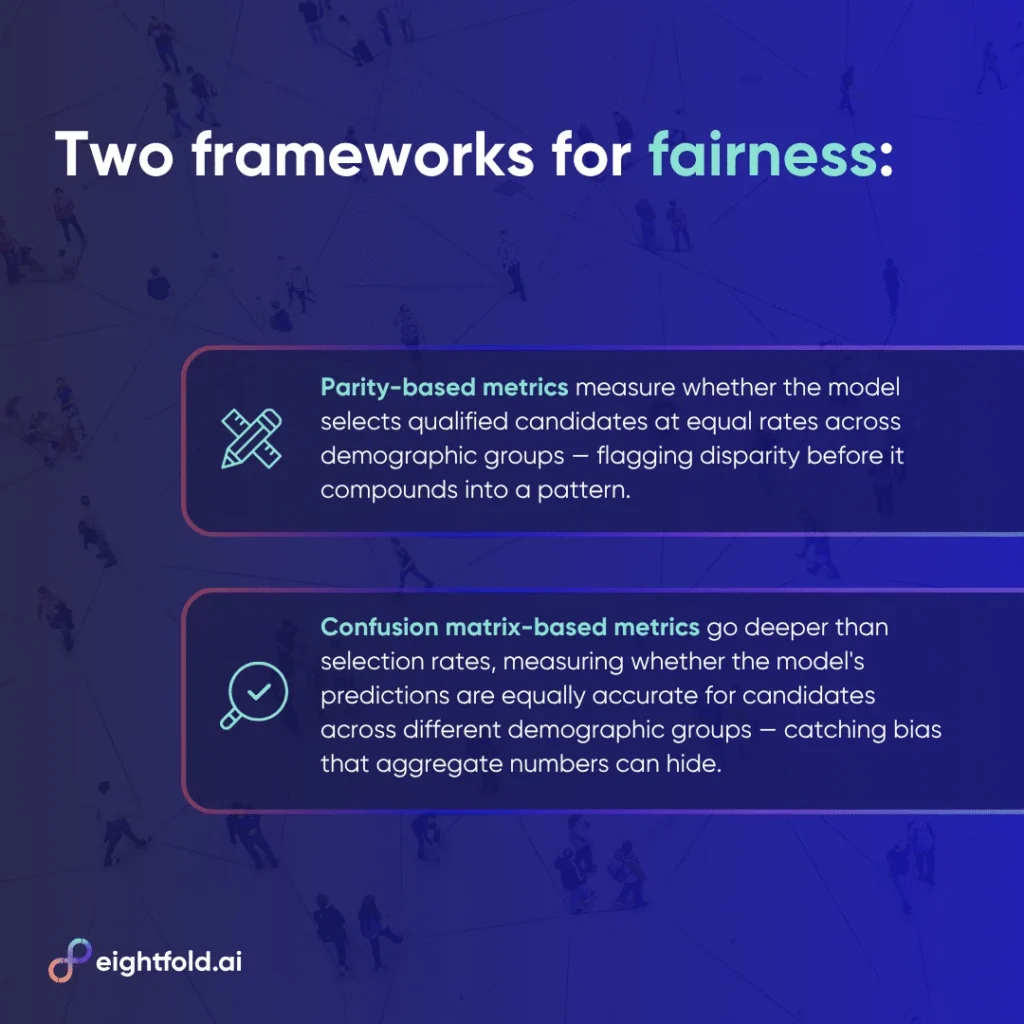
Within the domain of group fairness, a primary category of metrics focuses on "predicted positive rates." This refers to the rate at which the model assigns a positive outcome, such as a recommendation for an interview, to candidates across different groups. These parity-based metrics serve as useful initial screening tools due to their straightforward calculation and interpretation. However, their limitation lies in the fact that equal selection rates do not always equate to equal model quality or predictive accuracy across groups. This is where confusion matrix-based metrics become essential.
Confusion matrix-based metrics delve deeper into the quality of the model’s predictions for different groups. They move beyond merely observing the rates of positive classification to assess the accuracy of those classifications. These metrics provide a more granular view of how well the model is performing for each subgroup, considering true positives, true negatives, false positives, and false negatives. For instance, they can reveal whether a model is more prone to false positives (inappropriately recommending a candidate) or false negatives (failing to recommend a qualified candidate) for certain demographic groups.
Rigorous Evaluation in Practice: Beyond Initial Deployment
The evaluation of these fairness metrics is not a one-time event conducted at the initial launch of a model. Every new iteration of a model undergoes a comprehensive battery of fairness and performance evaluations. The results are meticulously benchmarked against the performance of the previous version. A model that demonstrates improvements in accuracy metrics but shows regression in fairness metrics will not be approved for deployment.
Furthermore, metrics are assessed across multiple dimensions. This includes evaluation by job title cluster, by language, and across other relevant segmentation criteria. A model that performs equitably on average but exhibits disparities in specific contexts – such as certain industries, languages, or types of roles – will fail the evaluation, even if aggregate numbers appear satisfactory. Compliance is not a threshold to be cleared once; it is a standard that must be consistently maintained at every level of specificity. This granular approach ensures that fairness is not a generalized claim but a verifiable reality across diverse applications.
The Limits of Evaluation: The Imperative of Ongoing Monitoring
Even a model that successfully navigates rigorous pre-release evaluation exists within a dynamic and ever-changing world. Production data can diverge from training data, usage patterns evolve, and candidate populations shift in ways that no static model can fully anticipate.
This reality underscores why thorough model evaluation, while critically important, constitutes only one component of a comprehensive responsible AI strategy. The work that continues after a model is deployed – including ongoing monitoring, robust governance structures, and mechanisms for detecting and correcting performance drift – is where the commitment to fairness is either sustained or, conversely, quietly abandoned. This continuous oversight is essential to ensure that AI systems remain equitable and effective over time, adapting to new data and contexts without compromising their foundational principles.
Eightfold AI invites further exploration into its responsible AI initiatives, offering resources such as whitepapers detailing their bias audit results. This transparency aims to build trust and demonstrate a tangible commitment to developing AI that not only performs effectively but also upholds the principles of fairness and equity in the critical domain of talent acquisition.