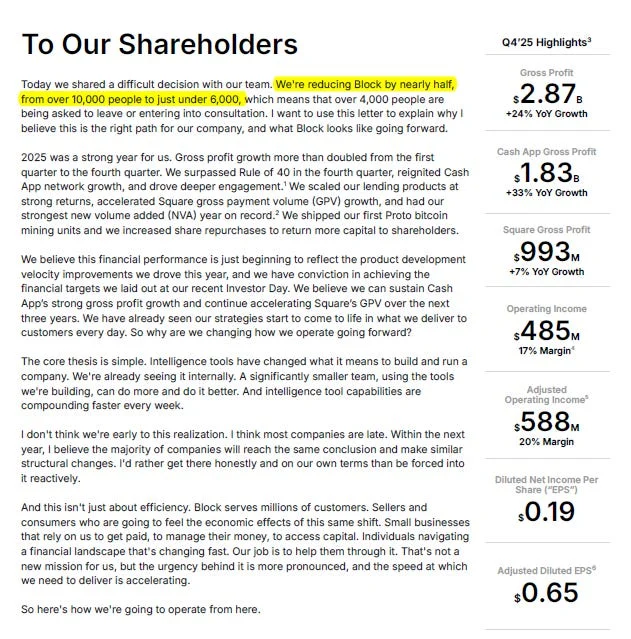
The recent announcement by Block Inc., the financial technology giant behind Square and Cash App, to potentially replace 40% of its workforce with artificial intelligence has sent shockwaves through the corporate world and ignited a fierce debate about the accelerating integration of AI in the workplace. CEO Jack Dorsey’s declaration, though brief and lacking specific implementation details, signals a dramatic shift in how companies may approach staffing and operational efficiency in the coming years. With an estimated 10,000+ employees, the proposed reduction could impact approximately 4,000 individuals, raising significant questions about job security, the true capabilities of AI, and the strategic motivations behind such a move.
Background of the Announcement
The announcement, made last week, was characterized by its directness and a conspicuous absence of granular information. This has left many employees and industry observers scrambling for clarity. While Block Inc. has not publicly detailed which specific roles are slated for replacement or the exact AI technologies that will be deployed, the sheer scale of the proposed reduction – 40% of its workforce – is unprecedented in recent corporate history for a company of its size and scope.

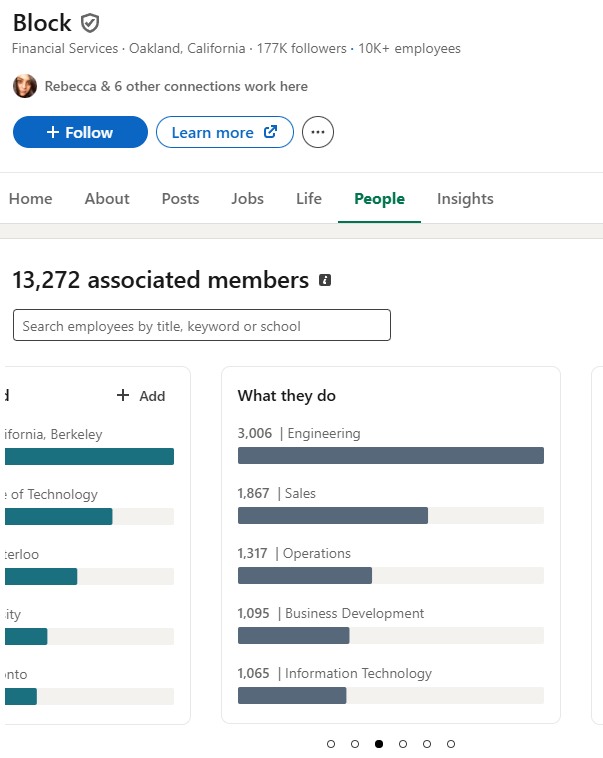
LinkedIn data suggests Block Inc. employs around 13,000 individuals, with significant concentrations in engineering, IT, operations, and sales. The broad strokes of Dorsey’s announcement suggest that roles within these departments, particularly those involving repetitive tasks or data processing, could be prime candidates for AI integration. This is a sentiment echoed by industry insiders, with one individual close to AI development firm Anthropic noting the "big story" potential and the increasing likelihood of job displacement due to AI advancements.
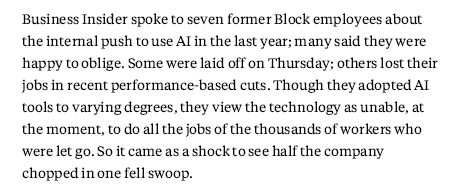
The lack of specifics has fueled speculation. While some interpret this as a genuine, albeit aggressive, push towards an AI-augmented future, others view it as a potential smokescreen for broader organizational restructuring or performance management initiatives. An article by Business Insider, which interviewed seven Block Inc. employees, revealed a collective uncertainty regarding the precise mechanisms of this AI-driven transformation, underscoring the ambiguity surrounding the announcement.
Dorsey’s known enthusiasm for AI, as highlighted in various industry discussions and his personal endorsements, suggests a genuine belief in its transformative power. However, the practical application of AI to replace a substantial portion of a human workforce is a complex undertaking, fraught with technical, ethical, and financial considerations.
Financial Context and Operational Efficiency

To understand the potential drivers behind Block Inc.’s aggressive AI strategy, a brief financial comparison can be instructive. When juxtaposed with industry giants like Visa and Mastercard, as well as e-commerce platform Shopify, Block Inc.’s financial performance reveals a different landscape. Data indicates that Block Inc. exhibits lower profitability and a considerably smaller gross margin compared to its peers. This suggests the company may be operating at a less efficient scale, prompting a search for strategies to enhance operational output and cost-effectiveness.
The financial charts and data presented in the original context illustrate this disparity, showing Block Inc. lagging behind Visa, Mastercard, and Shopify in key financial metrics. This performance gap could be a significant catalyst for exploring radical operational changes, with AI presented as a potential solution to bridge this divide and satisfy investor expectations, which have reportedly been less than enthusiastic. The current financial realities may be pushing Block Inc. towards drastic measures to improve its bottom line.
The Case for AI in Job Displacement: A Nuanced Perspective
The narrative surrounding AI and job displacement is often polarized. While the potential for AI to automate tasks and, consequently, reduce the need for human labor is undeniable, the reality of widespread job elimination is more complex. Industry research and expert analysis suggest that while AI is highly effective at automating specific tasks, its ability to fully replace entire job functions, especially those requiring complex reasoning, creativity, and human interaction, is still developing.
A comprehensive study on organizational redesign around AI, which surveyed over 70 companies, found that many organizations that viewed AI solely as a tool for individual productivity enhancement did not experience significant job reductions. True job displacement on the scale suggested by Block Inc. typically requires a fundamental re-engineering of business processes, not merely the introduction of AI tools to perform existing tasks. This re-engineering involves redesigning workflows, redefining roles, and integrating AI strategically into the fabric of operations.
The cost factor of AI implementation is another critical consideration. While the goal might be to replace human labor, the expenses associated with building, implementing, scaling, and maintaining AI systems can be substantial. For instance, in customer support, while AI agents might offer savings compared to human agents, the compute costs, training, system maintenance, and governance of data contribute significantly to the overall expenditure. In highly specialized fields like software engineering, where tasks are non-linear and context-dependent, the operating costs of AI, particularly for complex reasoning, can sometimes rival or even exceed the cost of human engineers.
For example, consider a team of 100 software engineers earning $100,000 annually, resulting in a payroll of $10 million. If AI could theoretically automate 80% of their manual coding time, representing $8 million in labor capacity, the cost of implementing and running the AI system must be factored in. Initial analyses suggest that the capital and operating costs for such AI solutions can represent one-third to one-half, or even more, of the cost of retaining human staff, especially when considering the expenses of data centers and ongoing AI model development.
The "Superworker" and Re-engineering Processes
The true return on investment (ROI) of AI transformation, as observed in successful implementations across various industries, lies not in outright job displacement but in the re-engineering of processes and the enhancement of human capabilities. Companies like Allianz, which utilizes digital twins for claims processing, and Travelers, which leverages AI for employee enablement, are prime examples of this approach. These organizations are not aiming to eliminate their workforce but rather to augment it, creating what some experts term "superworkers" – individuals empowered by AI to achieve higher levels of productivity and innovation.
Hubspot’s strategy of building AI to offer new services to clients, rather than reduce its labor force, exemplifies a forward-thinking approach. Similarly, the author’s own AI tool, Galileo, is designed to scale business operations exponentially, enabling the company to reach a broader client base that would be impossible with traditional staffing models. These examples underscore that the most impactful AI transformations are those that fundamentally redesign how work is done, leading to increased efficiency, enhanced service delivery, and the creation of new value.
Potential Motivations Behind Block Inc.’s Announcement
Given the complexities and costs associated with AI implementation, the aggressive nature of Block Inc.’s announcement raises questions about underlying motivations. One plausible interpretation is that the AI initiative serves as a justification for performance management and organizational streamlining. Drawing a parallel to the significant layoffs that occurred at Twitter following Elon Musk’s acquisition, where a perceived surplus of bureaucracy was identified, it’s possible that Block Inc. is using AI as a rationale to address inefficiencies or restructure its workforce.
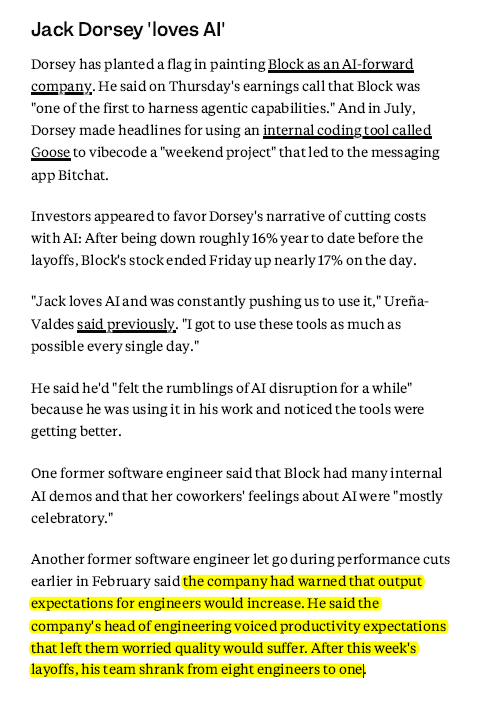
The company’s financial performance, as previously noted, suggests a need for improved operational efficiency. Investors have expressed dissatisfaction, and a significant workforce reduction, framed as an AI-driven modernization, could be a strategic move to signal decisive action and a commitment to future profitability. This approach, while potentially effective in the short term for appeasing market concerns, carries the risk of alienating employees and damaging company culture if not handled with transparency and strategic foresight.
Timeline and Future Implications
The timeline for Block Inc.’s proposed AI integration remains unclear. The lack of detailed plans suggests that this is likely an initial announcement, with the implementation phase yet to be fully defined. The coming months will be critical in observing how the company navigates this transition. Will they provide a clear roadmap for affected employees? Will they invest in retraining and upskilling programs for those whose roles are impacted? Or will the focus remain solely on AI deployment?
The broader implications of Block Inc.’s announcement are significant for the entire tech industry and beyond. If successful, it could set a precedent for other large corporations to pursue similar AI-driven workforce reductions, accelerating the trend of automation. Conversely, if the implementation proves challenging or fails to deliver the projected efficiencies, it could temper the immediate enthusiasm for such drastic AI-driven job cuts, encouraging a more measured and strategic approach.
The debate also highlights the evolving role of human capital in the age of AI. The emphasis is shifting from rote task execution to skills that AI cannot easily replicate, such as critical thinking, creativity, emotional intelligence, and strategic decision-making. Companies that successfully integrate AI will likely be those that foster a symbiotic relationship between human talent and artificial intelligence, leveraging AI to enhance human capabilities rather than simply replace them.
Conclusion: A Lesson in Strategic AI Integration
The Block Inc. announcement serves as a potent reminder that AI is not a simple "job-eliminating" strategy. Instead, it represents a profound opportunity for business re-engineering. The true value of AI lies in its potential to transform processes, create new avenues for growth, and empower human workers to achieve unprecedented levels of productivity and innovation.
For Block Inc., the coming period will be a critical test of its strategic vision. The initial layoff announcement may be the first step, but the long-term success of its AI initiative will depend on its ability to fundamentally re-engineer its business operations around this technology. Whether this leads to sustainable growth and enhanced shareholder value, or simply a short-term cost-cutting measure, remains to be seen. The business world will be watching closely to understand if Block Inc. can truly achieve the transformative potential of AI, or if this bold declaration will be a cautionary tale in the ongoing evolution of work.