Employee recognition has transcended its traditional role as a mere HR perk, emerging as a critical business performance system directly influencing the behaviors that drive successful organizational outcomes. A pivotal 2026 study from Harvard Business Review Analytic Services, surveying 566 respondents, revealed that a significant 66% of organizations consider recognition "very important" to business performance. Despite this acknowledgment, a concerning gap exists, with only 33% reporting their current recognition programs as "very effective." This disparity highlights a profound opportunity for Chief Human Resources Officers (CHROs) to recalibrate and elevate recognition into a clear, potent signal of what the organization truly values, prioritizes, and rewards, thereby shaping a more engaged, productive, and resilient workforce.
The Evolution of Recognition: From Perk to Strategic Pillar
The modern workplace, characterized by rapid technological advancement, evolving employee expectations, and the lingering effects of global disruptions, has fundamentally reshaped the role of human capital. The "Great Resignation" and subsequent "quiet quitting" phenomena underscore a growing employee demand for psychological safety, belonging, and a clear understanding of their impact. In this dynamic landscape, the ad-hoc, episodic recognition models of the past—think annual awards dinners or infrequent "employee of the month" plaques—have proven inadequate. These legacy approaches, often disconnected from daily work and lacking real-time relevance, fail to resonate with a workforce seeking continuous feedback and a sense of purpose.
Historically, employee recognition was often relegated to the periphery of HR functions, viewed primarily as a morale booster rather than a strategic lever. Early programs, prevalent in the mid-to-late 20th century, typically focused on tenure-based awards or singular achievements, often administered top-down and with limited frequency. The advent of digital platforms in the early 2000s began to democratize recognition, introducing peer-to-peer elements, but many still struggled with integration into core business processes. By 2026, however, the understanding has matured: recognition is now recognized as a continuous feedback loop, a cultural architect, and a data-driven system that provides a compass for performance. The HBR study, "Improving business performance through appreciation," explicitly notes that 88% of recognition leaders now design their programs to drive specific employee behaviors, a stark contrast to the mere 28% of organizations slower to adopt such strategic frameworks. This evolution underscores a paradigm shift where recognition is intrinsically linked to organizational strategy, not just generic appreciation.
Why Recognition Demands a Business Strategy in 2026
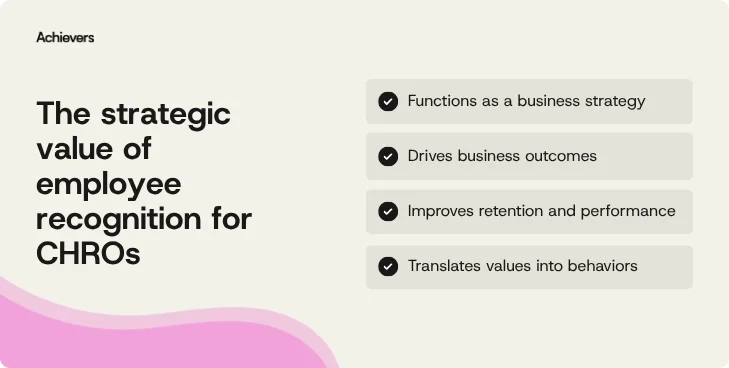
For CHROs, treating recognition as a fundamental business strategy is non-negotiable. It serves multiple critical functions that directly impact the bottom line and long-term organizational health:
-
Guiding Employee Behavior and Priorities: Recognition acts as an organizational compass, signaling which behaviors, priorities, and values are most critical for business success. When recognition is specific and tied to desired actions, it provides employees with actionable feedback, reinforcing desired patterns and helping them understand what "good work" truly looks like in practice. This clarity reduces ambiguity and fosters a culture of intentional contribution.
-
Driving Tangible Business Outcomes: Strategic recognition directly influences key HR metrics that exert significant pressure on CHROs: employee engagement, retention, and performance. Organizations with consistently applied recognition programs frequently report lower voluntary turnover rates, demonstrably stronger employee engagement scores, and enhanced productivity. For instance, studies by Gallup consistently link high engagement (often bolstered by effective recognition) to 21% higher profitability and 17% higher productivity. By affirming hard work and aligned efforts, recognition not only motivates but also educates employees on how to replicate success.
-
A Cost-Effective Retention and Performance Lever: The financial and operational costs associated with employee disengagement and turnover are substantial, often estimated to be 1.5 to 2 times an employee’s annual salary. Strategic recognition serves as a proactive, cost-effective defense against this "slide" by fostering a stronger sense of connection, value, and belonging from the outset. In a climate of tight budgets and escalating expectations, recognition stands out as one of the few levers that delivers meaningful, sustained impact without necessitating constant reinvention or costly organizational overhauls. It builds organizational loyalty and commitment incrementally, preventing the need for expensive recruitment cycles.
-
Translating Values into Daily Action: Corporate values often exist as aspirational statements on a wall or website. Strategic recognition breathes life into these values by illustrating them through daily actions. As Robert Dur, Professor of Economics at Erasmus University Rotterdam, aptly describes in the HBR report, recognition functions as "a compass that directs people’s attention, time, and energy." For CHROs, this makes recognition an unparalleled tool for embedding organizational values into the fabric of everyday work, transforming abstract ideals into concrete, repeatable behaviors.
The Modern Mandate: Moving Beyond Legacy Models

Traditional recognition models, designed for a more hierarchical and static workplace, are increasingly obsolete in 2026. Their limitations are stark:
- Limited Reach: Often confined to specific teams, departments, or management layers, failing to acknowledge the contributions of a diverse, distributed workforce.
- Reduced Relevance: Infrequent, generic awards lack the immediacy and specificity needed to reinforce current priorities and behaviors.
- Missed Moments: The most impactful recognition often occurs spontaneously, close to the moment of contribution, which legacy systems are ill-equipped to capture.
The shift towards modern recognition is characterized by consistency and integration into the flow of work. This involves:
- Frequent, Embedded Recognition: Moving from annual or quarterly events to continuous, real-time feedback and appreciation. Recognition should be a daily occurrence, integrated into team meetings, project milestones, and routine collaboration.
- Credibility and Inclusivity: Modern systems ensure recognition is authentic, specific, and accessible to everyone, regardless of role, location, or work model. This fosters a sense of fairness and ensures all contributions are visible and valued.
- Behavioral Shaping: The deliberate design of programs to reinforce specific behaviors and efforts that align with strategic objectives, moving beyond generic "good job" accolades.
This transformative shift makes recognition more credible, inclusive, and exponentially more effective at shaping day-to-day behavior, fostering a culture of continuous improvement and positive reinforcement.
Recognition as a Stabilizing Force in Times of Change
In an era of relentless organizational change—from digital transformations to evolving market demands—recognition plays a vital role beyond mere motivation; it acts as a powerful stabilizing force.
- Alignment During Disruption: Consistent recognition of efforts aligned with new strategies helps employees navigate uncertainty, providing clear signposts during transitions.
- Reinforcing Adaptability: Acknowledging agility, problem-solving, and resilience during change encourages these critical behaviors across the organization.
- Fostering Psychological Safety: Regular, authentic recognition builds trust and psychological safety, empowering employees to take risks and innovate, knowing their efforts will be seen and valued even if outcomes are uncertain.
This cultivates the foundation of a truly connected company, where recognition is the steadying thread that keeps people aligned with purpose, engaged with their teams, and prepared for whatever challenges lie ahead.
How CHROs Can Operationalize Strategic Recognition
To harness recognition as a powerful leadership and culture system—rather than a mere engagement tactic—CHROs must adopt an intentional, scalable approach:
-
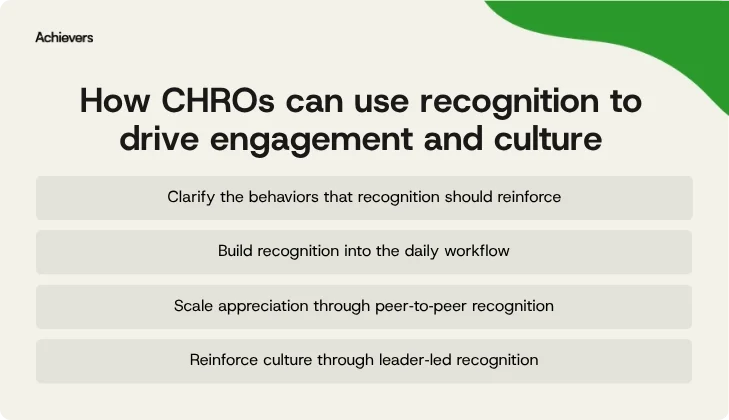
Clarify Behaviors for Reinforcement: The bedrock of effective recognition is clarity. CHROs must meticulously define which specific behaviors directly support key organizational objectives like engagement, morale, retention, and performance. Recognition efforts must then consistently reinforce these defined behaviors. Vague or generic praise weakens impact; specific recognition tied to strategic priorities and core values provides actionable signals employees can internalize and replicate daily. This requires strong alignment with executive leadership and clear communication of what success looks like.
-
Integrate Recognition into Daily Workflows: Recognition achieves maximum efficacy when it is seamlessly embedded into the rhythm of daily work, not treated as a separate, episodic event. Instead of existing solely within annual review cycles or formal programs, recognition should manifest organically during team check-ins, project milestones, client successes, and everyday collaborative efforts. This can be facilitated through integrated digital platforms that allow for instant peer-to-peer or manager-to-employee recognition directly within communication tools or project management suites.
-
Scale Appreciation Through Peer-to-Peer Recognition: While managerial recognition is crucial, it cannot bear the entire burden. Peer-to-peer recognition significantly expands the visibility of contributions, strengthens social bonds, and captures achievements that might otherwise go unnoticed by leadership. When recognition becomes a shared responsibility, a positive, supportive culture scales organically. CHROs must champion this by setting the expectation that every employee is an active participant in giving and receiving appreciation, fostering a collective culture of gratitude and mutual support. This democratizes recognition and strengthens internal networks.
-
Reinforce Culture Through Leader-Led Recognition: Recognition from senior leaders carries unique weight, unequivocally signaling what truly matters to the organization. A CEO publicly commending a team for successfully navigating a challenging change, or an executive recognizing exceptional cross-functional collaboration during a difficult quarter, communicates priorities and values more powerfully than any policy document or internal memo. CHROs play a critical role in coaching leaders to recognize visibly, consistently, and authentically, ensuring their recognition serves as a powerful learning tool and cultural amplifier. This visibility also models desired behaviors for the entire organization.
-
Design Inclusive Recognition for Diverse Work Models: The modern workforce is diverse, encompassing frontline workers, remote teams, hybrid models, and employees across various time zones. Recognition programs must be designed to reach and resonate with everyone, regardless of their work location or role. This necessitates creating flexible recognition mechanisms, from quick verbal shout-outs on a factory floor to digital badges and personalized messages shared across geographically dispersed teams. The focus should always be on recognizing real contribution and impact, ensuring every employee feels seen and valued for their unique input.
-
Position Recognition as a System for Shaping Culture: The ultimate value of recognition materializes when it transforms into a consistent leadership habit and an organizational system, rather than a one-off initiative. Applied consistently over time, it helps employees internalize organizational values, understand their role in achieving collective goals, and feel a deeper sense of belonging. CHROs must establish recognition as a trackable, improvable system, leveraging data to refine its impact and continuously strengthen organizational culture.
Measuring Recognition ROI and Addressing Challenges
Proving the business impact of recognition starts with rigorous measurement of usage, consistency, and overall effect. These metrics provide invaluable insights into program effectiveness and areas needing improvement.
What CHROs Should Measure to Prove Business Impact:
- Participation Rates: Track the percentage of employees giving and receiving recognition, across different levels and departments. High participation indicates broad adoption and cultural integration.
- Frequency and Consistency: Monitor how often recognition occurs, identifying any "cold spots" or periods of inactivity. Consistent, frequent recognition is generally more impactful.
- Sentiment and Specificity: Analyze the language and sentiment of recognition messages. Are they specific, value-aligned, and authentic? Sentiment analysis tools can help gauge the quality and impact.
- Budget Utilization: Track how recognition budgets (if monetary) are allocated and spent, ensuring fair and equitable distribution.
- Program Reach: Assess who is being recognized and by whom, ensuring inclusivity and preventing recognition "deserts."
How to Link Recognition Data to People and Business Outcomes:
- Correlation with Engagement Scores: Compare recognition program data with employee engagement survey results. Organizations with higher recognition rates often show higher engagement.
- Impact on Voluntary Turnover: Analyze turnover rates in teams or departments with high recognition versus those with low recognition. A strong correlation can demonstrate recognition’s role in retention.
- Performance Metrics: Link recognition data to individual or team performance indicators, such as productivity improvements, project success rates, or customer satisfaction scores.
- Absenteeism Rates: Investigate potential correlations between recognition levels and employee absenteeism, as highly engaged and recognized employees tend to have lower absence rates.
- Diversity, Equity, and Inclusion (DEI) Impact: Analyze if recognition is equitably distributed across demographic groups, contributing to a more inclusive environment.
Common Recognition Challenges CHROs Face – And How to Overcome Them:
- Lack of Leadership Buy-in: Without visible support from senior leadership, recognition efforts can flounder. Solution: Present recognition as a strategic business driver, tying it directly to executive priorities like talent retention, productivity, and culture. Provide leaders with training and easy-to-use tools.
- Budget Constraints: Perception that recognition is a costly endeavor. Solution: Emphasize the high ROI of non-monetary and peer-to-peer recognition. Highlight the cost savings from reduced turnover and increased productivity. Advocate for a modest but consistent budget allocation.
- Inconsistent Application: Recognition is not uniformly applied across the organization. Solution: Implement clear guidelines and training for managers and employees. Utilize recognition platforms that track activity and allow for targeted nudges. Foster a culture where recognition is everyone’s responsibility.
- Program Fatigue or Lack of Adoption: Employees find the program cumbersome or irrelevant. Solution: Keep the program simple, intuitive, and integrated into existing workflows. Regularly solicit feedback and iterate on the program design to ensure relevance and ease of use.
- Difficulty in Measuring ROI: Struggling to quantify the tangible benefits. Solution: Establish clear KPIs from the outset and invest in analytics tools that can correlate recognition data with broader HR and business outcomes. Regularly report on these findings to stakeholders.
Recognition as the Thread Connecting People to Purpose
For CHROs in 2026, the question is no longer whether recognition matters, but whether it is effectively functioning in the moments that matter most. In an increasingly uncertain and demanding work environment, recognition often serves as the primary signal employees look for to ascertain if their contributions are still valued and if their work still counts. When executed thoughtfully and strategically, it becomes the vital thread that connects individuals to their purpose, binds them to their colleagues, and aligns them with the overarching values and objectives of the organization.
The CHROs who are excelling in this domain are not chasing fleeting trends or one-off "shiny programs." Instead, they are meticulously observing where recognition manifests, who it reaches, and how effectively it reinforces the kind of culture that is proven to drive results. They are also characterized by their willingness to honestly assess program effectiveness, identifying what works well and, crucially, what needs to evolve. By embracing recognition as a strategic, systemic imperative, CHROs can build organizations that are not only more productive and resilient but also deeply human and purpose-driven. Companies like Achievers stand ready to partner with organizations committed to unlocking the full potential of strategic employee recognition.