

The global professional education sector has reached a critical inflection point where "Artificial Intelligence" is no longer a niche curiosity but a standard baseline for workplace competency. As the novelty of generative AI fades, training providers are facing an increasingly saturated market where the generic message of "Learn AI" has lost its efficacy. According to the World Economic Forum’s Future of Jobs Report 2025, approximately 77% of employers now plan to upskill their workforce in response to AI-driven structural changes, yet 63% cite significant internal skills gaps as the primary barrier to successful business transformation. This disconnect represents a massive opportunity for training providers who can pivot from theoretical instruction to outcome-based, practical education.
The Evolution of the AI Training Landscape
The journey of AI education has moved through three distinct phases since the public release of large language models in late 2022. The first phase was characterized by "Novelty and Exploration," where learners sought basic literacy and prompt engineering tips. The second phase, spanning late 2023 through 2024, focused on "Tool Proliferation," as thousands of specialized AI applications entered the market. Entering 2025, the market has matured into the "Integration and Governance" phase.
In this current environment, demand for AI skills is at an all-time high, but the supply of educational content—ranging from free YouTube tutorials and vendor-led academies to university certifications and independent bootcamps—has created a "paradox of choice" for buyers. For marketing strategies to succeed today, they must move beyond listing course modules and instead demonstrate a direct correlation between the training and measurable improvements in daily productivity, career longevity, or organizational performance.
Identifying the Multi-Faceted Buyer Persona
One of the most common failures in marketing AI training is treating the "buyer" as a monolithic entity. In reality, the decision-making process for AI education involves various stakeholders, each with distinct motivations and risk tolerances.

The Individual Learner
For individuals, the primary drivers are employability and "AI-proofing" their careers. These prospects are looking for validation of competence—such as certifications—and practical skills that reduce their daily workload. Their decision cycle is typically short, often influenced by social proof, instructor authority, and the immediate perceived ROI of the tuition fee.
Departmental Managers and Team Leaders
Managers are less concerned with individual career growth and more focused on team-wide efficiency. They seek training that can be seamlessly integrated into existing workflows without disrupting operations. Their key question is: "How much time will my team save, and how will this improve our output quality?"
HR and Learning & Development (L&D) Leaders
At the enterprise level, HR and L&D professionals evaluate training based on scalability, workforce readiness, and standardized capability. They require evidence that a program can be deployed across hundreds or thousands of employees while maintaining a consistent quality of instruction.
Executive Sponsors and Procurement
Executive-level buyers view AI training through the lens of strategic advantage and risk mitigation. They prioritize governance, data security, and the long-term ROI of the investment. Meanwhile, procurement departments focus on compliance, data privacy documentation, and the provider’s ability to meet rigorous corporate standards.
The Positioning Formula: Moving from Content to Context
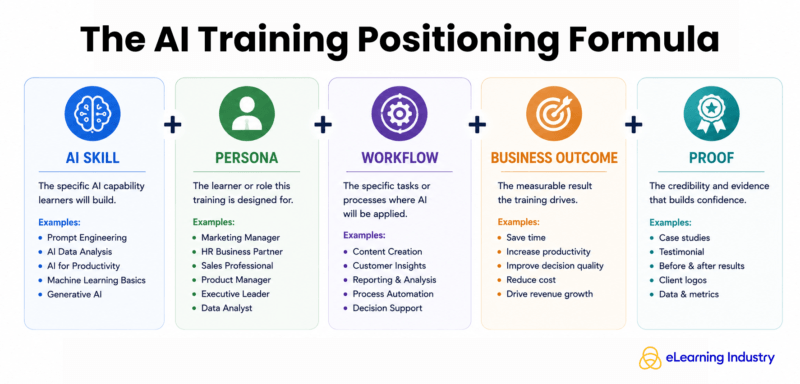
Effective marketing in 2025 requires a shift in positioning. A "Weak Positioning" strategy focuses on the technology itself, such as "A Masterclass in Generative AI." Conversely, "Strong Positioning" connects the technology to a specific role and a measurable outcome.
The industry-standard positioning formula for successful AI courses is now defined as: AI Capability + Priority Persona + Workplace Use Case + Measurable Outcome.
For example, instead of offering a "Prompt Engineering Guide," a provider might market "An AI Workshop for Financial Analysts to Automate Quarterly Reporting while Ensuring Data Compliance." This approach immediately identifies the audience, the specific task, and the critical concern of the buyer (compliance), making the value proposition undeniable.
Selling Outcomes Over Syllabi
A frequent mistake in educational marketing is the "Feature Dump," where providers list every module in their curriculum. In a time-starved professional environment, prospects do not want more content; they want solutions.
Marketing materials should translate curriculum items into marketable outcomes. "Prompting Fundamentals" should be marketed as "Reducing first-draft revision time by 40%." "Governance Modules" should be framed as "Using AI without exposing sensitive company data." By showing what changes in the learner’s life or the company’s bottom line after the course, providers can justify higher price points and increase conversion rates.
Building a Strategic "Offer Ladder"
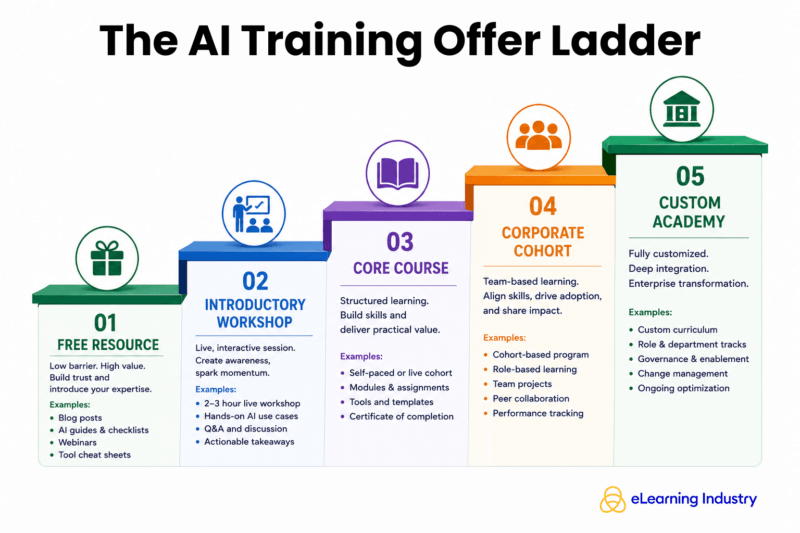
Not every prospect is ready to commit to a multi-week certification or a five-figure corporate contract. Successful providers utilize an "Offer Ladder" to guide prospects through the sales funnel:
- Low-Commitment Entry Points: These include free webinars, AI readiness assessments, or "cheat sheets." These assets serve to identify the prospect’s specific pain points and establish initial trust.
- Entry-Level Paid Offers: Self-paced introductory modules or short, role-specific workshops allow buyers to "test" the quality of instruction with minimal financial risk.
- Core Offers: These are the flagship products, such as comprehensive cohort-based courses or departmental upskilling programs.
- Premium Offers: These include executive advisory services, custom enterprise academies, and "train-the-trainer" programs designed to scale AI learning internally.
Digital Discovery: SEO and the Rise of GEO
As search behavior evolves, AI course providers must optimize for both traditional Search Engine Optimization (SEO) and the emerging field of Generative Engine Optimization (GEO). While SEO focuses on ranking in Google’s search results, GEO ensures that AI tools like ChatGPT, Claude, and Perplexity recommend a specific course when users ask for "the best AI training for architects."
To succeed in this dual landscape, providers must clearly define their niche. Targeting broad terms like "AI courses" is often a losing battle against giants like Coursera or LinkedIn Learning. Instead, focusing on long-tail, intent-driven keywords such as "AI governance training for legal teams" or "generative AI workshops for healthcare administrators" allows smaller providers to dominate specific segments of the market.
Establishing Authority through EEAT
In a field as fast-moving as AI, "Expertise, Experience, Authoritativeness, and Trustworthiness" (EEAT) are the currencies of the market. Buyers are increasingly skeptical of "AI influencers" who lack professional backgrounds in the subjects they teach.
To build credibility, marketing campaigns should highlight:
- Instructor Credentials: Professional experience beyond the world of AI.
- Demonstrable Projects: Real-world examples of AI implementation handled by the instructors.
- Case Studies: Evidence of past students or corporate clients achieving specific business results.
- Regular Updates: A clear policy on how the curriculum is updated to reflect the latest technological shifts, ensuring the training doesn’t become obsolete within months.
The Consultative B2B Sales Approach
Selling AI training to large organizations requires a move away from "transactional" marketing toward "consultative" selling. Corporate buyers rarely purchase a "course"; they purchase a "transformation."
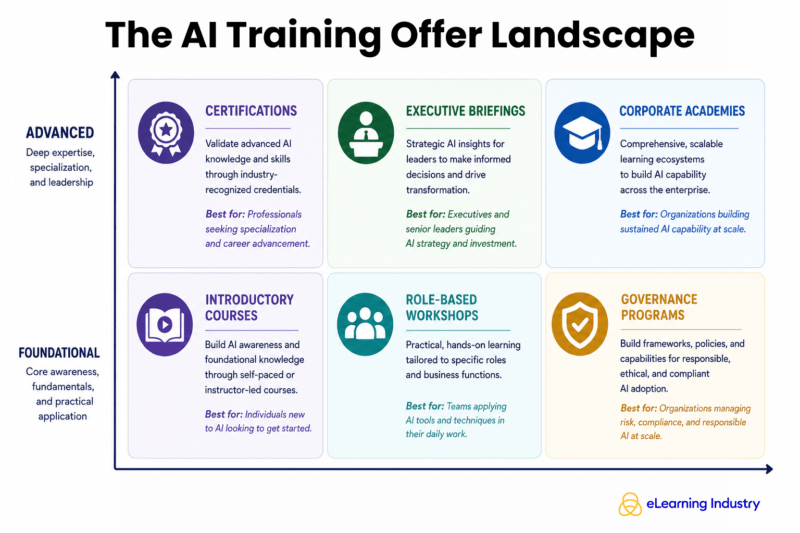
The B2B marketing funnel often begins with thought leadership—white papers or webinars that address the macro challenges of AI adoption. This leads to a "discovery phase" where the provider conducts a training-needs analysis or an AI readiness assessment for the client. By helping the organization identify its own gaps, the provider positions their training as the logical solution to a newly identified problem.
Future Implications: The Shift Toward Human-Centric AI Education
As we look toward 2026 and beyond, the impact of AI training will be measured not just by technical proficiency, but by how well it empowers human creativity and strategic thinking. Analysis of the current market suggests that while AI-generated learning materials are becoming common, the value of human-led, cohort-based instruction is actually increasing. Learners are seeking mentorship, community, and the nuanced "human-in-the-loop" strategies that automated platforms cannot provide.
The broader implication for the labor market is significant. As AI handles more routine tasks, the "skills gap" identified by the World Economic Forum will increasingly center on "soft skills" augmented by AI—critical thinking, ethical judgment, and complex problem-solving. Training providers who can market their programs as a bridge between technical execution and human strategy will be the ones who define the next decade of professional education.
Ultimately, the goal of marketing AI training is to reduce the perceived risk of a rapidly changing future. By providing clear paths to mastery, credible proof of results, and role-specific relevance, educators can transform AI from a source of professional anxiety into a catalyst for unprecedented career and organizational growth.






