The perennial challenge of writing, updating, and managing job descriptions, once a largely administrative burden, has evolved into a strategic imperative for talent acquisition. Companies of all sizes grapple with this task, but as organizations scale, the complexity magnifies exponentially, transforming a seemingly simple function into a formidable operational bottleneck. The solution, increasingly adopted by forward-thinking HR departments, lies in automated job description builders, a technological advancement poised to redefine the landscape of talent acquisition.
The Evolving Landscape of Talent Acquisition and the JD Imperative
In an increasingly competitive global talent market, a well-crafted job description (JD) is far more than a list of duties and qualifications; it is the critical first impression, a powerful branding tool, and a foundational element for a diverse and high-performing workforce. Historically, job descriptions were static documents, often gathering dust in shared drives or forgotten in departmental silos. However, the digital age, coupled with a heightened focus on diversity, equity, and inclusion (DEI), legal compliance, and candidate experience, has dramatically elevated the role and complexity of JDs.
For small organizations, managing a limited number of positions might seem straightforward. Yet, even here, the lack of standardized practices can lead to inconsistencies, subjective language, and missed opportunities to attract top talent. As companies expand, the challenge escalates rapidly. Managing hundreds, or even thousands, of unique job descriptions across disparate systems – shared drives, email inboxes, Applicant Tracking Systems (ATS) platforms, and spreadsheets – becomes a logistical nightmare. The administrative overhead of manually updating each version when a single compliance requirement changes, or when the company culture evolves, renders the task nearly impossible. This fragmented approach not only consumes valuable HR resources but also introduces significant risks of non-compliance, brand inconsistency, and a poor candidate experience.
Industry reports highlight the tangible impact of these challenges. A Career Plug study revealed that 52% of job seekers reject offers due to negative experiences with prospective employers, a figure often directly linked to poorly written or managed job descriptions. Furthermore, studies by the Society for Human Resource Management (SHRM) indicate that companies spend an average of 25-30 hours per new hire on administrative tasks related to job postings and candidate screening, much of which can be attributed to inefficient JD management. The shift towards centralized job content management, treating job descriptions not as isolated documents but as dynamic assets within a unified system, is therefore not merely a convenience but a strategic necessity.
The Intricacies of Crafting Effective Job Descriptions
Effective job descriptions must strike a delicate balance: they need to be detailed, accurate, consistent, and objective, while simultaneously being engaging, gender-neutral, free from exclusionary jargon, and reflective of the company’s unique culture and values. They must clearly outline the role, responsibilities, required qualifications, and the value proposition for potential candidates.
Smaller companies often struggle with objectivity and professionalism in their JDs simply because HR managers and recruiters write them less frequently. This lack of regular practice can lead to generic, uninspired, or even biased language. In contrast, larger organizations face the formidable task of maintaining consistency. With multiple hiring managers and recruiters from various teams contributing, ensuring adherence to company-wide standards for content, format, and language becomes a Herculean effort. This divergence can dilute the employer brand, confuse candidates, and inadvertently create barriers for diverse applicants.
The consequences of subpar job descriptions extend beyond mere inconvenience. They can hinder the creation of a diverse hiring pipeline, increase churn during the hiring process, and ultimately impact an organization’s ability to secure critical talent. An external perspective or a specialized tool can standardize language, formatting, and tone, driving winning candidate engagements at scale and significantly improving conversion rates.
Automated Solutions: A Paradigm Shift in JD Management
Enter automated job description builders, exemplified by solutions like Ongig’s Text Analyzer. These platforms represent a paradigm shift, moving beyond basic templates to offer intelligent, AI-driven capabilities for the entire lifecycle of job content. They address the core struggles of managing not just one or two JDs, but hundreds, thousands, or even tens of thousands.
At the heart of such systems is a centralized Job Library. This single, searchable source of truth eliminates the chaotic sprawl of files across disparate systems. Recruiters, HR teams, compensation specialists, and hiring managers can all access and collaborate within the same ecosystem, ensuring everyone works from the most current and approved version. Ongig’s Job Library, for instance, includes robust features such as version history, customizable fields, job families, requisition IDs, and unlimited job volume. This comprehensive approach allows teams to maintain consistency and compliance without creating additional administrative burdens.
Ongig’s Text Analyzer: A Comprehensive Approach to Smart Recruitment
Ongig’s Text Analyzer offers a multi-faceted approach to smart recruitment, empowering organizations to create, manage, and optimize job descriptions with unprecedented efficiency and impact.
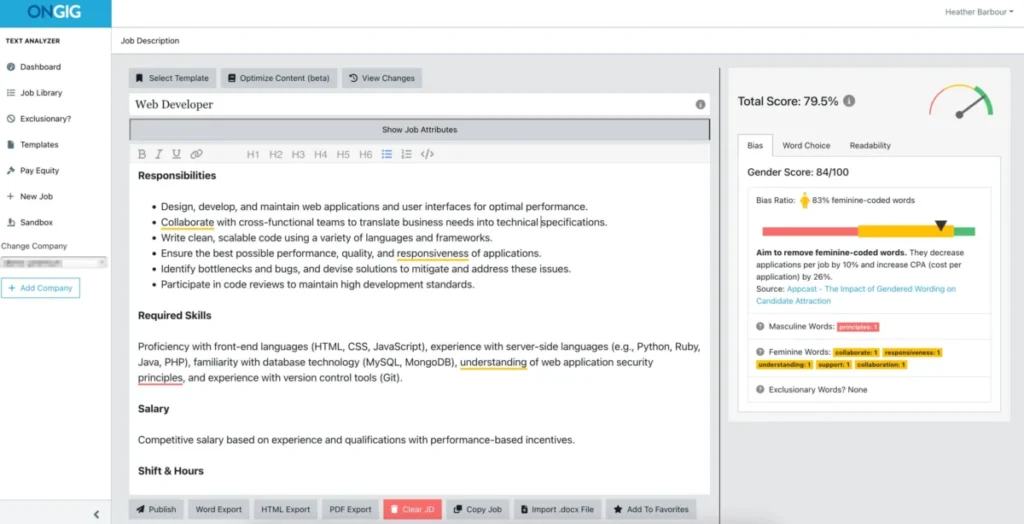
1. AI-Powered Creation from Scratch: For new roles or when starting fresh, the Text Analyzer simplifies the creation process. By simply inputting a job title, such as "Web Developer," the tool leverages AI to generate a comprehensive draft. Users can select desired sections based on custom templates or Ongig’s research-backed recommendations, then initiate the "Generate Now" function. This AI-powered initial draft provides a solid foundation that teams can then refine to perfectly match the specific requirements of the position. Further optimization, such as reducing masculine bias or shortening complex sentences, is achieved with a single click of the "Optimize Content" and "Rewrite Now" buttons.
2. Readability and Inclusivity Optimization: A critical feature is the "Readability Score" and "Section Finder" tab. This not only evaluates the overall clarity of the JD but also highlights essential sections that appeal to quality candidates, such as "Required Skills," "Diversity & Inclusion," and "Mission Statement." The platform provides data-backed insights, for example, noting that 32% of professionals would consider a pay cut for remote work, thereby emphasizing the importance of a "Flexible Location" section where applicable. The tool automatically suggests improvements, increasing the overall score.
Beyond readability, Text Analyzer is a powerful engine for inclusivity. It identifies potentially biased language, such as the subtle "feminine-coded" term "support," and suggests neutral alternatives like "help," or allows for complete removal. This granular analysis extends to flagging any "exclusionary words," ensuring job descriptions are gender-neutral and welcoming to all. Users can "View Changes" to compare versions, ensuring transparency and control over the optimization process. This meticulous attention to language is crucial; workplace surveys indicate that diverse companies outperform their less inclusive competitors with a 36% increase in profitability, and objective, skills-based hiring leads to a 2.6 times higher likelihood of meeting hiring targets.
3. Robust Compliance Assurance: In an ever-evolving regulatory environment, compliance is paramount. Ongig’s platform significantly mitigates compliance risk by allowing teams to update approved language once and apply those changes across their entire job content library. Built-in approval workflows, revision tracking, pay transparency guidance, and audit-ready version history provide HR teams with complete visibility and control. The Text Analyzer keeps JDs current with the latest Office of Federal Contract Compliance Programs (OFCCP) rules through a simple checkbox, ensuring checks for discrimination and supporting merit-based talent acquisition decisions. This streamlines hiring contracts and reinforces a company’s reputation as an Equal Employment Opportunity (EEO) employer, a vital component of strong employer branding, particularly in light of recent merit-based hiring criteria.
4. Streamlined Updates for Existing Job Descriptions: Even for organizations with extensive existing JD libraries, automation proves invaluable. Text Analyzer reviews existing job descriptions for quality, consistency, and language, helping to remove biased language and jargon, which directly translates to better conversion rates from prospective employees. By automating this review process, organizations can significantly reduce the costly human labor associated with manual updates. For teams that prefer a manual approach, the tool still provides a comprehensive score based on readability and inclusivity, offering actionable suggestions and facilitating comparative analysis. The ability to instantly replace biased or overly complex language with more inclusive or plain alternatives empowers recruiters to attract top talent more effectively.
5. Large-Scale Reformatting and Template Management: Reformatting and updating a large volume of job descriptions is another area where Ongig’s automation capabilities shine. The tool compares existing JDs against preferred templates, making automated edits to enhance readability, clarity, and consistency. It can also automatically populate missing sections according to company-wide standards, such as details on salary, benefits, and the hiring process. These customized templates, once configured, can be locked to prevent unauthorized edits, ensuring consistent branding and compliance across the organization, regardless of the volume of JDs.
6. Bridging the Gap Between Job Descriptions and Job Postings: Ongig’s AI-driven platform offers a seamless transition from internal job descriptions to external, attractive job postings. With a single click, it reformats JDs into candidate-friendly job ads, boosting the talent acquisition team’s efficiency and improving speed-to-market. The platform optimizes these postings for SEO, enhancing visibility on job boards and increasing candidate conversions. It reorders sections to prioritize what candidates seek most, such as "What You’ll Do," "Salary," and "Making an Impact," aligning with current job seeker trends.
7. One-Stop JD Library and ATS Integration: The centralized, cloud-based JD library provides a reliable storage solution, offering an intuitive design with useful details at a glance, including job titles, job families, creation dates, last updated dates, status, and associated requisitions. The ability to filter between active and non-active jobs ensures systematic management and consistent record-keeping for hiring teams.
Crucially, Ongig’s Text Analyzer integrates seamlessly with existing ATS and HRIS systems, supporting both one-way and two-way integrations. This synchronization eliminates the need for manual copy-pasting between systems, preventing version confusion and ensuring that all stakeholders work from the same "source of truth." This tiered system flexibly adapts to an organization’s evolving needs, allowing them to pay only for the tools necessary, from basic JD analysis to large-scale content library management.
Tangible Impact: Success Stories and Industry Validation
The efficacy of automated job description builders is not merely theoretical; it is demonstrated through compelling success stories across diverse industries. A global employment website, for instance, witnessed a remarkable 133% jump in total application starts and a 21% rise in applications from women after testing Text Analyzer on 60,000 job postings. This underscores the profound impact of thoughtful, inclusive language on attracting a broader and more diverse applicant pool.
In the healthcare sector, a client successfully revamped over 5,000 job postings for standardization and inclusivity, while another managing over 100,000 monthly postings achieved complete automation, significantly streamlining their operations. An entertainment industry enterprise reported a 100% increase in candidate quality after focusing on inclusivity and consistency in their job descriptions. These results highlight how optimized JDs can attract higher-caliber talent.
Furthermore, an aerospace technology agency, addressing gender imbalance in traditionally male-dominated fields like engineering and finance, observed a 22% increase in female applicants with Text Analyzer. Similarly, a major insurance organization targeting underrepresented groups achieved a 4X increase in applications from these demographics. These case studies, some featured in Ongig’s YouTube video, consistently demonstrate how nuanced changes in job content, facilitated by automation, can yield substantial improvements in recruitment outcomes.
Broader Implications for Employer Branding and DEI
The strategic adoption of automated job description builders extends far beyond operational efficiency. It directly impacts employer branding and an organization’s commitment to Diversity, Equity, and Inclusion (DEI). By prioritizing employee-first environments and ensuring equal opportunities regardless of background, companies build trust among potential hires, and gain credibility with investors, partners, and clients. EEO branding not only improves employee engagement but also enhances the quality of hires and reduces workplace dissatisfaction. This proactive approach to inclusive hiring aligns with the merit-based criteria emphasized by various administrations, reinforcing a company’s commitment to fairness and legal compliance.
The Future of Job Content Management
As the world of hiring and recruitment continues its rapid evolution, the role of dynamic, compliant, and inclusive job descriptions will only grow in importance. Automated builders are not just tools; they are strategic partners in talent acquisition, enabling companies to adapt swiftly to changing market demands, regulatory shifts, and evolving candidate expectations. They empower HR and talent teams to move from reactive, manual processes to proactive, data-driven strategies, allowing them to focus on high-value candidate engagement rather than administrative overhead.
In conclusion, the journey from struggling with job descriptions to mastering them is now facilitated by sophisticated automated builders. Ongig’s Text Analyzer stands out as a comprehensive solution, offering AI-powered creation, optimization for readability and inclusivity, robust compliance features, and seamless integration. This technology not only saves time and resources but fundamentally transforms how organizations attract, engage, and secure the talent essential for future success. The future of talent acquisition is automated, intelligent, and inherently inclusive, with the job description builder at its core.
FAQ: Automated Job Description Builders
Many modern job description builders, including Ongig’s, leverage Artificial Intelligence (AI) to generate and optimize job content. Ongig’s Text Analyzer, for instance, uses AI to suggest edits, rewrite text for inclusivity and readability, and score job descriptions based on quality metrics. The AI can also identify potentially biased or exclusionary words and propose more inclusive alternatives, thereby helping organizations reach a broader, more diverse talent pool.
Automated JD builders significantly streamline the hiring process by reducing the time and effort required to write and edit job descriptions. They ensure that postings are compliant with legal standards, engaging for candidates, and consistent across the organization. This consistency enhances the candidate experience and improves the overall quality of applicants. Tools like Ongig’s also flag outdated language, optimize formatting, and integrate seamlessly with Applicant Tracking Systems (ATS), allowing HR teams to dedicate less time to administrative tasks and more time to engaging top talent.
An automated job description builder is a digital platform designed to assist HR teams and hiring managers in quickly and efficiently creating, updating, and optimizing job postings. Rather than starting from scratch or relying on outdated templates, these tools utilize structured inputs, customizable templates, and often AI-powered suggestions to generate clear, accurate, and brand-aligned job advertisements. Solutions such as Ongig’s Text Analyzer also provide capabilities for managing extensive libraries of job postings and ensuring uniformity across various departments and roles.
June 5, 2026 by Olivia Jones in Job Descriptions