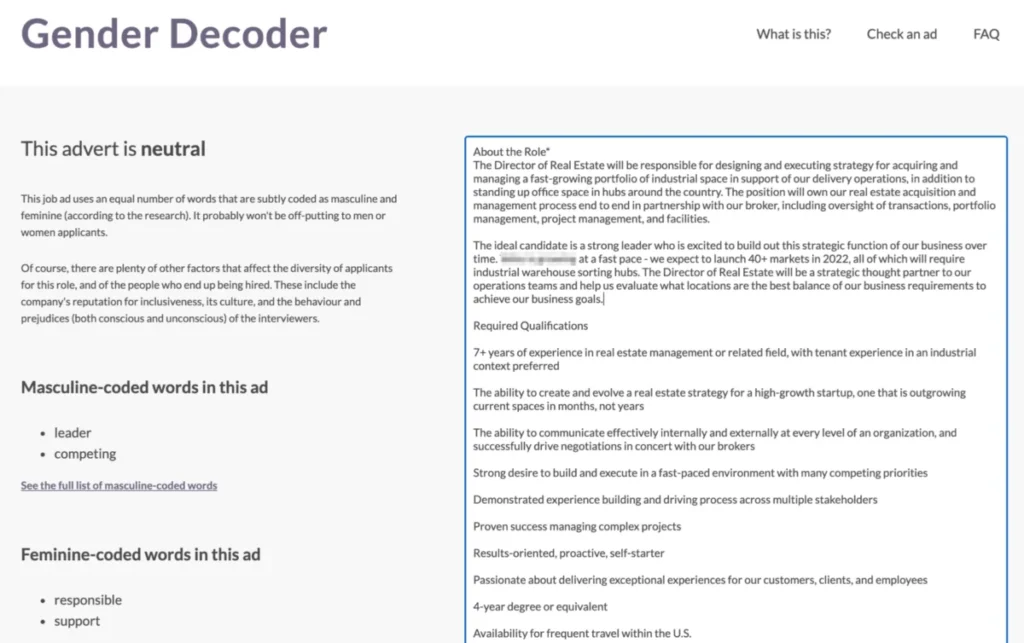
The contemporary landscape of talent acquisition demands an unprecedented focus on inclusivity, extending even to the subtle nuances of language used in job descriptions, applicant communications, and social media outreach. Recognizing and mitigating linguistic bias, particularly gender-coded language, has become a strategic imperative for organizations striving to attract a broader, more diverse pool of candidates. This evolving need has propelled gender analysis writing tools from niche utilities to essential components of modern recruitment technology stacks.
The Pervasive Impact of Gender-Coded Language in Recruitment
Research consistently demonstrates the tangible benefits of gender-neutral language in talent attraction. A landmark Appcast study, analyzing an extensive dataset of 473,742 job postings, provided compelling evidence: "Job ads with gender-neutral language result in 67.75% more applications at a cost that is 68.5% less per application in comparison to job ads that use a combination of female and male-coded terms." This data underscores a critical economic and operational advantage for companies adopting inclusive language practices. Gender-coded words, often subtle and ingrained in corporate vernacular, can inadvertently deter specific demographic groups. For instance, terms like "dominant," "leader," and "analytical" are frequently associated with masculine stereotypes, while "supportive," "collaborative," and "nurturing" can carry feminine connotations. When job descriptions are heavily skewed towards one type of coding, they can create an unconscious barrier, signaling to potential applicants that they may not belong or thrive in that environment.
The implications extend beyond mere application numbers. A separate study by the Harvard Kennedy School highlighted that women are approximately 50% less likely to apply for roles advertised with predominantly masculine-coded language. This phenomenon contributes significantly to gender imbalances in various industries, particularly in leadership and STEM fields where masculine language has historically dominated. The subtle psychological cues embedded in biased language can lead to self-selection out of opportunities, effectively shrinking the talent pipeline before formal applications even begin.
Evolution of Diversity, Equity, and Inclusion (DEI) in Hiring
The journey towards inclusive hiring has seen significant advancements over the past decade. Initially, DEI efforts often focused on broader policy changes and representation targets. However, as understanding deepened, organizations began to recognize the systemic nature of bias, including its manifestation in written communication. The mid-2010s saw the emergence of basic text analysis tools, but these were often limited in scope, primarily identifying overt discriminatory terms. By the early 2020s, with rapid advancements in artificial intelligence (AI) and natural language processing (NLP), the sophistication of these tools dramatically increased.
The year 2026 marks a pivotal moment where AI-powered gender analysis writing tools are no longer considered optional but rather a fundamental requirement for any organization committed to fair and effective recruitment. This shift is driven by a confluence of factors: heightened societal awareness of gender equality, evolving legal frameworks promoting non-discrimination, and a growing recognition that diverse teams outperform homogeneous ones. The demand for unbiased content extends beyond job postings to all applicant-facing communications, including emails, career site content, and social media posts, necessitating comprehensive linguistic scrutiny.
Leading Gender Analysis Writing Tools in 2026
A robust ecosystem of gender analysis writing tools has developed to address this critical need, offering solutions for businesses of all sizes and complexities. These tools leverage advanced algorithms to identify, explain, and suggest alternatives for gender-coded and other biased language.
1. Ongig Text Analyzer
Ongig’s Text Analyzer stands out as an augmented gender analysis writing tool, leveraging AI to go beyond simple flagging. It intelligently identifies masculine language and provides contextually relevant, inclusive replacement suggestions. Users can easily copy/paste text or upload .docx files for comprehensive scanning across various bias types. The tool visually highlights problematic words with a red underline, enabling quick and informed revisions. Beyond bias detection, Ongig offers smart templating functions, allowing companies to create, store, and edit job descriptions (JDs) at scale. This capability ensures consistency and compliance across multiple vacancies, integrating seamlessly with Applicant Tracking Systems (ATS) and career sites to facilitate skills-based hiring campaigns that appeal to a diverse talent pool. Ongig caters to a wide range of organizations, from SMBs to large enterprises, supporting multiple users including recruiters, hiring managers, and diversity teams. Pricing starts at $11,997 annually, with demos available for deeper exploration.
2. Grammarly
While broadly known for its grammar and spelling correction capabilities, Grammarly has evolved to incorporate sophisticated inclusive language checks. Its premium versions are equipped to identify exclusionary words, flagging terms that could inadvertently alienate valuable candidates. For instance, it can suggest alternatives for "manpower." The process involves simply pasting text into the editor, and Grammarly’s algorithms analyze content for non-inclusive language. While basic spelling and grammar checks remain free, advanced features, including inclusive hiring suggestions, require a professional account. These accounts typically start at $12 per month, scaling up to $12.50 per member per month for teams ranging from 3 to 149 users. This makes Grammarly a versatile option for individuals and smaller teams seeking a general-purpose writing assistant with an inclusive edge.
3. Gender Decoder
Gender Decoder offers a straightforward and accessible solution for evaluating text for gender bias. This free online tool allows users to paste their content and instantly receive an analysis that categorizes words as masculine-coded or feminine-coded. It then provides a clear list of these words, empowering users to make targeted revisions for greater inclusivity. The platform also features a comprehensive reference panel of potentially biased or offensive words, serving as a quick guide for hiring teams to proactively craft fair and appealing job descriptions from the outset. Its simplicity and no-cost access make it an excellent entry-level tool for immediate bias checks.
4. Witty.Works
Witty.Works positions itself as an inclusive writing assistant designed to help hiring teams scale inclusive content across their ATS and career sites. The software’s intelligent algorithms identify exclusionary language and propose neutral alternatives that resonate with a diverse audience. Witty.Works is also lauded for its "witty recommendations" that aim to foster teamwork and diversity by replacing exaggerations and facilitating friendlier communications, living up to its name. Its high integration capabilities allow it to run seamlessly within existing talent acquisition pipelines, contributing directly to improved application and hiring rates.
5. Microsoft Word
Microsoft Word, a ubiquitous tool in professional environments, now includes an inclusive language checker within its Microsoft 365 subscription. This feature allows users to activate settings that flag gender writing bias and other forms of bias directly within their documents. The checker can be enabled by navigating through File > Options > Proofing > Settings and selecting the "Gender Neutral" option. While the core software is widely used, this advanced inclusive language functionality is exclusive to Microsoft 365 subscribers. Business plans typically range from $7 to $14 per month, depending on the chosen package. A significant enhancement comes with integrating MS Word with Copilot add-ons, which enables AI-powered rewrites of job descriptions, further streamlining the process of achieving gender-neutral efficiency.
6. Total Jobs Gender Bias Decoder
The Total Jobs Gender Bias Decoder is a user-friendly, free online tool specifically designed to identify gender bias in written content. Users simply copy and paste their text into a designated box, and the tool color-codes words: female-coded terms appear in blue, and male-coded terms appear in pink/red. Critically, it also provides neutral alternatives for masculine-coded words. The tool’s design note highlights that it primarily focuses on masculine-coded terms, as research indicates that feminine-coded words do not typically dissuade male candidates from applying. This focused approach makes it an efficient and accessible resource for ensuring fairness and equality in recruitment language.
7. Applied Text Analysis (JDAT)
Applied’s Job Description Analysis Tool (JDAT) is a sophisticated component of their broader job description platform. It meticulously scans for masculine and feminine words to ensure gender neutrality. Beyond gender, JDAT incorporates specialized algorithms to track socioeconomic background and age, promoting truly skills-based hiring campaigns. Users can paste text into the tool, which then highlights exclusionary terms and provides a comprehensive readability report. This report analyzes reading time, content reading level, and word count, offering holistic insights into JD quality. While a free gender bias decoder function is available, a broader suite of features requires a paid version, accessible via a customized quote.
8. Clovers
Clovers is an AI-driven interview intelligence platform that tackles unconscious biases throughout the hiring process. Its offerings range from redacted resume reviews to a robust gender bias checker for job descriptions. Clovers excels at minimizing interviewer biases through natural language processing (NLP), assessing interview flow, and providing data-guided insights. Its gender bias language checker reviews JDs for gender stereotypes and coded language, aligning with the critical finding from the Harvard Kennedy School study that masculine language deters female applicants. Clovers integrates seamlessly with Microsoft Teams, facilitating the application of impactful, data-guided interview practices across ATS platforms.
9. Datapeople
Datapeople specializes in optimizing job descriptions through its Smart Editor tool, which promotes inclusive language and provides strategic recommendations beyond mere bias detection. The software reviews JDs for problematic language but also offers guidance on length, structure, and formatting. This comprehensive approach ensures content aligns with evolving employer compliance standards and best practices. Smart Editor includes pre-approved templates, enabling users to confidently publish impactful JDs that meet stringent standards for candidate engagement. Its user transparency features for content revision reviews are particularly beneficial for larger organizations with complex HR workflows and significant internal oversight responsibilities.
10. Happy Dance Job Page Grader
Happy Dance’s Job Page Grader is a free, accessible tool that scans published job descriptions for unconscious bias and gendered language directly from their URLs. Its free nature makes it available to organizations of all sizes, democratizing access to bias detection. Beyond gender bias, the Job Page Grader vets and suggests improvements for mobile optimization, SEO, and code hygiene, all crucial for boosting page loading speeds and overall candidate experience. While limited to scanning one live URL at a time and not supporting offline documents, it serves as a robust and valuable tool for users requiring essential support and evaluation functions for their online job postings.
Why the Continued Emphasis on Gender Bias in 2026?
The year 2026 marks a heightened awareness and a critical juncture in the ongoing effort to dismantle systemic biases in the workplace. Traditional job description writing, often relying on established industry jargon and unchallenged phrasing, has inadvertently perpetuated gender stereotypes and reinforced outdated gender roles. Such language not only appears clunky and old-fashioned to top-tier candidates but can also be subtly offensive, creating an unwelcoming atmosphere.
Beyond the ethical imperative, there’s a strong business case. Outdated practices miss out on the transformative potential of a diverse workforce. As AI and augmentation technologies rapidly advance, the ability to eliminate socioeconomic and accessibility biases has become not merely a "nice-to-have" but a fundamental standard in attracting talent from all backgrounds. Companies must remain agile in adapting to the evolving nuances of language, particularly in critical documents like job descriptions. Even the most well-intentioned HR professionals can inadvertently overlook language that reinforces gender bias without the aid of specialized tools.
The ten gender bias language checker tools discussed herein are crucial for minimizing costly human errors by recognizing subtle linguistic cues, such as masculine or male-coded words, within job descriptions. Systemic issues like the gender wage gap, the lack of paid paternity leave, and the extraordinary cost of childcare continue to affect talent across all industries. While these are broad societal challenges, hiring and retaining women necessitates a holistic reform of corporate policies, and AI-enhanced job descriptions are a vital first step.
Research from the United Nations continues to highlight the pervasive nature of workplace bias despite advancements in inclusive hiring. In 2026, the widespread implementation of smart AI tools capable of tackling subconscious hiring bias at its core offers a tangible pathway to providing all talent with an equal footing in a highly competitive job market. These tools are instrumental in fostering equitable opportunities and driving organizational success through diversity. The journey to truly inclusive workplaces is ongoing, but armed with these technological advancements, the path forward in 2026 appears clearer and more attainable than ever before.