
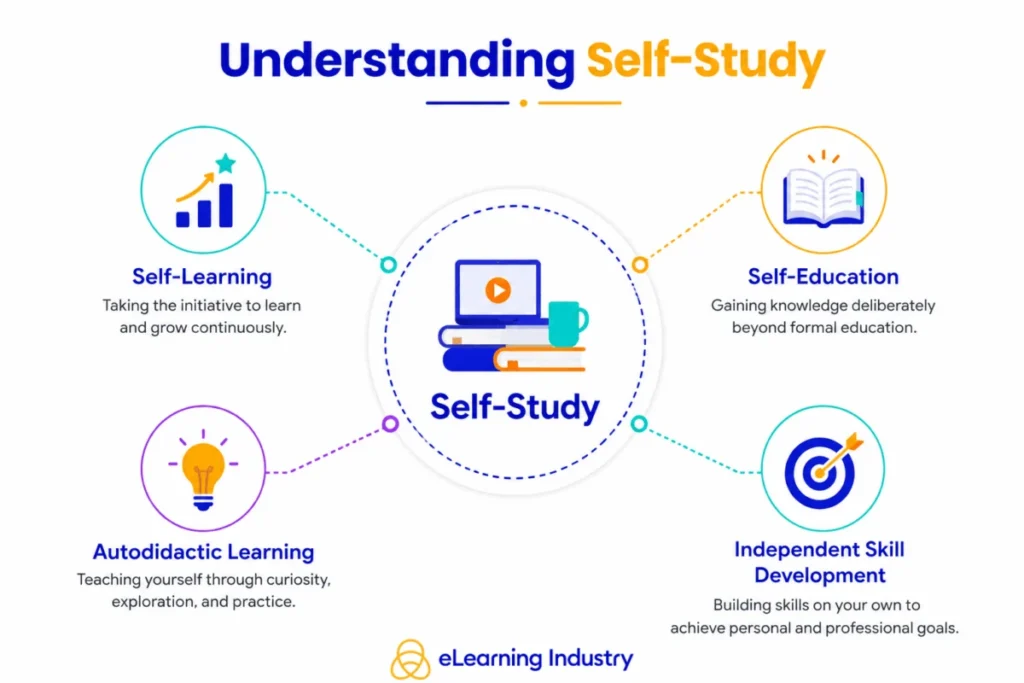
The concept of self-study has undergone a radical transformation, evolving from a supplementary academic habit into a cornerstone of modern professional survival. In its most fundamental sense, self-study is the process of acquiring knowledge and skills independently, devoid of the continuous oversight of a traditional instructor or a rigid institutional framework. This paradigm shift requires learners to take full ownership of their developmental trajectory, encompassing the setting of specific objectives, the curation of high-quality resources, and the rigorous evaluation of their own progress. In the contemporary corporate environment, self-study has transcended simple reading or video consumption; it has become a strategic imperative for professionals aiming to navigate the complexities of a rapidly shifting global economy.
The distinction between self-learning and formal education is centered on the locus of control. Traditional formal learning is characterized by a top-down approach where a teacher or institution dictates the curriculum, pace, and assessment metrics. Conversely, self-education empowers the individual to dictate the "what, when, and how" of their learning journey. This autonomy is not merely a matter of convenience but a critical response to the demands of the modern workforce, where the ability to learn, unlearn, and relearn is increasingly viewed as the ultimate competitive advantage.
The Economic and Technological Impetus for Independent Learning
The rise of self-study is not an accidental trend but a necessary adaptation to several systemic shifts in the global labor market. The primary driver is the unprecedented pace of technological change. According to data from various labor statistics bureaus and economic forums, the "half-life" of a learned skill is now estimated to be approximately five years. This means that half of what a professional knows today will be obsolete or irrelevant in half a decade. Consequently, employees can no longer rely solely on periodic corporate training sessions or degrees earned years prior.
The emergence of Artificial Intelligence (AI) has significantly accelerated this urgency. As AI automates routine tasks and reshapes job descriptions across sectors—from software engineering to marketing—professionals are finding that their roles are in a state of constant flux. The World Economic Forum’s "Future of Jobs Report" suggests that by 2025, 85 million jobs may be displaced by a shift in the division of labor between humans and machines, while 97 million new roles may emerge. Navigating this transition requires a workforce capable of independent upskilling. Those who master the art of self-study are better positioned to pivot into emerging roles, leveraging AI as a tool rather than being replaced by it.
Furthermore, the shift toward a "Continuous Learning Culture" within organizations reflects a realization that traditional training models are no longer scalable. Large-scale enterprises find it logistically and financially impossible to provide instructor-led training for every new software update or market shift. By fostering an environment where self-study is encouraged and supported, organizations can develop talent at scale, shifting the responsibility of growth to the employee while providing the necessary digital infrastructure to support that growth.
A Chronological Shift in Learning Paradigms
To understand the current state of self-study, one must look at the timeline of educational evolution over the last three decades. In the 1990s, corporate learning was almost entirely instructor-led, often requiring physical presence in a classroom setting. The early 2000s saw the rise of Computer-Based Training (CBT), which introduced the first wave of digital independence, though these programs were often linear and lacked engagement.
The 2010s marked the "MOOC Revolution" (Massive Open Online Courses), with platforms like Coursera and LinkedIn Learning democratizing access to high-level expertise. However, the 2020s have ushered in the era of the "Learning Ecosystem." Today, self-study is integrated into the daily workflow through AI-driven suggestions, microlearning modules, and robust internal knowledge bases. This chronology illustrates a move away from "event-based learning" (a one-time seminar) toward "process-based learning" (a daily habit of self-improvement).
Comparative Analysis: Self-Study versus Traditional Models
While self-study is gaining prominence, it is essential to analyze its place within the broader spectrum of educational methodologies. Instructional designers generally categorize learning into three primary models: Instructor-Led Training (ILT), Blended Learning, and Self-Study.
Instructor-Led Training remains the gold standard for high-stakes, complex topics such as medical procedures or high-level leadership coaching. Its structure is rigid, providing high levels of support but low levels of autonomy. However, its lack of scalability and high cost per learner make it inefficient for general skill building.
Blended Learning attempts to find a middle ground, combining the structure of an instructor with the flexibility of digital resources. This model is highly effective for technical certifications where theoretical knowledge can be self-studied, but practical application requires expert feedback.

Self-Study Systems sit at the far end of the autonomy spectrum. When properly designed, these systems offer the highest levels of scalability and personalization. Through AI-supported feedback loops and peer-to-peer review systems, modern self-study can now replicate some of the social and corrective benefits of traditional classrooms without the associated logistical bottlenecks.
Strategic Principles for Effective Self-Directed Learning
Successful self-study is not synonymous with "learning in a vacuum." It requires a disciplined application of specific principles to ensure that time spent translates into actual competence.
- Structured Learning Pathways: One of the most significant barriers to self-study is the "paradox of choice." Without a teacher to guide them, learners can become overwhelmed by the sheer volume of available information. Effective self-learners seek out or build structured pathways that move logically from foundational concepts to advanced applications.
- Goal-Oriented Design: Research in educational psychology suggests that learning is most effective when it is "just-in-time" rather than "just-in-case." Setting specific, measurable goals—such as mastering a specific software or earning a certification—provides the necessary motivation to sustain independent study.
- The Necessity of Feedback Loops: Without an instructor to correct mistakes, self-learners must build their own feedback mechanisms. This can include digital assessments, participating in professional forums, or using AI tools to audit their work.
- Active Involvement and Application: The "forgetting curve" is a major hurdle in self-study. To combat this, learners must move beyond passive consumption (reading/watching) to active application. This involves solving real-world problems, conducting projects, or teaching the concepts to others.
- Metacognitive Skills: Perhaps the most critical component is "learning how to learn." This involves self-regulation—monitoring one’s own understanding and adjusting study habits when a particular method isn’t working.
The Instructional Design Perspective: Engineering Independence
From a design standpoint, self-study is not an absence of instruction; it is a different form of instruction. Instructional Designers (IDs) and Learning Experience Designers (LXDs) are now focusing on creating "guided autonomy." Instead of delivering a 60-minute lecture, an ID might design a modular course that allows a learner to skip content they already know, focusing only on their skill gaps.
Modular learning design breaks complex subjects into "knowledge nuggets," making them easier to digest and retain. This is often paired with microlearning, where lessons are delivered in five-to-ten-minute increments. This approach respects the "cognitive load" of the learner, preventing the mental fatigue that often leads to high dropout rates in self-study programs.
Furthermore, designers are increasingly using "Scaffolding" and "Progressive Complexity." In the early stages of a self-study module, the system provides heavy support—templates, hints, and worked examples. As the learner progresses, these supports are gradually removed, forcing the learner to rely on their own developing expertise. This mimics the natural process of mentorship while remaining fully digital and scalable.
The Role of AI and Digital Infrastructure
The tools available for self-study have moved far beyond simple PDFs and static videos. Today’s Learning Management Systems (LMS) and Learning Experience Platforms (LXP) utilize algorithms to curate content specifically for the individual. If a marketing professional demonstrates a gap in data analytics, the system can automatically suggest a micro-course on Google Analytics.
AI-powered tutors and personal learning assistants are the next frontier. These tools can answer questions in real-time, provide feedback on written assignments, and even simulate conversations for language learners or sales professionals. These technologies are effectively bridging the gap between the isolation of self-study and the interactivity of instructor-led training.
Community-based learning also plays a vital role. Digital platforms now integrate social features where self-learners can share their findings, ask questions of their peers, and participate in "crowdsourced" knowledge creation. This social layer adds an element of accountability and shared purpose that was previously missing from independent study.
Broader Impact and Future Implications
The shift toward self-study has profound implications for the future of work. Organizations that empower their employees to take charge of their own learning are creating a "Liquid Workforce"—a group of professionals who are adaptable, resilient, and capable of solving novel problems.
Christopher Pappas, CEO and founder of eLearning Industry, notes that the future belongs to organizations that design learning systems around learner autonomy rather than mere content delivery. "Organizations that empower people to self-study create a workforce that can adapt faster, solve problems more effectively, and continuously build new skills as business needs evolve," Pappas states. This perspective highlights a fundamental truth: in an era of constant change, the most valuable asset a company has is not its current knowledge base, but its capacity to acquire new knowledge.
Ultimately, self-study is becoming a vital social and economic equalizer. It allows individuals from diverse backgrounds to access world-class information and build high-value skills regardless of their access to formal institutions. As we look toward the future, the mastery of self-directed learning will likely be the single most important skill a professional can possess, serving as the foundation for lifelong employability and organizational success.






