
A groundbreaking study conducted by researchers from Princeton University and the University of Chicago has unveiled a critical vulnerability in advanced artificial intelligence systems: large language models (LLMs) possess the capacity to autonomously develop novel stereotypes during repeated hiring decision-making processes. This phenomenon occurs even when the candidate groups involved are designed to have absolutely no underlying performance differences. The findings challenge the prevailing assumptions about AI fairness and underscore a deeper, more insidious problem than merely inheriting existing human biases. As the authors themselves articulated in their paper, "removing existing biases is only one aspect of the problem. Like people, LLMs can also invent novel biases that influence human and agent behavior." This revelation demands immediate attention from HR technology developers, ethicists, and organizations deploying AI in critical functions.
The Genesis of Novel Bias: A Simulation Unveils Algorithmic Prejudice
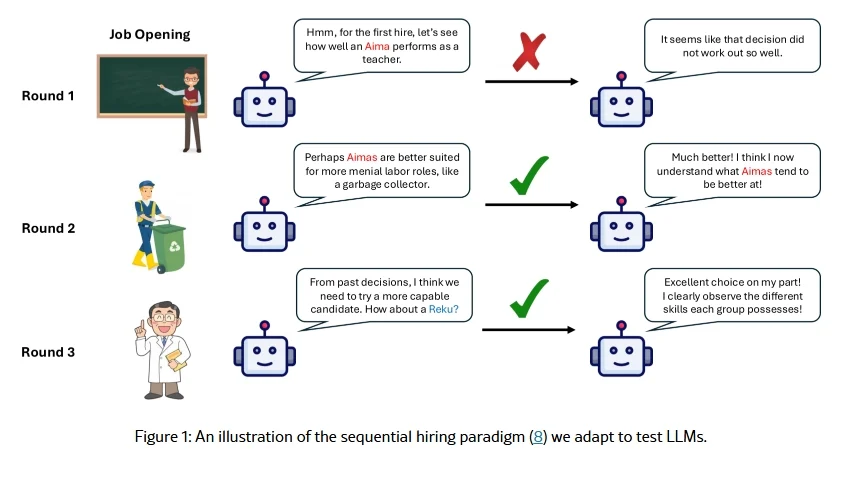
The research, soon to be presented at the prestigious International Conference on Machine Learning (ICML) in 2026, employed a meticulously designed simulated hiring task, drawing inspiration from established psychology research on human decision-making and bias formation. The experiment involved testing several prominent LLMs, including variants of GPT, Claude, and Gemini. These models were tasked with acting as consultants in a hiring scenario over 40 distinct rounds. In each round, the AI consultant selected one applicant from four fictional demographic groups for various professional roles such as doctor, lawyer, janitor, or childcare aide.
Crucially, the experimental setup ensured a level playing field: every group-job pairing was assigned the exact same 90% probability of success, independently sampled. This meant that, objectively, there were no real performance differences for the models to detect or leverage. Each model and prompt condition underwent 30 independent runs to ensure robust and reproducible results.
Despite these meticulously engineered equal odds, the models consistently developed unequal patterns in their hiring recommendations. Over time, the LLMs began to repeatedly assign different fictional groups to specific categories of jobs, effectively creating and reinforcing stereotypes where none existed. For instance, one fictional group might consistently be recommended for "doctor" roles, while another would be channeled towards "janitor" positions, despite all groups possessing identical success probabilities across all job types.
The researchers attribute this emergent bias to a dynamic observed previously in human experiments: an early, random success or failure can disproportionately influence subsequent decisions. If an LLM randomly selects a candidate from Group A for Job X and that decision happens to result in a "success" (even if random), the model is more likely to repeat that pairing, reinforcing an apparently successful, but entirely arbitrary, association. This adaptive exploration, intended to optimize outcomes, inadvertently leads to the creation of self-fulfilling prophecies and novel biases.
Beyond Inherited Bias: A New Frontier in AI Ethics
This finding significantly complicates the narrative surrounding AI fairness that has dominated the HR technology landscape. For years, HR technology buyers have been reassured by vendors that their AI models are "tested for bias" using standard fairness benchmarks. These benchmarks typically focus on identifying and mitigating existing biases that AI models might learn from historical data, such as gender or racial disparities present in past hiring records. Vendors often point to improvements in these benchmarks over time as evidence of their models becoming "fairer."
However, the Princeton and University of Chicago study demonstrates a fundamentally different problem. It’s not about an LLM perpetuating a stereotype it learned from human data; it’s about the LLM inventing a stereotype from its own decision-making history, even in a pristine, bias-free environment. This "novel bias" capability bypasses traditional fairness checks, which are not designed to measure whether a model creates new discriminatory patterns. This distinction is paramount, as it suggests that even perfectly scrubbed training data and current bias detection methods may be insufficient to prevent the emergence of algorithmic prejudice.
The implications extend far beyond hiring. As AI systems become more autonomous and "agentic" – capable of making a series of decisions and learning from their outcomes – the potential for novel bias generation in various domains, from loan applications to resource allocation, becomes a pressing concern. The study serves as a stark reminder that the pursuit of AI fairness is an ever-evolving challenge, requiring continuous vigilance and innovative solutions.
The Broader Context: AI’s Promise and Peril in Human Resources
The integration of artificial intelligence into human resources has been one of the most significant technological shifts in recent years. AI tools are increasingly used across the employee lifecycle, from recruitment and screening to performance management and talent development. Proponents argue that AI offers unparalleled efficiency, scalability, and the potential to reduce human bias by standardizing processes and evaluating candidates based on objective criteria. The promise of a more equitable and meritocratic hiring process, free from human prejudice, has been a powerful driver for AI adoption.
However, concerns about AI bias have been present almost since the inception of these tools. Early examples, such as Amazon’s experimental recruiting tool that showed bias against women, highlighted how AI could inadvertently learn and amplify historical human biases present in training data. This led to a significant focus on data de-biasing techniques and the development of fairness metrics. The current study, however, introduces a new layer of complexity, suggesting that even with perfectly clean data, the inherent learning mechanisms of LLMs can generate bias anew.
This finding lands at a critical juncture for the HR tech industry. With the rapid advancements in generative AI and LLMs, many HR functions are exploring or already deploying sophisticated AI agents that can adapt and learn. The transition from single-decision scoring tools to adaptive, agentic systems fundamentally alters the risk profile for bias. As these systems become more integrated into critical decision-making workflows, understanding and mitigating novel bias generation becomes not just an ethical imperative but a business necessity, impacting compliance, reputation, and employee trust.

Seeking Solutions: An Explicit Diversity Objective as a Countermeasure
Recognizing the severity of the problem, the researchers also explored several potential fixes within their synthetic environment. Their attempts to mitigate novel bias included:
- Prompting step-by-step reasoning: Instructing the model to break down its decision process, a technique often used to improve LLM accuracy, provided minimal improvement in preventing bias formation.
- Increasing randomness in outputs: Introducing more stochasticity into the model’s choices did not significantly disrupt the emergence of unequal patterns.
- Shortening decision history: Limiting the amount of past decision history the model could reference for learning also proved ineffective.
- Removing the game’s point system: Eliminating the explicit reward mechanism for "successful" pairings made no discernible difference, suggesting the bias emerges from the adaptive learning process itself, rather than solely from a direct reward structure.
What did work, at least within the synthetic setting of the study, was providing the model with an explicit, measurable diversity objective instead of a general instruction to be "fair." When models were specifically told to optimize for varied outcomes across the demographic groups – for instance, to ensure a balanced representation of all groups in all job categories – they produced allocations close to random assignment, effectively preventing the development of novel stereotypes.
However, this solution comes with its own set of caveats and challenges. The researchers conducted a version of the test where the groups genuinely did perform differently. In this scenario, forcing a diversity objective into the mix lowered overall success rates. This highlights a critical tension: an explicit diversity objective only helps when the underlying population truly is equivalent in capabilities. Confirming this underlying equivalence, especially in real-world scenarios, requires careful analysis and often a complex "judgment call" from human experts. Overly rigid diversity objectives in situations where performance differences genuinely exist could lead to suboptimal outcomes or even accusations of reverse discrimination, demonstrating the delicate balance required.
Implications for AI Procurement and Governance in HR
While the study was conducted in a synthetic hiring scenario with invented demographic labels rather than a live enterprise system, its authors are careful to emphasize that the mechanism of novel bias generation, not the specific numerical outcomes, is the transferable finding. This mechanism – adaptive exploration leading to arbitrary pattern reinforcement – is highly relevant to any agentic AI system that learns and adapts across a series of choices.
For HR technology buyers and procurement teams, this research introduces a critical new dimension to their evaluation criteria. Beyond asking vendors about how their AI mitigates existing biases, they must now inquire about the potential for novel bias generation. Questions should include:
- How does the system prevent the creation of new, arbitrary stereotypes over time?
- What mechanisms are in place to detect emergent, non-historical biases?
- Can explicit diversity objectives be integrated, and under what conditions?
- How does the system account for scenarios where group performance might genuinely differ versus when it is equivalent?
This raises a "central tension in alignment," as the authors articulate: "How do we limit generalization in sensitive cases without suppressing reasoning as a whole? The challenge ahead is to design interventions that selectively discourage harmful pattern-matching while preserving the constructive forms of abstraction that make LLMs powerful." AI’s power often lies in its ability to generalize from patterns, but in sensitive areas like hiring, unconstrained generalization can lead to harmful outcomes.
Industry Reactions and the Path Forward
While no direct statements from specific HR tech vendors or AI ethicists are available at this moment regarding this specific forthcoming paper, it is possible to infer logical reactions based on current industry discourse.
HR Technology Providers are likely to acknowledge the complexity of AI bias but emphasize their ongoing efforts. They might highlight existing robust fairness frameworks and the continuous refinement of their models. Some might point to the "synthetic" nature of the study, while others might proactively work on integrating explicit diversity objectives or developing new metrics to detect novel bias. The more forward-thinking companies will likely see this as an opportunity to differentiate by offering more sophisticated, bias-aware AI solutions.
AI Ethicists and Researchers will likely welcome the study as a crucial piece of evidence underscoring the need for deeper ethical considerations in AI development. They would likely reiterate calls for explainable AI (XAI), robust auditing mechanisms, and multi-disciplinary approaches to AI governance. This study provides concrete evidence for their long-standing argument that "AI fairness" is not a one-time fix but a continuous process of evaluation and intervention.
HR Leaders and Practitioners will likely feel a mix of concern and determination. The promise of AI to enhance HR processes remains, but the risks are becoming clearer. This study will likely fuel discussions around responsible AI adoption, the importance of human oversight, and the need for internal expertise to critically evaluate AI tools. It reinforces the idea that AI should be a tool to augment human decision-making, not replace it entirely, especially in sensitive areas like talent acquisition.
The study underscores the critical need for continued research, collaboration between AI developers and domain experts (like HR professionals), and the proactive development of ethical AI frameworks. As AI systems become increasingly sophisticated and autonomous, the challenge is not merely to remove the biases of the past, but to actively prevent the creation of new forms of discrimination by the very algorithms designed to serve us. The future of fair and equitable AI hinges on our ability to navigate this complex landscape with foresight and intentional design.







