
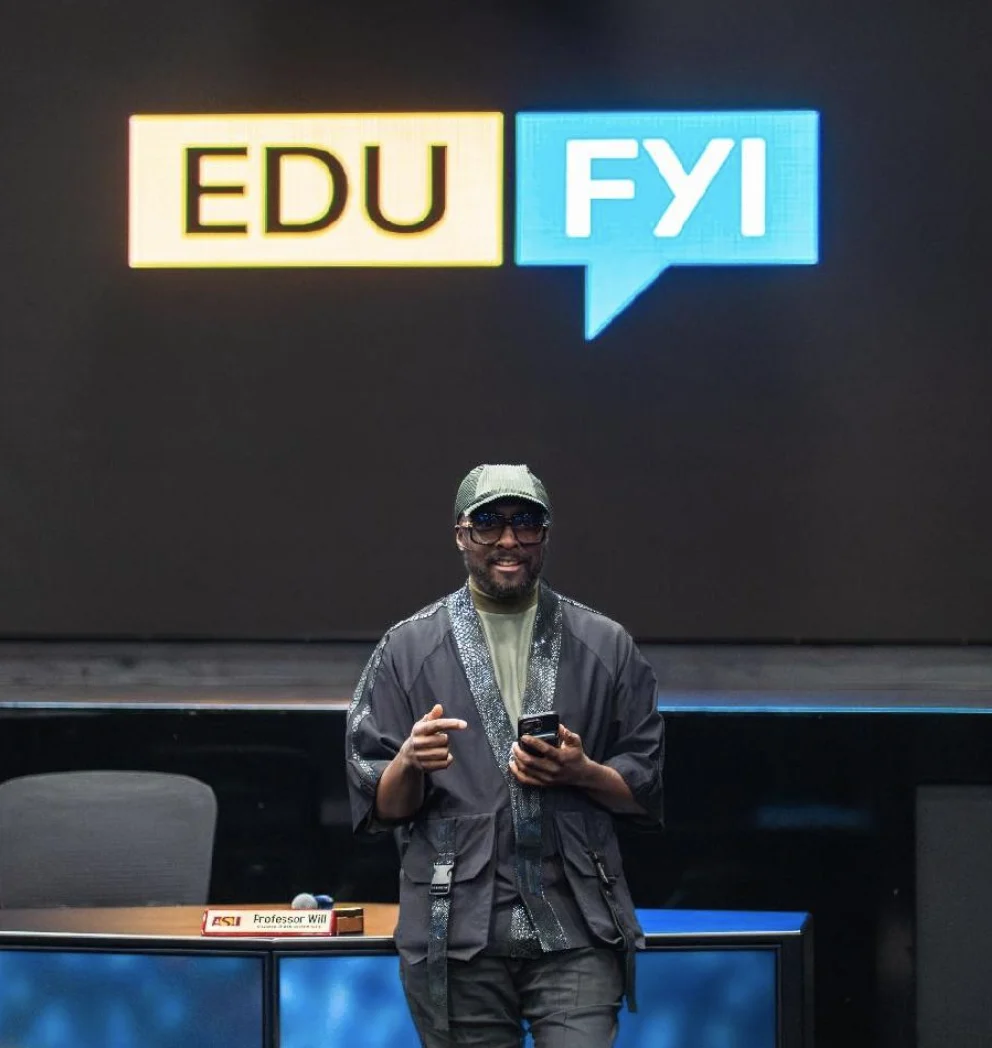
Arizona State University (ASU) has officially launched its inaugural cohort for "The Agentic Self," a pioneering course developed in collaboration with musician and tech entrepreneur will.i.am. The program, which was first conceived in 2025, represents a significant shift in higher education, moving beyond the technical instruction of artificial intelligence toward a curriculum centered on human agency, data ownership, and the creation of personalized AI "personas." Held at the FYI campus in Hollywood—a facility described as a high-tech intersection of creative production and digital innovation—the course aims to empower students to build AI agents that reflect their individual beliefs, passions, and professional interests.
The initiative comes at a critical juncture for the education and technology sectors. As generative AI moves from simple chat interfaces to complex, autonomous agents, the question of how individuals maintain control over their digital identities has become a primary concern for educators and industry leaders alike. "The Agentic Self" addresses this by providing a physical and digital environment where students can experiment with AI platforms, ranging from large language models to multimodal avatar creators.
The Architecture of Collaborative Learning
The physical environment of the course reflects its pedagogical goals. Professor Will, as will.i.am is known within the program, reimagined the learning space at the FYI campus to facilitate high-level discourse and global connectivity. The room is designed in a U-shaped format, modeled after the United Nations General Assembly. Each participant is equipped with a dedicated station and microphone, an architectural choice intended to equalize the presence of in-person students and virtual guests.
This design is more than aesthetic; it is a functional requirement for a course that emphasizes the "human-led" nature of technology. By fostering a space where every voice is amplified, the program encourages a shift from passive consumption of AI tools to active, agentic participation. The curriculum focuses on the concept of "claiming your data," a philosophy will.i.am has championed in various public forums. According to the artist, the "Agentic Self" involves putting personal data to work through agents that act as extensions of the user’s own values and concerns.
A Chronology of Innovation: From LLMs to Guided Mastery
The evolution of the "Agentic Self" concept mirrors the broader trajectory of AI development over the last two years. In early 2024, much of the global conversation focused on Large Language Models (LLMs) like ChatGPT as tools for increasing efficiency and productivity. However, by 2025, the focus began to shift toward "agentic AI"—systems capable of taking action and making decisions on behalf of a user.
The journey of the course participants highlights the distinct phases of this technological evolution:
- The Exploratory Phase (ChatGPT): Early adoption focused on testing whether AI could handle complex human interactions, such as conversational skill-building and practicing difficult professional scenarios.
- The Enterprise Integration Phase (Microsoft Copilot Studio): As organizations like Providence St. Joseph Health began adopting AI, the focus shifted to governance, strategic alignment, and deploying tools at an enterprise scale within complex regulatory environments.
- The Multimodal Phase (Acolyte AI): The introduction of avatars and multimodal experiences allowed for richer, more immersive learning environments, moving AI beyond text-based interactions.
- The Agentic Phase (FYI Platform): The current stage, exemplified by the ASU course, focuses on "AI-guided mastery." This involves a middle ground between the open-ended nature of an AI prompt and the rigidity of traditional e-learning.
This progression suggests that AI is no longer viewed as a static tool but as an adaptive, scaffolded support system that provides structure while allowing for individual movement and growth.
Addressing the Workforce Readiness Gap
Despite the rapid licensing of AI tools across the corporate world, a significant "readiness gap" remains. Recent data indicates that while many organizations have established governance and provided access to AI, a large portion of the workforce remains hesitant to integrate these tools into their daily roles.
Brad Bigelow, founder of Acolyte AI and a collaborator on the "Agentic Self" project, notes that the challenge is rarely technical. "What I observe most often is organizations that have invested heavily in AI access while underinvesting in the structures that help people use it with confidence and purpose," Bigelow stated. He argues that the distinction between being "equipped" and being "ready" will define organizational success in the coming years.

The ASU program seeks to close this gap by fostering a "learning culture" rather than a "compliance culture." By giving students permission to explore, fail, and iterate across different AI platforms, the course develops the "agentic self"—a professional who can navigate the complexities of AI with intention and ethical clarity.
Case Study: Enterprise Deployment at Providence St. Joseph Health
The practical applications of the theories taught in "The Agentic Self" are already being seen in the healthcare sector. Providence St. Joseph Health, a large healthcare system, recently completed the governance process for a conversational skill-builder based on these agentic principles. The tool allows healthcare professionals to practice high-stakes conversations in a safe, simulated environment, receiving immediate, personalized feedback.
This deployment at scale highlights a key takeaway for leaders: "best fit" is essential for adoption. An idea that works in a controlled, exploratory environment like ChatGPT must be adapted to meet the constraints of organizational complexity and strategic goals. The success of the Providence rollout suggests that when an AI tool is aligned with the specific needs and environment of the workforce, it becomes a powerful driver of internal performance.
The Ethical Framework and the Role of Leadership
A recurring theme throughout the ASU course is the importance of an ethical and moral compass in AI development. will.i.am has positioned the FYI platform not just as a technological tool, but as a community and "tribe" for those who believe AI should expand human agency rather than replace it.
For leaders and executives, this emphasizes that the "company you keep" and the platforms you choose carry significant weight. As competitors explore similar technologies, the advantage will go to those who find the best environment and the most ethical path to delivery. The ASU initiative suggests that "courageous curiosity" is a core capability for modern leadership.
Implications for the Future of Higher Education
The partnership between ASU and will.i.am may serve as a blueprint for future educational models. By moving away from static curricula and toward dynamic, project-based exploration of emerging technologies, universities can better prepare students for a rapidly shifting labor market.
The "Agentic Self" course posits that learning is the capability that drives everything else forward. In a world where AI can automate many technical tasks, the human ability to lead, to ask the right questions, and to maintain a coherent sense of self in action becomes the most valuable asset.
Conclusion: The Shift to Human-Led AI
The launch of "The Agentic Self" marks a transition from the era of AI as a novelty to the era of AI as a fundamental component of human identity and professional mastery. The experience of the first cohort suggests that when individuals are given the space to move their ideas through different environments—from simple prompts to complex, personalized agents—they discover the true potential of those ideas.
As the program expands, its influence is expected to reach beyond the walls of the FYI campus and the ASU classrooms. It challenges organizations to rethink how they support their employees and asks individuals to consider how they will claim their data and their future in an increasingly automated world. The invitation extended by the course is clear: to stay human-led, one must be willing to explore, to build, and to claim the agency that technology now makes possible.






