
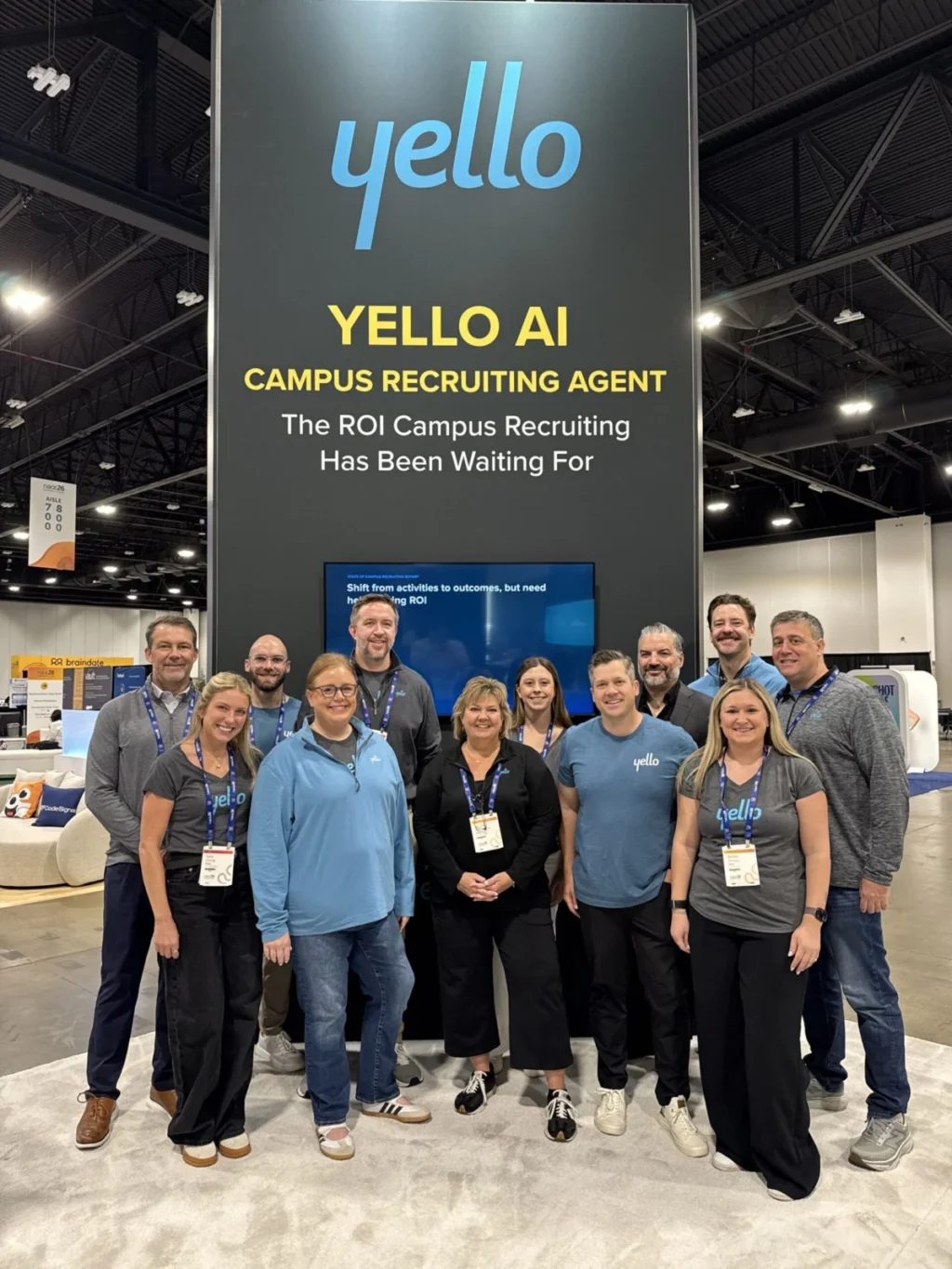
Denver, CO – Yello, a leading provider of early talent acquisition software, concluded a significant presence at NACE26, the annual conference of the National Association of Colleges and Employers, where it served as a platinum sponsor. The event, a crucial gathering for professionals in the early talent community, saw Yello introduce its innovative AI Campus Recruiting Agent and announce a strategic partnership with Symplicity, aiming to redefine the landscape of campus recruitment. These announcements, coupled with extensive discussions on artificial intelligence, evolving event strategies, and candidate retention, underscored the dynamic shifts occurring in how organizations attract and secure top emerging talent.
The National Association of Colleges and Employers (NACE) serves as the premier professional organization for those involved in the career development and employment of college students. Its annual conference, NACE26, is a pivotal platform for sharing best practices, networking, and exploring the latest trends and technologies shaping the early talent ecosystem. This year’s gathering in Denver highlighted a sector grappling with unprecedented challenges, from managing surging application volumes to navigating the complexities introduced by advanced technological tools. Yello’s prominent role as a platinum sponsor facilitated a deep engagement with attendees through speaking sessions, a dedicated booth, and networking events, reinforcing its commitment to advancing the field.
The Transformative Role of AI in Campus Recruitment
A central theme dominating conversations at NACE26 was the increasing integration of artificial intelligence into recruitment processes. While AI is undeniably changing how organizations identify and engage with candidates, the nuanced discussion focused on how it should be deployed for maximum impact and ethical integrity. Yello’s recent "State of Campus Recruiting report" indicated that current AI usage is heavily concentrated at the top of the recruitment funnel, with 26% of usage in sourcing and 25% in candidate communications. However, the report also revealed a significant gap: AI’s potential to drive impact through data analysis and proving return on investment (ROI) remains largely untapped.
This discrepancy resonated deeply with recruiters in Denver. The consensus was clear: talent acquisition professionals are not seeking AI to make hiring decisions for them. Instead, they desire AI to automate mundane administrative tasks and recurring responsibilities, thereby freeing up valuable time that can be redirected towards more meaningful candidate engagement and relationship building. This sentiment was robustly explored in Yello’s session, "Can Campus Recruiting Be Autonomous? The Answer Is Complicated." The panel, featuring Tamara Welch from LPL Financial, NACE’s Matthew Brink, and Yello’s Dan Bartfield, dissected the core question of whether the ultimate goal is fully autonomous recruiting or merely empowering recruiters to focus on higher-value work. The audience overwhelmingly favored the latter, advocating for AI solutions purpose-built to address the unique challenges of campus recruiting, such as sifting through vast candidate pools and coordinating complex event logistics.
Matthew Brink, representing NACE, articulated a critical perspective: students exhibit a pronounced wariness towards employers who rely excessively on AI in their hiring processes, particularly when its use is not transparently disclosed. A recruitment experience perceived as impersonal or automated can deter highly qualified candidates and subtly erode an employer’s brand reputation. This underscores the imperative for organizations to adopt AI responsibly, maintaining a human-centric approach that prioritizes authentic connection and clear communication. According to a recent survey by Talent Board, over 70% of candidates expect transparency regarding AI usage in the hiring process, highlighting the ethical dimensions of technology adoption in HR. Analysts predict that by 2025, nearly half of all HR functions will incorporate AI tools, emphasizing the urgency for best practices and ethical guidelines to be established.
Evolving Event Strategies for Enhanced ROI
Beyond AI, the strategic approach to recruitment events emerged as another critical discussion point. The session, "Purpose Over Presence: Rethinking Your Event Strategy for Better ROI," featured Vincent Bond from Synchrony, Kristin Leek from Boeing, and Christopher Cantu from Marathon Petroleum. These industry leaders echoed a shared challenge: despite climbing application volumes, identifying genuinely qualified candidates has become increasingly difficult. A contributing factor, as Vince Bond succinctly put it, is the phenomenon of "AI fighting AI," where candidates leverage AI to generate resumes, and employers, in turn, use AI tools to evaluate them, creating a cyclical challenge in authentic candidate assessment.
In response to this dynamic, the panelists advocated for a fundamental shift in event strategy. The focus is moving away from merely achieving a high presence at numerous career fairs, hoping to stumble upon suitable candidates, towards a more intentional, outcomes-based approach. This paradigm prioritizes events that demonstrably drive quality hires and yield a measurable return on investment. Christopher Cantu likened traditional career fairs to the "end zone"—the point of closure, not the starting line. He emphasized that the foundational work of relationship building occurs months, even years, before through targeted engagements and consistent touchpoints. This "relationship equity" is increasingly seen as the competitive differentiator in campus recruiting, enabling teams to navigate rising application volumes and mitigate issues like candidate fraud.
This strategic re-evaluation aligns with broader industry trends. Data from various recruitment surveys indicates a declining efficacy of large, untargeted career fairs in directly yielding quality hires. Instead, smaller, more focused events, such as hackathons, informational sessions, and specific departmental visits, are gaining traction for their ability to foster deeper connections and provide clearer insights into candidate capabilities. Investing earlier and more intentionally in these relationships is not just about finding candidates; it’s about cultivating a pipeline of genuinely interested and qualified individuals who are a strong cultural and skill fit.
Mitigating Candidate Reneges: A Persistent Challenge
The issue of candidate reneges—when an accepted offer is subsequently declined—was another hot topic, directly linked to the importance of robust relationship building. In today’s competitive talent market, an offer acceptance no longer guarantees a closed deal. Organizations that effectively manage this challenge treat the post-offer period as an active and crucial recruiting phase. Consistent, personalized communication between the offer date and the start date is deemed essential for retaining top talent. Panelists at NACE26 highlighted that their proactive relationship-building efforts at events played a significant role in keeping their renege rates low.
Yello’s virtual session, "Designing the Complete Journey: From Pre-Boarding to Off-Boarding," led by Yello’s Ahva Sadeghi, provided actionable strategies to combat reneges. Sadeghi introduced the "KEEP framework" (Kick Off, Engage, Enable, Perform), a four-pillar approach designed to maintain candidate engagement throughout the entire journey from offer acceptance to the employee’s first day. The framework underscores the need for structured communication, clear expectations, and continuous support to ensure a smooth transition. Sadeghi also delved into the underlying reasons why candidates renege, highlighting factors such as competing offers, cold feet, and a lack of continued engagement from the employer. The true cost of a renege extends beyond immediate recruitment expenses, encompassing lost productivity, team morale impact, and potential damage to employer brand. Demonstrating the effectiveness of proactive engagement, Symba customers have reported reducing their renege rates by more than 55% through focused retention strategies.
Industry data consistently shows that renege rates can hover between 10-20% for early talent, with the cost of replacing a reneged offer estimated to be thousands of dollars per candidate, including re-advertising, interviewing, and administrative overhead. This makes proactive post-offer engagement not merely a best practice but a critical financial imperative for talent acquisition teams.
Yello’s Strategic Innovations: AI Campus Recruiting Agent and Symplicity Partnership
NACE26 also served as the launchpad for two pivotal developments from Yello, directly addressing the aforementioned industry challenges.
First, Yello officially introduced its AI Campus Recruiting Agent, an innovation poised to transform how organizations manage early talent acquisition. This new AI-powered agent is engineered to automate a significant portion of manual tasks, simplifying processes such as building events, sourcing candidates, managing campaigns, and scheduling interviews. The core philosophy behind the agent is to liberate recruiting teams from administrative burdens, allowing them to dedicate more time and energy to genuine candidate engagement and strategic relationship building.
The Yello Campus Recruiting Agent fundamentally "flips the model" of traditional campus recruiting. Historically, recruiters would attend events hoping the right candidates would visit their booth. Now, the agent proactively identifies best-fit candidates and pre-schedules interviews before the event even begins. This comprehensive tool handles the heavy lifting of event creation and management, candidate matching and prioritization, initial outreach, and interview scheduling. Instead of arriving at an event with an uncertain agenda, recruiters are equipped with a pre-filled interview schedule comprising candidates who have already been identified as strong fits for their roles. This strategic shift promises to significantly enhance recruiter efficiency, improve candidate quality, and optimize event ROI. Dan Bartfield, a key figure at Yello, remarked, "Our AI Campus Recruiting Agent is designed to deliver the ROI campus recruiting has been waiting for. By automating the arduous administrative tasks, we empower recruiters to do what they do best: connect with talent and build relationships that drive successful hires."
Second, Yello announced a significant new partnership with Symplicity, a leading global provider of student success and engagement solutions. This collaboration grants Yello customers unparalleled access to Symplicity’s extensive network of over 600,000 early talent candidates. The integration means that employers utilizing the Yello Campus Recruiting Agent can now match against active candidates from the Symplicity database, in addition to candidates sourced from their own Applicant Tracking Systems (ATS), existing Yello databases, WayUp, and over 35 other diverse online sources. This partnership dramatically expands the reach for campus recruiters, enabling them to tap into a broader and more diverse pool of qualified early talent. Symplicity CEO, Matthew Small, commented on the partnership, "Connecting our vast network of highly engaged students with Yello’s innovative recruiting technology creates a powerful synergy. This partnership will undoubtedly enhance opportunities for students and streamline the talent acquisition process for employers, fostering a more efficient and equitable pathway to career success."
Broader Implications and Future Outlook
The discussions and announcements at NACE26 underscore a pivotal moment for early talent acquisition. The confluence of advanced AI, evolving candidate expectations, and the persistent challenge of talent retention demands a strategic recalibration from employers. The trends highlighted—a move towards ethical and purposeful AI, a shift from event presence to event purpose, and the critical importance of post-offer engagement—collectively point towards a more personalized, data-driven, and relationship-centric approach to recruitment.
Yello’s new AI Campus Recruiting Agent and its partnership with Symplicity represent a significant step in this evolution. By leveraging AI to automate tedious processes and expanding access to diverse talent pools, Yello aims to equip organizations with the tools necessary to compete effectively in a fiercely contested market for emerging professionals. The future of campus recruiting will likely see an even greater emphasis on intelligent automation that supports human interaction, targeted engagement strategies that prioritize quality over volume, and comprehensive candidate journey management that extends well beyond the offer letter. Organizations that embrace these shifts, prioritizing both technological innovation and genuine human connection, will be best positioned to attract, engage, and retain the next generation of leaders and innovators.






